
1. Introduction: The Long Road to Redemption
There are very few stories in Indian banking that carry as much emotion, pain, and hope as Yes Bank. If you were in the markets during 2020, you would remember the chaos—the moratorium, the rescue plan, and the uncertainty that wiped out investor confidence almost overnight.
Fast forward to today, and the Yes Bank Q4 Results FY26 feel like a completely different chapter.
This is no longer a story of survival. This is a story of stability, normalization, and gradual rebuilding.
As someone who closely tracked the 2020 rescue, I can confidently say that FY26 marks the year where Yes Bank has moved from “repair mode” to “growth mode.” The focus has shifted away from firefighting bad loans to building a sustainable, high-yield retail franchise.
These results also came during what the market called a “Super Saturday” banking earnings cycle, where multiple banks reported numbers. Yet, Yes Bank managed to stand out—not because of size, but because of directional improvement.
2. Q4 FY26 Financial Scorecard (Real-Time Data)
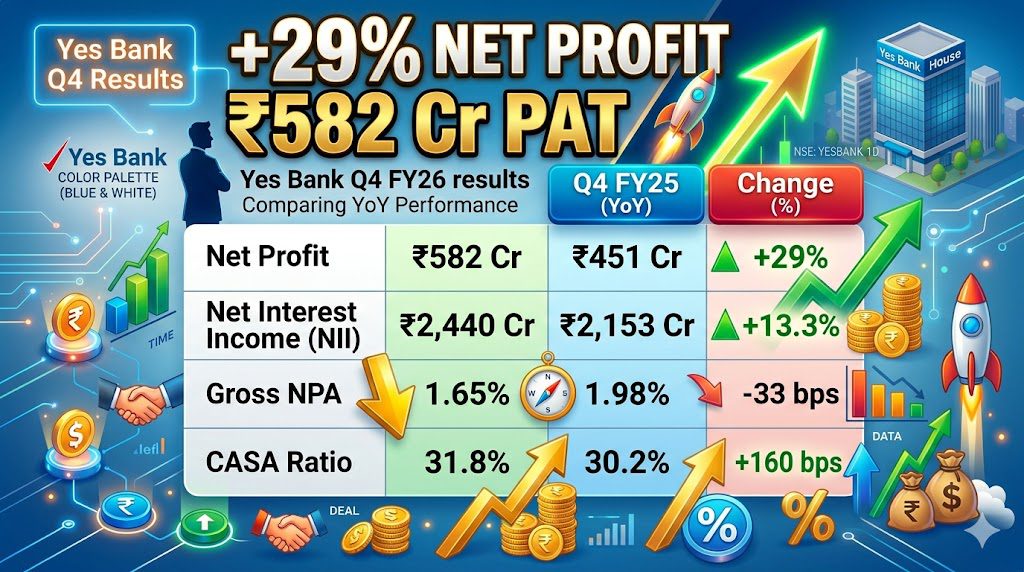
Let’s first look at the numbers, because numbers tell the real story.
Yes Bank reported a net profit of ₹582 crore in Q4 FY26, compared to ₹451 crore in Q4 FY25. That’s a solid 29% year-on-year growth, showing that profitability is slowly but steadily improving.
Net Interest Income (NII), which is the core earnings engine for any bank, came in at ₹2,440 crore, up from ₹2,153 crore last year. This represents a 13.3% increase, indicating that the bank’s lending book is becoming more productive.
On the asset quality front, the improvement is even more encouraging. Gross NPA has reduced to 1.65% from 1.98%, a decline of 33 basis points. For a bank that was once drowning in bad loans, this is a significant milestone.
Another key metric is the CASA ratio, which has improved to 31.8% from 30.2%, reflecting a stronger deposit base and lower cost of funds.
Overall, these numbers point toward one thing: Yes Bank is stabilizing faster than many expected.
3. Fundamental Analysis: The “Granular” Pivot
The real transformation of Yes Bank is not just in the numbers—it is in the quality of its business model.
Deposit Franchise: Moving Away from Risky Dependence
Before the crisis, Yes Bank relied heavily on wholesale funding, which made it vulnerable during stress periods.
Today, the bank is consciously building a granular retail deposit base. This shift is crucial because retail deposits are more stable and cheaper compared to bulk deposits.
The improvement in CASA ratio to nearly 32% is a clear sign that the bank is moving in the right direction.
Asset Quality: From Weakness to Strength
At one point, asset quality was Yes Bank’s biggest weakness. Today, it is slowly becoming a strength.
With Gross NPAs now below 1.7%, Yes Bank’s balance sheet is arguably cleaner than some mid-sized banks. This is not just about writing off bad loans—it is about better underwriting and risk management.
The bank has learned its lesson the hard way, and it shows in the discipline it is now maintaining.
The ARC Angle: JC Flowers Partnership
One of the most important parts of Yes Bank’s recovery story is its partnership with JC Flowers Asset Reconstruction Company (ARC).
This move helped the bank transfer a large portion of its stressed assets off its books. As recoveries continue from these bad loans, they are adding incremental gains to the bank’s profitability.
In simple terms, even old problems are now slowly contributing to new profits.
4. Technical Analysis: Breaking the “Penny Stock” Shackles
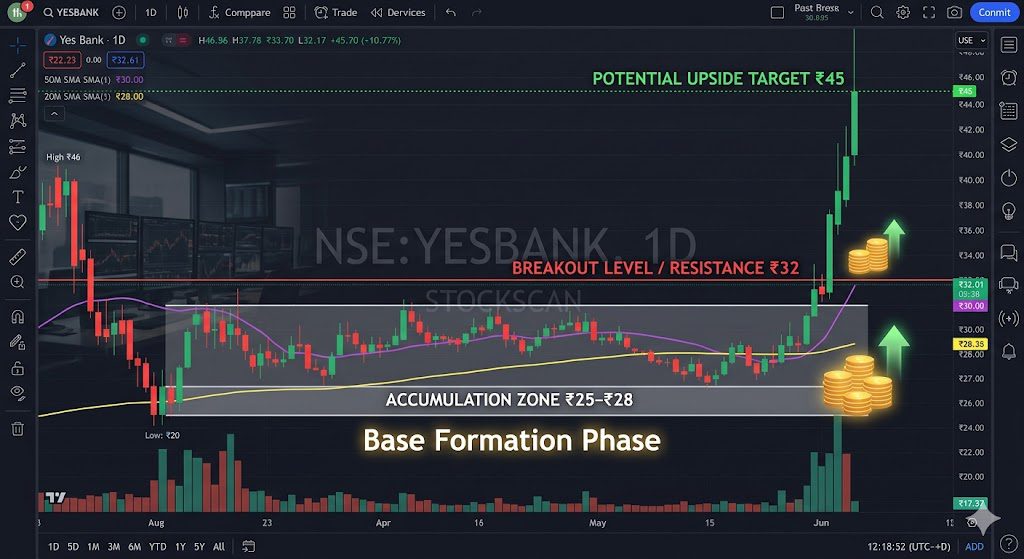
For a long time, Yes Bank was treated like a penny stock—high volatility, low trust, and heavy retail participation.
But the technical structure is now evolving.
Currently, the stock is trading in a broad consolidation range between ₹24 and ₹30. This phase is important because it indicates base formation.
The most critical level to watch is ₹32. A strong weekly close above this level could act as a major breakout trigger, potentially opening the path toward ₹40–₹45 levels.
On the downside, immediate support is seen near ₹25.50, which aligns with the 100-day EMA. A stronger base exists around ₹22, which has held multiple times in recent months.
One interesting observation is that volume is gradually increasing around ₹26 levels. This often suggests that institutional investors are slowly accumulating shares, while weaker retail hands exit.
For technical traders, this is a classic “accumulation before breakout” setup.
5. Management Guidance: Prashant Kumar’s Roadmap
Under the leadership of Prashant Kumar, Yes Bank has taken a cautious but clear path forward.
The management has guided toward achieving a double-digit Return on Equity (ROE) by FY27. This is a key milestone because ROE is the ultimate measure of profitability for banks.
Loan Mix Strategy: Focus on Higher Yield Segments
The bank is gradually increasing its exposure to SME and mid-corporate segments. These segments offer better yields compared to large corporates, while still maintaining manageable risk levels.
This shift will help improve margins over time.
Digital Strength: The Silent Weapon
One area where Yes Bank continues to punch above its weight is digital banking.
The bank is a major player in UPI transactions, which gives it access to a large customer base without heavy infrastructure costs.
This “tech-first” approach is acting as a customer acquisition engine, especially among younger users.
6. Brokerage Reports & Price Targets
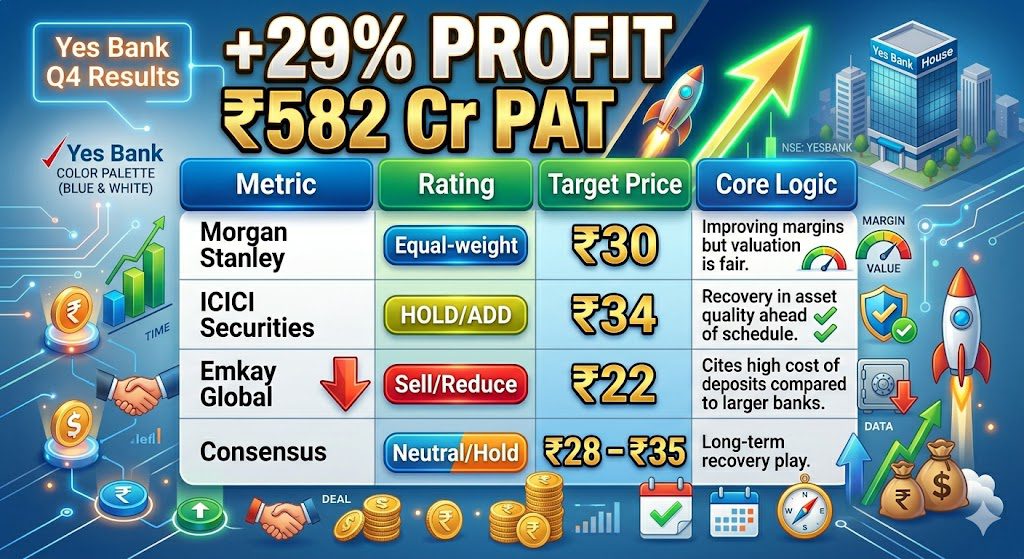
Brokerage views on Yes Bank remain mixed, reflecting both optimism and caution.
Morgan Stanley has maintained an Equal-weight rating with a target of ₹30, acknowledging improving margins but limited upside at current valuations.
ICICI Securities has a slightly positive stance with a HOLD/ADD rating and ₹34 target, citing faster-than-expected asset quality recovery.
On the other hand, Emkay Global has a Reduce rating with a target of ₹22, highlighting concerns around higher cost of deposits compared to larger banks.
The overall consensus falls in the ₹28–₹35 range, indicating that Yes Bank is currently seen as a recovery play rather than a high-growth stock.
7. The Investor’s Dilemma: Buy, Hold, or Exit?
This is where things get interesting.
For Retail Investors
If you are someone who held Yes Bank through the crisis, these results are a form of validation. The bank has stabilized, and the worst seems to be behind.
However, it is important to reset expectations. This is no longer a “multibagger in one year” story. It is now a slow and steady compounding story.
For Traders
For short-term traders, the current range of ₹26 to ₹31 is tricky—it is what we call a “no man’s land.”
The better strategy is to wait for a confirmed breakout above ₹32 with strong volume before taking aggressive positions.
The Dividend Question
One of the biggest questions investors are asking is:
Will Yes Bank start paying dividends again?
While no dividend has been declared for FY26, improving capital adequacy and profitability suggest that FY27 could see the return of dividends.
8. Conclusion: From Repair to Growth
To sum it up, Yes Bank’s Q4 FY26 results mark a turning point.
- Profitability is improving
- NPAs are under control
- Deposit franchise is strengthening
- Management strategy is clear
The bank has successfully transitioned from “repair” to “growth mode.”
But the journey is not over yet. The next phase will depend on how effectively the bank can scale its operations while maintaining discipline.
CTA (Call to Action)
Are you a Yes Bank “long-hauler” who stayed invested through the crisis?
Or are you planning a fresh entry after seeing these results?
💬 Share your strategy in the comments—Buy, Hold, or Wait? Let’s discuss this turnaround story.
FAQ Section (SEO Optimized)
Is Yes Bank share good to buy for long term?
Yes Bank is now a recovery-to-growth story with improving fundamentals. However, it is best suited for investors with patience and moderate risk appetite.
What is Yes Bank share price target for 2026?
Based on current analysis, the expected range is ₹28 to ₹35, with a breakout above ₹32 potentially leading to higher targets.
Will Yes Bank give dividend in 2026 or 2027?
While no dividend was declared in FY26, improving financials indicate a strong possibility of dividend resumption in FY27.