1. Introduction: The Compounding Machine
There was a time in the early 2000s when ICICI Bank was seen as an aggressive lender—fast growth, high risk, and sometimes volatile performance. But if you look at the ICICI Bank Q4 Results FY26, what you see today is something completely different: a calm, disciplined, and highly efficient compounding machine.
At a time when several banks are still dealing with merger-related issues, liquidity pressures, or margin compression, ICICI Bank is quietly delivering one of the most consistent performances in the Indian banking sector. This quarter is not just about strong numbers—it is about execution excellence over multiple years.
The headline number says it all. Net profit for Q4 FY26 has crossed ₹11,000 crore, growing 18.5% year-on-year. For a bank of this size, such consistent growth is rare. Over the last three decades of tracking Indian banks, it is not easy to find a large-cap lender that has maintained such strong Return on Equity (ROE) with such stability.
This is why many analysts are calling this the “Consistency Quarter” for ICICI Bank.
2. Q4 FY26 Financial Scorecard (The Sunday Update)
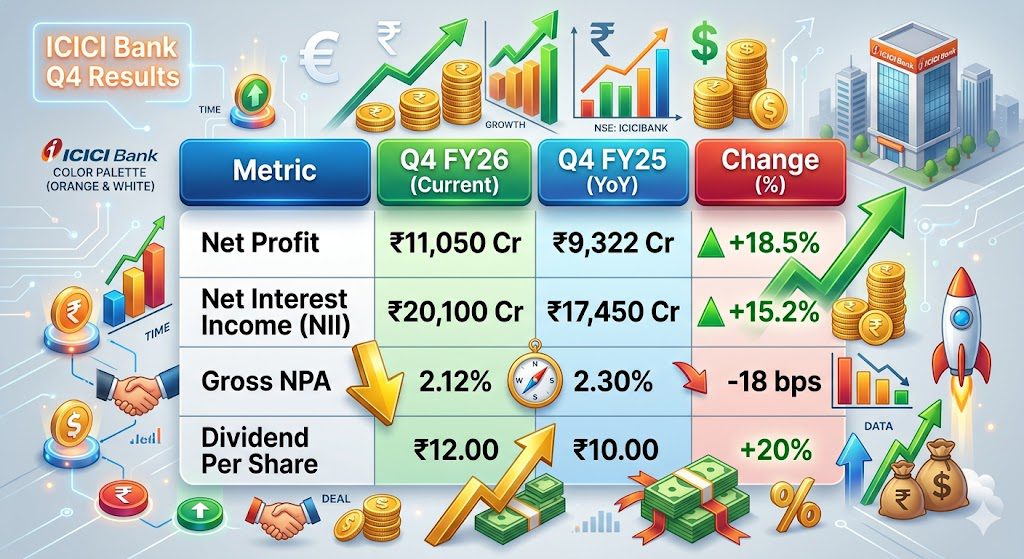
Let’s break down the numbers in a simple and meaningful way.
ICICI Bank reported a net profit of ₹11,050 crore in Q4 FY26, compared to ₹9,322 crore in Q4 FY25. This translates into a solid 18.5% growth, driven by strong core income and stable asset quality.
Net Interest Income (NII), which is the backbone of any bank’s earnings, came in at ₹20,100 crore, up from ₹17,450 crore last year—showing a healthy 15.2% increase. This indicates that the bank is not just growing, but doing so with strong lending margins.
On the asset quality front, Gross NPA declined further to 2.12% from 2.30%, showing continued improvement. Even more impressive is the Net NPA at just 0.42%, which puts ICICI Bank among the best in the industry.
And then comes the part investors love—dividends. The bank has announced a ₹12 per share dividend for FY26, up from ₹10 last year, marking a 20% increase.
These numbers are not just strong—they are balanced. Growth, profitability, and risk management are all moving in the right direction.
3. Fundamental Analysis: The “3-D” Strategy
What is driving this consistency? The answer lies in what I like to call ICICI Bank’s “3-D Strategy” — Deposits, Digital, and De-risking.
Deposits: Growth Without Overpaying
One of the biggest challenges for banks today is deposit mobilization. Many banks are forced to offer higher interest rates to attract deposits, which hurts margins.
ICICI Bank, however, has managed to grow its deposits by around 16% YoY without aggressively raising costs. This is crucial because it helps protect the bank’s Net Interest Margin (NIM), which remains stable around 4.3%–4.4%.
A strong CASA (Current Account Savings Account) ratio continues to give ICICI Bank a cost advantage over peers.
Digital: The Silent Growth Engine
ICICI Bank is no longer just a traditional bank—it is a technology platform.
Its flagship app, iMobile Pay, has become a key growth driver. Today, nearly 35% of retail loan disbursements are happening digitally. This not only reduces operational costs but also improves customer experience and scalability.
Digital banking is also helping ICICI Bank penetrate deeper into semi-urban and rural markets without heavy physical infrastructure investment.
De-risking: The Fortress Balance Sheet
Perhaps the most impressive part of ICICI Bank’s transformation is its asset quality.
A Net NPA of 0.42% is not just low—it reflects a disciplined lending approach. The bank has consciously reduced exposure to risky segments and improved underwriting standards.
In simple words, ICICI Bank today has a “fortress balance sheet”—strong enough to handle economic shocks while continuing to grow.
4. Technical Analysis: The Blue-Chip Breakout
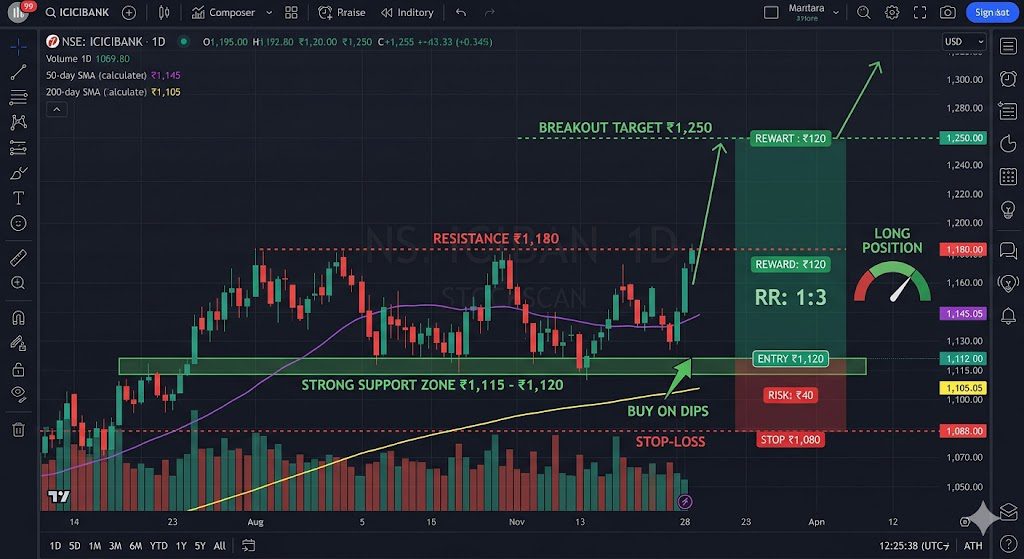
From a technical perspective, ICICI Bank’s stock is showing a very interesting setup.
Currently trading around ₹1,140, the stock is forming a classic high-base consolidation pattern. This usually indicates that the stock is preparing for its next move upward.
The 50-day moving average (DMA) is acting as strong support near ₹1,115, which is a good sign for short-term stability.
The key level to watch is ₹1,180, which is close to its lifetime high zone. If the stock manages to break this level with strong volumes, the next target could be around ₹1,250.
One important technical signal is the Golden Cross, where the 50-DMA has crossed above the 200-DMA. This typically indicates a long-term bullish trend.
For traders and investors, this is a classic blue-chip breakout setup.
5. Management Guidance: The Bakhshi Era Stability
Under the leadership of Sandeep Bakhshi, ICICI Bank has become a model of stability and disciplined growth.
For FY27, the management has guided for 17–18% loan growth, with a focus on retail and SME segments. This is important because these segments provide better diversification and higher yields.
Unlike many peers who are facing margin pressure, ICICI Bank expects its NIM to remain stable at 4.3%–4.4%. This confidence comes from its strong deposit franchise and CASA base.
The messaging from management is clear:
Grow steadily, manage risk carefully, and protect margins.
6. Brokerage Reports & Price Targets
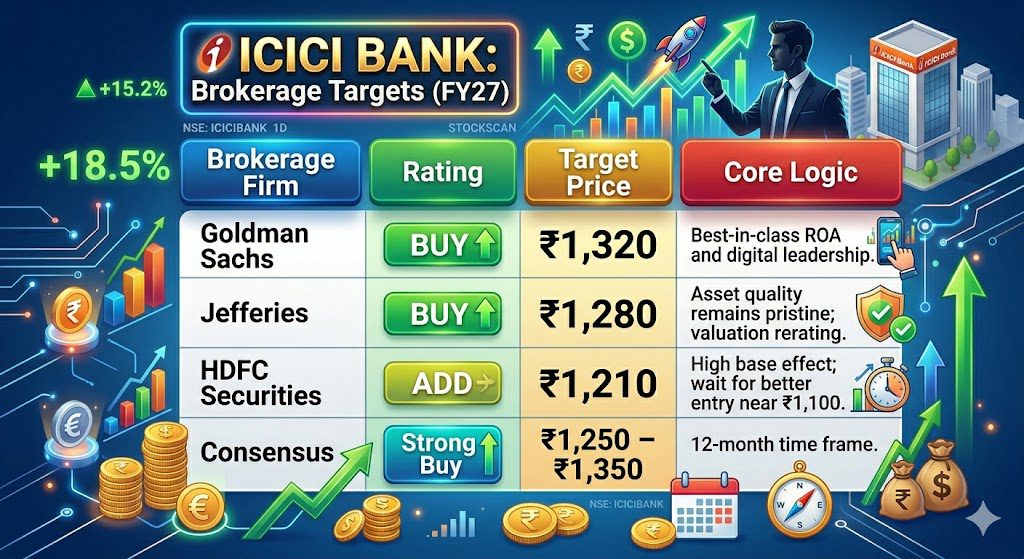
Brokerages across the board remain bullish on ICICI Bank after its Q4 FY26 results.
Global brokerage firms like Goldman Sachs have given a BUY rating with a target of ₹1,320, highlighting the bank’s best-in-class return ratios and digital leadership.
Jefferies has also maintained a BUY rating with a target of ₹1,280, citing strong asset quality and potential valuation re-rating.
Domestic brokerage HDFC Securities has taken a slightly cautious stance with an ADD rating and a target of ₹1,210, suggesting investors wait for dips around ₹1,100.
The overall consensus remains strongly positive, with a 12-month target range of ₹1,250 to ₹1,350.
7. Investor’s Verdict: The “Sleep Well” Stock
ICICI Bank is increasingly becoming what investors call a “sleep well stock.”
For Traders
Short-term traders can consider buying on dips near ₹1,120, with a stop-loss around ₹1,080. The upside potential toward ₹1,250 offers a favorable risk-reward ratio.
For Long-Term Investors
For long-term investors, ICICI Bank is no longer a cyclical bet—it is a structural growth story.
With consistent earnings growth, improving asset quality, and strong management, the bank is well-positioned for the next decade.
The ₹12 dividend in 2026 also adds a steady income component, which is rare for a growth stock.
The Key Risk
No investment is without risk. The biggest concern to watch is any regulatory tightening in unsecured retail lending, which has been growing rapidly across the banking sector.
However, given ICICI Bank’s conservative approach, the risk appears manageable.
8. Conclusion: The King of Private Banking
To sum it up, ICICI Bank’s Q4 FY26 results reflect everything a long-term investor looks for:
- Strong profit growth
- Stable margins
- Improving asset quality
- Consistent management execution
- Attractive dividend
In many ways, ICICI Bank has quietly emerged as the “King of Private Banking” in India—not because of hype, but because of consistent performance.
CTA (Call to Action)
Are you choosing ICICI Bank over HDFC Bank for your portfolio in FY27?
What’s your ICICIBANK share price target for the next 12 months?
Tell us your view in the comments—let’s discuss.
FAQ Section (SEO Optimized)
What is the ICICI Bank dividend record date for 2026?
The official record date for the ₹12 dividend is expected to be announced soon after the AGM. Investors should track exchange filings for confirmation.
Is ICICI Bank a good buy after Q4 FY26 results?
Yes, based on strong earnings growth, stable NIM, low NPAs, and positive brokerage outlook, ICICI Bank remains a strong buy candidate for both short-term and long-term investors.