Introduction: The Elephant Learns to Dance Again
For much of the past year, HDFC Bank has carried the weight of expectations. The merger with HDFC Ltd., while strategically sound, created short-term pressures—especially on liquidity, margins, and growth visibility. Many investors began to question whether India’s most trusted private lender had lost its rhythm.
But Q4 FY26 tells a different story.
This is what I would call a “cleaning the slate” quarter—a phase where the noise begins to settle, and the underlying strength of the institution starts becoming visible again.
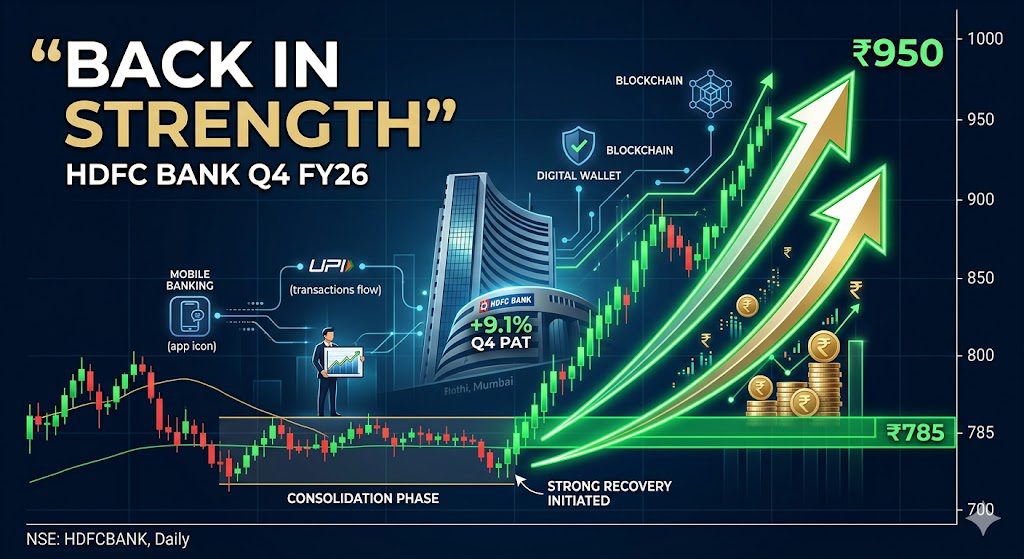
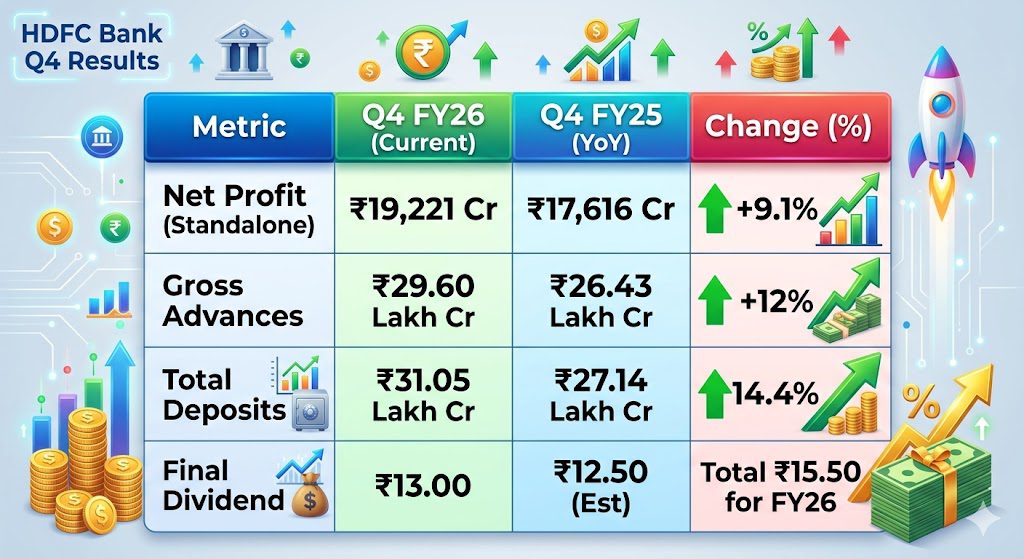
HDFC Bank reported a standalone net profit of ₹19,221 crore, registering a 9.1% year-on-year growth. On paper, this may look modest. But in a high-interest-rate environment where funding costs are elevated and competition for deposits is intense, this level of profitability is not just acceptable—it is a clear sign of resilience.
More importantly, the bank has announced a total dividend of ₹15.50 per share for FY26, including a final dividend of ₹13. This reflects strong cash generation and management confidence.
In simple terms, the elephant is not just standing—it is learning to move freely again.
Q4 FY26 Financial Scorecard: Stability with Scale
The numbers in Q4 FY26 highlight a bank that continues to grow, even in a challenging macro environment.
HDFC Bank’s net profit rose to ₹19,221 crore, up from ₹17,616 crore in the same quarter last year. This growth is supported by steady expansion in both loans and deposits, which remain the core drivers of any banking business.
Gross advances grew to ₹29.60 lakh crore, reflecting a 12% year-on-year increase. This indicates that credit demand remains strong, and the bank continues to expand its lending book in a disciplined manner.
On the liability side, total deposits increased to ₹31.05 lakh crore, marking a 14.4% growth. This is particularly important because in the current environment, deposit growth is the real competitive advantage.
The bank has also declared a final dividend of ₹13 per share, taking the total payout for FY26 to ₹15.50. This consistent return to shareholders reinforces HDFC Bank’s position as a reliable long-term wealth compounder.
Fundamental Analysis: Quality Over Quantity
The Deposit Engine: The Real Strength of HDFC Bank
In banking, growth without deposits is meaningless. Over three decades of watching this sector, one principle has remained constant: the bank with the strongest deposit franchise wins in the long run.
HDFC Bank’s 14.4% deposit growth is a clear indicator that it continues to command trust among customers. This is not just about numbers—it is about brand strength, distribution, and customer loyalty.
At a time when many banks are struggling to attract low-cost deposits, HDFC Bank’s ability to grow its deposit base gives it a significant advantage in managing funding costs.
NIM Stability: The Pressure Is Easing
Net Interest Margins (NIMs) have been under pressure due to rising interest rates and higher cost of funds. However, the latest quarter suggests that the worst of the compression may be behind us.
While margins have not expanded significantly, they have stabilized, which is the first step toward recovery. As deposit costs normalize over the coming quarters, there is potential for gradual improvement.
The Subsidiary Boost: Strengthening the Ecosystem
One of the most strategic moves in this quarter is the ₹1,000 crore investment in HDFC Life, which increases HDFC Bank’s stake to over 50%.
This is not just a financial investment—it is a long-term strategic alignment. By strengthening its position in the insurance business, HDFC Bank is building a multi-layered financial ecosystem, where banking, insurance, and wealth management work together.
This integrated model is what will define the next phase of growth.
Technical Analysis: The 50-DMA Battle Begins
Current Price Action: Early Signs of Strength
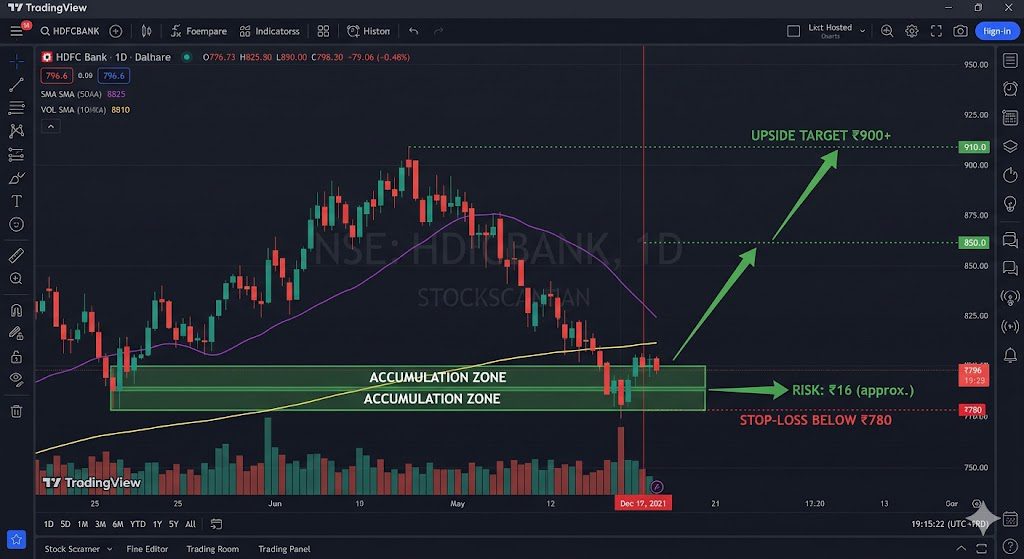
HDFC Bank’s stock has recently shown signs of recovery, outperforming the broader market with a 4.4% rally, and is currently trading near ₹810.
This move is significant because it indicates renewed buying interest, particularly from institutional investors.
Resistance Levels: The “Iron Gate” Ahead
The key level to watch is the 50-day moving average (50-DMA), which acts as a strong resistance zone. A decisive breakout above this level—around ₹850–₹853—could trigger a sharp rally driven by short covering and fresh buying.
Support Levels: Where Risk Is Limited
On the downside, strong support exists at:
- ₹794 (S3 level)
- ₹785 (20-day moving average)
These levels provide a safety net for investors looking to enter on dips.
Momentum Indicators: Long-Term Accumulation
The monthly RSI is showing positive divergence, which is often a sign that long-term investors are accumulating the stock. This is a subtle but powerful signal.
Management Guidance & Corporate Governance
Leadership Stability: The Mistry Factor
The bank’s intention to retain Keki Mistry as interim chairman reflects a focus on stability. In times of transition, strong governance is as important as financial performance, especially for institutional investors.
Cultural Integrity: Addressing Mis-Selling Concerns
CEO Sashidhar Jagdishan has clearly articulated the bank’s commitment to maintaining strong “guardrails” against mis-selling practices.
This is important because trust is the foundation of banking. By reinforcing its ethical standards, HDFC Bank is protecting its most valuable asset—its reputation.
Brokerage Reports & Institutional Targets
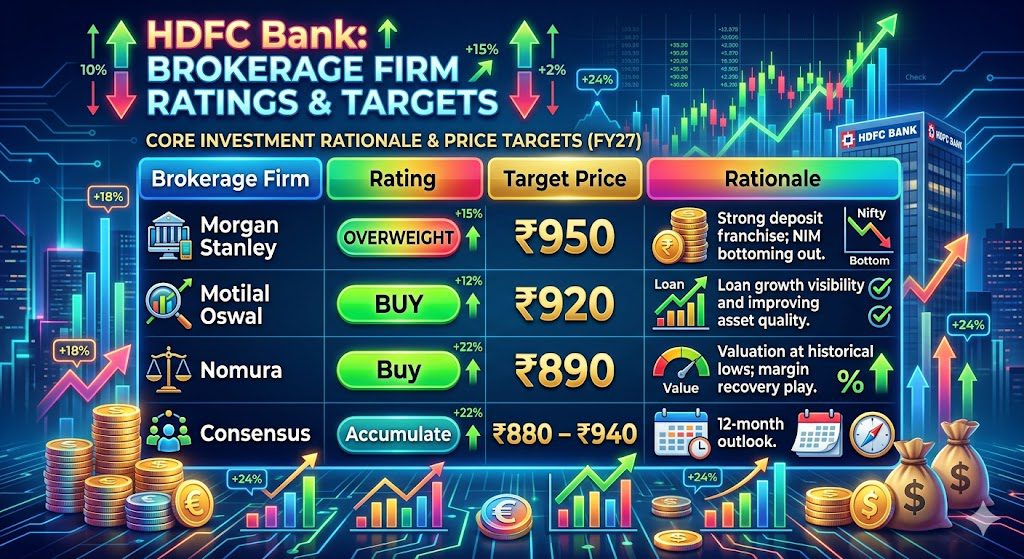
Brokerages have largely maintained a positive outlook on HDFC Bank, reflecting confidence in its long-term fundamentals.
Morgan Stanley has assigned an Overweight rating with a target price of ₹950, citing strong deposit growth and the potential for margin recovery. Motilal Oswal has a Buy rating with a ₹920 target, highlighting visibility in loan growth and improving asset quality.
Nomura has also maintained a Buy rating with a ₹890 target, noting that the stock is currently trading at attractive valuations compared to historical levels.
The consensus target range stands between ₹880 and ₹940, indicating a potential upside of 10–15% over the next 12 months.
The 30-Year Analyst Perspective: A Rare Valuation Opportunity
To the Reader: Look Beyond the Noise
Short-term volatility often distracts investors from long-term opportunities. HDFC Bank is currently trading at valuation levels not seen since the 2014–15 period.
This is unusual for a bank of this quality.
The Verdict: A Cornerstone Stock
For long-term portfolios, HDFC Bank remains a cornerstone stock. The combination of:
- Strong deposit franchise
- Stable asset quality
- Consistent dividend
- Integrated financial ecosystem
makes it one of the most reliable investment options in the Indian market.
Conclusion: Stability Returns, Growth Follows
HDFC Bank’s Q4 FY26 results may not be explosive, but they are reassuring.
The bank has demonstrated:
- Stable profit growth
- Strong deposit momentum
- Strategic investments
- Consistent shareholder returns
This is what long-term investing is about—not chasing short-term spikes, but identifying institutions that compound steadily over time.
Call to Action (CTA)
Now the key question is yours:
Are you buying HDFC Bank for its steady dividend yield, or are you waiting for a breakout above the 50-DMA to enter?
Share your Bank Nifty strategy in the comments—because the best investing ideas always start with a conversation.