
Introduction: The Foundation is Laid
If you look only at the headline numbers, Jio Financial Services’ Q4 FY26 results may seem disappointing. A 14% decline in net profit is not something that excites short-term investors. But if there’s one lesson from studying the Ambani playbook over decades, it’s this—the foundation years are never about profits; they are about scale, ecosystem, and dominance.
And that’s exactly what is happening here.
Jio Financial is no longer just a newly listed NBFC trying to find its footing. It is rapidly transforming into what can be described as a “neural financial marketplace”, where lending, payments, investments, and insurance are integrated into one digital ecosystem. The launch and rapid adoption of the JioFinance app, now with over 23 million users, is a clear signal that the distribution engine is already being built at scale.
The most important number in this quarter is not profit—it is total income, which has almost doubled to ₹1,020 crore. That kind of growth, especially at an early stage, tells you that the engine is not slowing down—it is accelerating.
Q4 FY26 Financial Scorecard: Growth is Visible, Profit is Deferred
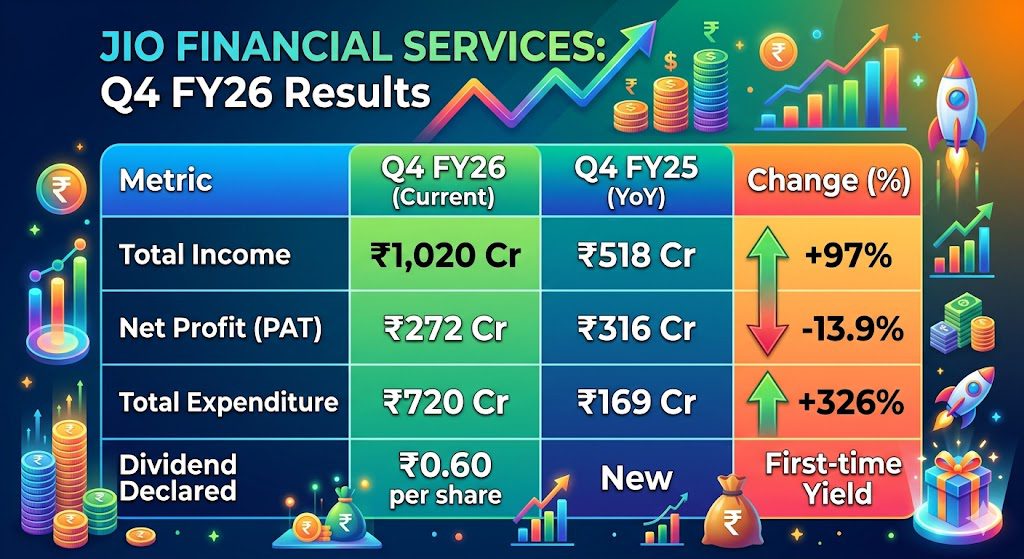
The financial performance of Jio Financial Services in Q4 FY26 clearly reflects a company that is investing aggressively for the future while building strong revenue momentum today.
Total income surged to ₹1,020 crore, up from ₹518 crore in the same quarter last year, representing a remarkable 97% year-on-year growth. This is not incremental growth—it is a sign of rapid scale expansion, which is exactly what investors should expect in a business that is still in its early growth phase.
However, net profit (PAT) came in at ₹272 crore, compared to ₹316 crore in Q4 FY25, marking a 13.9% decline. On the surface, this might raise concerns, but the real story lies in the expenditure line. Total expenditure jumped sharply to ₹720 crore, up from ₹169 crore last year, reflecting a massive 326% increase.
This spike is not inefficiency—it is intentional investment. The company is deploying capital into technology infrastructure, talent acquisition, and new business verticals.
Additionally, Jio Financial announced its first-ever dividend of ₹0.60 per share, which may appear small, but symbolically, it marks the transition from a startup phase to a profit-generating, shareholder-returning entity.
Fundamental Analysis: Investing in the Future, Not the Present
Expense Spike Explained: The Cost of Building Scale
The decline in profit is directly linked to the sharp rise in expenses, but this should not be viewed negatively. In fact, this is what seasoned investors call “good stress”—the kind of financial pressure that comes from expansion, not from weakness.
A significant portion of these expenses is driven by:
- Technology development
- Digital platform scaling
- Talent hiring
- Expansion into new financial segments
In addition, treasury income has been impacted by market volatility, which is a short-term factor rather than a structural issue.
The Jio-BlackRock Powerhouse: AUM Growth at Unmatched Speed
One of the most important developments is the rapid rise of the Jio-BlackRock joint venture, which has already amassed an impressive ₹15,200 crore in Assets Under Management (AUM) within just nine months of operation.
This is extraordinary.
In the asset management industry, building AUM at this pace is extremely rare. It highlights the power of:
- Jio’s distribution network
- BlackRock’s global expertise
- India’s growing appetite for financial assets
This segment alone has the potential to become a multi-billion-dollar business over the next decade.
Payments Bank and Reinsurance: Expanding the Financial Ecosystem
Jio Financial is not limiting itself to lending or asset management. The company is actively building a full-stack financial ecosystem.
Jio Payments Bank reported an 11x growth in income, reaching ₹87 crore, indicating strong traction in digital payments. Additionally, the company has entered the reinsurance space through a strategic partnership with Allianz, further diversifying its revenue streams.
This multi-layered approach ensures that Jio Financial is not dependent on a single revenue source, which enhances long-term stability.
Management Guidance: Building Strategic Moats for the Future
JioFinance App: The Core Distribution Engine
The JioFinance app is emerging as the central pillar of the company’s strategy. With over 1.7 million downloads since February 2026, the platform is rapidly becoming a key acquisition channel for financial products.
In the long run, this app could function as:
- A lending marketplace
- An investment platform
- An insurance aggregator
Essentially, it becomes the gateway to financial services for millions of users.
Product Expansion: Targeting Bharat, Not Just India
Management has indicated a strong focus on expanding into Tier-2 and Tier-3 cities, where financial penetration is still low. By leveraging AI-driven “neural agentic” systems, the company aims to offer personalized lending and insurance solutions.
This approach is critical because the next phase of India’s financial growth will come from smaller cities and rural markets, not just metros.
Leadership Shift: Institutional Discipline Kicks In
The appointment of Annapoorna Venkataramanan as Group CFO signals a shift toward greater financial discipline and institutional rigor. As the company scales, strong governance and capital allocation will become increasingly important.
Technical Analysis: The Accumulation Zone
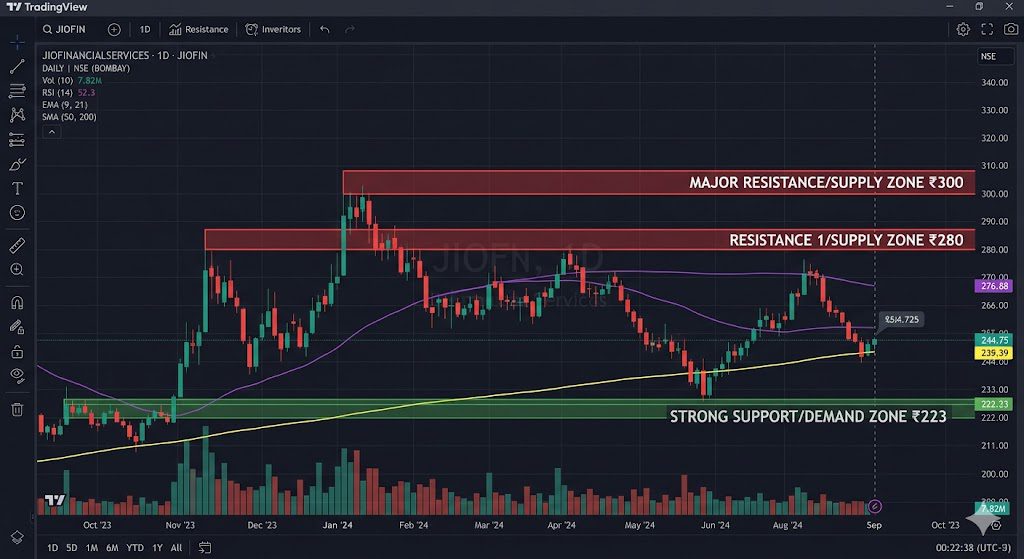
From a technical standpoint, Jio Financial Services appears to be entering a consolidation and accumulation phase.
Price Structure: Recovering from Correction
The stock is currently trading around ₹244, significantly below its 52-week high of ₹338. This correction has removed excess valuation froth and created a more balanced entry zone.
Support Levels: Where Smart Money Accumulates
A strong support level exists around ₹223, which has acted as a reliable floor. As long as this level holds, the long-term structure remains intact, making it an attractive zone for value-focused investors.
Resistance Zones: Path to Upside
On the upside, the stock faces immediate resistance at ₹280, followed by a major psychological barrier at ₹300. A breakout above these levels could trigger fresh momentum.
Trend Insight: Early Signs of Reversal
Technically, the stock has broken out of its medium-term falling trendline, suggesting a transition toward a sideways-to-bullish phase. This is typically where long-term investors begin accumulating positions.
Brokerage Reports & Price Targets (FY27 Outlook)
| Brokerage Firm | Rating | Target Price | Rationale |
| Motilal Oswal | BUY | ₹320 | 48% PAT CAGR expected over FY26-28. |
| Jefferies | Buy | ₹310 | Unmatched distribution via the Jio ecosystem. |
| INDmoney | Neutral | ₹275 | Near-term pressure due to high tech spending. |
| Consensus | Accumulate | ₹290 – ₹330 | 12-18 month horizon. |
Brokerages are increasingly aligning around the long-term potential of Jio Financial, even as they acknowledge short-term earnings pressure.
Motilal Oswal has assigned a Buy rating with a target price of ₹320, expecting a strong 48% PAT CAGR over FY26–28. Jefferies also remains bullish with a target of ₹310, citing the unmatched distribution advantage of the Jio ecosystem.
INDmoney has taken a more cautious stance with a Neutral rating and ₹275 target, pointing to near-term pressure due to heavy technology investments.
Overall, the consensus target range stands between ₹290 and ₹330, suggesting meaningful upside over the next 12–18 months.
The “Ambani Alpha”: A Human Perspective
For Retail Investors: A Long-Term Wealth Story
Jio Financial is not a stock for quick trading gains—it is a long-term wealth creation story. The ₹0.60 dividend is not about yield; it is about signaling that the business has reached a stage where it can start sharing profits.
The Risk: Short-Term Volatility
The primary risk remains market volatility impacting treasury income, along with high upfront investments. However, these are temporary factors in a long-term growth story.
The Verdict: A Generational Opportunity
If you look back, early investors in Reliance Industries during its expansion phase experienced similar periods of high investment and low profit visibility. Jio Financial appears to be following a similar trajectory.
For investors who missed that opportunity, this could represent a second chance at participating in a large-scale financial transformation.
Conclusion: Growth Today, Profits Tomorrow
Jio Financial Services’ Q4 FY26 results are a classic example of growth taking precedence over short-term profitability. The company is building infrastructure, expanding its ecosystem, and positioning itself at the center of India’s financial future.
The combination of:
- Rapid income growth
- Strong ecosystem expansion
- Strategic partnerships like BlackRock
- Massive digital distribution
creates a powerful foundation for long-term value creation.
In simple terms, this quarter is not about what the company earned—it’s about what it is becoming.
Call to Action (CTA)
Now the real question is yours:
Are you investing in JIOFIN for the Jio-BlackRock AMC story, or for its future lending dominance?
Drop your view in the comments—because the best investment ideas are always built through discussion.