Introduction: The Great Capital Return
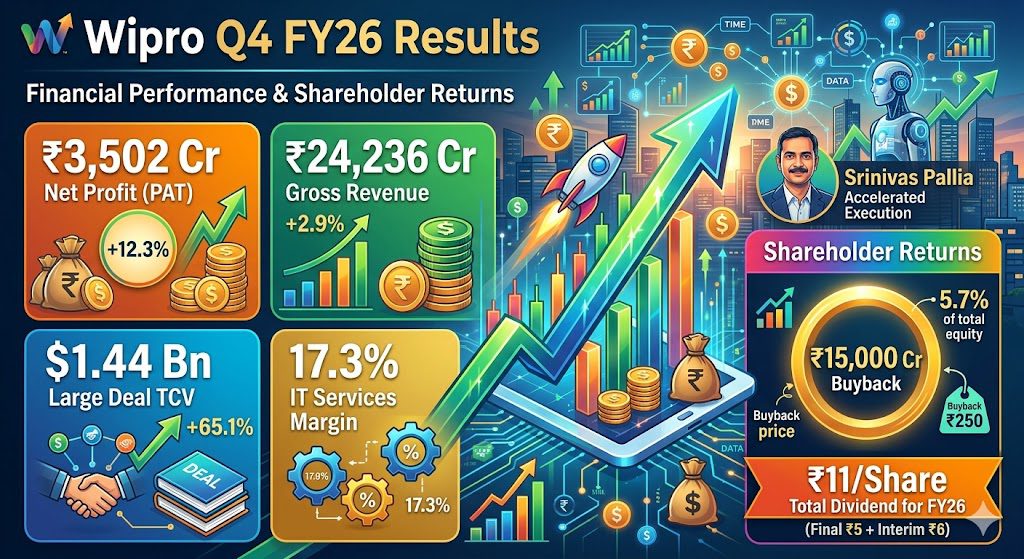
If there is one number that defines Wipro’s Q4 FY26 results, it is not revenue or profit—it is the ₹15,000 crore buyback announcement. At a buyback price of ₹250 per share, which is roughly an 18–20% premium to current market levels, the company has sent a very clear message: if growth is taking time, shareholder returns will not.
At a time when the IT sector is dealing with muted demand and cautious client spending, Wipro’s decision to return such a large amount of capital stands out as a strategic move to support investor confidence. This is not just a financial decision—it is a signal that the company has strong cash flows, balance sheet strength, and the intent to reward shareholders.
Operationally, the quarter can best be described as “steady but cautious.” Net profit rose 12% sequentially, which is encouraging, but management guidance for the next quarter suggests that the road ahead is still uncertain.
This was also the first full quarter under CEO Srinivas Pallia, who has emphasized “accelerated execution” as the core strategy. The tone is clear—Wipro is fixing its engine while continuing to fly.
Q4 FY26 Financial Snapshot: Stability with Select Strength
The financial performance of Wipro in Q4 FY26 reflects a company that is holding its ground in a challenging environment while showing early signs of recovery.
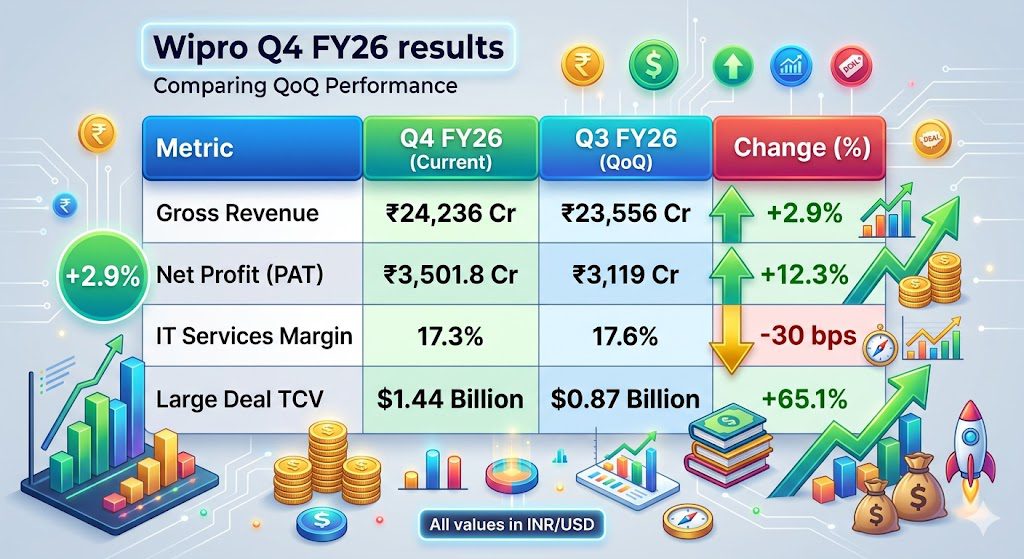
Gross revenue came in at ₹24,236 crore, representing a 2.9% sequential growth over ₹23,556 crore in Q3 FY26. While this growth is modest, it indicates that the company is gradually stabilizing after a period of softness.
The real highlight is profitability. Net profit (PAT) increased to ₹3,501.8 crore, up from ₹3,119 crore in the previous quarter, marking a strong 12.3% sequential growth. This suggests improved cost control and operational efficiency.
However, IT services margins declined slightly to 17.3% from 17.6%, reflecting a 30 basis point contraction. While this is not alarming, it indicates that margin expansion remains a challenge in the current environment.
One of the most positive indicators is the surge in large deal wins. Total Contract Value (TCV) for large deals stood at $1.44 billion, compared to $0.87 billion in the previous quarter—a sharp 65% increase. This provides visibility for future revenue and signals that Wipro is still competitive in securing large contracts.
The Buyback & Dividend: A Strategic Masterstroke
The Buyback Numbers: Scale and Impact
The ₹15,000 crore buyback is one of the largest capital return programs announced by Wipro in recent years. The company plans to buy back approximately 60 crore shares, representing about 5.7% of its total equity.
This has two immediate effects. First, it provides a price floor and support for the stock, especially in a volatile market. Second, it enhances earnings per share (EPS) by reducing the number of outstanding shares.
Why Now? The Cash Advantage
Wipro currently holds one of the strongest balance sheets among India’s top IT companies, with cash reserves of approximately ₹41,500 crore. In a low-growth environment, deploying this cash for buybacks is a logical move.
Instead of letting capital sit idle, the company is using it to:
- Reward shareholders
- Support stock valuation
- Improve return ratios
Dividend Consistency: Stable Cash Returns
In addition to the buyback, Wipro has maintained a steady dividend policy. The total dividend for FY26 stands at ₹11 per share, including a final dividend of ₹5 and an interim dividend of ₹6.
This combination of dividend + buyback makes Wipro a strong yield play, even in the absence of aggressive growth.
Fundamental Analysis: The Deal Pipeline Tells the Real Story
Flagship Deal: Olam Group Win
One of the most important developments in Q4 is Wipro’s 8-year deal with the Olam Group, valued at over $800 million. This is not just a large contract—it is a validation of Wipro’s ability to compete for mega deals in a highly competitive IT services market.
Such deals provide:
- Long-term revenue visibility
- Stability in client relationships
- Opportunities for cross-selling services
Sector Performance: Mixed but Stabilizing
The BFSI (Banking, Financial Services, and Insurance) segment, which contributes around 34% of Wipro’s revenue, is showing signs of stabilization. This is critical, as BFSI is typically the backbone of IT services demand.
However, other sectors such as Consumer and Technology continue to face pressure due to global economic uncertainty.
Attrition Stability: A Positive Signal
Voluntary attrition has stabilized at 13.8%, which is a positive sign. Lower attrition means:
- Better project continuity
- Lower hiring costs
- Improved productivity
In an industry where talent retention is crucial, this stability adds to operational strength.
Technical Analysis: Navigating Key Levels
Current Setup: Buyback as a Price Anchor
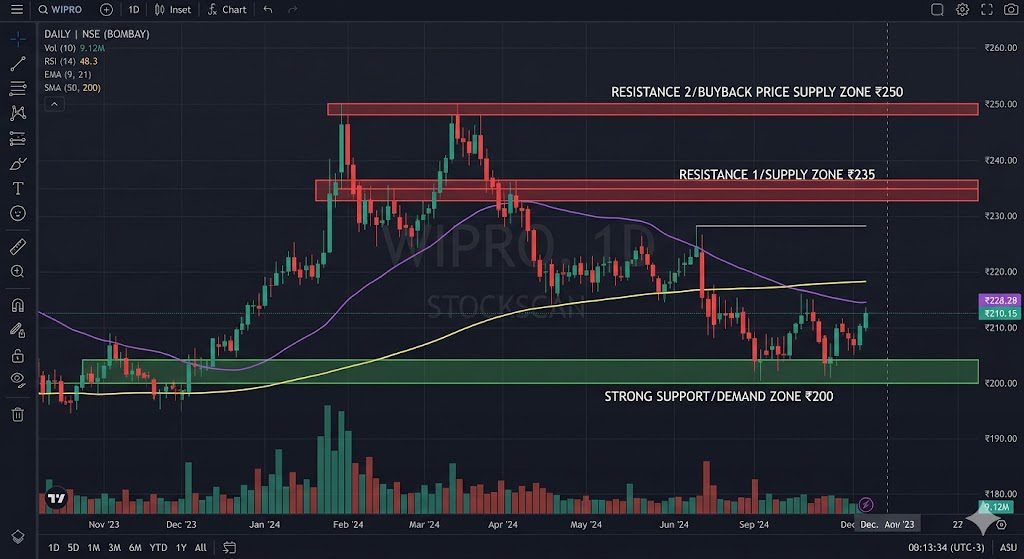
Wipro is currently trading in the ₹210–₹215 range, which places it significantly below the buyback price of ₹250. This creates a natural upward pull, as the buyback acts as a psychological anchor.
Support Levels: Strong Downside Protection
The ₹200 level serves as a major psychological and technical support. This level has historically acted as a floor and is likely to attract buying interest.
Resistance Levels: Path to Upside
On the upside, the stock faces resistance at ₹235, followed by the key level of ₹250, which coincides with the buyback price. A breakout above ₹250 could trigger a move toward higher levels.
Momentum Indicator: Bullish Divergence
The Relative Strength Index (RSI) is showing a bullish divergence, indicating that selling pressure may be weakening. This is often an early signal of a potential trend reversal.
Management Guidance & Future Outlook
Q1 FY27 Outlook: A Cautious Start
Management has guided for -2% to 0% sequential revenue growth in Q1 FY27. This cautious outlook reflects ongoing macroeconomic uncertainties and cautious client spending.
For investors, this is an important point—the turnaround is not immediate.
AI Pivot: Betting on the Future
Wipro has been recognized as a “Horizon 3 Leader” in Agentic AI services, indicating its focus on next-generation technologies. The company is investing heavily in AI-driven solutions, which could become a key growth driver in the coming years.
This shift toward AI is not optional—it is essential for staying competitive in the global IT landscape.
Brokerage Ratings & Price Targets
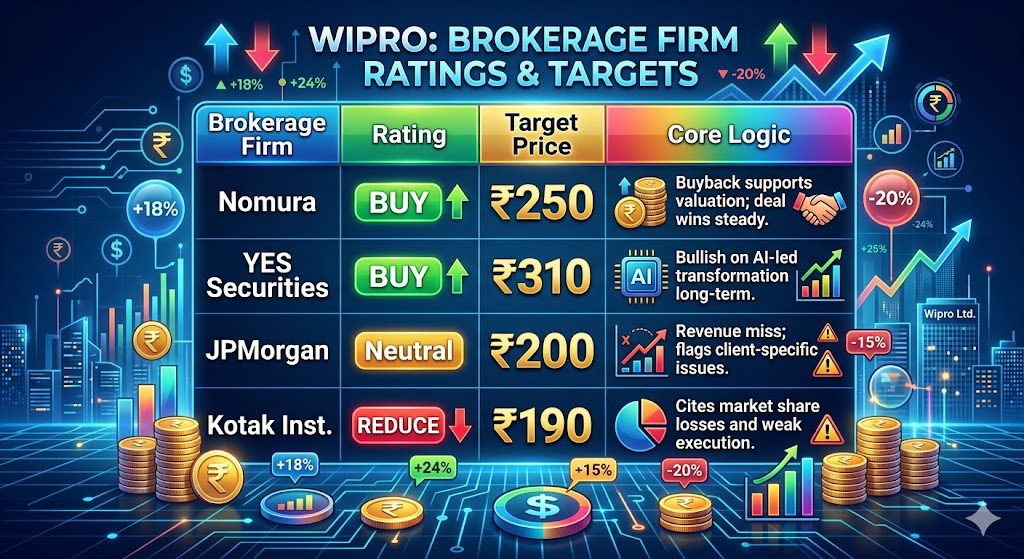
Brokerage firms have taken a mixed view on Wipro, reflecting the balance between strong capital return and weak growth visibility.
Nomura has maintained a Buy rating with a target price of ₹250, citing the buyback as a key support factor. YES Securities is more optimistic, with a ₹310 target, driven by expectations of long-term AI-led transformation.
On the other hand, JPMorgan has a Neutral rating with a ₹200 target, highlighting concerns around revenue growth and client-specific issues. Kotak Institutional Equities has taken a more cautious stance with a Reduce rating and a ₹190 target, pointing to execution challenges.
The divergence in views highlights the central debate—is Wipro a turnaround story or a value trap?
Investor’s Verdict: Buy, Sell, or Tender?
For Retail Investors: The Buyback Opportunity
For investors holding shares at higher levels, the buyback offers a guaranteed exit at ₹250, making it an attractive option. It acts as a safety net in an otherwise uncertain environment.
For Long-Term Investors: A Patience Game
For those who believe in the leadership of Srinivas Pallia and the company’s transformation strategy, holding the stock may make sense. The company continues to defend 17%+ margins, which is a positive sign.
The Bottom Line: Yield Over Growth
At this stage, Wipro is not a high-growth story. It is a yield and capital return story, driven by dividends and buybacks rather than rapid revenue expansion.
Conclusion: A Strong Balance Sheet Meets Slow Growth
Wipro’s Q4 FY26 results present a mixed picture. On one hand, there is strong deal momentum, stable margins, and a massive buyback. On the other hand, growth remains muted, and near-term guidance is cautious.
The company is clearly in a transition phase, balancing operational improvements with shareholder returns.
In simple terms, Wipro is not yet back to high growth—but it is far from weak.
Call to Action (CTA)
Now the key question is yours:
Will you tender your shares in the ₹15,000 crore buyback, or are you betting on Wipro crossing ₹300 in the next cycle?
Share your strategy in the comments—because smart investing always starts with the right discussion.