Scope Outline
Introduction: The Global Agchem Giant’s Pivot
Expert Hook
Over the last three decades, the global agrochemical industry has witnessed dramatic transformations. From the post-patent boom of generic agrochemicals in the early 2000s to today’s growing focus on biological crop solutions, sustainability, and balance-sheet repair, the sector has repeatedly rewarded companies that prioritize long-term financial discipline over short-term expansion. In cyclical industries like agrochemicals, investors eventually realize that a strong balance sheet often matters more than a single quarter’s earnings surprise. This is exactly the phase currently unfolding at UPL Limited. The company’s Q4 FY26 performance may appear mixed at first glance, but beneath the surface, it reflects a deeper operational transformation driven by deleveraging, free cash flow generation, and strategic financial discipline.
The Narrative
UPL is gradually shifting away from a purely volume-driven business strategy toward a more sustainable margin-led growth approach. Instead of aggressively chasing market share through low-margin expansion, management is now prioritizing profitability quality, operating leverage, balance-sheet strength, and long-term shareholder value creation. This transition is particularly important because the global agrochemical sector continues facing pricing pressure from Chinese generic manufacturers, inventory normalization across international markets, and broader commodity-cycle volatility. Despite these industry headwinds, UPL successfully exceeded its annual guidance targets while simultaneously strengthening its financial structure through significant debt reduction.
Market Pulse
As of May 12, 2026, shares of UPL Limited were trading near ₹674 on the NSE. The stock has stabilized despite mixed investor sentiment surrounding the quarterly earnings report. While some traders focused on the slight earnings miss versus consensus estimates, long-term investors appear increasingly optimistic regarding the company’s improving balance-sheet quality and deleveraging progress. Several macroeconomic trends continue influencing the agrochemical sector globally, including falling raw-material prices, Chinese pricing competition, climate-driven agricultural demand, biological-product adoption, and global food-security concerns. UPL’s strategy increasingly appears aligned with these long-term structural shifts.
Q4 FY26 Performance: The “Hard Numbers” (NSE Actuals)
Consolidated Revenue Growth
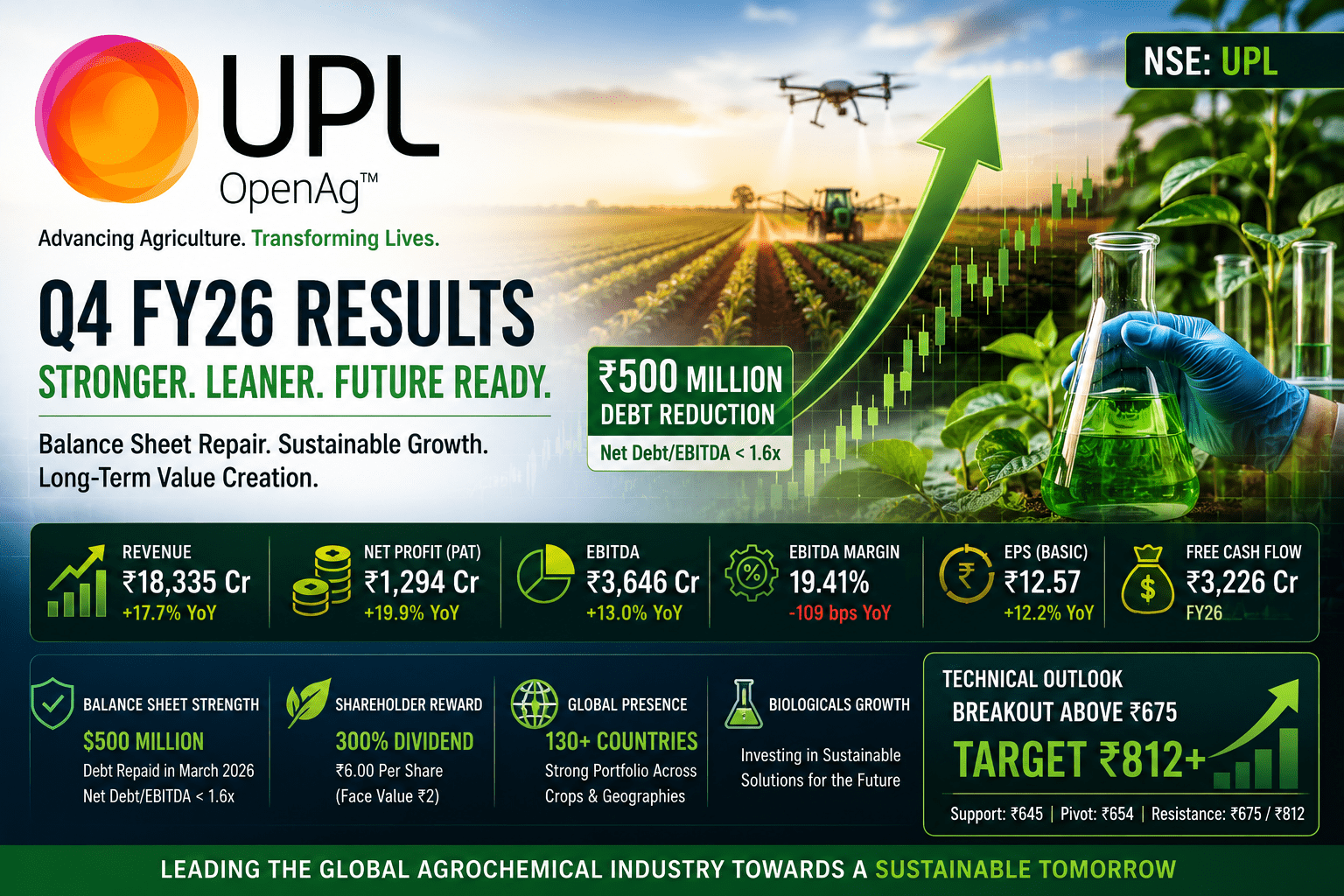
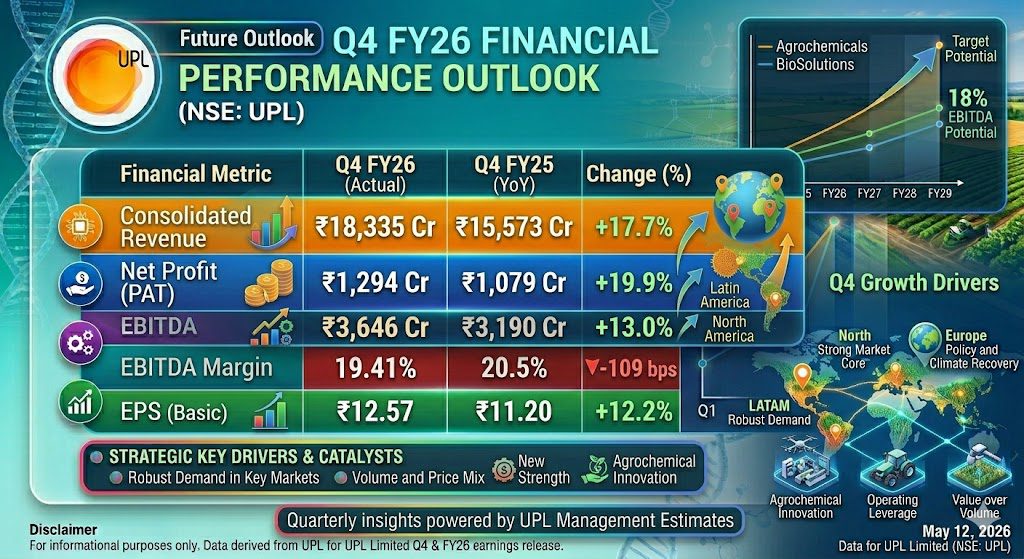
UPL reported consolidated revenue of approximately ₹18,335 crore during Q4 FY26 compared to nearly ₹15,573 crore during the same quarter last year. This represents strong year-on-year growth of approximately 17.7%. The revenue growth was supported by recovery across key global agricultural geographies, improved channel normalization, stronger product demand, and expansion within specialty and biological-product categories. Despite a challenging global agrochemical environment, the company successfully maintained healthy top-line momentum through operational execution and diversified geographic exposure.
Net Profit Growth
Net Profit After Tax for Q4 FY26 stood at approximately ₹1,294 crore compared to nearly ₹1,079 crore during the same quarter last year. This reflects year-on-year growth of approximately 19.9%. Although the profit numbers remained healthy, the market initially reacted cautiously because analysts had expected slightly stronger earnings near the ₹1,300 crore mark. However, the marginal earnings miss appears relatively insignificant compared to the broader financial improvements taking place within the company, especially its aggressive debt reduction and improving cash-flow generation.
EBITDA Performance
EBITDA during Q4 FY26 increased to approximately ₹3,646 crore compared to nearly ₹3,190 crore during Q4 FY25.
EBITDA Margin=EBITDARevenue×100EBITDA\ Margin = \frac{EBITDA}{Revenue} \times 100EBITDAMargin=RevenueEBITDA×100
This represents EBITDA growth of approximately 13% year-on-year. The improvement reflects better operational efficiency, stronger execution, stabilizing agricultural demand, and improving product mix across several global markets. Even during difficult agrochemical cycles, EBITDA stability remains an important indicator of operational resilience.
EBITDA Margin Pressure
Despite healthy EBITDA growth, EBITDA margins declined from approximately 20.5% during Q4 FY25 to nearly 19.41% during Q4 FY26. This represents margin contraction of approximately 109 basis points. Margin pressure was mainly caused by aggressive pricing competition from Chinese generic manufacturers, product-pricing normalization, and broader oversupply conditions across global agrochemical markets. However, management has clearly indicated that margin recovery remains a key priority moving into FY27 through operating leverage improvement, cost optimization, and focus on higher-value products.
Earnings Per Share (EPS)
Basic Earnings Per Share increased from approximately ₹11.20 during Q4 FY25 to nearly ₹12.57 during Q4 FY26. This reflects EPS growth of approximately 12.2%. Rising EPS continues supporting long-term shareholder value creation despite ongoing industry volatility and pricing challenges.
Fundamental Deep-Dive: Balance Sheet vs. P&L
The Deleveraging Milestone
The single most important highlight of UPL’s FY26 performance was the repayment of approximately $500 million in debt during March 2026. This achievement significantly reduced the company’s Net Debt-to-EBITDA ratio below approximately 1.6x, comfortably beating management guidance. For long-term investors, this development may actually be more important than a quarterly profit beat because lower leverage directly reduces financial risk, improves future profitability, strengthens free cash flow, enhances credit quality, and improves institutional confidence. In cyclical industries like agrochemicals, balance-sheet strength often becomes the defining factor separating long-term winners from structurally weak competitors.
Full-Year Operational Excellence
For the full financial year FY26, UPL reported total revenue of approximately ₹51,839 crore. This exceeded the company’s earlier guidance range of 4%–8% growth and ultimately delivered approximately 11% annual revenue growth. The stronger-than-expected annual performance reflects better operational discipline, improved geographic diversification, channel recovery, and expansion within biological and specialty-product categories. Management’s ability to outperform guidance despite difficult global conditions has strengthened investor confidence regarding long-term execution quality.
The Profit “Miss”
While PAT growth remained healthy, the company slightly missed aggressive Street estimates because of ongoing pricing pressure from Chinese agrochemical manufacturers. Chinese competitors continue impacting the industry through aggressive price competition, excess inventory liquidation, lower-cost generic products, and broader margin compression. However, UPL is increasingly attempting to differentiate itself through biological products, sustainable crop solutions, specialty chemicals, and technology-driven agricultural innovation. This strategic transition could become increasingly valuable as global agricultural practices evolve toward sustainability-focused solutions.
Shareholder Rewards: The Dividend Story
Recommended Dividend
The board of UPL Limited proposed a 300% dividend for FY26 amounting to approximately ₹6.00 per equity share with a face value of ₹2. The dividend announcement reflects management’s confidence regarding cash-flow generation, balance-sheet stability, and long-term financial sustainability. Stable dividend payouts remain particularly attractive for investors seeking both income generation and long-term capital appreciation within cyclical industries.
Free Cash Flow Strength
UPL generated free cash flow of approximately ₹3,226 crore during FY26. Strong free cash flow is extremely important because it supports debt repayment, dividend sustainability, business expansion, research investments, and overall financial flexibility. The company’s ability to simultaneously reduce leverage and maintain strong shareholder rewards highlights improving operational quality and disciplined capital allocation.
Technical Analysis: Navigating the ₹650 Pivot
Pivot Point Analysis
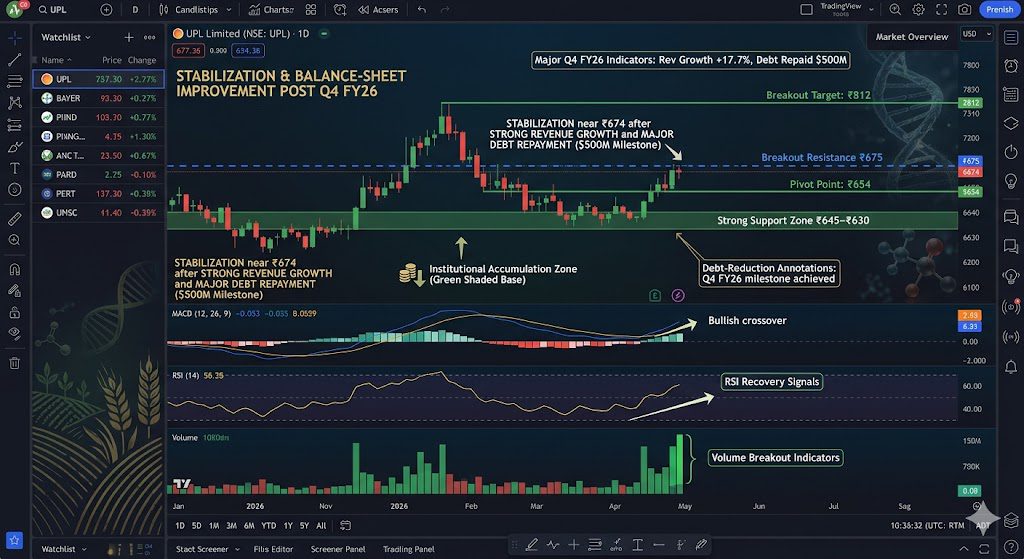
The key technical Pivot Point for the stock currently stands near ₹654.53. This level now acts as a crucial short-term trend indicator for traders, institutions, and momentum participants. Stocks trading above major pivot levels generally maintain stronger bullish sentiment.
Immediate Resistance Levels
The stock currently faces immediate resistance near ₹659.91, ₹669.38, and ₹674.76. A sustained breakout above the ₹675 region could potentially trigger fresh momentum buying and pave the way toward a re-test of the stock’s 52-week high near ₹812.2. Technical traders are therefore closely monitoring the ₹675 breakout zone for signs of institutional accumulation.
Critical Support Levels
Important support zones currently remain near ₹645.06, ₹639.68, and ₹630.21. These levels are likely to attract institutional buying interest if broader market volatility causes temporary pullbacks. Long-term investors often prefer accumulating quality cyclical stocks near strong technical support regions during periods of temporary uncertainty.
Technical Outlook
Technically, the stock continues showing signs of stabilization after prolonged agrochemical-sector volatility. A decisive breakout above ₹675 may potentially trigger renewed bullish momentum, institutional accumulation, improved investor sentiment, and possible valuation re-rating. However, traders continue monitoring global commodity trends, Chinese pricing behavior, and agricultural demand recovery very closely.
Brokerage Sentiment & FY27 Guidance
Revenue Growth Outlook
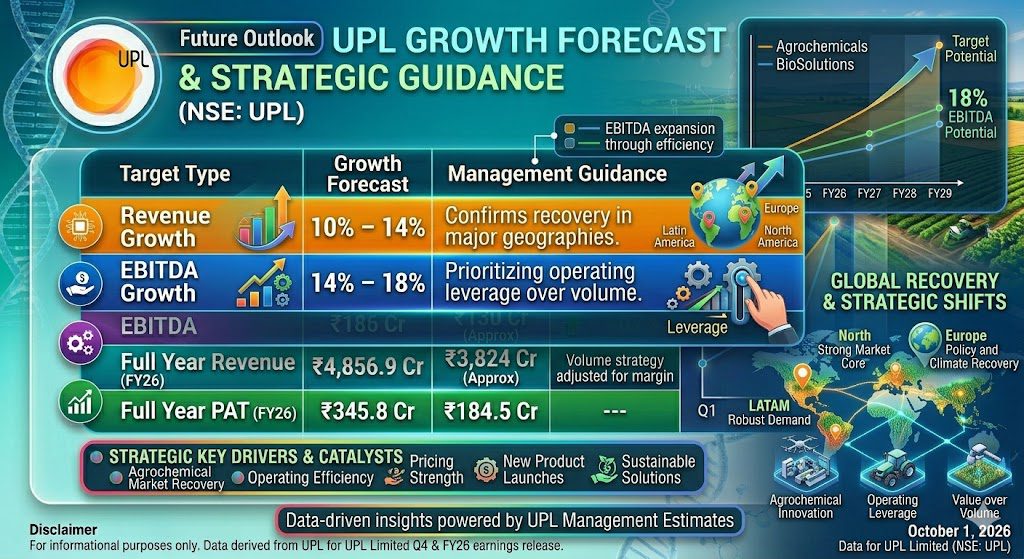
Management currently expects revenue growth between approximately 10%–14% during FY27. This guidance reflects improving recovery across major agricultural geographies, stabilizing demand conditions, and expanding contribution from biological and specialty products. Growth is expected to be supported by geographic diversification, channel normalization, and continued agricultural demand recovery.
EBITDA Growth Outlook
UPL expects EBITDA growth between approximately 14%–18% during FY27. Management is prioritizing operating leverage, margin improvement, better product mix, and financial discipline rather than aggressive low-margin volume expansion. This strategic shift toward profitability quality may significantly improve long-term earnings sustainability.
The “30-Year” Analyst Verdict
For Long-Term Investors
UPL’s most important achievement during FY26 was not merely profit growth but balance-sheet repair. The reduction in leverage substantially lowers the company’s long-term risk premium and improves overall business quality. The company now appears strategically positioned for margin recovery, biological-product expansion, stronger free cash flow generation, and long-term sustainable growth. For patient investors, deleveraging often creates significantly more value than short-term quarterly earnings surprises.
For Active Traders
From a trading perspective, the stock may continue witnessing short-term volatility because of the slight earnings miss and broader uncertainty within the global agrochemical sector. However, the ₹645 support zone now represents an important strategic accumulation region. As long as the stock continues holding above this support range, the broader medium-term structure remains constructive.
Conclusion & Engagement (CTA)
Final Word
UPL’s Q4 FY26 results reflect a company transitioning from aggressive expansion toward disciplined and sustainable long-term growth. While short-term pricing pressure and competitive challenges remain, the company has successfully strengthened its financial foundation through substantial debt reduction, strong free cash flow generation, and operational discipline. With leverage now under control, biological-product expansion accelerating, and global recovery gradually improving, UPL Limited appears increasingly prepared for a multi-year recovery cycle heading into FY27 and beyond.
Investor Discussion
Are you buying UPL primarily for its deleveraging story, or are you more attracted to the 300% dividend and long-term agrochemical recovery potential? Share your agchem-sector investment strategy and UPL outlook in the comments below.