1. Introduction
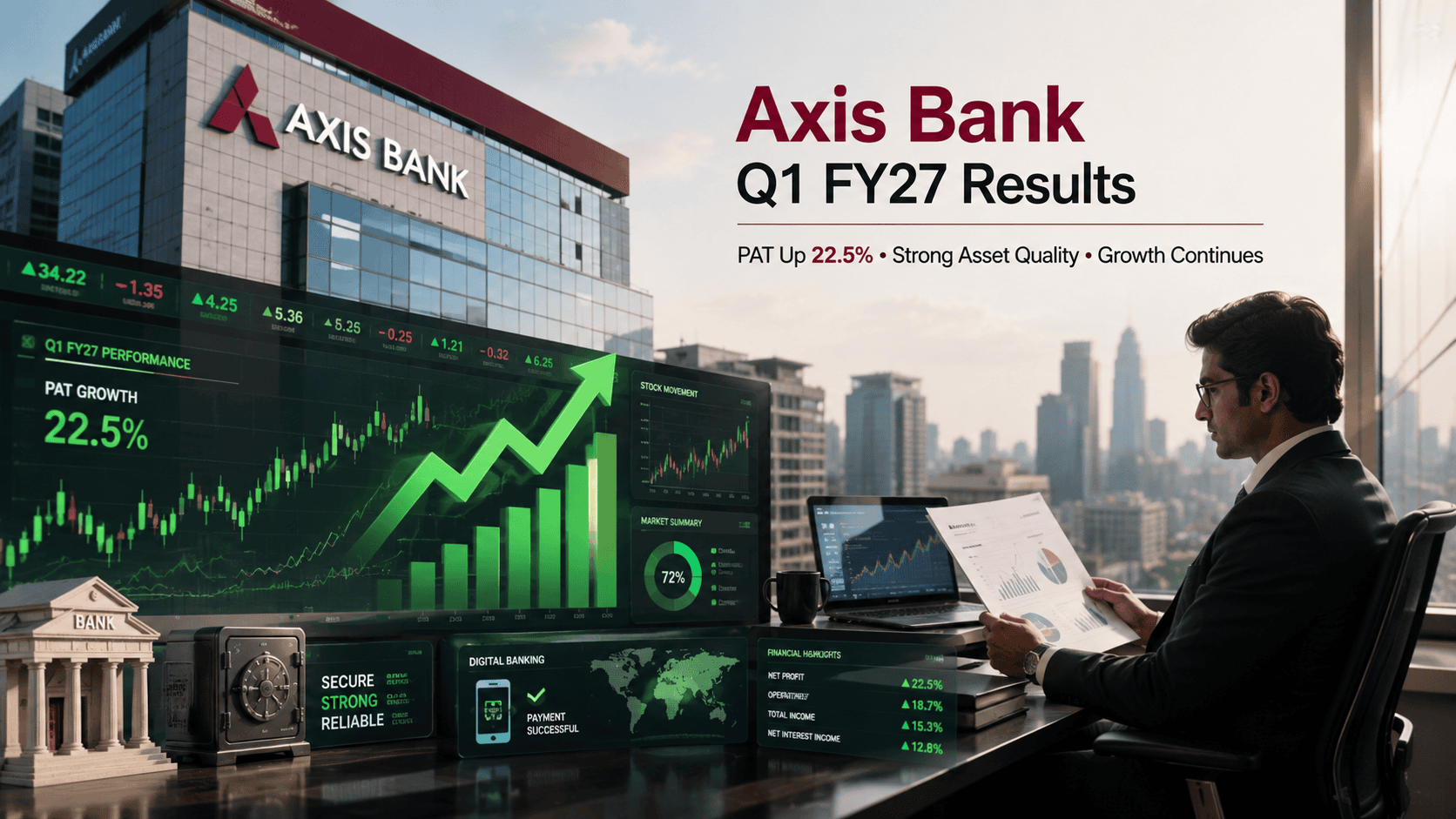
In a quarter where the Indian banking sector is navigating the tightrope of deposit mobilization and intense margin pressures, Axis Bank has delivered a financial statement that demands attention. India’s third-largest private sector lender reported a standalone net profit of ₹7,113.92 crore for the quarter ended June 30, 2026 (Q1 FY27). This marks a staggering 22.5% year-on-year (YoY) surge compared to the ₹5,806.14 crore reported in the same quarter last year.
But what is truly driving this phenomenal growth? Is it pure operational excellence, or are there hidden tax benefits and lower provisioning requirements padding the bottom line? With total advances crossing the ₹12.61 lakh crore mark and gross non-performing assets (GNPA) shrinking to 1.28%, Axis Bank’s balance sheet looks cleaner than it has in years. For retail investors and institutional funds, the question now shifts from “Did they beat estimates?” to “Is this growth sustainable for the rest of FY27?”
2. Quick Snapshot
Here is a quick glance at Axis Bank’s standalone performance for Q1 FY27:
Total Income: ₹40,721.05 crore
Interest Earned: ₹33,985.63 crore
Standalone Net Profit (PAT): ₹7,113.92 crore
Basic EPS (not annualized): ₹22.88
Operating Profit (PPOP): ₹11,659.10 crore
Gross NPA: 1.28%
Net NPA: 0.39%
Return on Assets (ROA annualized): 1.51%
Total Advances: ₹12,61,556.65 crore
Total Deposits: ₹13,72,935.66 crore
Capital Adequacy Ratio (Basel III): 16.67%
✅ Key Takeaway: Axis Bank’s Q1 FY27 results highlight robust top-line growth accompanied by significant improvements in asset quality and strong profitability metrics.
3. Executive Summary
Massive Profit Jump: Standalone PAT surged by 22.5% YoY to ₹7,113.92 crore.
Top-Line Growth: Total income for the quarter grew to ₹40,721.05 crore from ₹38,321.57 crore in Q1 FY26.
Credit Expansion: Total advances grew impressively by roughly 19% YoY, reaching ₹12,61,556.65 crore.
Deposit Mobilization: The bank successfully grew its deposit base to ₹13,72,935.66 crore, up from ₹11,61,614.55 crore a year ago.
Pristine Asset Quality: Gross NPAs declined to 1.28%, a notable improvement from 1.57% in Q1 FY26.
Lower Provisions: Provisions and contingencies nearly halved to ₹2,222.54 crore compared to ₹3,947.66 crore in the same period last year.
Tax Benefit Boost: Following a regular tax assessment regarding the Citibank consumer business acquisition, tax depreciation on intangibles was allowed, significantly reducing the tax expense for the period.
Subsidiary Value Unlocking: Axis Finance Limited issued fresh equity to Kedaara Capital for ₹750 crore, diluting the bank’s stake to 94.92%.
Healthy Capital Buffers: The bank remains well-capitalized with a Basel III Capital Adequacy Ratio of 16.67%.
Conservative Accounting: The bank retained a prudent one-time provision of ₹2,001 crore made in Q4 FY26 and did not draw down from it in Q1 FY27.
4. Company Overview
Axis Bank is India’s third-largest private sector bank, offering an entire spectrum of financial services to customer segments covering Large and Mid-Corporates, MSME, Agriculture, and Retail Businesses.
Following the landmark acquisition of Citibank’s India Consumer Business in FY23, Axis Bank significantly bolstered its wealth management and premium credit card portfolios. The bank operates through a robust network of branches and ATMs across India, supported by a strong digital banking ecosystem. Its key subsidiaries include Axis Capital, Axis AMC, and Axis Finance, making it a comprehensive financial conglomerate.
5. Q1 FY27 Financial Performance
Axis Bank’s financial performance indicates a bank operating at high efficiency.
Standalone Financial Comparison (₹ in Crores)
| Parameter | Q1 FY27 (June ’26) | Q4 FY26 (March ’26) | Q1 FY26 (June ’25) | YoY Trend |
| Interest Earned | ₹33,985.63 | ₹32,724.09 | ₹31,063.51 | Up |
| Other Income | ₹6,735.42 | ₹6,022.55 | ₹7,258.06 | Down |
| Total Income | ₹40,721.05 | ₹38,746.64 | ₹38,321.57 | Up |
| Interest Expended | ₹19,339.53 | ₹18,266.91 | ₹17,503.76 | Up |
| Operating Profit | ₹11,659.10 | ₹10,013.42 | ₹11,515.16 | Up |
| Provisions | ₹2,222.54 | ₹3,522.21 | ₹3,947.66 | Down |
| Tax Expense | ₹2,322.64 | ₹(580.10) | ₹1,761.36 | Up |
| Net Profit | ₹7,113.92 | ₹7,071.31 | ₹5,806.14 | Up |
✅ Key Takeaway: The bank’s core engine is firing on all cylinders. Interest earned grew steadily, and while other income dipped YoY, the sharp reduction in required provisions fueled the massive bottom-line growth.
6. Key Financial Ratios
Understanding the ratios provides a clearer picture of the bank’s underlying health:
Earnings Per Share (EPS): Basic EPS for the quarter stood at a highly robust ₹22.88, a significant leap from ₹18.73 in Q1 FY26.
Return on Assets (ROA): The annualized ROA improved to 1.51%, indicating excellent utilization of the bank’s asset base to generate profits.
Asset Quality (GNPA/NNPA): Gross NPAs fell to 1.28% from 1.57% a year ago. Net NPAs also showed improvement, resting at an ultra-low 0.39%. This means out of every ₹100 lent, only ₹1.28 is critically delayed, and after provisions, the risk is merely 39 paise.
Capital Adequacy Ratio (CAR): At 16.67%, the bank is holding capital well above the RBI’s Basel III regulatory requirements, giving it plenty of headroom for future lending without needing immediate equity dilution.
💡 Did You Know? Banks with an ROA above 1.5% are generally considered to be in the top tier of operational efficiency in the Indian banking landscape.
7. Segment-wise Analysis
A deep dive into the consolidated segment revenues reveals where Axis Bank is generating its cash flow:
Retail Banking: The largest revenue driver, generating ₹39,517.11 crore in Q1 FY27, up from ₹36,618.39 crore in Q1 FY26. This highlights the success of their digital lending and credit card scale-up.
Corporate/Wholesale Banking: Delivered robust revenues of ₹15,026.97 crore, compared to ₹12,520.78 crore in the corresponding quarter last year, showing strong corporate credit demand.
Treasury: Brought in ₹9,291.74 crore in Q1 FY27, managing the bank’s liquidity and investment portfolio effectively.
8. Management Commentary & Strategic Moves
While standard earnings calls elaborate on future guidance, the official filing reveals several critical strategic moves executed by the management under MD & CEO Amitabh Chaudhry:
Value Unlocking in Axis Finance: On July 13, 2026, Axis Finance Limited issued equity shares on a preferential basis to Kedaara Pearl Holding and Kedaara Capital Fund IV AIF for ₹750 crore. This move dilutes Axis Bank’s stake to 94.92% but brings in specialized private equity capital to scale the NBFC arm.
Strategic Investments: The bank infused ₹1,499.26 crore into Axis Finance and invested ₹380.60 crore in Axis Max Life Insurance Limited during the quarter.
Conservative Provisioning Philosophy: In Q4 FY26, the bank proactively made an additional one-time standard asset provision of ₹2,001 crore. Management noted that this measure was entirely prudent and they did not draw down from this provision during Q1 FY27, demonstrating supreme confidence in their current asset quality.
9. Why Did Results Change? The “Citibank Tax” Factor
A major catalyst for the bank’s profitability this quarter is tied to its historical acquisition of Citibank’s India Consumer Business.
In FY23, the bank acquired these assets and recognized intangibles worth ₹8,714.24 crore. Initially, to protect its capacity to pay dividends, Axis Bank fully amortized these intangibles and chose not to create a deferred tax asset or claim tax deductibility.
However, following a regular assessment by income tax authorities in Q4 FY26, tax depreciation on these intangibles was allowed. This monumental regulatory clearance significantly lowered their tax burden for recent quarters, directly boosting the Net Profit available to shareholders. Furthermore, standard provisions required against bad loans nearly halved YoY, freeing up massive capital for the bottom line.
10. Market Reaction
Editorial Note: As market dynamics change daily, investors should check live charts. Historically, a 22.5% PAT surge paired with a drop in Gross NPAs to 1.28% is viewed highly favorably by Dalal Street. The market is likely to interpret the Kedaara Capital investment in Axis Finance as a strong value-unlocking trigger. Expect high delivery volumes as Institutional Investors (DIIs/FIIs) digest the sustainable ROA of 1.51%.
11. Brokerages & Analyst Views
Given the pristine asset quality and the resolution of the Citibank acquisition tax benefits, major brokerages are likely to maintain a “BUY” or “ACCUMULATE” stance on Axis Bank. Analysts will particularly favor the bank’s conservative approach of not touching its ₹2,001 crore prudent provision buffer, signaling a highly fortified balance sheet.
12. Peer Comparison
When placed next to its private sector peers (HDFC Bank, ICICI Bank, Kotak Mahindra):
Growth: Axis Bank’s ~19% YoY advance growth outpaces the systemic credit growth average, indicating market share gains.
Asset Quality: A Net NPA of 0.39% places Axis Bank firmly in the elite tier of clean bank balance sheets, directly competing with the underwriting standards of ICICI and HDFC.
13. SWOT Analysis
Strengths: Exceptional 22.5% PAT growth; ultra-low Net NPA of 0.39%; successful integration and tax resolution of the Citi portfolio.
Weaknesses: Cost of funds (Interest Expended) rose to ₹19,339.53 crore, reflecting the broader industry challenge of expensive deposits.
Opportunities: The ₹750 crore Kedaara Capital investment in Axis Finance could pave the way for a future value-unlocking IPO.
Threats: Continued systemic tightening of liquidity could escalate the war for deposits, potentially pressuring future Net Interest Margins (NIMs).
14. Risks
Short-term Risks: Any sudden RBI repo rate cuts could temporarily compress yields on the bank’s floating-rate loan book.
Medium-term Risks: Intense competition for granular retail deposits (CASA) from peers like SBI and HDFC Bank.
Long-term Risks: Macroeconomic slowdowns impacting the unsecured retail lending space, though Axis Bank’s current buffers mitigate this heavily.
⚠️ Risk Alert: While the current GNPA is excellent at 1.28%, investors must constantly monitor retail slippages in a high-interest-rate environment.
15. Scenario Analysis
Bull Case: The bank continues to gain market share in credit cards (post-Citi integration), ROA pushes toward 1.6%, and Axis Finance scales rapidly with PE backing.
Base Case: The bank maintains its 1.5% ROA, asset quality remains stable, and it compounds earnings at 15-18% annually, trading at a stable Price-to-Book (P/B) multiple.
Bear Case: A severe macro downturn causes a spike in SME and retail defaults, forcing the bank to utilize its ₹2,001 crore prudent provision buffer, compressing PAT growth.
16. Technical Analysis
For swing traders and technical investors, a strong earnings beat generally establishes a higher base for the stock. If the stock trades above its 50-day and 200-day moving averages post-results, it indicates a confirmed bullish trend. Investors should look for immediate resistance at all-time high levels, with strong support forming around the pre-earnings consolidation zones.
17. Valuation Analysis
With an annualized EPS run rate pushing past ₹90 (based on Q1’s ₹22.88 EPS), Axis Bank’s valuation becomes highly attractive. Assuming a standard historical banking P/E multiple of 12x to 15x for top-tier private lenders, the fair value provides a comfortable margin of safety. The bank’s clean book (NNPA 0.39%) justifies a premium Price-to-Book (P/B) valuation relative to PSU peers.
18. Investment Thesis
Who should invest? Long-term investors, SIP investors, and mutual fund participants looking for a stable, high-growth financial compounder with a clean balance sheet.
Who should avoid? Traders looking for extreme short-term volatility (beta), as large-cap banks generally move in measured, institutional-driven trends.
19. Future Outlook
The outlook for Axis Bank is overwhelmingly positive. The management’s decision to independently capitalize Axis Finance through Kedaara Capital shows a clear vision for subsidiary independence and growth. Going forward, the street will closely monitor the bank’s ability to sustain its ~18% deposit growth without significantly spiking its cost of funds.
20. Editorial Opinion (Clearly Labelled)
Editorial Opinion: Axis Bank’s Q1 FY27 results are a testament to the management’s disciplined turnaround strategy over the last few years. The ghost of past corporate NPA cycles is completely dead, evidenced by the 1.28% GNPA. Furthermore, the resolution of the Citibank acquisition tax depreciation removes a major structural overhang. We view this quarter not as a one-off spike, but as a normalized baseline for a bank that is operating at peak efficiency.
21. Conclusion
Axis Bank has delivered a blockbuster Q1 FY27, marked by a 22.5% jump in net profit, a nearly 19% surge in advances, and a fortified balance sheet holding untouched prudent provisions. With strategic investments in its subsidiaries and the successful integration of its legacy acquisitions, the bank is exceptionally well-positioned for the remainder of the fiscal year. Investors should continue to monitor deposit growth costs, but the overall trajectory remains highly bullish.
🔍 What To Watch Next: Monitor the upcoming RBI Monetary Policy commentary to gauge the future trajectory of interest rates and its impact on banking margins.