1. Introduction
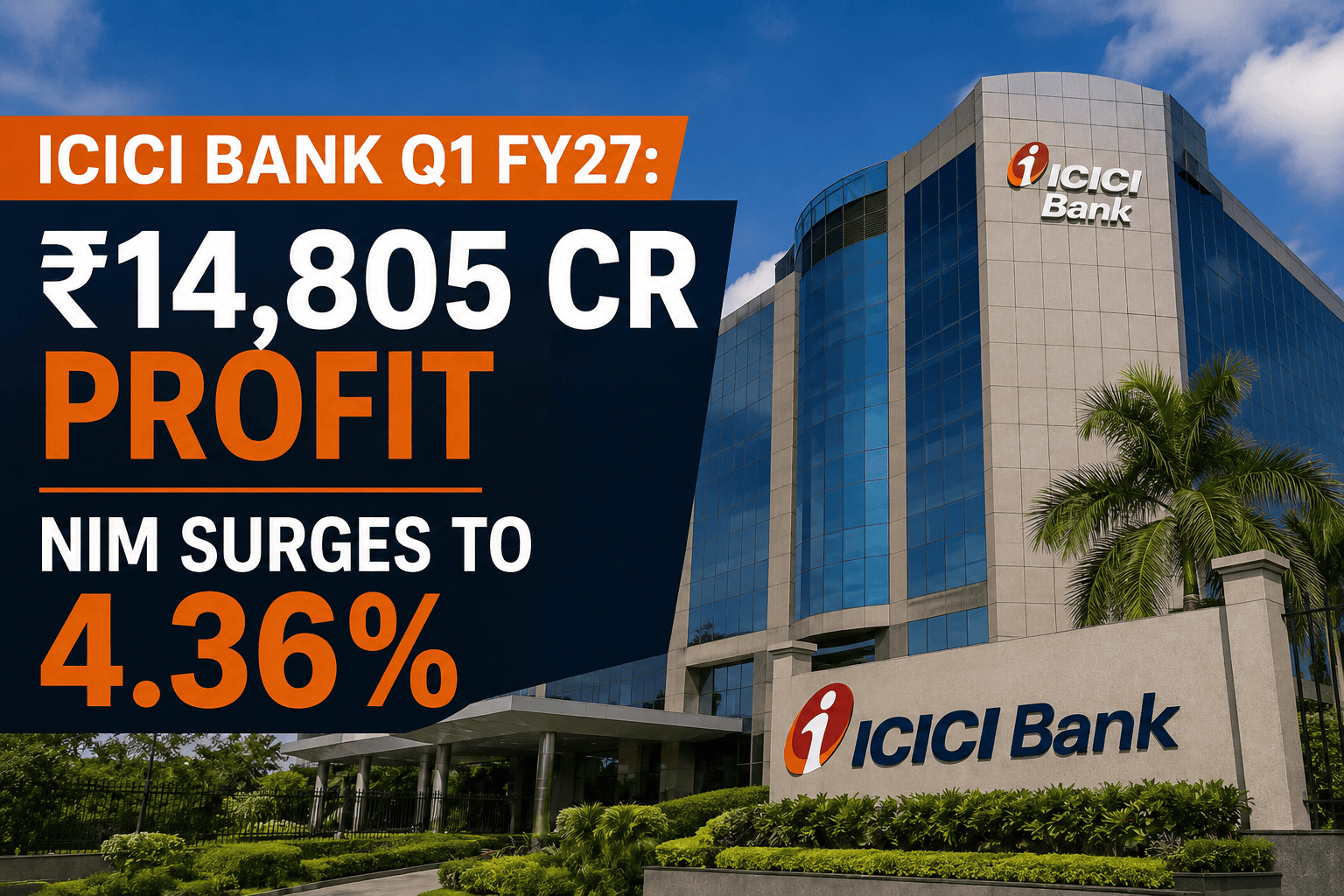
In an economic environment where market participants have been bracing for squeezed margins and decelerating credit demand, ICICI Bank has delivered a masterclass in structural banking resilience. For the first quarter of the financial year 2026–2027 (Q1 FY27), India’s premier private lender reported a standalone net profit of ₹14,804.50 crore, marking a decisive 15.9% year-on-year (YoY) growth.
The most surprising element of this earnings print wasn’t just the sheer volume of the profit, but the underlying engine driving it. Against the tide of systemic margin compression, ICICI Bank actually expanded its Net Interest Margin (NIM) to a highly lucrative 4.36%. Furthermore, the bank aggressively pivoted its growth vectors—while retail loans grew by a steady 12.0%, the rural and business banking portfolios surged by an astronomical 35.4% and 28.2%, respectively.
This is not merely a quarterly beat; it is a demonstration of superior asset-liability management. By holding a massive fortress of ₹13,100 crore in contingency provisions and keeping its Gross Non-Performing Assets (GNPA) firmly suppressed at 1.38%, ICICI Bank has signaled to the street that it can simultaneously chase high-yield growth and maintain pristine asset quality. For retail investors and institutional funds alike, this result underscores why ICICI Bank continues to command a premium valuation in the Indian banking landscape.
2. Executive Summary: 10 Key Takeaways
Profitability Surge: Standalone profit after tax (PAT) jumped 15.9% YoY to ₹14,805 crore.
Core Revenue Expansion: Net Interest Income (NII) increased by 12.7% YoY to ₹24,384 crore, showcasing robust core operations.
Defying Margin Gravity: Net Interest Margin (NIM) expanded to 4.36% in Q1-2027, up from 4.32% in the preceding quarter (Q4-2026) and 4.34% a year ago.
High-Yield Credit Pivot: Total advances grew 19.6% YoY to ₹16,31,260 crore, powered by explosive growth in rural (35.4% YoY) and business banking (28.2% YoY).
Deposit Base Fortification: Total period-end deposits expanded by 14.0% YoY to ₹18,33,586 crore, with average CASA ratio remaining healthy at 38.1%.
Pristine Asset Quality: Gross NPA ratio improved YoY to 1.38% (from 1.67%), while Net NPA settled at a negligible 0.35%.
Fortress Balance Sheet: The bank continues to hold a massive contingency provision buffer of ₹13,100 crore, shielding it from unforeseen macroeconomic shocks.
Subsidiary Value Unlocking: Key subsidiaries fired on all cylinders; ICICI Prudential Asset Management Company saw PAT grow to ₹965 crore, while ICICI Securities reported a PAT of ₹419 crore.
Regulatory Compliance: The bank maintained an additional standard asset provision of ₹1,283 crore as directed by the RBI regarding an agricultural priority sector portfolio.
Capital Abundance: Total capital adequacy ratio (Basel III) stood at a highly comfortable 16.84%, well above the minimum regulatory requirement of 11.70%.
3. Financial Snapshot
All figures are on a standalone basis for the quarter ended June 30, 2026 (Q1 FY27) unless otherwise stated.
| Metric | Q1 FY27 (June 2026) | Q1 FY26 (June 2025) | YoY Growth | Q4 FY26 (March 2026) | QoQ Growth |
| Total Income | ₹54,246.84 crore | ₹51,451.81 crore | +5.4% | ₹50,584.38 crore | +7.2% |
| Net Interest Income (NII) | ₹24,384.00 crore | ₹21,635.00 crore | +12.7% | ₹22,979.00 crore | +6.1% |
| Core Operating Profit | ₹20,235.00 crore | ₹17,505.00 crore | +15.6% | ₹18,305.00 crore | +10.5% |
| Net Profit (PAT) | ₹14,804.50 crore | ₹12,768.21 crore | +15.9% | ₹13,701.68 crore | +8.0% |
| Basic EPS (₹, not ann.) | ₹20.65 | ₹17.91 | +15.3% | ₹19.15 | +7.8% |
| Net Interest Margin (NIM) | 4.36% | 4.34% | +2 bps | 4.32% | +4 bps |
| Gross NPA Ratio | 1.38% | 1.67% | -29 bps | 1.40% | -2 bps |
| Net NPA Ratio | 0.35% | 0.41% | -6 bps | 0.33% | +2 bps |
| Total Advances | ₹16,31,259.71 cr | ₹13,64,157.06 cr | +19.6% | ₹1,553,892.95 cr | +5.0% |
| Total Deposits | ₹18,33,585.79 cr | ₹16,08,517.32 cr | +14.0% | ₹1,794,624.98 cr | +2.2% |
| Return on Assets (ROA) | 2.49% (annualised) | 2.44% | +5 bps | 2.40% | +9 bps |
| Total Capital Adequacy | 16.84% | 16.31% | +53 bps | 17.18% | -34 bps |
4. Financial Performance Analysis
The Revenue Engine: Broad-Based and High-Yield
ICICI Bank’s revenue trajectory in Q1 FY27 illustrates a masterclass in pricing power. Interest earned stood at ₹45,670.78 crore, a notable jump from the ₹42,946.91 crore reported in the same quarter last year. What truly surprised the street was the quality of this income. The Net Interest Income (NII)—the core difference between interest earned on loans and interest paid on deposits—grew by 12.7% YoY to ₹24,384 crore.
Why did it happen? This growth was primarily driven by the bank’s strategic tilt towards high-yield loan segments. By expanding rural credit by 35.4% YoY and business banking by 28.2% YoY, the bank optimized its asset mix to offset the rising cost of deposits in the broader Indian banking system.
The NIM Surprise: While most peers are battling severe Net Interest Margin (NIM) compression due to repricing of deposits, ICICI Bank successfully expanded its NIM to 4.36% (up from 4.32% in Q4-2026). This indicates that the bank successfully passed on lending rate hikes or shifted its portfolio into higher-yielding assets faster than its cost of funds rose.
Profitability: Clean and Sustainable
The standalone net profit of ₹14,804.50 crore (up 15.9% YoY) is exceptionally clean. Operating expenses increased by 10.4% YoY to ₹12,574 crore, which is well below the core operating profit growth of 15.6%. This creates a positive “jaws” effect (revenue growing faster than expenses), underscoring strict cost control and operating leverage.
Provisions (excluding tax) fell sequentially but stood at ₹1,260 crore for Q1-2027, compared to ₹1,815 crore in Q1-2026. The bank’s profitability is highly sustainable because it is not reliant on releasing historical provisions to inflate the bottom line; rather, core pre-provisioning operating profit is doing the heavy lifting.
Cash Flow and Other Income
Non-interest income, excluding treasury, jumped 16.0% YoY to ₹8,425 crore. Fee income alone soared by 23.5% YoY to ₹7,286 crore. Significantly, 72% of this fee income was generated from retail, rural, and business banking customers, proving that the bank’s granular, transaction-heavy customer base is a highly reliable cash cow.
5. Segment Wise Analysis
ICICI Bank’s loan book expansion reveals a calculated strategy to diversify risk while maximizing yield.
Retail Banking
The retail portfolio remains the bedrock of the bank, comprising 49.2% of the total loan portfolio. However, it grew at a measured pace of 12.0% YoY and 2.7% sequentially. This calibrated growth suggests the bank is prioritizing quality over volume in the retail unsecured and mortgage segments, navigating potential headwinds in consumer leverage carefully.
Rural and Business Banking (The Growth Drivers)
The true stars of the quarter were the rural and SME segments.
Rural Portfolio: Surged an impressive 35.4% YoY and 6.2% sequentially.
Business Banking: Grew 28.2% YoY and 6.9% sequentially. These segments traditionally offer higher yields. The aggressive, yet risk-calibrated expansion here is exactly why the bank’s NIM expanded.
Corporate Banking
The domestic corporate portfolio delivered solid, steady growth, rising 18.5% YoY and 6.9% sequentially. The total domestic advances grew 18.8% YoY, showing that corporate India’s capex and working capital demands are finding a willing partner in ICICI’s balance sheet.
Treasury
The treasury segment reported a modest gain of ₹151 crore for the quarter. While this is significantly lower than the ₹1,241 crore gain in Q1-2026, it marks a positive turnaround from the ₹106 crore loss in Q4-2026.
Consolidated Subsidiaries
ICICI Bank’s subsidiaries function as powerful value multipliers:
ICICI Prudential Life Insurance: Value of New Business (VNB) margin improved to 26.7%. Profit after tax grew to ₹386 crore from ₹302 crore in Q1-2026.
ICICI Lombard General Insurance: Gross Direct Premium Income (GDPI) increased to ₹8,318 crore. However, PAT dropped to ₹403 crore from ₹747 crore, with the combined ratio inching up to 107.2%.
ICICI Prudential AMC: Delivered a stellar PAT of ₹965 crore, up from ₹784 crore.
ICICI Securities: Reported a consolidated PAT of ₹419 crore.
6. Management Commentary & Strategic Moves
While the raw data speaks volumes, the underlying management actions approved by the Board provide critical forward-looking context.
Board Expansion & Governance: The Board appointed Mr. Mrugank Paranjape as an Additional (Independent) Director for a five-year term commencing August 1, 2026. Mr. Paranjape’s deep expertise in capital and commodity markets (former MD & CEO of MCX) signals the bank’s intent to strengthen its institutional governance and market strategies.
Global Fundraising Preparedness: The Board approved undertaking borrowing by way of issuances of bonds/notes/offshore Certificate of Deposits in overseas markets for a revised limit of up to USD 2.50 billion. This implies management expects sustained credit demand and is proactively securing diversified, dollar-denominated funding lines to support future growth.
Prudent Provisioning: The management maintained its ultra-conservative stance by holding ₹13,100 crore in contingency provisions. Additionally, they continued to hold an additional standard asset provision of ₹1,283 crore as directed by the RBI regarding a specific agricultural priority sector portfolio from FY2026. This “provisioning first” mentality protects future earnings from sudden systemic shocks.
7. Market Reaction (Analysis & Expectations)
Editorial Note: Based on the structural beat in these earnings.
Share Price Anticipation: A 15.9% profit growth combined with NIM expansion to 4.36% is a rare feat in the current macro cycle. The stock is likely to witness strong institutional buying, leading to a potential gap-up opening.
Institutional View: FIIs and DIIs have historically favored ICICI Bank for its predictable earnings visibility. The 23.5% jump in fee income and the 19.6% advance growth will likely prompt analysts to upgrade their target prices.
Relative Valuation: With an annualized ROA of 2.49%, ICICI Bank justifies a premium valuation over its public sector peers and is strongly contesting the valuation premium historically enjoyed by its closest private sector rival.
8. Industry Comparison
When benchmarked against the broader Indian banking industry:
Margins: Most Indian banks are suffering from NIM compression due to the “war for deposits” driving up the cost of funds. ICICI Bank’s ability to expand NIM to 4.36% demonstrates superior pricing power.
Credit vs. Deposit Growth: The industry average for credit growth has been outpacing deposit growth, creating liquidity tightness. ICICI Bank balanced this masterfully, growing loans at 19.6% while securing a robust 14.0% growth in deposits, backed by an enviable average CASA ratio of 38.1%.
Asset Quality: An industry-leading Gross NPA of 1.38% and a Net NPA of 0.35% place ICICI Bank in the top decile of asset quality performance among Indian lenders.
9. Balance Sheet Analysis
ICICI Bank’s balance sheet is a fortress.
Total Size: The standalone total capital and liabilities reached ₹24,32,426.04 crore.
Capital Adequacy: The Basel III total capital adequacy ratio stands at 16.84%, with a Common Equity Tier 1 (CET-1) ratio of 16.19%. This is vastly superior to the regulatory minimum of 11.70% and 8.20% respectively, meaning the bank requires no immediate equity dilution to fund its 19%+ loan growth.
Liquidity: The bank holds ₹73,942.76 crore in cash and balances with the RBI, alongside ₹89,104.37 crore in balances with banks and money at call.
Provision Coverage: The provisioning coverage ratio on non-performing loans is an iron-clad 74.7%.
Leverage: The debt-equity ratio remains incredibly healthy at 0.17, indicating low reliance on market borrowing compared to core equity and deposits.
10. Valuation Analysis
Disclaimer: This is for educational analysis based on reported data and does not constitute a buy/sell recommendation.
Earnings Per Share (EPS): The basic EPS for Q1-2027 (not annualized) is ₹20.65. If we crudely annualize this run-rate, the bank is generating over ₹82 in EPS per year.
Return Metrics: The Return on Assets (ROA) is an elite 2.49% annualized. Generally, an ROA above 1.5% for a commercial bank is considered excellent; 2.49% is exceptional and justifies a high Price-to-Book (P/B) multiple.
Premium Justification: The bank’s valuation premium is underpinned by its 38.1% CASA ratio (providing cheap funds) and a massive 72% chunk of fee income derived from retail and SME sectors, ensuring granular, non-cyclical cash flow.
11. SWOT Analysis
Strengths:
NIM expansion (4.36%) in a tough macro environment.
Massive contingency provision of ₹13,100 crore acting as a shock absorber.
High CET-1 ratio of 16.19%.
Weaknesses:
Retail loan growth has decelerated to 12.0%, suggesting potential saturation or cautiousness in urban consumer credit.
ICICI Lombard reported a drop in PAT to ₹403 crore with a combined ratio over 100% (107.2%).
Opportunities:
Rural (up 35.4%) and Business Banking (up 28.2%) offer immense high-yield growth runways.
The USD 2.5 billion overseas borrowing limit opens doors for cheap global liquidity to fund domestic capex.
Threats:
Sustained higher interest rates could eventually suppress corporate credit demand.
The RBI’s continuous scrutiny on agricultural and priority sector lending classifications poses minor compliance execution risks.
12. Risks to Watch
Regulatory Risks: The RBI directed an additional standard asset provision of ₹1,283 crore regarding an agricultural priority sector portfolio in FY2026. While fully provisioned, any further regulatory reclassifications could impact near-term accounting.
Macro Risks: While the CASA ratio is healthy at 38.1%, systemic shifts away from savings accounts into mutual funds (as seen across the industry) could increase the cost of deposits over the medium term.
Execution Risks: Scaling the rural portfolio at 35.4% YoY requires immaculate underwriting. Fast-growing unsecured or rural books can sometimes lead to asset quality issues down the line if not monitored via tight credit models.
13. Future Outlook
The outlook for ICICI Bank remains overwhelmingly positive. Management has proven its ability to pull the right levers—slowing down saturated retail growth while stepping on the gas in SME and rural lending to protect margins. The USD 2.5 billion offshore borrowing mandate sets the stage for the bank to support the next leg of India’s corporate capex cycle.
Analysts will likely focus on whether the 4.36% NIM has peaked or if there is further room for expansion. However, with ₹13,100 crore in contingency reserves, the bank’s future earnings are highly insulated against cyclical downturns.
14. Investor Takeaways
For Long-Term Investors: The 2.49% ROA and 16.19% CET-1 ratio scream “quality compounder.” The bank is generating high returns internally without needing to dilute equity.
For Short-Term Traders: The unexpected NIM expansion and 15.9% PAT growth offer strong positive momentum. Watch for technical breakouts in the stock price as brokerages upgrade targets.
For Dividend/Value Investors: While not a traditional high-yield dividend play, the bank’s core operating profit excluding dividend from subsidiaries grew by 18.3%, ensuring immense cash generation capacity.
Disclaimer: This analysis is purely for educational purposes and is based on publicly available data. Please consult a SEBI-registered advisor before making investment decisions.
15. Conclusion
ICICI Bank’s Q1 FY27 results are a testament to flawless execution. Reporting a net profit of ₹14,805 crore with a 19.6% advance growth, the bank has effectively silenced concerns about peak margins and slowing credit. By strategically expanding into rural and business banking, while maintaining an iron-clad balance sheet with 1.38% GNPA and vast contingency provisions, ICICI Bank has reinforced its position as a crown jewel of the Indian financial sector.