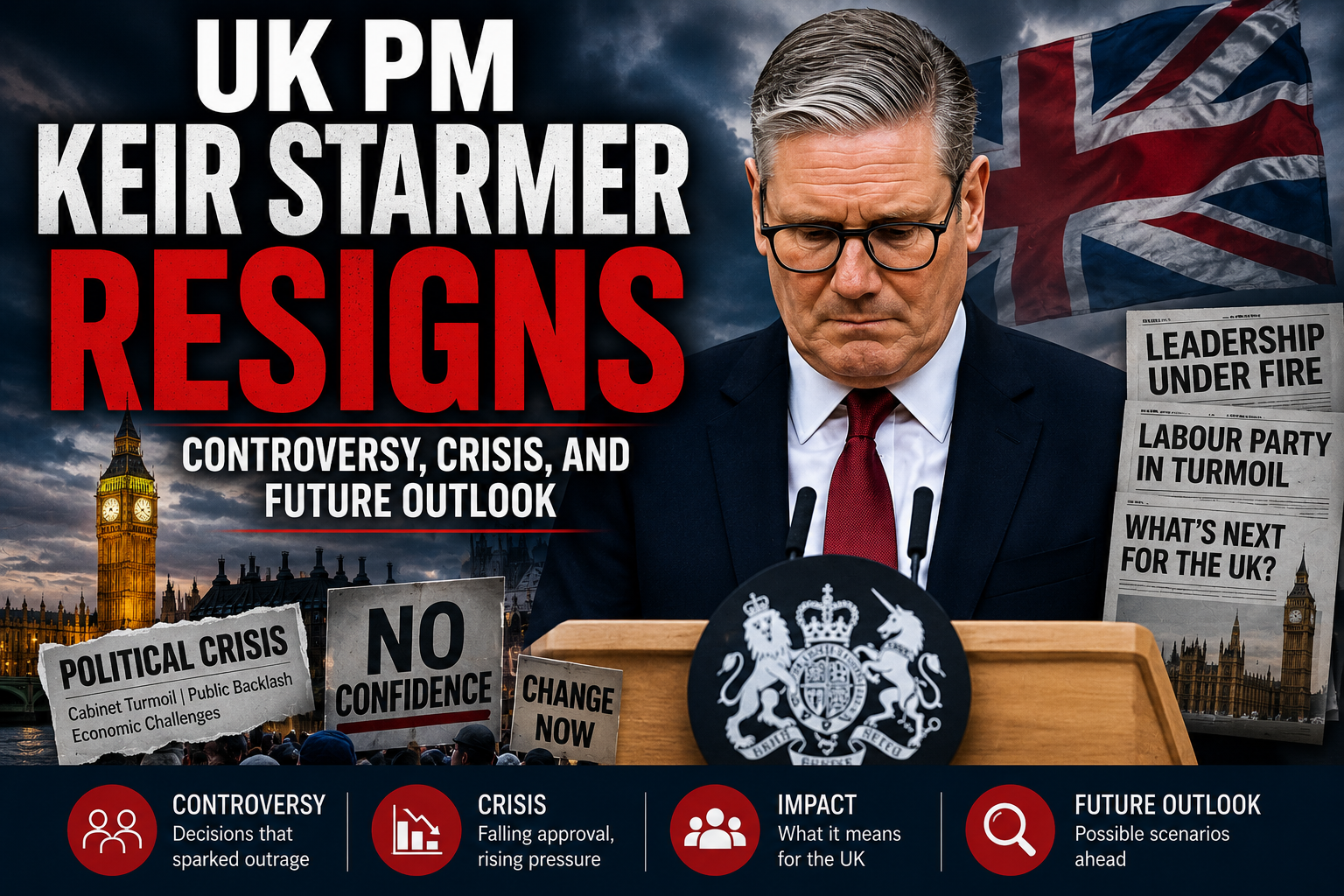
The global political landscape has been fundamentally shaken by the sudden resignation of British Prime Minister Keir Starmer. Stepping outside the iconic doors of 10 Downing Street, Starmer addressed a stunned nation, admitting that he was no longer the right person to lead his party into the next general election cycle. This sudden exit plunges the ruling Labour Party into an acute leadership crisis and marks a staggering historical milestone: Britain has now seen six Prime Ministers resign in just a single decade.
To international observers, investors, and political analysts across the United States, the United Kingdom, Europe, Canada, and Australia, this rapid leadership turnover underscores a deeper malaise within the British political system. While Starmer cited domestic pressures and party dissent as his immediate motivators, a deeper examination reveals a complex web of intense economic pressures, domestic policy stalemates, high-stakes international rivalries, and explosive controversies that compromised his administration from within.
The Historical Blueprint: Ten Years, Six Prime Ministers
To comprehend the magnitude of Starmer’s exit, one must view it through the lens of recent British political history. The United Kingdom, traditionally celebrated for its institutional stability, has experienced unprecedented executive volatility since 2016.
[2016] David Cameron (Resigned post-Brexit Vote)
   │
[2019] Theresa May (Resigned over Brexit Deadlock)
   │
[2022] Boris Johnson (Resigned over Partygate / Ethics Crises)
   │
[2022] Liz Truss (Resigned after 44 Days over Mini-Budget Crisis)
   │
[2024] Rishi Sunak (Defeated in General Election after economic stagnation)
   │
[2026] Keir Starmer (Resigned amid systemic domestic & external friction)
This rapid rotation of heads of government has transformed 10 Downing Street into what international political commentators call a revolving door. While past leaders crumbled under the weight of the Brexit transition or internal ethical scandals, Starmer’s downfall serves as a distinct case study of a leader caught between severe domestic inflation, contentious immigration figures, and a bruising geopolitical feud with Washington.
The Transatlantic Feud: The Trump-Starmer Friction
A defining element of Keir Starmer’s tenure was his overtly strained relationship with US President Donald Trump. The ideological and tactical friction between Washington and London began long before Starmer’s resignation, originating during the late stages of the 2024 US Presidential campaign.
1. Electoral Interference Accusations
In the autumn of 2024, Starmer’s Labour Party openly established communication and aligned ideologically with the US Democratic platform. Trump’s campaign team quickly seized upon this, accusing the British ruling party of direct interference in foreign elections. Although Starmer downplayed the diplomatic friction at the time, Trump made it clear that a victory for his administration would result in significant diplomatic challenges for Starmer’s government.
2. The Geopolitical Split
Following Trump’s return to the White House, the policy rifts widened significantly:
The Middle East & Diego Garcia: When regional tensions escalated with Iran, Washington requested operational usage of the strategic military facility at Diego Garcia in the Indian Ocean to launch fighter detachments. Fearful of domestic backlash and entanglement in another long-term conflict, Starmer’s cabinet officially denied the request. Trump publicly criticized the decision, labeling the UK’s leadership as hesitant and unreliable.
The State of Hormuz Crisis: The UK similarly resisted active military participation in enforcing maritime security corridors in the Strait of Hormuz, further alienating Washington.
The China Alignment: In a bold move to hedge against American economic unilateralism, Starmer conducted a high-profile diplomatic visit to Beijing. While intended to secure trade alternatives for a struggling post-Brexit Britain, Washington viewed the pivot as a significant geopolitical realignment.
The Epstein Link and Internal Party Collapse
While external geopolitical pressure isolated the Starmer administration on the global stage, an explosive domestic political controversy directly triggered his internal party collapse. The catalyst was the comprehensive unsealing of the Epstein investigative files in late 2025.
[Unsealing of Epstein Files]
              │
[Exposure of Peter Mandelson's Association]
              │
[Public Discontent & Local Election Losses (May 2026)]
              │
[Labour Party Demands Starmer's Resignation]
In December 2024, Starmer had appointed his close political ally and long-time strategist, Peter Mandelson, as the UK’s Ambassador to the United States. However, when the unsealed files revealed unredacted financial and social ties between Mandelson and Jeffrey Epstein, Starmer’s government faced immediate, intense scrutiny.
Despite Mandelson’s eventual resignation, the political damage was done. The British electorate expressed deep discontent during the local elections in May 2026, where the Labour Party suffered historic losses across traditional strongholds. Internal party factions quickly revolted, explicitly warning Starmer that his damaged public image had become an unsustainable liability for the party’s future electoral prospects.
Domestic Deadlocks: Immigration, Defense, and Inflation
Beyond the geopolitical disputes and political scandals, Starmer’s administration faced severe domestic policy deadlocks that alienated working-class voters:
The Immigration Crisis: Immigration remained a highly volatile issue in British politics. Official data revealed that approximately 850,000 to 900,000 migrants arrived seeking asylum via the English Channel route. Starmer’s progressive approach to migrant integration drew sharp criticism from conservative factions and working-class communities, who argued that public infrastructure was being pushed to its limits.
The Defense Budget Standoff: Simultaneously, Starmer faced significant external pressure from NATO to scale up national defense spending toward 2.5% of GDP. Citing severe domestic fiscal constraints and an over-leveraged treasury, Starmer’s defense ministry resisted the mandate, triggering sharp rebukes from Washington.
Persistent Stagnation and Inflation: Rising global energy costs, exacerbated by the ongoing exclusion of Russian energy resources from European markets, kept domestic inflation stubbornly high. The average citizen faced declining purchasing power, which directly undermined the central economic promises of the Labour platform.
The Ascent of Andy Burnham: The Next Prime Minister?
As Starmer’s approval ratings plummeted, Manchester Mayor Andy Burnham emerged as the leading figure to reshape the party’s future. Burnham, a prominent critic of Starmer’s centralized leadership style, recently won a critical parliamentary by-election. This victory allowed him to transition directly into Westminster with significant grassroots momentum.
┌──────────────────────────────────────────────────────────────────────────┐
│                    LABOUR PARTY LEADERSHIP PROFILES                      │
├──────────────────────────────────────────┬───────────────────────────────┤
│ Keir Starmer (Outgoing)                  │ Andy Burnham (Contender)      │
├──────────────────────────────────────────┼───────────────────────────────┤
│ • Strong Centralized Westminster Focus   │ • High Regional Popularity    │
│ • Damaged by Transatlantic Controversies │ • Positioned as Transnational │
│ • Approval Ratings Dropped to 3rd Place  │ • Current #1 in Popularity    │
└──────────────────────────────────────────┴───────────────────────────────┘
Burnham has successfully positioned himself as a unifying leader capable of bridge-building between progressive metropolitan factions and disillusioned working-class voters. With Starmer’s departure official, Burnham enters the upcoming leadership contest as the clear frontrunner to serve as the United Kingdom’s next Prime Minister.
Data & Statistics Section
The following table compiles verified operational, economic, and demographic indicators that shaped the collapse of the Starmer administration:
| Metric Parameter | Observed Value / Impact | Verified Source Attribution |
| UK Prime Ministerial Resignations | 6 Cabinet Leaders in 10 Years | UK Parliamentary Archive Records |
| Starmer’s Completed Tenure | Approximately 2 Years (Term truncated) | 10 Downing Street Official Gazette |
| Annual Asylum Seeker Influx | ~850,000 to 900,000 Migrants | UK Home Office Demographic Returns |
| NATO Defense Spending Target | Minimum 2.5% of National GDP | NATO Supreme Allied Command Minutes |
| Shortest Prime Ministerial Term | Liz Truss (44 Days of Active Tenure) | Hansard Official Parliamentary Record |
| Local Election Performance | Substantial Seats Lost (May 2026) | UK Electoral Commission Data Repository |
Expert Insights
“The sudden collapse of Keir Starmer’s government highlights a growing vulnerability in modern middle-power diplomacy. Attempting to pursue an independent foreign policy—such as leaning toward Beijing and declining strategic access to Diego Garcia—while simultaneously managing severe domestic inflation and party instability is incredibly difficult. When Washington actively shifts its support elsewhere, internal party dynamics can fracture very quickly.”
— Senior Transatlantic Relations Fellow
“Andy Burnham’s rise represents a clear shift away from traditional Westminster-centric politics. His strong regional support base gives him a unique advantage as the Labour Party attempts to rebuild its identity, address deep-seated public concerns over immigration, and restore economic stability.”
— British Institutional Governance Analyst
Frequently Asked Questions (FAQ)
Why did UK Prime Minister Keir Starmer resign?
Keir Starmer resigned after facing a severe internal rebellion within the Labour Party, driven by significant losses in the May 2026 local elections, public discontent over immigration figures, and fallout from the unsealed Epstein investigative files involving close political allies.
How many Prime Ministers has the UK had in the last 10 years?
The United Kingdom has seen six Prime Ministers step down within the last decade: David Cameron, Theresa May, Boris Johnson, Liz Truss, Rishi Sunak, and Keir Starmer.
What was the controversy surrounding Peter Mandelson?
Peter Mandelson, appointed by Starmer as the UK Ambassador to the United States, was heavily scrutinized after unsealed investigative files revealed personal and financial ties to Jeffrey Epstein, causing significant domestic political damage to the Starmer administration.
Why did Donald Trump criticize Keir Starmer’s administration?
Trump criticized Starmer’s government over allegations of electoral interference during the 2024 US election, the UK’s refusal to grant US forces strategic access to Diego Garcia for regional operations, and Starmer’s decision to pursue independent diplomatic engagement with Beijing.
Who is expected to replace Keir Starmer as leader of the Labour Party?
Manchester Mayor Andy Burnham is currently the frontrunner to succeed Starmer, following his recent by-election victory that brought him back into Parliament with strong grassroots and regional support.
What are the main economic challenges currently facing the UK?
The UK continues to navigate high domestic inflation and flatlining economic growth, driven by elevated global energy costs and structural post-Brexit trade adjustments.
How did the immigration issue impact Starmer’s leadership?
With annual migration figures reaching between 850,000 and 900,000 arrivals via the English Channel, the administration faced intense domestic criticism for its handling of asylum infrastructure and border enforcement.
What happens next in the UK government selection process?
The ruling Labour Party will initiate an expedited internal leadership contest to select a new party leader, who will then be formally invited by the monarch to form a government and serve as Prime Minister.
Official Links & Resources
Official Website: UK Government Cabinet Office Portal
Official Announcement: 10 Downing Street Prime Ministerial Statements
Official Press Release: UK Parliament Hansard Official Documentation
Contact Information: Electoral Commission of the United Kingdom, London Headquarters. Email: info@electoralcommission.org.uk