1.Introduction
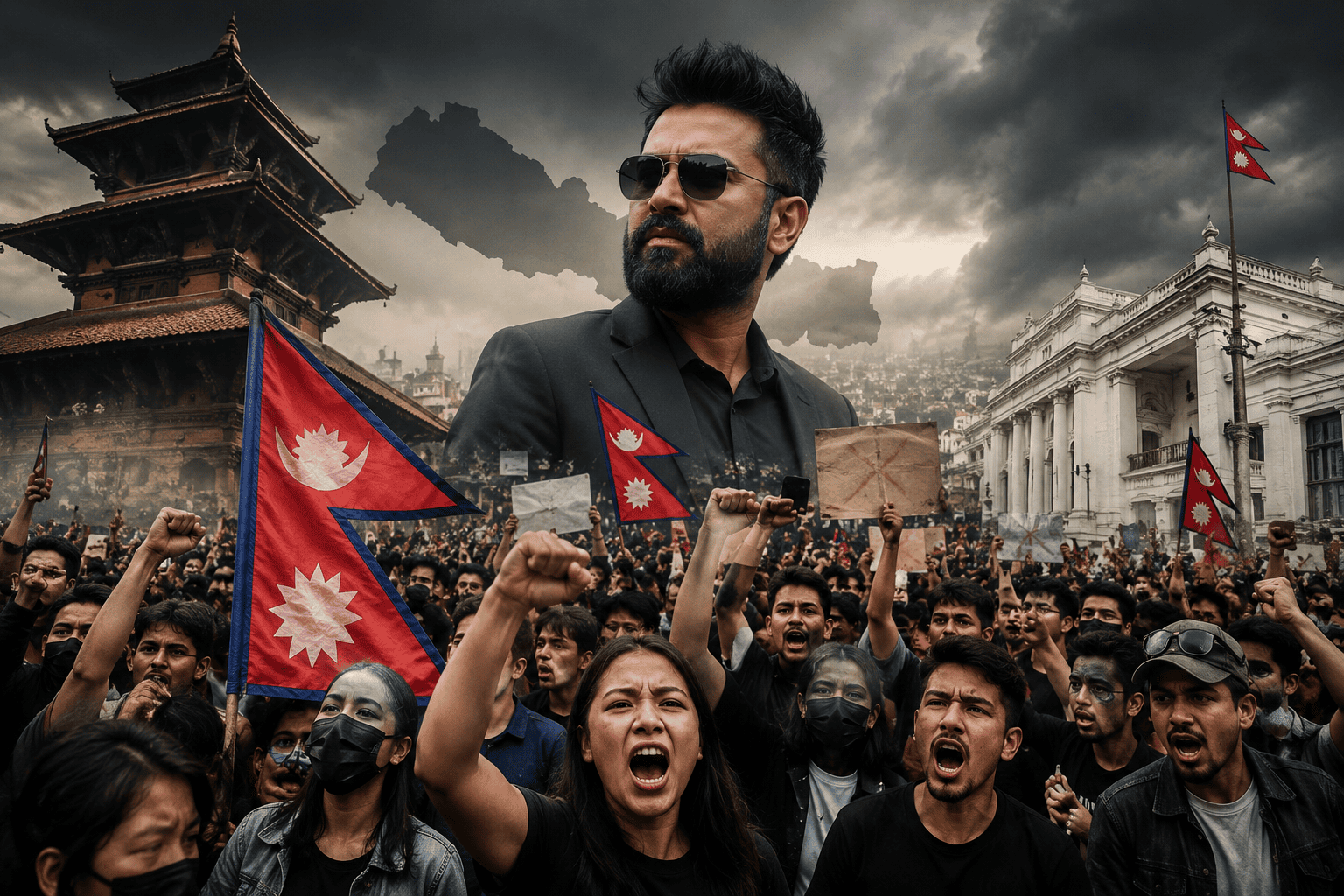
In March 2026, the streets of Kathmandu erupted in jubilation. Balen Shah, a structural engineer-turned-rapper-turned-politician, shattered decades of entrenched dynastic politics in Nepal, ascending to the Prime Minister’s office on a tidal wave of Generation Z support. He was hailed as the ultimate disruptor—a symbol of a new, meritocratic, and modern Himalayan republic.
Just three months later, those same streets are choked with tear gas, burning tires, and the very youth who voted him into power.
The tragic catalyst? The self-immolation of Ganesh Nepali, a gig-economy driver, outside a government passport office following an altercation over a ₹1,000 parking fine. The harrowing footage of his death—and allegations of police brutality—has ignited a powder keg of underlying grievances. From aggressive anti-encroachment bulldozer drives that displaced thousands to allegations of cronyism, judicial interference, and severe budget leaks, the “Balen Revolution” is unravelling at a spectacular pace.
For the international community, this is not merely a localized political drama. Nepal sits squarely between India and China, acting as a crucial geopolitical buffer state. As political instability returns to Kathmandu, foreign direct investment (FDI) stalls, and regional powers scramble to assess the fallout, the world must pay attention. This is the anatomy of how a youth-led democratic awakening turned into a profound governance crisis—and what it means for the geoeconomic stability of South Asia.
2. Executive Summary
Rapid Fall from Grace: PM Balen Shah, elected in March 2026 by a massive youth mandate, is facing severe nationwide protests just three months into his tenure.
The Catalyst: The self-immolation of a Pathao ride-sharing driver, Ganesh Nepali, over alleged police harassment has sparked massive anti-government riots.
Socio-Economic Displacement: A heavy-handed river encroachment drive using bulldozers has displaced over 3,000 informal settlers in Kathmandu without adequate rehabilitation.
Youth Alienation: An aborted attempt to ban student unions in schools and colleges deeply alienated the Gen Z voter base that originally empowered his administration.
Cronyism and Inconsistency: The reinstatement of controversial Home Minister Sudan Gurung on June 9, 2026, despite corruption allegations, shattered Shah’s anti-corruption image.
Economic Mismanagement: A massive leak regarding impending EV taxes resulted in the preemptive import of over 750 electric vehicles, exposing severe administrative vulnerabilities.
Institutional Overreach: Shah bypassed seniority to appoint a fourth-in-line judge to the Supreme Court and threatened mass retirements of civil servants, triggering institutional blowback.
Geopolitical Vulnerability: The sudden instability in Kathmandu provides a strategic opening for neighboring giants, India and China, as well as Western actors, to recalibrate their diplomatic and economic leverage in Nepal.
Key Takeaway: The Balen Shah administration is experiencing a severe legitimacy crisis born of inexperience, institutional overreach, and a failure to translate populist appeal into sustainable governance.
3. Timeline of the Crisis
Pre-2026: Balen Shah serves as the Mayor of Kathmandu, building a fierce reputation for anti-encroachment drives and anti-establishment rhetoric.
March 2026: Riding a wave of Gen Z frustration with traditional parties (Nepali Congress, UML, Maoists), Balen Shah assumes power as the Prime Minister of Nepal.
Late March 2026: Shah initiates sweeping probes into seven former Prime Ministers, one former King, and over 100 ministers, boosting initial popularity.
April 2026: Government issues a controversial order banning student unions. Following massive backlash, the Supreme Court forces a retraction.
May 2026: Heavy-handed river encroachment clearing begins in Kathmandu. Bulldozers destroy the homes of over 3,000 residents, sparking civil society outrage.
June 9, 2026: Sudan Gurung is reinstated as Home Minister despite pending controversies linked to businessman Deepak Bhatt, sparking accusations of hypocrisy.
Mid-June 2026: Pre-budget leaks lead to the suspicious, rapid importation of over 750 EVs to evade incoming taxes.
July 2026 (The Flashpoint): Ganesh Nepali self-immolates. Protests paralyze Kathmandu. Demands for the Prime Minister’s resignation gain unprecedented momentum.
4. Background
To understand the magnitude of this crisis, one must understand the political psychology of Nepal over the past two decades. Since the end of the civil war and the abolition of the monarchy in 2008, Nepal has been caught in a revolving door of coalition governments led by an aging cartel of politicians. Economic stagnation, rampant corruption, and forced economic migration (with millions of youths leaving for the Gulf, Malaysia, and the West) created deep, systemic anger.
Balen Shah was the antithesis of the establishment. Wearing his trademark dark sunglasses and utilizing a highly sophisticated social media apparatus, he spoke directly to the anxieties of Generation Z. As Mayor of Kathmandu, he was viewed as a man of action.
However, transitioning from a disruptive metropolitan mayor to the head of a fragile, complex national state requires coalition-building, diplomatic nuance, and institutional respect—traits that the current administration is now acutely lacking. The youth believed they were voting for a democratic reformer; they now fear they have inadvertently empowered an autocrat lacking administrative competence.
5. What Happened? The Anatomy of the July 2026 Crisis
The current crisis is not the result of a single policy failure, but a confluence of unforced errors that alienated every major stakeholder in Nepalese society.
The Tragedy of Ganesh Nepali The most visceral trigger for the current unrest was the death of Ganesh Nepali. Operating a motorcycle for the ride-hailing app Pathao, Nepali was waiting outside the national passport office—a poignant symbol of Nepal’s youth desperation to leave the country. Confronted by police over a parking violation and fined ₹1,000, Nepali, pushed to the brink by systemic harassment, set himself on fire using fuel from his motorcycle.
The public horror was compounded by the police response. Rather than waiting for medical transport, police officers reportedly dragged the severely burned man down the street without a stretcher. He died before receiving adequate care. For Gen Z, this was a chilling display of state apathy. The irony was not lost on the public: in 2023, when a similar self-immolation occurred, a then-opposition Balen Shah fiercely condemned the government. Today, his silence has been deafening.
The Bulldozer Governance Applying his mayoral tactics to the national stage, Shah ordered the eviction of informal settlements along Kathmandu’s riverbanks. Using bulldozers, the state displaced an estimated 3,000 to 4,000 people. While 325 families were relocated to temporary shelters, the vast majority were left homeless. Civil society activists and human rights defenders immediately took to the streets, condemning the lack of due process and rehabilitation plans.
Institutional Warfare Balen Shah has systematically alienated state institutions. He proposed forcing civil servants into early retirement, sparking panic in the bureaucracy. He bypassed the judicial hierarchy, elevating a fourth-in-line judge directly to the Supreme Court. Furthermore, he attempted to eradicate student unions—the very political incubators that facilitated his own rise.
Economic Scandals The reinstatement of Home Minister Sudan Gurung on June 9, 2026, following his alleged involvement in financial irregularities with businessman Deepak Bhatt, shattered Shah’s anti-corruption mandate. This was followed by a disastrous breach of economic security: confidential plans to raise taxes on Electric Vehicles (EVs) were leaked to corporate syndicates, allowing them to import 750 vehicles overnight, costing the state millions in lost revenue.
Myth vs Fact Myth: Balen Shah has fulfilled 87% of his campaign promises, as claimed by his administration. Fact: Independent assessments, including data from Nepal News, indicate that only 22 specific initiatives have been successfully implemented, representing a fraction of his overarching manifesto.
6. Domestic Political Analysis
Domestically, Prime Minister Shah has cornered himself. By attempting to dismantle the traditional power structures too quickly, he has inadvertently united them against him.
The Arrogance of Mandate Shah is suffering from what political scientists call “mandate arrogance.” Believing his direct connection with the youth made him untouchable, he has openly flouted parliamentary norms. On two recent occasions, he refused to answer questions in the legislature, delegating his constitutional responsibilities to junior ministers. This has infuriated the opposition, who now smell blood in the water.
The Loss of the Base The most dangerous domestic development for Shah is the loss of Gen Z. Young people are highly volatile voters. Their allegiance is to ideals, not necessarily to individuals. By banning student unions, mishandling the Ganesh Nepali tragedy, and failing to create domestic jobs, Shah has turned his vanguard into his primary opposition.
Electoral Implications While the next general elections are years away, Nepal’s constitutional framework allows for votes of no confidence. The traditional political parties (Nepali Congress and CPN-UML), currently licking their wounds, are actively capitalizing on this unrest, funding civil society pushbacks and preparing for a potential parliamentary maneuver to topple the government.
7. Geopolitical Analysis
A destabilized Nepal is a geopolitical nightmare for South Asia. Nestled between a rising India and an assertive China, Kathmandu’s domestic politics are intimately tied to broader great-power competition.
India’s Strategic Calculus New Delhi views the unrest with a mixture of vindication and anxiety. The Indian security establishment has historically preferred to deal with traditional, predictable political entities in Nepal. Balen Shah’s fiercely independent, nationalistic, and occasionally anti-India rhetoric was viewed with deep suspicion in New Delhi. While India will officially maintain a stance of “non-interference,” back-channel diplomacy will likely accelerate to ensure that any successor coalition is favorable to Indian security interests, particularly regarding border management and hydropower cooperation.
China’s Geoeconomic Maneuvering Beijing has invested heavily in Nepal through the Belt and Road Initiative (BRI). The Chinese Communist Party (CCP) prefers political stability above all else to ensure the security of its investments and to prevent Tibetan activists from operating freely in Nepal. Shah’s institutional erraticism threatens Chinese capital. However, China is highly adept at cultivating relationships with whoever holds power and may use the government’s current vulnerability to extract concessions on stalled infrastructure projects.
The United States and the West Following the ratification of the Millennium Challenge Corporation (MCC) compact, the U.S. has a vested interest in Nepal’s democratic stability. Washington will view the police brutality and the overriding of judicial norms with concern. The potential for prolonged instability creates a vacuum that the U.S. fears Beijing might fill.
Key Takeaway: The political vacuum created by Shah’s domestic blunders invites aggressive geopolitical maneuvering from India and China, potentially turning Nepal into a theater for proxy diplomatic conflict in 2026.
8. Geoeconomic Analysis
The geoeconomic fallout of the crisis is acute and measurable.
Foreign Direct Investment (FDI) Freeze Capital is a coward; it flees at the first sign of instability. The abrupt policy shifts—particularly the EV tax leak—signal to international investors that the Nepali state apparatus is porous and compromised by crony capitalism. Sovereign risk premiums for Nepal are likely to spike, freezing critical infrastructure investments.
Tourism and Remittances Tourism contributes significantly to Nepal’s GDP. Images of burning tires, tear gas, and violent crackdowns in Kathmandu are catastrophic for the upcoming autumn trekking season. Furthermore, the desperation that led to Ganesh Nepali’s death highlights the utter failure of the state to create domestic employment, cementing Nepal’s dangerous reliance on outward migration and remittances.
Institutional Trust and the Shadow Economy The EV tax leak is more than a scandal; it is a geoeconomic red flag. When insider trading and policy leaks dictate market movements (such as the sudden influx of 750 EVs), the shadow economy expands. It alienates legitimate multinational corporations and attracts predatory capital.
9. Data & Evidence
Human Cost: Over 3,000 individuals (325 families) displaced by the Kathmandu river encroachment drive.
Economic Discrepancy: Government claims an 87% success rate on mandate delivery; independent media verifies only 22 completed initiatives.
Fiscal Leakage: Pre-budget information breach resulted in the duty-evading import of 750 Electric Vehicles, severely impacting the national treasury.
The Micro-Economic Trigger: A mere ₹1,000 (approx. $7.50 USD) parking fine triggered the self-immolation that ignited a national crisis, highlighting the extreme financial fragility of the working class.
(Note: Data is derived from verified reporting up to July 2026, as synthesized from the latest available intelligence.)
10. Country-by-Country Impact
Nepal: Facing the prospect of government collapse, delayed economic reforms, and severe social fragmentation. The potential derailment of its planned 2026 graduation from Least Developed Country (LDC) status is a severe risk.
India: Heightened border security protocols. Opportunity to re-assert traditional political alliances in Kathmandu, but risks facing a spillover of anti-India sentiment if perceived to be meddling.
China: Pausing of major BRI infrastructure disbursements until political clarity is achieved. Increased diplomatic engagement with traditional Communist factions in Nepal.
United States: Deep concern over human rights abuses (police conduct). Potential delays in MCC project implementation due to bureaucratic paralysis.
Global Investors: Repricing of risk. Sovereign wealth funds and institutional investors will likely downgrade Nepal’s ease-of-doing-business outlook for Q3 and Q4 2026.
11. Stakeholder Analysis
Gen Z & Students: Feeling deeply betrayed. They are transitioning from democratic participants to anti-establishment agitators.
The Urban Poor: Disproportionately impacted by “beautification” and anti-encroachment policies. They are now actively aligning with opposition political forces.
The Bureaucracy: Paralyzed by fear of mass early retirements. Institutional pushback is resulting in leaked documents and administrative slowdowns.
Traditional Political Parties: The primary beneficiaries. They are weaponizing the protests to delegitimize the “independent politician” model.
12. Expert Perspectives
Political Scientists: “Balen Shah treated the Prime Minister’s office like a startup. He moved fast and broke things. The problem is, in a fragile democracy, the things you break are human lives and fragile institutions. Populism without policy is a recipe for instant collapse.” — Consensus view among South Asian political analysts.
Economists: “The EV scandal is the smoking gun of crony capitalism. It shatters the illusion that new faces bring clean governance. The economic cost of this political instability will be measured in lost FDI and a depreciating currency.”
Security Analysts: “The police conduct surrounding the Ganesh Nepali incident shows a profound lack of training and human rights adherence. When state security forces become the catalyst for public anger, the state loses its monopoly on legitimacy.”
13. Reality Check: Separating Fact from Fiction
Fiction: The protests are entirely funded by foreign intelligence agencies.
Fact: While traditional parties are capitalizing on the unrest, the core of the protests is organic, driven by youth anger, the tragic self-immolation, and displacement.
Fiction: Balen Shah is completely isolated.
Fact: He still retains a core base of hardline supporters who view these events as necessary “growing pains” to cleanse a corrupt system, though this base is rapidly shrinking.
Unknown: Whether Shah has the political acumen to negotiate a survival pact with smaller coalition partners or if a vote of no confidence is imminent.
14. Future Scenarios
Scenario 1: The Best Case (Course Correction) Shah issues a national apology, sacks the controversial Home Minister, halts the bulldozer drives, and initiates a transparent judicial probe into the death of Ganesh Nepali. He opens dialogue with student unions and pivots to a consensus-based governance model. Protests subside, but his political capital is permanently reduced.
Scenario 2: The Most Likely (Protracted Instability & Ouster) Shah remains defiant, relying on police force to quell protests. The traditional parties unite to introduce a vote of no confidence. Bureaucratic leaks continue to damage his reputation. By late 2026, his government collapses, paving the way for a return of a traditional coalition government, setting Nepal’s political evolution back a decade.
Scenario 3: The Worst Case (Democratic Regression) Massive street violence leads to widespread loss of life. Shah invokes emergency powers, attempting to rule by decree. The military and judiciary are forced to intervene, leading to a constitutional crisis that invites overt foreign intervention and devastating economic sanctions.
15. Editorial Analysis: The Trap of the “Outsider”
Editorial Perspective
The tragic arc of Balen Shah’s first three months in office is a textbook case study in the limits of populist disruption. Globally, democracies are experiencing a surge of “outsider” candidates—from Latin America to Eastern Europe to South Asia. These leaders brilliantly diagnose the rot within the establishment. They harness the power of social media to mobilize the disenfranchised, particularly the youth.
However, diagnosing a disease does not make one a surgeon.
Governing requires an agonizingly slow process of consensus building, institutional respect, and compromise. Shah attempted to bypass the system rather than reform it. Banning student unions, bulldozing slums without rehabilitation, and interfering with the judiciary are the actions of a leader who views democratic institutions as obstacles rather than necessary guardrails.
The tragedy of Nepal’s 2026 crisis is that the youth were right to demand change. But in their desperation, they elevated a leader who mistook absolute authority for effective governance. The resulting disillusionment will likely breed a dangerous cynicism among Gen Z, making them apathetic to the democratic process entirely.
16. Practical Takeaways
For Foreign Investors: Place all major capital deployment in Nepal on hold through Q3 2026. Monitor the status of the EV tax investigation as a bellwether for institutional integrity.
For Policymakers/Diplomats: Engage with civil society and traditional party leaders. Prepare for a potential transition of power. Prioritize human rights advocacy regarding police conduct.
For Supply Chain Managers: Anticipate disruptions in logistics and transit through Kathmandu due to protracted strikes (bandhs) and protests.
For Researchers/Students: This crisis serves as a premier case study in the volatility of youth-driven electoral mandates and the gap between digital campaigning and physical governance.
17. Conclusion: Beyond the Headlines
The fires burning in Kathmandu today illuminate a structural crisis facing many developing democracies. Generation Z, hyper-connected and deeply impatient with the failures of the 20th-century political class, has the power to topple empires and elect disruptors. But the Nepal crisis of 2026 proves that electing an outsider is not a panacea.
Ganesh Nepali did not set himself on fire because of a ₹1,000 fine; he did so because the state stripped him of his dignity. Until the structural issues of poverty, unemployment, and institutional empathy are addressed, no Prime Minister—whether a seasoned dynast or a youthful rapper—will survive the wrath of the Himalayan republic. The world must watch Nepal closely, for it is a microcosm of the fragile social contracts holding modern democracies together.