1. Introduction
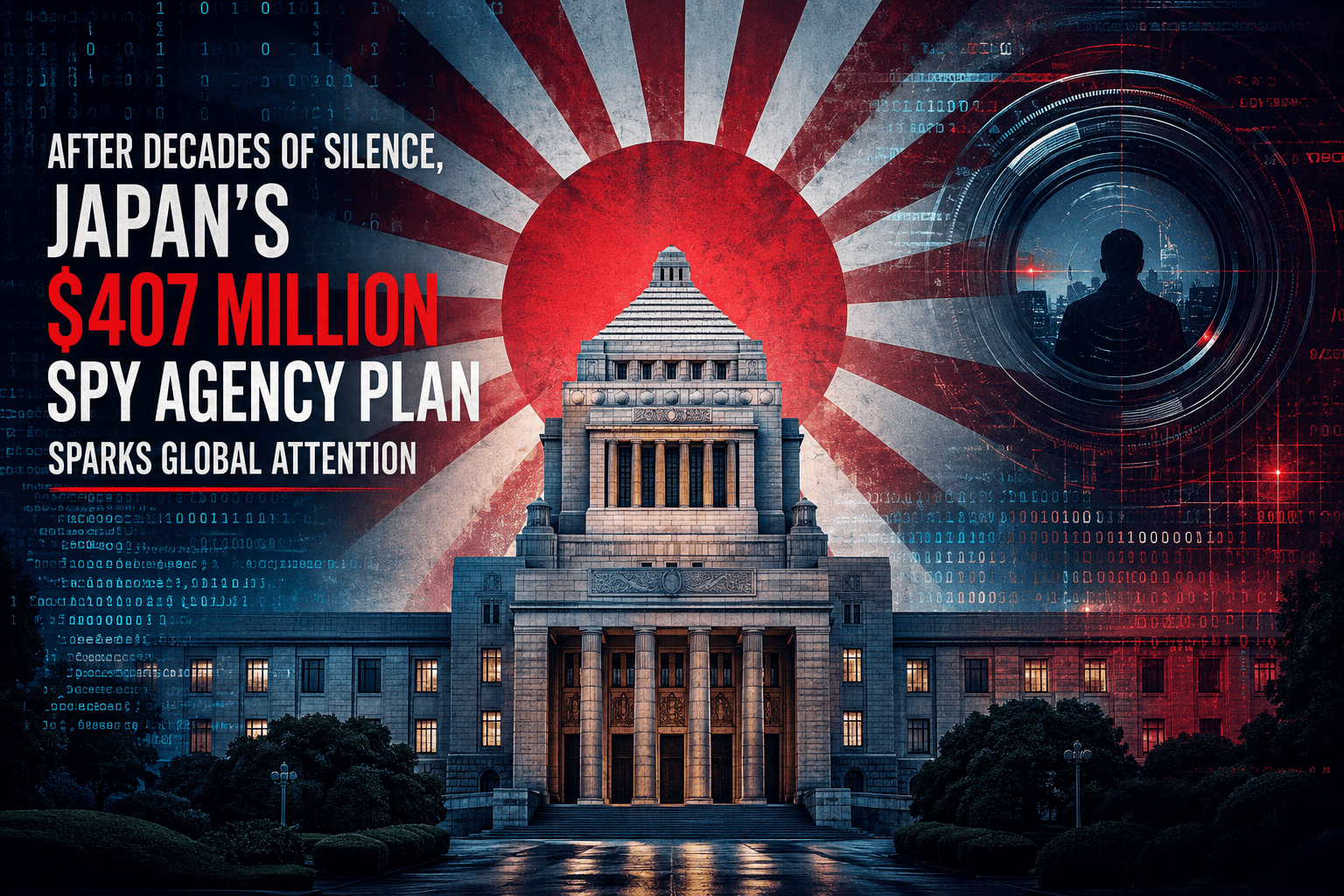
In the hushed corridors of global intelligence, a seismic shift has quietly unfolded. For eight decades following the devastation of World War II, Japan strictly adhered to a pacifist constitution, deliberately crippling its own capacity for foreign espionage. Yet, in the summer of 2026, Tokyo abruptly abandoned this self-imposed exile from the shadow wars. Prime Minister Sanae Takaichi’s government has formalized a $407 million (approx. 4,000 crore INR) initiative to build Japan’s first modern, centralized intelligence apparatus—comprising the National Intelligence Council and the National Intelligence Bureau.
Why now? The catalyst was not merely regional posturing by Beijing or Pyongyang. Rather, it was a quiet, alarming discovery in the ruins of Ukraine: advanced Japanese electronic components were found embedded in Russian ballistic missiles. Exploiting Japan’s lack of counter-espionage infrastructure, foreign agents had turned the island nation into a frictionless procurement hub for the Kremlin’s war machine. Coupled with immense pressure from a demanding administration in Washington, Tokyo realized that in the 21st century, a nation without eyes in the shadows is a nation entirely exposed. For policymakers, investors, and defense analysts in Washington, London, and Brussels, Japan’s strategic awakening is the most consequential Indo-Pacific development of the decade.
2. Executive Summary
Historic Reversal: After 80 years of constitutional pacifism, Japan is establishing a centralized foreign and domestic intelligence agency.
The Investment: The initial operational budget is explicitly set at $407 million to launch the National Intelligence Council and National Intelligence Bureau.
The Catalyst: Western intelligence discovered Japanese technological components in Russian missiles in Ukraine, exposing Japan as a critical vulnerability in global sanctions enforcement due to a lack of counter-intelligence.
Geopolitical Drivers: Sustained pressure from the United States (demanding greater allied burden-sharing), the rising multipolar threat of a militarized China, a nuclear North Korea, and a hostile Russia.
Legislative Speed: The legislation moved with unprecedented velocity—approved in March 2026, passed the lower house in April, cleared the upper house on May 27, and launched operations in July 2026.
Allied Support: Germany and Australia are actively assisting Tokyo in architecting this new espionage framework.
Geoeconomic Impact: The move secures vital supply chains, tightly regulating the export of dual-use technologies, semiconductors, and critical minerals.
Global Security Integration: This places Japan on a trajectory to seamlessly interface with Western intelligence networks like the “Five Eyes” alliance.
Key Takeaway: Japan is no longer solely relying on the U.S. security umbrella for its situational awareness. By launching a centralized intelligence agency, Tokyo is taking sovereign control over its national security narrative.
3. Timeline of Intelligence Modernization (2026)
| Date | Milestone | Geopolitical Significance |
| Pre-2026 | Discovery of Japanese components in Russian missiles in Ukraine. | Exposes severe vulnerabilities in Japan’s counter-espionage framework. Western allies apply pressure. |
| March 2026 | Draft legislation for a centralized intelligence agency approved by the Cabinet. | Marks the definitive end of the “Information Pacifism” era. |
| April 2026 | Bill passes the Lower House of the National Diet. | Demonstrates strong domestic political consensus against external threats. |
| May 27, 2026 | Bill officially clears the Upper House. | Legal framework cemented; $407M budget allocated. |
| July 2026 | Formal operational launch of the National Intelligence Council and Bureau. | Japan officially enters the global intelligence community as an active participant. |
4. Historical Background
To understand the magnitude of this $407 million investment, one must look backward. Prior to and during World War II, Japan operated a highly feared secret police apparatus known as the Tokubetsu Kōtō Keisatsu (Special Higher Police, or Tokko). The Tokko were ruthless, suppressing political dissidents, journalists, and ordinary citizens under the guise of national security. The trauma inflicted by this domestic repression created a deep-seated, generational revulsion among the Japanese populace toward secret government agencies.
Following its defeat in 1945, Japan adopted a new constitution in 1947. Under the famous Article 9, the nation renounced the sovereign right to belligerency and the maintenance of armed forces with offensive capabilities. Concurrently, it dismantled its intelligence apparatus, handing the reins of its strategic security to the United States. For 80 years, Japan existed in an artificial bubble of “information pacifism,” relying heavily on the CIA and allied intelligence for foreign threat assessment, while utilizing fragmented, low-profile domestic offices (like the Cabinet Intelligence and Research Office) purely for inter-departmental coordination rather than active espionage.
5. What Happened? The 2026 Pivot
In an era of hyper-competition, Prime Minister Sanae Takaichi spearheaded the legislative push to fundamentally alter Japan’s intelligence posture.
What has been officially confirmed?
The Japanese Diet has legally established two new pillars: the National Intelligence Council (focused on strategic assessment and international coordination) and the National Intelligence Bureau (focused on active intelligence gathering and counter-espionage operations). A starting budget of $407 million has been allocated. Germany and Australia have been confirmed as international partners assisting in the structural formation and training of these units.
Why now?
The immediate trigger was glaring international embarrassment. Following the Russian invasion of Ukraine, Western sanctions aimed to choke Moscow’s access to high-tech components. However, Russian operatives exploited Japan’s lack of counter-intelligence oversight. Without an agency to track foreign spies on Japanese soil, Russian agents successfully procured advanced Japanese microelectronics and funneled them into their missile programs. When these Japanese-made components were recovered from the battlefields of Ukraine, Tokyo faced intense diplomatic pressure to plug the leak.
Simultaneously, political shifts in Washington changed the calculus. With Donald Trump demanding extreme financial and operational burden-sharing from U.S. allies—effectively holding the U.S. security umbrella hostage to financial contributions—Japan realized that outsourcing its intelligence to a transactional Washington was a catastrophic risk.
Did You Know? The Japanese passport frequently ranks in the top 3 globally on the Henley Passport Index. Experts warn that as Japan begins deploying intelligence officers overseas, this frictionless, visa-free travel could face intense scrutiny from adversarial nations.
6. Deep Geopolitical Analysis
Japan’s intelligence renaissance drastically alters the balance of power in the Indo-Pacific and beyond.
Great Power Rivalry and the U.S. Alliance
Historically, the U.S.-Japan alliance was described as the “shield and spear” (Japan as the defensive shield, the U.S. as the offensive spear). The creation of a foreign intelligence agency means Japan is forging its own conceptual spear. While this theoretically reduces Washington’s burden, it also gives Tokyo the capability to independently verify U.S. intelligence, potentially leading to sovereign foreign policy decisions that may not always perfectly align with Washington’s immediate interests.
Countering the Triad of Threats (China, Russia, North Korea)
Japan sits at the geographical nexus of three nuclear-armed adversaries:
China: Beijing’s rapid naval expansion and opaque military intent require active human intelligence (HUMINT) and signals intelligence (SIGINT) to penetrate the veil of the CCP.
North Korea: Pyongyang’s unpredictable ballistic missile testing over the Sea of Japan necessitates pre-emptive, actionable intelligence rather than reactive radar tracking.
Russia: The Kuril Islands dispute and Moscow’s aggressive covert procurement networks demand a robust domestic counter-intelligence shield.
Integration into Western Networks
By relying on Australia and Germany to structure its agency, Japan is signaling a desire to seamlessly interface with European and Indo-Pacific intelligence architectures. This is a critical stepping stone toward formal integration into the “Five Eyes” network (potentially making it the “Six Eyes”), expanding the democratic world’s blind-spot coverage in East Asia.
7. Deep Geoeconomic Analysis
Intelligence is no longer strictly about troop movements; it is about supply chains, intellectual property, and capital flows.
Supply Chain Security and Technology Protection
Japan remains a global titan in semiconductor manufacturing equipment, robotics, and advanced materials. The new National Intelligence Bureau will act as a corporate shield. By monitoring foreign operatives attempting to set up front companies or infiltrate Japanese tech giants, the agency will protect proprietary dual-use technologies from bleeding into the military industrial bases of Beijing or Moscow.
Impact on FDI and Capital Markets
For international investors, this is a double-edged sword. On one hand, a secure Japan is a safe haven for capital. Foreign Direct Investment (FDI) in Japanese tech sectors will benefit from reduced IP theft. On the other hand, corporate due diligence will become drastically more stringent. Foreign executives and companies operating in Japan will likely face unprecedented, quiet background checks.
Currency and Trade Diplomacy
Economic coercion has become a favored weapon of statecraft. Japan’s new intelligence apparatus will likely feature a strong geoeconomic division tasked with forecasting hostile tariffs, supply chain embargoes (such as Rare Earth mineral restrictions by China), and currency manipulation, giving the Bank of Japan and the Ministry of Economy, Trade and Industry (METI) critical lead time to react.
8. Intelligence & National Security Analysis
Building an intelligence agency from scratch in the 21st century is a Herculean task fraught with operational hazards.
The Counter-Intelligence Imperative
Japan’s immediate priority is defensive: flushing out foreign agents operating within its borders. For decades, foreign intelligence officers operated with near-impunity in Tokyo, often under the guise of diplomats, technical analysts, or journalists. The new agency will systematically map and dismantle these networks, closing the loopholes that allowed Russian military-industrial procurement.
The HUMINT Challenge
While Japan has excellent technological capabilities (satellites, cyber), Human Intelligence (HUMINT) takes decades to cultivate. Deploying Japanese operatives abroad poses severe risks. If a Japanese operative is captured in a hostile nation, the resulting diplomatic fallout could be disastrous for a government unaccustomed to the cynical realities of spy swaps and deniability.
Information Warfare and Cyber Resilience
Adversaries will undoubtedly launch massive disinformation campaigns aimed at the Japanese public, attempting to equate the new agency with the brutal World War II-era Tokko police, thereby eroding domestic political support. The new agency must engage in aggressive, yet transparent, public relations to maintain its democratic legitimacy.
9. Data & Evidence
Note: All figures are based on official legislative announcements as of Mid-2026.
Key Figures at a Glance
Initial Budget Allocation: $407 Million USD
Legislation Passed: May 27, 2026
Operational Start: July 2026
Structure: Bifurcated (National Intelligence Council for strategy; National Intelligence Bureau for operations).
Analysis of the Budget: While $407 million is a relatively modest sum compared to the U.S. CIA’s classified multi-billion-dollar black budget, it represents purely the organizational and operational seed capital. It does not include the pre-existing military satellite budgets or cyber defense budgets, which run into the tens of billions.
10. Global Comparison
How does Japan’s nascent agency compare to established global heavyweights?
| Agency / Country | Primary Focus | Operational Style | Historical Advantage |
| CIA (USA) | Global Covert Action, HUMINT, Analysis | Highly aggressive, heavily funded, global reach. | 70+ years of institutional architecture. |
| MI6 (UK) | Foreign Intelligence, Cyber, HUMINT | Surgical, highly integrated with global allies. | Deep historical ties, exceptional tradecraft. |
| RAW (India) | Regional dominance, Counter-terrorism | Covert action, deep regional penetration. | Battle-tested in continuous sub-continental conflicts. |
| Mossad (Israel) | Targeted operations, Counter-proliferation | Ruthless, pre-emptive, technologically elite. | Absolute existential imperative driving risk tolerance. |
| FSB/SVR (Russia) | Subversion, Assassination, Disinformation | Hybrid warfare, highly aggressive on foreign soil. | State-backed integration with organized crime and cyber. |
| NIB/NIC (Japan) | Counter-espionage, Tech-security, SIGINT | Nascent, legally constrained, tech-heavy. | Unmatched domestic technology infrastructure. |
5 Quick Facts:
Japan’s Article 9 previously deterred intelligence gathering.
The $407M budget is just the foundational “seed” money.
Australian and German intelligence are providing operational blueprints.
Japanese electronics in Russian missiles accelerated this policy shift.
PM Sanae Takaichi managed to pass the bill in just 4 months.
11. Stakeholder Analysis
Governments & Allies (US, UK, Europe, India):
Allied nations view this overwhelmingly positively. A Japan that can police its own technological exports and contribute hard intelligence on Chinese naval movements is a massive asset to the Quad and NATO-aligned democracies.
Competitors & Adversaries (China, Russia, North Korea):
Beijing and Moscow will view this as a provocative escalation, likely framing it as a resurgence of Japanese imperialism. Expect increased cyber-attacks on Japanese infrastructure in an attempt to cripple the agency before it fully matures.
Global Businesses & Defense Contractors:
Defense contractors (Lockheed Martin, BAE Systems, Mitsubishi Heavy Industries) will see a surge in contracts for secure communications, biometric databases, and SIGINT hardware. Conversely, multinational corporations operating in Japan will face tighter regulations regarding personnel data and dual-use technology exports.
12. Expert Perspectives
Intelligence Historians: Point out the psychological hurdle Japan has overcome. Overcoming the trauma of the Tokko requires the government to embed strict, transparent parliamentary oversight into the new agency to prevent domestic abuse.
Geoeconomic Analysts: Emphasize that the primary immediate value of this agency will be economic security—preventing the bleeding of Japanese IP into the Chinese military-industrial complex.
Defense Strategists: Note that this is the final nail in the coffin of the post-WWII order. Japan is normalizing its posture to match its economic weight.
13. Reality Check: Fact vs. Myth
| Myth | Verified Fact |
| Japan is preparing for an offensive war. | Japan is creating a defensive counter-intelligence and strategic assessment unit to protect its sovereignty. |
| The CIA will run the new Japanese agency. | While allied, Tokyo is explicitly creating this to reduce over-reliance on Washington, maintaining sovereign control. |
| This violates the Japanese Constitution. | Intelligence gathering is not belligerency. Legal scholars have cleared the agency under the mandate of self-defense. |
| The budget is massive. | At $407M, it is actually a highly conservative, lean startup budget compared to global peers. |
14. Scenario Analysis
Base-Case Scenario (Most Likely):
The agency spends the next 3 to 5 years heavily focused on domestic counter-espionage, expelling embedded Russian and Chinese operatives. Japan becomes a trusted intelligence-sharing partner, likely gaining observer status or full entry into the Five Eyes network by 2030.
Best-Case Scenario:
The agency rapidly successfully integrates advanced AI and quantum computing into its SIGINT capabilities, becoming the world’s premier technological intelligence gatherer in the Indo-Pacific, acting as the ultimate early-warning system against North Korean and Chinese aggression without escalating regional tensions.
Worst-Case Scenario:
Inexperienced Japanese operatives are compromised abroad, leading to humiliating diplomatic incidents. Concurrently, domestic political opposition seizes on a privacy scandal, paralyzing the agency with red tape and returning Japan to a state of information blindness.
15. Future Outlook: What to Watch Next
Recruitment and Vetting: Watch how Japan recruits. Will they draw purely from the military (JSDF) and police, or will they actively recruit from the private tech sector and academia?
The Henley Passport Index: Keep an eye on whether adversarial nations begin revoking visa-free access for Japanese citizens out of paranoia over embedded spies.
Diplomatic Expulsions: In the coming 12-18 months, expect a sudden, quiet exodus of “diplomats” from the Russian and Chinese embassies in Tokyo as the new National Intelligence Bureau flexes its counter-espionage muscles.
16. Editorial Perspective (Evidence-Based Analysis)
Editorial Note: The following represents institutional analysis based on current geopolitical trajectories.
Japan’s decision to build a $407 million intelligence agency is not merely a policy shift; it is a profound psychological maturation of a nation. For too long, Tokyo enjoyed the economic benefits of globalism while outsourcing the dirty, vital work of national security to Washington. The discovery of Japanese technology inside Russian weapons used against Ukrainians was a stark moral awakening: willful blindness is a form of complicity.
Prime Minister Sanae Takaichi’s government has made the correct, albeit difficult, calculation. In an era where authoritarian states weaponize everything from microchips to social media, a democracy without a shield is merely waiting to be dismantled. However, the true test will not be in the establishment of the agency, but in its governance. Japan must balance ruthless external efficiency with ironclad internal oversight to ensure the ghosts of the Tokko remain permanently in the past.
17. Practical Takeaways
For Investors: Tighter regulations are coming to Japanese tech and manufacturing sectors. Ensure your supply chains and export compliance regarding dual-use technologies are flawless.
For Policymakers in the West: Japan is stepping up. This is the time to deepen intelligence-sharing protocols and offer advanced tradecraft training to ensure interoperability.
For the General Public: The era of a purely pacifist Japan relying entirely on the U.S. is over. We are watching the birth of a fully normalized, muscular democratic power in Asia.
18. Conclusion
After 80 years of self-imposed silence, the activation of Japan’s National Intelligence Council and Bureau in July 2026 represents a geopolitical earthquake. Driven by the urgent need to protect its technological sovereignty from Russian and Chinese exploitation, and spurred by the unpredictability of its American ally, Tokyo has crossed the Rubicon. The $407 million investment is small in monetary terms, but its implications for global power competition, supply chain security, and the balance of power in the Indo-Pacific are immeasurable. The shadows of the international arena just gained a formidable new player.