1. Introduction
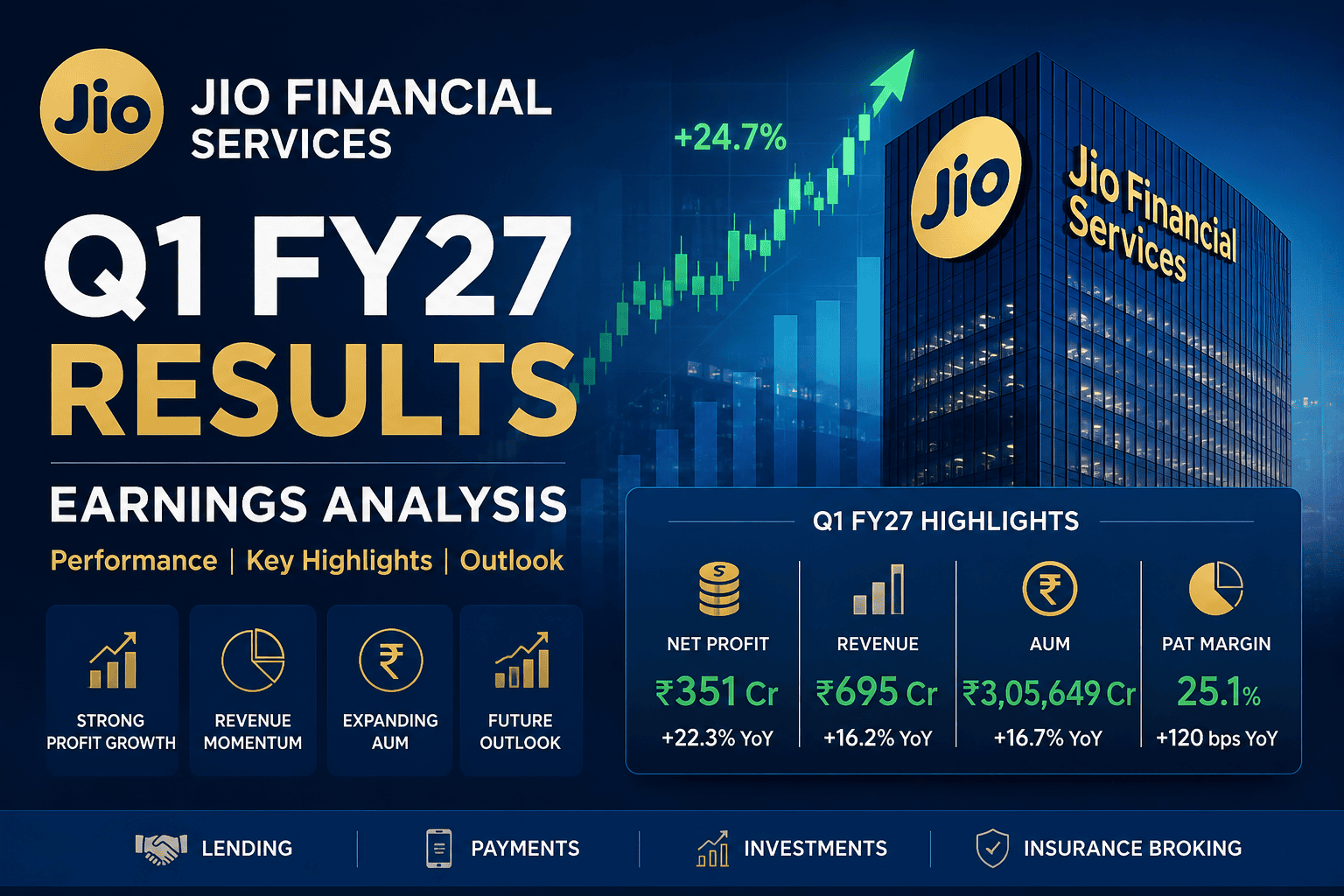
The Q1 FY27 financial results of Jio Financial Services Limited (JFSL) represent a significant operational and financial inflection point. For a company long regarded as a well-capitalized shell with immense potential, this quarter showcases the tangible execution of a multi-pronged, tech-driven financial ecosystem. JFSL’s strategic shifts—from capital aggregation to rapid product rollouts and key corporate restructurings—are visibly materializing in the profit and loss statement.
The headline numbers speak volumes: Consolidated Revenue from Operations expanded to ₹2,004.47 crore, while Profit After Tax (PAT) registered a 156% Year-on-Year (YoY) surge to ₹830.25 crore. The market’s reception of these disclosures reflects a transition from pricing pure “option value” to assessing core execution metrics across lending, payments, and wealth management. For Indian equity investors, JFSL’s metrics provide an entry point into analyzing the playbook of a digital-first, corporate-backed financial heavyweight aiming to disrupt traditional finance.
2. Executive Summary
Topline Expansion: Consolidated revenue from operations reached ₹2,004.47 crore for Q1 FY27, up significantly from ₹612.46 crore in the corresponding quarter of the previous fiscal year.
Bottomline Surge: Profit After Tax (PAT) stood at ₹830.25 crore, absolute growth of 156% YoY driven by scaling lending volumes and robust treasury performance.
Operational Turnaround: Key digital-facing business units—Jio Payments Bank Limited (JPBL) and Jio Payment Solutions Limited (JPSL)—attained functional and operational turnarounds during the quarter.
Lending Momentum: Jio Credit Limited (the lending arm) grew its Assets Under Management (AUM) by 2.6x YoY to reach ₹30,667 crore.
Promoter Capital Infusion: The company received the second tranche of ₹5,934.38 crore from promoter group entities, taking the total cumulative equity infusion via warrant conversions to ₹9,890 crore.
Asset Management Growth: The asset management joint venture with BlackRock grew its sequential closing AUM by 21% to ₹18,412 crore.
Insurance Joint Venture Milestones: Incorporating Jio Allianz General Insurance Limited (JAGIL) alongside structural milestones in Allianz Jio Reinsurance Limited establishing market presence.
Corporate Restructuring: Petroleum Trust distributed its holdings, establishing Reliance Services and Holdings Limited (RSHL) as a wholly owned step-down subsidiary.
3. Company Snapshot
Jio Financial Services Limited operates as a Core Investment Company (CIC) registered with the Reserve Bank of India (RBI). Its corporate purpose centers on commanding a full-stack digital financial delivery environment spanning credit, payments, protection, and investments.
                    Jio Financial Services Limited (CIC)
                                     │
         ┌───────────────────────────┼───────────────────────────┐
  Subsidiaries (100% owned)     Joint Ventures (50:50)      Joint Ventures (50:50)
  ─────────────────────────     ──────────────────────      ──────────────────────
  • Jio Credit Ltd              • Jio BlackRock AMC         • Allianz Jio Reinsurance
  • Jio Insurance Broking       • Jio BlackRock Wealth      • Jio Allianz General Ins.
  • Jio Payment Solutions       • Jio BlackRock Broking
  • Jio Payments Bank
  • Reliance Services & Holdings
Institutional Metrics
Promoter and Promoter Group Shareholding: Rose from 47.12% to 49.13% post the execution of warrant choices.
Core Strategic Units: Jio Credit Limited, Jio Insurance Broking Limited, Jio Payment Solutions Limited, Jio Leasing Services Limited, Jio Finance Platform and Service Limited, and Jio Payments Bank Limited.
Strategic Joint Ventures: 50:50 structural setups with BlackRock (Asset Management, Wealth Management, and Broking) and Allianz Group (Reinsurance and General Insurance).
4. Quarter at a Glance
The consolidated and standalone disclosures indicate rapid growth across revenue sources:
Key Consolidated Financial Metrics (₹ in Crore)
| Financial Metric | Q1 FY27 (Unaudited) | Q4 FY26 (Audited) | Q1 FY26 (Unaudited) | YoY Change (%) | QoQ Change (%) |
| Interest Income | 961.58 | 642.50 | 362.66 | 165.17% | 49.66% |
| Dividend Income | 508.59 | – | 268.97 | 89.09% | N/A |
| Fees & Commission | 324.54 | 221.36 | 53.58 | 505.71% | 46.61% |
| Net Fair Value Gains | 209.76 | 154.66 | 106.02 | 97.85% | 35.63% |
| Total Revenue from Ops | 2,004.47 | 1,018.51 | 612.46 | 227.28% | 96.80% |
| Total Expenses | 1,015.81 | 719.99 | 280.51 | 262.13% | 41.09% |
| Profit Before Tax (PBT) | 969.68 | 338.53 | 418.97 | 131.44% | 186.44% |
| Profit After Tax (PAT) | 830.25 | 272.22 | 324.66 | 155.73% | 205.00% |
| Basic & Diluted EPS (₹) | 1.27 | 0.43 | 0.51 | 149.02% | 195.35% |
5. Financial Performance Analysis
Topline Analysis and Operational Leverage
The total revenue from operations exhibits diversification away from standard treasury-centered returns toward transactional income. Interest income expanded 165% YoY to ₹961.58 crore, underscoring the compounding expansion of the internal lending books. Crucially, fees, commission, and other operational service components scaled to ₹324.54 crore from ₹53.58 crore in Q1 FY26, emphasizing core customer monetization.
Expense Architecture and Margin Constraints
Total operational outflows scaled to ₹1,015.81 crore. The cost configuration reveals target-oriented expenditures across digital ecosystems:
Finance Costs: Advanced to ₹418.33 crore, reflecting increasing institutional leverage needed to fuel credit assets.
Employee Outlays: Increased to ₹151.95 crore from ₹63.68 crore YoY, highlighting active organizational investments in technology, data analytics, and operational management talent.
Other Expenses: Stood at ₹411.45 crore, primarily tracking onboarding investments, merchant acquisition outlays, and programmatic tech developments.
Consolidated Expense Breakdown (Q1 FY27)
┌───────────────────────────────────────────────┐
│ Finance Costs (41.2%)                         │
├───────────────────────────────────────────────┤
│ Other Expenses (40.5%)                        │
├───────────────────────────────────────────────┤
│ Employee Benefits (15.0%)                     │
├───────────────────────────────────────────────┤
│ Impairment & Depreciation (3.3%)              │
└───────────────────────────────────────────────┘
The underlying business model demonstrates strong operating leverage: despite infrastructure outlays, the platform generated ₹969.68 crore in pre-exceptional PBT, signaling robust structural conversion.
6. Segment-wise Performance
Consolidated Segment Analysis (₹ in Crore)
| Segment Type | Revenue (Q1 FY27) | Revenue (Q1 FY26) | PAT (Q1 FY27) | PAT (Q1 FY26) | Assets (June 30, 2026) | Liabilities (June 30, 2026) |
| Investing | 981.73 | 336.25 | 758.75 | 212.96 | 1,36,441.18 | 9,884.90 |
| Lending | 698.08 | 251.49 | 106.50 | 80.59 | 36,199.35 | 27,535.41 |
| Others | 357.91 | 65.49 | (35.00) | 31.11 | 3,067.15 | 1,068.66 |
| Gross Total | 2,037.72 | 653.23 | 830.25 | 324.66 | 1,75,707.68 | 38,488.97 |
Insights by Corporate Segment
Investing Segment: Remains the anchor of the balance sheet, managing capital distributions and core reserves. Segment revenue reached ₹981.73 crore with net segment earnings at ₹758.75 crore.
Lending Segment: Revenue grew to ₹698.08 crore, supported by a 2.6x YoY advancement in total corporate assets to ₹36,199.35 crore. Segment profits increased to ₹106.50 crore.
Others Segment: Spanning insurance distribution, digital infrastructure payments, and banking, this segment posted revenue of ₹357.91 crore. It recorded a minor net segment loss of ₹35.00 crore, reflecting foundational outlays across customer acquisition loops.
7. Key Management Commentary & Strategic Priorities
Ecosystem Advancements via the JioFinance App
Management highlighted the continuous development of the JioFinance app, which currently registers 25 million unique users. The application functions as an AI-native ecosystem featuring conversational “Neural Agentic Marketplaces” operating across 7 languages, driven by 16 unique AI agents and 10 machine learning variants. Customer engagement metrics indicate steady monetization, with product purchases averaging approximately 34,000 units daily in June 2026.
Focus on Capital Efficiency
CEO Hitesh Sethia focused his outlook on structural execution, stating:
“The sustained business momentum across our verticals validates the granular architecture of our full-stack ecosystem and the strength of our execution. By strategically integrating AI and data analytics, we have unlocked significant efficiency gains across the value chain.”
Management remains committed to investing capital into early-stage joint ventures (BlackRock and Allianz setups) while ensuring the lending segment focuses on sustainable unit economics rather than growth at any cost.
8. Financial Ratio Analysis
Asset Quality and Capital Composition
Consolidated Net Worth Base: Total Shareholders’ Equity stood at ₹1.37 lakh crore as of June 30, 2026, supported by the modern liquidity buffers derived from promoter transactions.
Lending Yield Profiles: Annualized credit outcomes indicate expanding Net Interest Income (NII) trends up 118% YoY to ₹257 crore for Jio Credit Limited, showcasing controlled cost-of-funds interfaces.
Leverage Metric Calculations: Consolidated liabilities to consolidated assets sit at a conservative 21.90% ($\frac{38,488.97}{1,75,707.68}$), providing ample headroom to raise institutional debt and drive balance sheet expansion.
9. Industry Comparison & Competitive Positioning
JFSL presents a unique business model that challenges direct comparison with standard NBFCs (e.g., Bajaj Finance) or digital payment networks (e.g., Paytm):
Capital Security: With a net worth base exceeding ₹1.37 lakh crore, JFSL possesses unmatched capital buffers compared to most domestic peer institutions.
Acquisition Efficiencies: Leveraging the broader Jio distribution architecture allows JFSL to achieve significantly lower customer acquisition costs (CAC) relative to traditional banking systems.
Asset Management Strategies: Collaborating with BlackRock facilitates rapid scalability across index, systematic, and specialized institutional long-short products. Sequential AUM expanded 21% this quarter to ₹18,412 crore.
10. Technical Analysis Insights
The following considerations track technical indicators and represent probabilistic assessment metrics rather than definitive price movements.
   Resistance 2: ₹385
   Resistance 1: ₹368
   ════════════════════════════════ CURRENT PRICE AREA
   Support 1:    ₹342
   Support 2:    ₹320
Core Distribution Patterns: The equity exhibits structural accumulation bases above historical moving averages (50-DMA and 200-DMA frameworks).
Momentum Metrics: Relative Strength Index (RSI) profiles hover around 58–62, pointing to constructive consolidation without extended overbought conditions.
Key Levels to Monitor: Immediate key technical support resides at ₹342, while strong resistance concentrations appear near the ₹368 and ₹385 price levels.
11. Shareholding & Institutional Matrix
Capital Structuring via Warrant Conversions
On April 21, 2026, JFSL completed the allocation of 12.5 crore equity shares (Face Value ₹10) at a premium allocation of ₹306.50 per share to promoter groups, including Sikka Ports & Terminals and Jamnagar Utilities & Power. This transaction injected the final 75% cash balance totaling ₹5,934.38 crore into the business.
Promoter Group Shareholding Shift
Before Conversion: 47.12%
Post Conversion:   49.13%
(25 Crore Warrants remain outstanding under the current issuance windows)
12. Primary Growth Drivers
Lending Growth at Jio Credit: Disbursements grew 2.7x YoY to ₹11,252 crore. The product mix balances consumer options with secured assets: Mortgages make up 45.4%, Retail Loan Against Securities represents 10.4%, and Corporate & SME exposure stands at 44.2%.
Operational Scale at Jio Payment Solutions: Total Payment Value (TPV) increased 2.5x YoY to ₹19,208 crore, supported by net processing margins expanding to 12 basis points.
Asset Expansion at Jio Payments Bank: Customer deposits grew 72% YoY to ₹617 crore, driven by a 51% increase in CASA accounts to 3.9 million. The bank also expanded its active business correspondent network to 5,27,037 touchpoints.
13. Strategic & Structural Risks
Execution Delays in Insurance Verticals: While Jio Allianz General Insurance Limited (JAGIL) was incorporated in May 2026, it awaits final statutory and regulatory clearances to begin formal business operations.
Margin Pressures from Customer Acquisition: The “Others” operating segment continues to post modest losses due to persistent tech infrastructure and onboarding costs.
Evolving Credit Cycle Risks: As Jio Credit aggressively scales its retail and SME books, maintaining robust risk assessment frameworks will be critical to keeping credit costs low over the long term.
14. Valuation Scenario Analysis
Bull Case
Accelerated conversion of the 25 million application users into active credit borrowers. Rapid regulatory approval for the Allianz general insurance venture, combined with the asset management business scaling past ₹50,000 crore in AUM.
Base Case
Steady loan book growth of 25-30% annualized, with the payments and banking units maintaining break-even operations. Gradual expansion of market share in the insurance broking sector.
Bear Case
Persistent structural losses within the non-lending subsidiaries due to intense industry competition. Slower-than-expected credit expansion driven by macro headwinds or tighter regulatory actions from the RBI.
15. Investment Perspective
JFSL functions less like a conventional financial services provider and more like an early-stage venture studio backed by massive capital. Long-term investors should evaluate the stock based on its ability to cross-sell financial products across a massive digital user ecosystem. Key indicators to track in upcoming quarters include credit disbursement trends, credit cost control, customer retention rates on the main app, and net processing margin improvements within the payments division.
16. Future Outlook & Strategic Catalysts
International Remittances: Launching cross-border settlement infrastructure designed to capture fee income from Indian exporters.
Expanded Alternative Investments: Closing the New Fund Offer for the Prism Specialized Investment Fund Hybrid Long-Short vehicle, alongside expanding operations as a retail Fund Management Entity in GIFT City.
Innovative Toll Processing: Scaling automated digital toll operations across 20 domestic plazas using advanced ANPR multi-lane barrierless tolling infrastructure.
17. Conclusion
Major Positives
Consolidated PAT increased 156% YoY, accompanied by strong operating revenue growth.
Operational turnarounds achieved at both Jio Payments Bank and Jio Payment Solutions.
Promoter capital injection of ₹5,934 crore provides a robust foundation for long-term growth.
Key Concerns
The “Others” operational segments recorded a net loss of ₹35.00 crore due to front-loaded investment costs.
The general insurance business remains pre-revenue pending final regulatory clearances.
In summary, Q1 FY27 confirms that JFSL’s operational engine is scaling efficiently. Investors should shift their focus from the company’s large cash reserves to tracking execution metrics across its diverse operating subsidiaries.