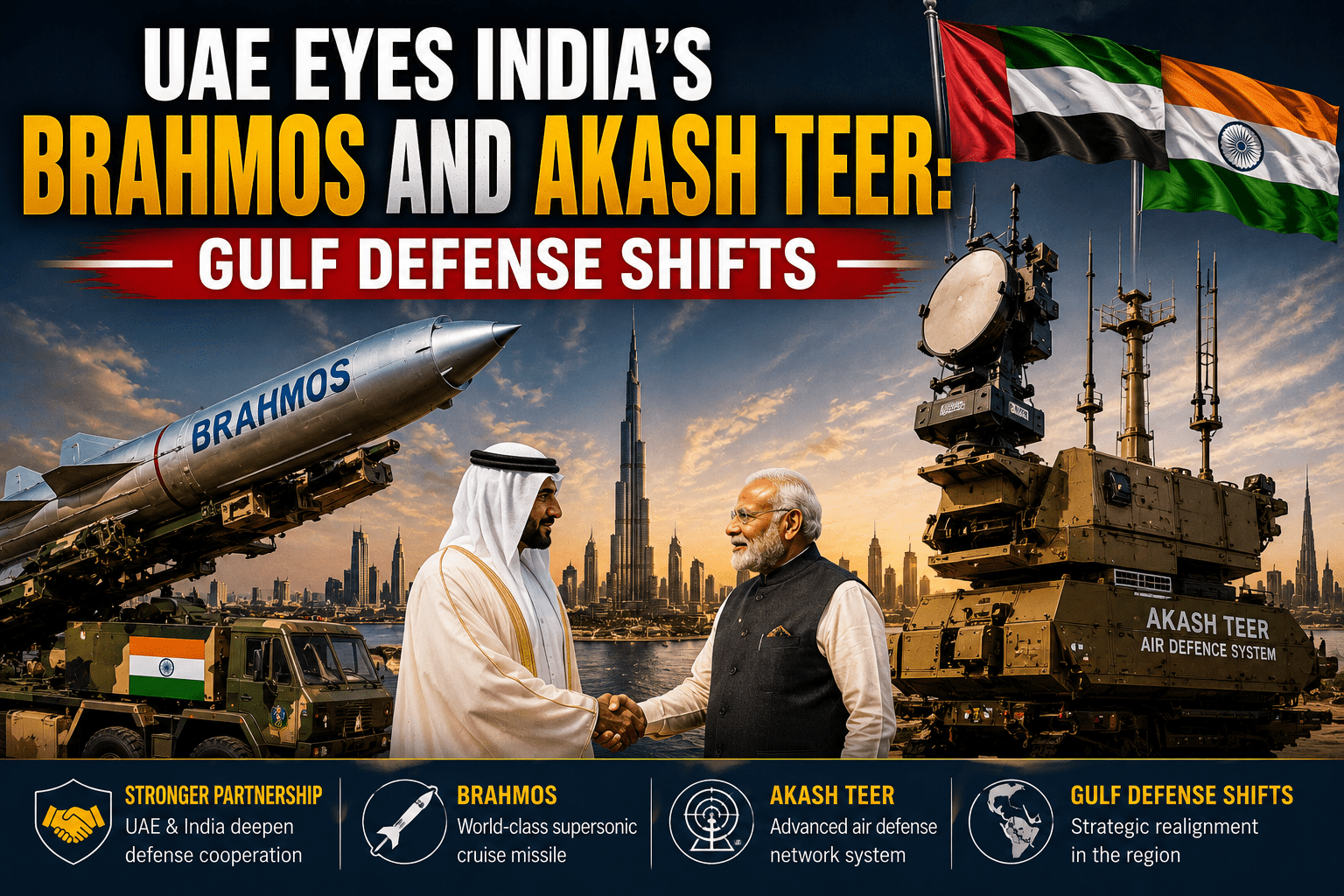
The defense architecture of the Middle East is undergoing a major recalibration, driven by shifting security dynamics and the clear need for multi-layered standalone protection. A highly significant development has emerged from the Arabian Peninsula: the United Arab Emirates (UAE) has entered fast-tracking, preliminary diplomatic negotiations with the Government of India to purchase two of New Delhi’s most elite military assets. These include the BrahMos supersonic cruise missile and the indigenous Akashteer automated air defense command and control network.
For global defense strategists, regional analysts, and institutional investors across the United States, United Kingdom, Europe, Canada, and Australia, this defense dialogue represents a milestone in South Asian and West Asian relations. This possible acquisition highlights Abu Dhabi’s clear policy of diversifying its defense equipment suppliers to achieve strategic autonomy. At the same time, it places India as a major, high-tech hardware provider in the global defense export landscape.
1. Background and Context: Security Realities of the Persian Gulf
The UAE’s defense calculations are directly tied to its geography. Coastal business hubs such as Dubai and Abu Dhabi are located between 120 to 240 kilometers away from major military logistics bases on the Iranian coast. Across the narrow Strait of Hormuz—the world’s most critical maritime transit choke point for energy exports—the maritime gap between the UAE and Iran narrows to under 50 kilometers.
       [UAE Coastline (Abu Dhabi / Dubai)]
                       │
       ◄─────── Under 50 KM Gap ───────►
                       │
         [The Strait of Hormuz Axis]
                       │
       ◄───── 120 to 240 KM Distance ─────►
                       │
         [Iranian Coastal Naval Bases]
Recent regional conflicts in the Middle East have highlighted the vulnerability of civilian population centers and energy infrastructure to low-altitude cruise missiles, coordinated drone swarms, and ballistic threats. While the UAE already operates advanced, top-tier Western interceptor systems like the United States’ Patriot networks and the Terminal High Altitude Area Defense (THAAD) system, military leaders recognize that defense alone is insufficient. True protection requires a dual-layered strategy: a highly lethal strike capability to act as a deterrent, alongside an automated tracking network that can link separate defensive systems together.
2. The Offensive Capability: The BrahMos Strategic Advantage
To build an effective strike deterrent, Abu Dhabi is looking toward the BrahMos supersonic cruise missile. Developed through a highly successful joint venture between India’s DRDO and Russia’s NPO Mashinostroyeniya, the BrahMos is widely considered the world’s fastest operational supersonic cruise missile.
[BrahMos Launch Point: UAE Coast]
               │
               ├── Speed: Mach 2.8 Sustained Velocity
               ├── Trajectory: Low-Altitude Sea-Skimming / Terrain-Hugging
               │
               ▼
[Target Realization: Southern Gulf Coastline within Minutes]
               │
[Result: Drastically Compresses Adversary Air Defense Interception Windows]
The weapon operates on a liquid-fueled ramjet engine, sustaining a velocity of Mach 2.8 across its entire flight path. Because it flies on a low-altitude, terrain-hugging trajectory, it remains highly elusive to standard ground-based naval radars. If deployed along the UAE’s coastal perimeter, a BrahMos strike could reach high-value targets across the Gulf within minutes. This speed drastically compresses an adversary’s air defense reaction window, providing the UAE with a reliable, precise tool to discourage regional aggression.
3. The Defensive Shield: Akashteer’s Automated Command Architecture
Alongside the BrahMos missile, the UAE is seeking to upgrade its defensive coordination by acquiring India’s indigenous Akashteer system. Developed by state-run Bharat Electronics Limited (BEL) in close partnership with the Indian Army, Akashteer is a fully automated air defense command and control network.
The effectiveness of an air defense network depends heavily on how efficiently radars, multi-tier sensors, and interceptors communicate with one another. Akashteer addresses this challenge by stepping away from manual tracking. It uses automated data-linking to process radar feeds, sensor inputs, and satellite telemetry into a unified, real-time picture of the battlefield.
┌──────────────────────────────────────────────────────────────────────────┐
│                   AKASHTEER AIR DEFENSE COMMAND PIPELINE                 │
├──────────────────────────────────────────┬───────────────────────────────┤
│ Distributed Sensor Influx                │ Automated Network Output      │
├──────────────────────────────────────────┼───────────────────────────────┤
│ • Early-Warning Ground Radars            │ • Generates Automated Air Picture│
│ • Coastal Electro-Optical Sensors        │ • Directs Fire Control Safely │
│ • Airspace Electronic Feeds              │ • Maximizes Existing Batteries│
└──────────────────────────────────────────┴───────────────────────────────┘
For the UAE, Akashteer would serve as an intelligence layer to coordinate its varied defensive inventory. By linking American Patriot and THAAD batteries, short-range Russian Pantsir-S1 units, and South Korean Cheongung-II (KM-SAM) platforms into a single interface, Akashteer allows commanders to track and counter incoming threats with optimal efficiency.
4. The Geopolitical Logic of Supplier Diversification
The UAE’s defense procurement strategy is guided by a clear focus on supplier diversification. Rather than relying on a single international partner, Abu Dhabi deliberately splits its military contracts across Western and non-Western nations. This approach provides several key strategic advantages:
Strategic Autonomy: Spurces from multiple suppliers prevents the country from becoming overly vulnerable to sudden export bans or political shifts in any single capital.
Smooth Regulatory Paths: Because the BrahMos missile is a joint venture, an export agreement requires formal consent from Moscow. Given the close diplomatic relationship between Russia and the UAE, this approval process is expected to move smoothly without geopolitical hurdles.
Stable Alliances: Strengthening military ties with India allows the UAE to diversify its inventory without straining its alliance with the United States, as New Delhi and Washington maintain a close strategic partnership.
5. India’s Evolution Into a Global Defense Export Hub
The fast-moving negotiations with Abu Dhabi highlight a major milestone in India’s own industrial goals. Driven by the government’s focus on domestic manufacturing, India’s defense sector has transitioned from being one of the world’s largest importers into an active international supplier.
[India's Annual Defense Export Trajectory]
  • 2013-14 Fiscal Base Line: $7.26 Million
  • FY 2025-26 Performance: Passed $4.00 Billion
  • Government 2030 target: $6.00 Billion (₹50,000 Crore)
Official figures show that India’s defense exports crossed the $4 billion mark for the fiscal year ending March 2026, a massive jump from just $7.26 million during the 2013-14 cycle. If this agreement is finalized, the UAE will follow the Philippines, Vietnam, and Indonesia to become the latest international operator of the BrahMos system, helping India move closer toward its target of $6 billion (₹50,000 crore) in defense exports by 2030.
Data & Statistics Section
The following table details the key performance data, fiscal values, and technical specifications behind the current defense discussions:
| Metric Parameter | Value / Technical Stat | Verified Reference Source |
| BrahMos Maximum Speed | Mach 2.8 (Supersonic Velocity) | Joint BrahMos Aerospace Engineering Specifications |
| India Defense Exports (FY26) | Surpassed $4 Billion (USD) | Ministry of Defence Government Disclosures |
| India Export Target (2030) | ₹50,000 Crore ($6 Billion USD) | Defense Production Policy Roadmap |
| Historical Export Base (2014) | $7.26 Million (USD) | Department of Defense Production |
| Strait of Hormuz Minimum Width | Under 50 Kilometers | Hydrographic Survey Mapping Records |
| Existing Interceptor Systems | THAAD, Patriot, Pantsir-S1, KM-SAM | UAE Armed Forces Inventory Logs |
Expert Insights
“The UAE’s clear interest in the BrahMos and Akashteer systems highlights a significant change in how Middle Eastern nations approach national security. By combining a highly precise supersonic strike capability with an automated command network, Abu Dhabi is working to protect its critical infrastructure along the Strait of Hormuz from evolving modern threats.”
— Gulf Regional Security & Procurement Analyst
“India’s recent surge in defense exports, crossing $4 billion in fiscal year 2026, shows the maturity of its domestic manufacturing sector. A successful partnership with a major buyer like the UAE will build further confidence in Indian military technology across global markets.”
— International Trade & Defense Economics Fellow
Frequently Asked Questions (FAQ)
What specific military systems is the UAE looking to buy from India?
The UAE is in advanced discussions to acquire the BrahMos supersonic cruise missile and the Akashteer automated air defense command and control network.
Why is the BrahMos missile considered a strategic asset for the UAE?
Operating at speeds of Mach 2.8 along a low, radar-evading trajectory, the BrahMos provides a rapid strike capability that drastically cuts down an adversary’s air defense reaction time.
What exactly is the Akashteer system?
Akashteer is an automated air defense command software that integrates data from diverse radars, communication feeds, and weapons into a unified, real-time map of the airspace to improve defense coordination.
How does Akashteer fit alongside the UAE’s existing Western air defense systems?
The system serves as an unclassified coordination network, allowing commanders to combine inputs from disparate assets—such as American Patriot batteries and Russian Pantsir units—into a single operational view.
Why is the UAE looking to diversify its defense suppliers?
By splitting contracts among multiple international partners, the UAE gains greater strategic autonomy and reduces its vulnerability to unexpected political shifts or export controls from any single nation.
Does Russia need to approve the sale of the BrahMos missile?
Yes, because the BrahMos is a joint development between India and Russia, Moscow’s formal approval is required for international sales. Given the close ties between Russia and the UAE, this is not expected to be a hurdle.
What is the current size of India’s annual defense exports?
India’s defense exports surpassed $4 billion for the fiscal year ending March 2026, representing a major increase from just $7.26 million in 2013-14.
Which other countries have already purchased or shown interest in the BrahMos missile?
The Philippines has officially deployed the system, while Vietnam, Indonesia, Thailand, and several nations in South America have held active discussions regarding potential acquisitions.
Official Links & Resources
Official Website: Ministry of Defence, Government of India
Official Announcement: Bharat Electronics Limited (BEL) Defense Systems
Official Press Release: Ministry of External Affairs – India-UAE Bilateral Relations
Official Documents: BrahMos Aerospace Official Portal