1. Introduction
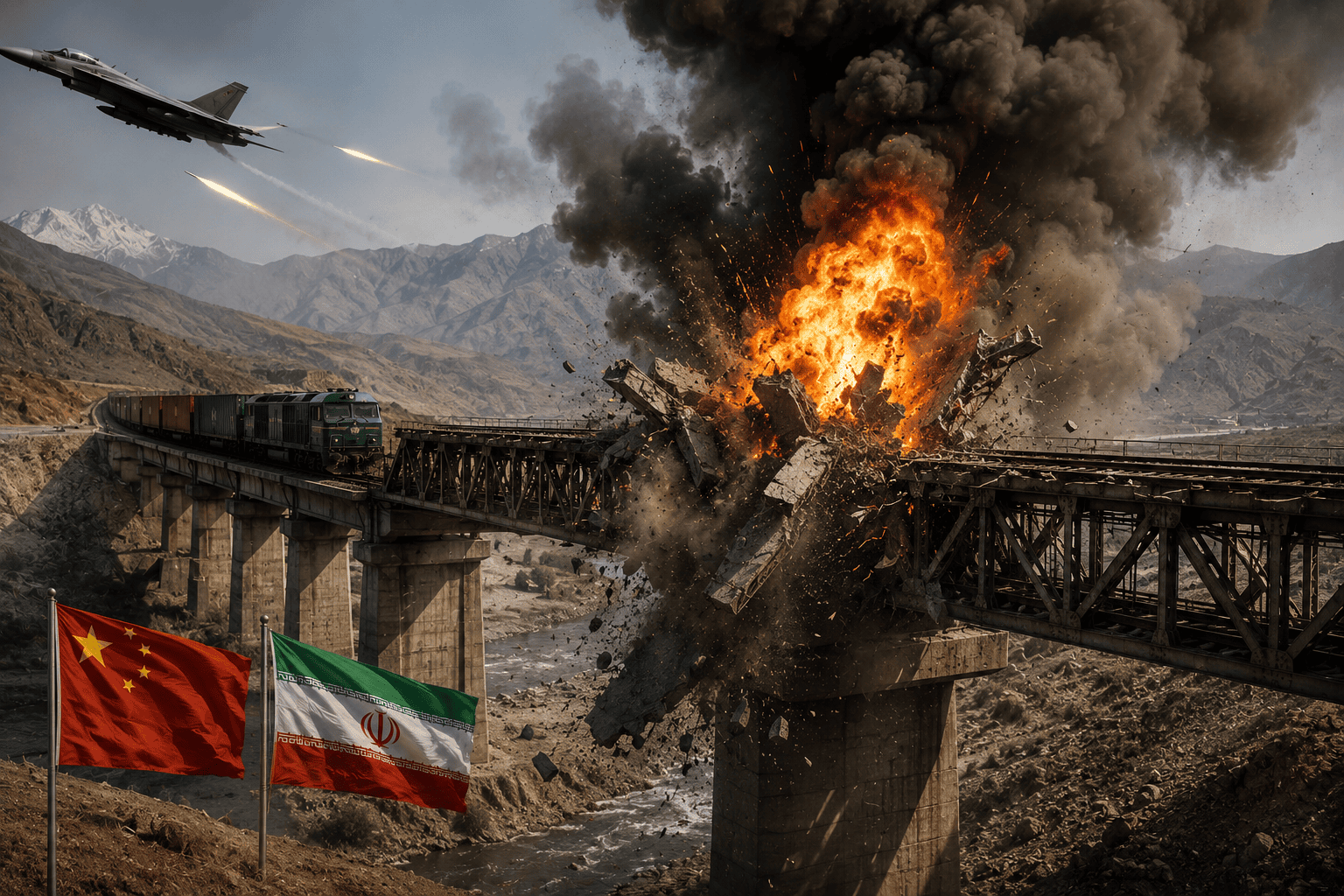
In the early hours of Thursday, July 9, 2026, the geopolitical map of Eurasia was abruptly redrawn—not by a diplomatic treaty, but by US cruise missiles. As the Middle East edges dangerously close to a renewed, full-scale regional conflict, American strikes targeted the Aq Taqeh Khan railway bridge in northern Iran’s Golestan province. This is not merely a tactical military strike; it is a profound geoeconomic shockwave. The bridge serves as a critical node on the China-Turkmenistan-Iran railway corridor—a vital land bridge that Beijing and Moscow have increasingly relied upon as maritime routes through the Strait of Hormuz grind to a near halt.
By striking infrastructure that facilitates the strategic alignment of Iran, China, and Russia, the United States has expanded the theater of engagement from traditional military deterrence to active geoeconomic disruption. For global policymakers, defense analysts, and supply chain architects, the destruction of this bridge poses a severe strategic question: Is the US now actively dismantling the overland trade networks that undergird the emerging multipolar world order?
2. Executive Summary
Infrastructure Targeted: US strikes destroyed the Aq Taqeh Khan railway bridge in Golestan province, a critical link on the China-Turkmenistan-Iran rail corridor.
Trilateral Disruption: The route has seen a 300% increase in Chinese freight and heavy Russian usage due to the ongoing US blockade and maritime insecurity in the Gulf.
Escalation of Tactics: This marks a shift in US strategy—targeting dual-use transport infrastructure rather than strictly military or nuclear installations.
Retaliatory Cycle: Iran has denounced the strikes as a “war crime” and launched retaliatory missile and drone attacks at US sites in Kuwait and Bahrain.
Economic Shock: The attack sent Brent crude prices surging past $79 a barrel, while European and Asian markets brace for prolonged supply chain fragmentation.
Strategic Messaging: The strike signals Washington’s willingness to forcibly interrupt the physical integration of the “axis of resistance” (Iran, Russia, China).
Central Asian Squeeze: Turkmenistan and Kazakhstan are now caught in the crossfire, highlighting the fragility of transit states in great power competition.
Ceasefire Collapse: The strikes definitively end the fragile 2025 memorandum of understanding, propelling the region into uncharted volatility.
3. Timeline of Escalation
| Date | Event | Significance |
| Late 2025 | US-Iran Ceasefire MoU Signed | A fragile agreement halts direct military confrontation, though proxy skirmishes persist. |
| Early 2026 | Red Sea & Hormuz Disruptions Peak | Commercial shipping grinds to a near halt; China and Russia divert freight to overland rail routes via Central Asia. |
| July 7, 2026 | US Declares MoU “Over” | President Trump officially declares the ceasefire nullified, citing Iranian attacks on commercial shipping. |
| July 8, 2026 | Global Markets Selloff | European and Asian equities plummet as energy prices spike in anticipation of US military action. |
| July 9, 2026 (Overnight) | US Strikes Golestan Rail Bridge | Cruise missiles hit the Aq Taqeh Khan bridge. Bridges to Mashhad are also damaged. |
| July 9, 2026 (Morning) | Iran Retaliates | IRGC launches drones and missiles toward US installations in Bahrain and Kuwait; UN ambassador condemns strikes. |
Key Takeaway: The rapid degradation from a fragile MoU to strikes on international trade infrastructure illustrates how quickly localized maritime disputes can metastasize into continental geoeconomic warfare.
4. Historical Background
The strategic significance of the Aq Taqeh Khan bridge cannot be understood without examining the broader historical context of Eurasian connectivity. For over a decade, China’s Belt and Road Initiative (BRI) has sought to revive the ancient Silk Road, minimizing Beijing’s reliance on maritime chokepoints like the Strait of Malacca and the Suez Canal—waterways dominated by US naval supremacy.
Concurrently, the International North-South Transport Corridor (INSTC), championed by Russia, India, and Iran, was designed to link the Indian Ocean to the Baltic Sea via Iranian ports and railways.
As Western sanctions severely isolated Russia following the 2022 Ukraine invasion, and as Iran faced crippling “maximum pressure” campaigns, Moscow and Tehran accelerated their infrastructural integration. By 2025, with maritime shipping in the Persian Gulf and Red Sea increasingly perilous due to asymmetric warfare, the overland rail route through Turkmenistan and Kazakhstan became a lifeline. The Aq Taqeh Khan bridge, therefore, was not just steel and concrete; it was a physical manifestation of Sino-Russian-Iranian economic resilience against Western sanctions.
5. What Happened? (Verified vs. Disputed)
What is Confirmed
The Strike: Overnight on July 9, 2026, US forces launched a wave of strikes against approximately 90 targets across Iran.
Infrastructure Hit: Cruise missiles specifically targeted and severely damaged the Aq Taqeh Khan railway bridge in Aqqala county, Golestan province.
Market Reaction: Brent crude futures spiked by over 5%, nearing $80 a barrel, reflecting immediate global market anxiety.
Diplomatic Fallout: Iran’s UN Ambassador Amir Saeid Iravani formally protested to the UN Security Council, citing violations of the UN Charter.
What Remains Disputed
Operational Intent: US Central Command claims the strikes aim to degrade Iran’s ability to threaten maritime freedom. It remains officially unverified if the rail bridge was targeted specifically to disrupt Chinese and Russian trade, or if it was classified as a military logistics node used by the IRGC.
Repair Timeline: Iranian state media (Fars News) asserts repairs will be completed “quickly,” while independent defense analysts suggest precision cruise missile strikes on load-bearing structural pylons could render the bridge impassable for months.
Extent of Retaliation: The IRGC claims successful strikes on US bases in Bahrain and Kuwait, but the US Department of Defense has not yet confirmed the extent of damage or casualties at these facilities.
6. Strategic Geopolitical Analysis
The destruction of the Golestan railway infrastructure marks a profound shift in US rules of engagement. Historically, US strikes in the Middle East have focused on counter-terrorism, nuclear containment, and degrading air defense systems. Targeting an international freight corridor introduces a new paradigm in Great Power Competition.
The Eurasian Land Bridge Under Fire
By severing this link, Washington is sending a stark message to Beijing and Moscow: the US military can and will project power deep into the heart of the Eurasian landmass to disrupt the Belt and Road Initiative (BRI) if it serves adversaries. This directly challenges the core premise of the BRI—that overland routes are immune to US naval blockades.
The “Axis of Resistance” Logistics
Russia and Iran have operated a “sanctions-evasion” partnership, trading military hardware (drones, missiles) for commodities and technical assistance. The rail corridor was a primary artery for this exchange, safe from interdiction at sea. Cutting this artery forces Russia and Iran to rely on the Caspian Sea—a slower, lower-capacity maritime route—or riskier air freight.
NATO and the Indo-Pacific Strategy
While European allies may privately fret about the resulting energy spikes, the US strike aligns with broader NATO and Indo-Pacific strategies aimed at containing Sino-Russian expansion. By demonstrating the vulnerability of China’s western trade routes, the US complicates Beijing’s strategic calculus regarding Taiwan and the South China Sea; if China’s overland “safe routes” are highly vulnerable to precision strikes, Beijing’s economic security is less robust than presumed.
Key Takeaway: The strike transforms a regional Middle Eastern conflict into a direct kinetic intervention in global great power logistics, challenging the perceived safety of Eurasian overland trade.
7. Deep Geoeconomic Analysis
The geoeconomic ramifications of targeting the China-Turkmenistan-Iran corridor will ripple through global supply chains for years.
Supply Chains and Rail Corridors
With the Strait of Hormuz effectively blockaded and the Red Sea hostile, global logistics companies had pivoted to the “Middle Corridor” and the Iran-Central Asia routes. The severing of the Aq Taqeh Khan bridge removes one of the few remaining high-capacity pressure valves for Eurasian freight.
China’s Dilemma: Chinese rail freight to the Middle East had reportedly tripled in early 2026. This cargo must now be rerouted, significantly increasing transit times, insurance premiums, and freight costs.
Russian Isolation: Russia relies on this route for imports of consumer goods, dual-use technology, and industrial components from the Global South. The bottleneck will exacerbate inflation within the Russian economy and strain its wartime industrial base.
Energy Markets and Global Trade
While the bridge itself does not carry oil, its destruction signals a broader targeting of Iranian infrastructure. Explosions reported on Kharg Island (Iran’s primary oil export terminal) and Bandar Abbas have sent shockwaves through energy markets.
Oil Prices: The immediate 5% jump in Brent crude is likely just the beginning. If transport infrastructure continues to be degraded, the risk premium on Middle Eastern oil could add $15–$20 per barrel in the short term.
Inflationary Pressures: Higher energy and logistics costs will inevitably be passed on to consumers in Europe and the US, complicating central banks’ efforts to manage inflation and potentially stalling global economic growth.
8. Country-by-Country Impact
United States: Tactically successful in degrading Iranian logistics, but risks severe political blowback if energy prices spike domestic inflation ahead of the US election cycle. It also risks drawing US forces into a protracted infrastructure war.
China: A major strategic setback. Beijing must now evaluate the security of its BRI investments globally. It will likely issue strong diplomatic condemnations while quietly seeking alternative routes through Pakistan (CPEC) or the Caucasus, though both are fraught with their own risks.
Russia: Highly negative. The strike throttles a vital supply line for both civilian and military-adjacent goods. Moscow will likely increase naval traffic across the Caspian Sea to compensate, stretching its maritime logistics.
Iran: Devastating for its economy, which relies on transit fees and trade with Eastern partners to survive Western sanctions. The strikes deeply humiliate Tehran’s defense establishment, necessitating a forceful—and potentially escalatory—response.
European Union: A double-edged sword. While the EU supports the containment of Russia and Iran, the ensuing spike in energy prices and the potential for a massive disruption in Asian supply chains threatens European industrial competitiveness.
Central Asia (Turkmenistan & Kazakhstan): Caught in the crossfire. These states rely on transit revenues and carefully balance relations with Russia, China, and the West. The strike turns their southern border into a conflict zone, chilling foreign direct investment in Central Asian infrastructure.
India: A major blow to New Delhi’s aspirations for the INSTC (via Chabahar port). If Iranian railways are legitimate US targets, India’s investments in Iranian transit infrastructure are essentially stranded assets.
9. Data & Evidence: Eurasian Trade Shifts (2025–2026)
The following data illustrates the strategic value of the targeted corridor prior to the July 2026 strike.
| Metric | 2024 (Baseline) | Early 2026 (Pre-Strike) | Implications |
| Strait of Hormuz Commercial Traffic | 100% (Index) | 35% | Severe maritime disruption forced trade overland. |
| China-Iran Rail Freight Volume | 50,000 TEU/yr | ~150,000 TEU/yr | 300% increase; highly dependent on Golestan route. |
| Russian Freight via Iran (INSTC) | 8 million tons | 14 million tons | Critical for Moscow’s sanctions evasion. |
| Brent Crude Oil Price | $75 / barrel | $79.28 / barrel | High volatility; highly sensitive to infrastructure strikes. |
Why This Matters: The data clearly shows that the targeted railway was not a marginal asset, but the primary release valve for a global economy choked by maritime insecurity.
10. Stakeholder Analysis
Governments: Western capitals must brace for retaliatory asymmetric warfare (cyberattacks, proxy mobilization). Beijing and Moscow will likely deepen their intelligence and military cooperation in response to what they view as US hegemony.
Logistics & Shipping Industry: A nightmare scenario. Freight forwarders cannot rely on the sea (Hormuz/Red Sea) or land (Iran/Russia). Supply chains will become highly fragmented, prioritizing “friend-shoring” over efficiency.
Defense Industry: Significant upside. The expansion of targets to include dual-use infrastructure indicates a prolonged, high-intensity conflict, driving up demand for precision munitions, air defense systems, and intelligence, surveillance, and reconnaissance (ISR) technologies.
Consumers: Will bear the brunt of this escalation through higher prices for energy, electronics, and imported consumer goods, as increased transit costs are passed down the supply chain.
11. Expert Perspectives
Consensus: Most defense analysts agree that the US strikes represent a massive escalation, signaling the definitive end of the 2025 MoU and a willingness to accept high levels of regional volatility to punish Iran.
Divergence:
The Deterrence Camp: Analysts from institutions like the RAND Corporation often argue that striking high-value infrastructure is necessary to restore deterrence. By imposing unacceptable economic costs on Tehran and its partners, the US forces a recalculation in Iranian behavior.
The Escalation Trap Camp: Scholars from the Quincy Institute and similar think tanks warn that this strategy is self-defeating. They argue that destroying civilian/dual-use infrastructure solidifies the Sino-Russian-Iranian axis, accelerates de-dollarization, and guarantees retaliatory strikes that could spiral into a broader war, drawing in Gulf allies like Kuwait and Bahrain.
12. Reality Check
Verified Fact: US cruise missiles struck the Aq Taqeh Khan railway bridge in Golestan province.
Verified Fact: Iran is actively using this route to facilitate trade with Turkmenistan, Kazakhstan, Russia, and China.
Common Misconception: The US is exclusively targeting military bases. False. The strikes on railway bridges and alleged explosions near oil terminals mark a shift toward degrading dual-use and economic infrastructure.
Unsupported Allegation: China will intervene militarily to protect its trade routes. Unknown/Unlikely. While Beijing relies on the route, its historical doctrine avoids direct military entanglement in the Middle East, favoring diplomatic protests and economic workarounds.
13. Future Scenarios
1. Best Case: De-escalation and Rerouting (Low Probability)
Iran limits its retaliation to performative, non-lethal drone strikes. The US refrains from further infrastructure attacks. China and Russia temporarily absorb the logistics costs by utilizing the Caspian Sea and the Baku-Tbilisi-Kars railway. Markets stabilize, and back-channel diplomacy resumes.
2. Most Likely Scenario: Protracted Infrastructure War (High Probability)
Iran successfully strikes US or allied infrastructure in the Gulf (e.g., desalination plants, minor energy facilities). The US responds by targeting Iran’s remaining rail networks and port facilities at Chabahar and Bandar Abbas. The Eurasian land bridge is effectively disabled for the duration of the conflict, structurally inflating global shipping costs and isolating Iran economically.
3. Worst Case: Total Regional War and Strait Closure (Medium-Low Probability)
Driven into a corner, Tehran attempts a full-scale closure of the Strait of Hormuz using naval mines and anti-ship ballistic missiles. The US and allied navies engage in a massive campaign to destroy the IRGC Navy. Oil prices soar past $150 a barrel, triggering a severe global recession.
14. Editorial Analysis (Commentary)
The decision to target the Aq Taqeh Khan bridge is a geoeconomic Rubicon. By weaponizing precision strikes against the physical infrastructure of the Belt and Road Initiative and the INSTC, the US has acknowledged a harsh reality: in the 21st century, logistics is warfare.
However, this tactic carries immense long-term risks. While it successfully hurts Tehran and inconveniences Moscow and Beijing in the short term, it accelerates the very thing Washington fears: the creation of a parallel, non-Western global architecture. If the US proves willing to destroy international trade routes with military force, nations across the Global South will view US-controlled waters and Western-backed infrastructure with deep suspicion. The strike may win the immediate tactical battle of disrupting Iranian logistics, but it risks losing the strategic war for global economic trust.
15. Key Takeaways
For Policymakers: The threshold for military engagement has shifted from strictly military targets to dual-use geoeconomic infrastructure.
For Investors: Volatility in energy and logistics sectors will remain extremely high. Divestment from Iranian-adjacent transit projects (like India’s Chabahar port investments) may accelerate.
For Businesses: Relying on Eurasian overland routes as a “safe alternative” to maritime shipping is no longer viable. Supply chains must be stress-tested for total route denial.
For Researchers: This event provides a live case study in how great power competition physically manifests through the destruction of connectivity projects.
16. Conclusion
The destruction of the China-Iran rail corridor bridge in Golestan is not an isolated incident of regional violence; it is a profound rupture in the global supply chain architecture. As the dust settles in northern Iran, the implications will be felt in the boardrooms of Beijing, the war rooms of Moscow, and the trading floors of New York. The United States has demonstrated its reach and resolve, but in doing so, it has initiated a new era of geoeconomic vulnerability where no trade route—whether by sea or by land—can be considered safe from the crossfire of great power competition.