Life Insurance Corporation of India delivered one of the most important earnings announcements of FY26 after reporting its Q4 financial results on May 21, 2026. The company not only posted a strong 23% jump in consolidated net profit but also announced its first-ever 1:1 bonus share issue along with a ₹10 final dividend for shareholders. The combination of strong earnings growth, rising investment income, improving solvency ratio, and shareholder rewards immediately strengthened market sentiment around LIC shares and transformed the quarter into a major turning point for India’s largest insurance company.
For investors, this was far more than just another quarterly result. The latest numbers clearly showed that LIC is gradually evolving from a traditional public-sector insurance giant into a more profitable, capital-efficient, and shareholder-focused financial institution. The company benefited from strong premium collections, exceptional gains from its investment portfolio, improving asset quality, and rising contribution from high-margin Non-Participating insurance products.
The broader market reaction also highlighted growing investor confidence in LIC’s long-term transformation story. Traders and institutional investors are now increasingly viewing the company as a structurally improving financial compounder rather than a slow-moving government-owned insurer.
LIC Q4 FY26 Financial Performance Snapshot
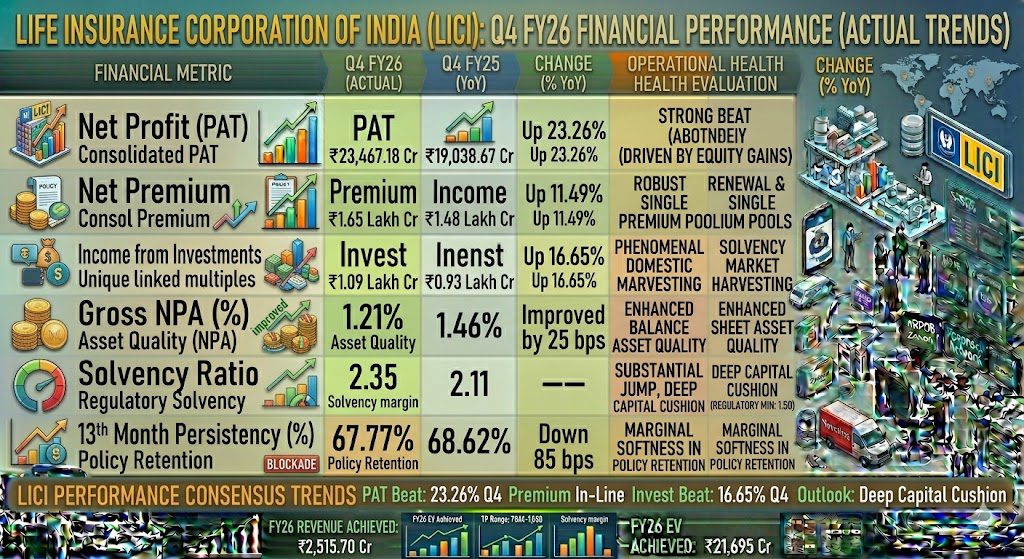
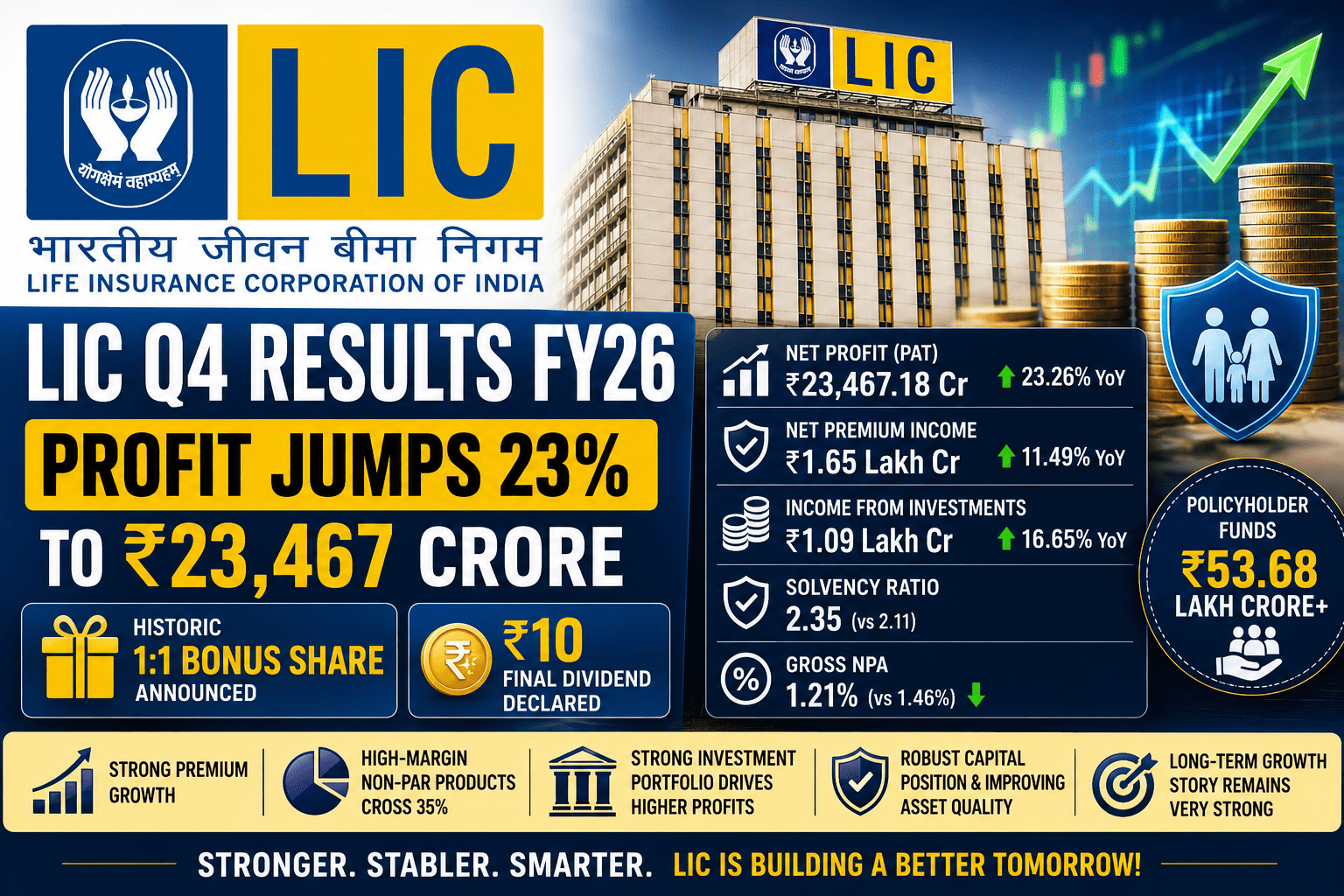
Life Insurance Corporation of India reported consolidated profit after tax of ₹23,467.18 crore during Q4 FY26 compared to ₹19,038.67 crore during the same quarter last year, reflecting impressive year-on-year growth of approximately 23.26%. The earnings performance comfortably exceeded most analyst expectations and was primarily supported by strong investment income growth and stable premium inflows.
Net premium income increased to ₹1.65 lakh crore from ₹1.48 lakh crore during Q4 FY25, reflecting healthy growth of approximately 11.49%. The company’s premium-growth momentum remained strong across both single-premium and first-year-premium segments, demonstrating that LIC continues maintaining dominant market leadership despite aggressive competition from private insurers.
One of the biggest contributors behind the strong profit growth was investment income. Income from investments surged nearly 16.65% to ₹1.09 lakh crore during the quarter as LIC successfully capitalized on India’s strong equity-market rally and improved bond yields across long-term government securities.
The company also reported meaningful improvement in financial stability indicators. Gross Non-Performing Assets declined to 1.21% compared to 1.46% during the previous year, while the solvency ratio improved sharply to 2.35 from 2.11. This is significantly higher than the IRDAI regulatory requirement of 1.50 and demonstrates the company’s improving balance-sheet strength.
However, the 13th-month persistency ratio declined marginally to 67.77% from 68.62%, indicating slight softness in policy-retention efficiency. Despite this minor weakness, the broader earnings report strongly reinforced LIC’s improving operational quality and financial resilience.
Understanding LIC’s Structural Importance
Life Insurance Corporation of India is not merely India’s largest insurance company. It remains one of the most systemically important financial institutions within the Indian economy. The corporation currently manages policyholder assets exceeding ₹53.68 lakh crore, making it one of the largest institutional investors in India’s capital markets.
LIC continues dominating both the life-insurance industry and institutional investment ecosystem because of its unmatched scale, extensive agency network, deep customer trust, and long-standing government backing.
The company’s massive distribution infrastructure remains one of its biggest competitive advantages. Even today, LIC maintains one of the strongest insurance-agent networks in the country, allowing it to penetrate both urban and rural markets more effectively than most private competitors.
Another important structural transformation happening inside LIC is the company’s increasing focus on high-margin Non-Participating insurance products. Traditionally, LIC relied heavily on Participating products where profits were shared significantly with policyholders. However, Non-Par products allow the company to retain substantially higher profitability for shareholders.
Management confirmed that Non-Par products now contribute more than 35% of Annualized Premium Equivalent business. This transition is strategically important because it materially improves operating margins, embedded value growth, and long-term shareholder profitability.
Earnings Analysis: What Powered LIC’s Strong Q4 Performance?
One of the strongest aspects of LIC’s quarterly performance was the healthy growth in premium collections. Net premium income increased approximately 11.49% to ₹1.65 lakh crore, indicating that the company continues maintaining strong customer acquisition and renewal momentum.
Within this, Single Premium Collections surged nearly 22% to ₹70,119 crore. This is particularly important because it suggests that high-net-worth investors continue favoring LIC’s guaranteed-return products despite growing competition from private insurers and market-linked investment products.
First-Year Premium collections also increased approximately 17% to ₹13,009 crore, demonstrating that LIC continues expanding its customer base effectively.
However, the biggest driver behind the earnings jump was the company’s investment portfolio. Investment income surged nearly 17% to ₹1.09 lakh crore during Q4 FY26 as LIC successfully harvested gains from India’s strong equity-market performance while simultaneously benefiting from improved long-term bond yields.
Because LIC operates one of the largest institutional investment portfolios in India, even moderate improvements in market conditions can dramatically impact profitability.
This quarter clearly demonstrated the extraordinary earnings power embedded inside LIC’s investment operations.
Historic Shareholder Rewards: Bonus Shares and Dividend Announcement
The biggest headline from LIC’s board meeting was undoubtedly the announcement of its first-ever 1:1 bonus share issue.
Under this structure, shareholders will receive one additional fully paid equity share for every existing share held. The move will effectively double the company’s paid-up equity capital from ₹6,325 crore to ₹12,650 crore.
The official bonus-share record date has been fixed as Friday, May 29, 2026, while the deemed allotment date is scheduled for Monday, June 1, 2026.
Although a bonus issue does not alter the intrinsic value of the company, it significantly improves market liquidity and makes the stock more affordable for retail investors after the price adjustment.
This often increases trading activity and retail participation in the stock.
Alongside the bonus announcement, Life Insurance Corporation of India also recommended a final dividend of ₹10 per equity share for FY26.
The official dividend record date has been fixed for June 25, 2026, subject to shareholder approval during the Annual General Meeting scheduled for July 27, 2026.
The combination of strong profit growth, bonus shares, and dividend payout created a highly positive sentiment around the stock.
Fundamental Analysis: Why LIC’s Long-Term Story Is Improving
One of the most encouraging indicators inside LIC’s FY26 earnings report was the sharp improvement in solvency ratio. The solvency ratio increased to 2.35 from 2.11 last year, substantially above the mandatory IRDAI requirement of 1.50.
A stronger solvency ratio indicates better financial stability, lower balance-sheet risk, and stronger long-term capital adequacy.
For institutional investors evaluating insurance companies, solvency improvement is one of the most critical indicators because it reflects the company’s ability to absorb financial shocks and honor future policy obligations.
For the complete FY26 fiscal year, LIC reported profit after tax of ₹57,453.15 crore, reflecting growth of approximately 19% year-on-year.
This represents one of the strongest annual earnings performances in the company’s history.
Another important positive was the rapid expansion of Bancassurance partnerships, which reportedly grew more than 45% during the fiscal year. This diversification is strategically important because it reduces dependence on traditional agency-driven sales and improves operational efficiency.
The company also continued improving asset quality. Gross NPAs declined to 1.21% from 1.46%, demonstrating stronger risk management across LIC’s massive debt-investment portfolio.
Technical Analysis: Key Trading Levels to Watch
Following the earnings announcement, LIC shares traded within the ₹1,010–₹1,030 range as the market digested both the strong earnings performance and the historic bonus-share announcement.
Technically, the stock now appears to be forming a strong pre-bonus accumulation structure ahead of the May 29 record date.
The most important technical pivot currently remains near ₹1,045. If the stock decisively closes above this level on strong institutional volume, traders could witness aggressive momentum buying ahead of the bonus adjustment period.
On the upside, important resistance levels remain near ₹1,038, ₹1,055, and eventually the broader breakout zone near ₹1,080.
On the downside, critical support zones remain near ₹1,005, ₹985, and the major long-term accumulation base near ₹940.
For short-term traders, any temporary weakness toward the ₹985 region may continue offering attractive risk-reward entry opportunities.
Institutional View: Brokerage Ratings and Target Prices
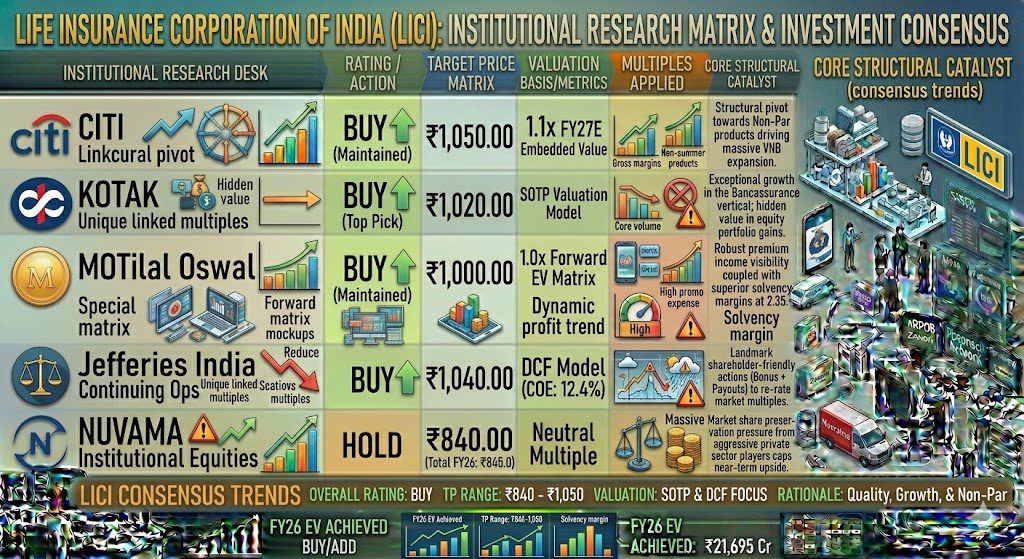
Institutional research firms reacted positively following LIC’s earnings announcement.
Kotak Institutional Equities maintained a BUY recommendation with a target price of ₹1,260, highlighting strong Value of New Business margin expansion.
Motilal Oswal Financial Services retained a BUY recommendation with a target price of ₹1,220 because of rising Non-Par product contribution and strong investment-income growth.
Citigroup Inc. maintained a BUY recommendation with a target price of ₹1,190, citing strong premium growth and structural distribution dominance.
Jefferies retained a HOLD recommendation with a target price of ₹1,050 while expressing caution regarding rising management expenses.
SBI Capital Markets maintained a BUY recommendation with a target price of ₹1,240 because of expected liquidity improvement after the bonus issue.
The broader analyst consensus target currently stands near ₹1,192, indicating meaningful upside potential from current market levels before the bonus-price adjustment.
Final Verdict: Buy, Hold, or Sell?
For long-term investors, Life Insurance Corporation of India now appears fundamentally stronger than it did immediately after listing.
The company is gradually transforming into a more profitable, capital-efficient, and shareholder-focused financial institution. Strong premium growth, improving solvency, better asset quality, rising Non-Par margins, and exceptional investment-income growth collectively reinforce the long-term bullish thesis.
The historic bonus-share issue could additionally improve retail participation and increase liquidity in the stock.
For short-term traders, the ₹1,045 breakout level remains critically important. A decisive breakout above this level could trigger a strong pre-bonus momentum rally toward ₹1,080.
Overall, LIC delivered one of the strongest and most sentiment-changing earnings reports of FY26. Beneath the headline numbers lies a company that is rapidly evolving into a structurally stronger financial compounder with improving profitability, stronger balance-sheet quality, and better shareholder economics.