Strategic Context: Capital Infusion Signals Long-Term Conviction
HDFC Life’s Q4 FY26 performance must be evaluated within the broader transformation currently underway in India’s life insurance sector. The most significant development this quarter is the ₹1,000 crore capital infusion by HDFC Bank, which has increased its stake in the insurer to 50.54%. This move is not merely financial in nature; it reflects a deeper strategic commitment from the parent entity toward scaling the insurance business over the long term. In an environment where regulatory adjustments—particularly related to GST structures and revised surrender value norms—are temporarily affecting industry profitability, such capital support provides HDFC Life with a strong buffer to sustain growth while maintaining balance sheet strength.
At a structural level, HDFC Life continues to operate as a top-tier private insurer with a market share of approximately 15.2%. However, Q4 FY26 should not be interpreted as a phase of aggressive expansion. Instead, it represents a period of normalization, where the company is aligning itself with evolving regulatory frameworks while maintaining operational stability. The emphasis, therefore, is less on rapid top-line acceleration and more on ensuring long-term sustainability through disciplined capital allocation and product mix optimization.
Financial Performance: Stability Over Aggression
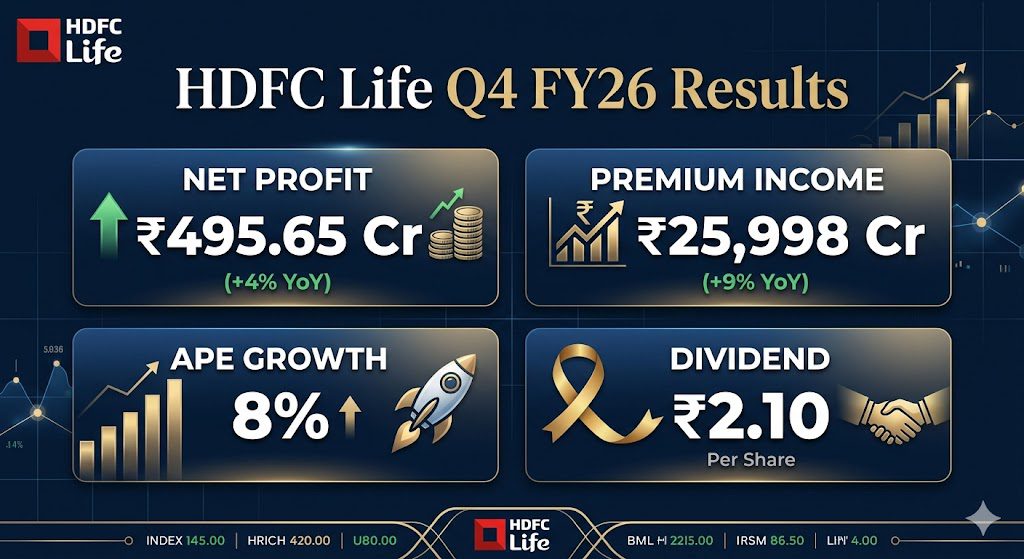
The financial performance of HDFC Life in Q4 FY26 reflects a deliberate balance between growth and stability. The company reported a net profit of ₹495.65 crore, marking a 4% year-on-year increase. While this growth rate may appear modest compared to earlier high-growth phases, it is important to contextualize it within the current regulatory environment, which has introduced temporary pressures on profitability across the insurance sector. The ability to sustain positive earnings growth in such conditions highlights the resilience of the underlying business model.
Net premium income stood at ₹25,998 crore, registering a healthy 9% year-on-year increase. This indicates that demand for insurance products remains intact, supported by strong distribution capabilities and brand credibility. Additionally, Annualized Premium Equivalent (APE) grew by 8% year-on-year, translating into a two-year compound annual growth rate of approximately 12%. This consistency in new business generation underscores the company’s ability to maintain momentum even during transitional phases.
From a shareholder perspective, the declaration of a ₹2.10 per share dividend, with a record date of June 19, 2026, reflects confidence in cash flow stability and earnings visibility. Overall, the financial performance suggests that HDFC Life is prioritizing durability and predictability over short-term growth spikes, a characteristic often associated with high-quality financial franchises.
Fundamental Lens: VNB Quality, Margin Integrity, and Balance Sheet Strength
Value of New Business (VNB): Anchoring Future Profitability
The Value of New Business (VNB) for FY26 stood at ₹4,034 crore, reaffirming HDFC Life’s position as a consistent generator of long-term value. Unlike accounting profits, VNB captures the present value of future profits from policies sold during the year, making it a more meaningful indicator of sustainable earnings potential. The steady expansion of VNB reflects disciplined underwriting, effective product positioning, and a strong distribution network.
Margin Analysis: Optical Compression vs. Structural Strength
The reported VNB margin of 24.2% indicates a marginal compression on a year-on-year basis. However, this figure needs to be adjusted for regulatory impacts, particularly those arising from GST-related changes. On an underlying basis, the margin remains robust at 25.5%, suggesting that the core economics of the business have not deteriorated. This distinction is critical, as it highlights that the observed margin pressure is largely transient and not indicative of any structural weakness in the company’s operating model.
Solvency Ratio: Capital Adequacy Reinforced
The solvency ratio, a key measure of an insurer’s financial strength, stood at 177% prior to the capital infusion. Following the ₹1,000 crore injection, this ratio improved to approximately 186%, significantly above the regulatory requirement of 150%. This enhanced solvency position provides HDFC Life with the flexibility to pursue growth opportunities, invest in product innovation, and absorb potential regulatory shocks without compromising financial stability.
Assets Under Management (AUM): Scale as a Competitive Advantage
HDFC Life’s Assets Under Management have reached ₹5.3 trillion, positioning it as one of the largest institutional asset managers in the country. This scale offers multiple strategic advantages, including improved investment efficiency, lower marginal costs, and greater resilience in volatile market conditions. More importantly, a large AUM base strengthens policyholder confidence and supports long-term business sustainability.
Management Commentary: Strategic Shift Toward High-Margin Segments
Retail Protection: The Core Growth Engine
Management has highlighted a strong 43% year-on-year growth in the retail protection segment, signaling a clear strategic pivot toward higher-margin products. Protection policies, unlike traditional savings-linked products, offer superior profitability and are less sensitive to fluctuations in interest rates. This shift aligns with broader industry trends, where insurers are increasingly focusing on pure-risk products to enhance margin profiles.
The Doubling Strategy: A Long-Term Growth Blueprint
HDFC Life has reiterated its ambition to double its VNB every 4 to 4.5 years. This target reflects a disciplined approach to growth, emphasizing scalability without compromising on profitability. If executed effectively, this strategy has the potential to deliver sustained earnings growth in the mid-to-high teens over the long term.
FY27 Outlook: Transition to a Risk-Based Framework
| Brokerage House | Rating | Target Price | Key Investment Thesis |
|---|---|---|---|
| Motilal Oswal | Buy | ₹930 | Strong VNB growth visibility, improving product mix, long-term margin expansion (Moneycontrol) |
| Jefferies | Buy / Outperform | ₹900 | High upside driven by retail protection growth and distribution strength (The Financial Express) |
| ICICI Securities / ICICI Direct | Buy | ₹860 | Stable margins, insurance penetration tailwinds, strong bancassurance synergy (Trendlyne.com) |
| Prabhudas Lilladher | Buy | ₹900 | Consistent APE growth and improving operating leverage (TradingView) |
| Consensus (30+ Analysts) | Strong Buy | ₹880 – ₹1020 | Average ~₹887 with upside potential ~25–35% (Investing.com India) |
Looking ahead, the company is preparing to transition toward a risk-based capital regime, which represents a more sophisticated approach to capital allocation. At the same time, management expects to offset the impact of recent GST-related changes by early FY27. These developments indicate that FY26 is likely a transitional phase, with FY27 potentially marking the beginning of a more stable and growth-oriented cycle.
Technical Structure: Consolidation Before Directional Clarity
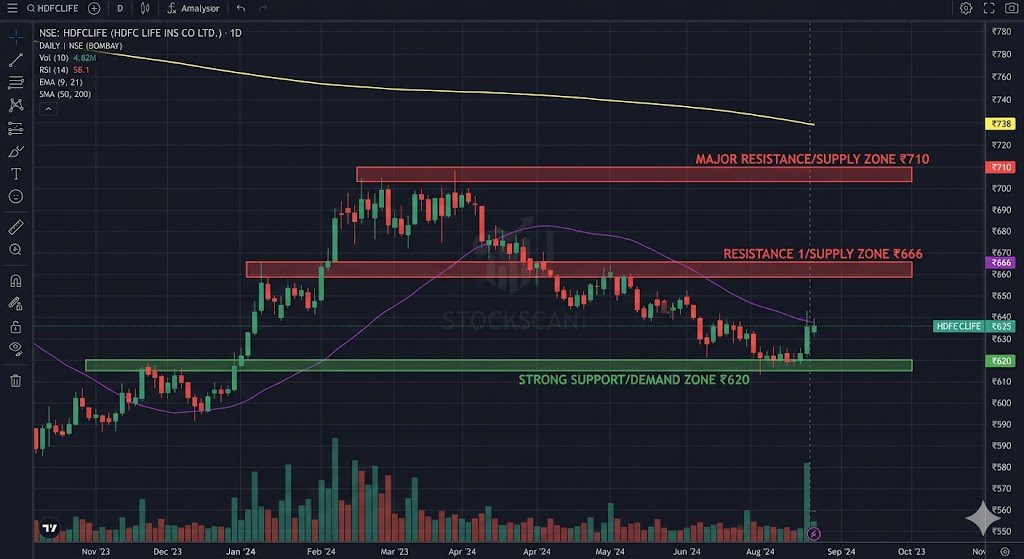
From a technical perspective, HDFC Life’s stock is currently trading in the ₹630–₹640 range, reflecting a phase of consolidation. The stock remains below its 200-day moving average of approximately ₹738, suggesting that the broader trend has yet to turn decisively positive. At the same time, the presence of strong support around ₹620, which coincides with recent lows, indicates that downside risks may be limited in the near term.
On the upside, resistance is observed at ₹666, aligned with the 50-day moving average, followed by a higher resistance level at ₹710. Momentum indicators present a neutral to slightly cautious outlook. The Relative Strength Index (RSI) stands at 54.7, indicating a balanced market position, while the Moving Average Convergence Divergence (MACD) remains in bearish territory but is showing early signs of stabilization. Overall, the stock appears to be in a base-building phase, awaiting a decisive trigger for directional movement.
Street View: Divergence in Targets, Convergence in Thesis
Brokerage firms maintain a broadly positive outlook on HDFC Life, although target prices vary across institutions. Axis Capital has assigned a ‘Buy’ rating with a target of ₹750, citing margin resilience despite regulatory headwinds. Jefferies has a target of ₹845, emphasizing the company’s focus on high-margin retail protection products. Macquarie, with a more optimistic stance, has set a target of ₹900, highlighting the strength of HDFC Bank’s distribution network.
Despite differences in valuation assumptions, there is a clear convergence in the underlying investment thesis. Analysts broadly agree on the company’s strong parentage, scalable distribution capabilities, improving product mix, and long-term margin stability. The consensus target range of ₹880 to ₹950 implies a potential upside of 30% to 40% over the next 12 months, reinforcing the stock’s appeal as a medium- to long-term investment opportunity.
Investment Framework: Positioning Across Time Horizons
Long-Term Investors: A Compounding Franchise
For long-term investors, HDFC Life represents a high-quality compounding opportunity within the financial services sector. The combination of low insurance penetration in India, strong backing from HDFC Bank, consistent VNB generation, and a robust solvency profile positions the company well for sustained growth. Rather than delivering rapid short-term gains, the stock offers the potential for steady wealth creation over extended periods.
Short-Term Traders: Range-Bound Opportunities
For short-term market participants, the stock is currently trading within a defined range of ₹610 to ₹650. A breakout above ₹666 could signal the beginning of an upward move toward ₹700–₹720, while a breach below ₹620 may indicate renewed downside pressure. As such, traders may find opportunities within this range-bound structure, particularly around key support and resistance levels.
Risk Factors: Monitoring the Uncertainties
Key risks include ongoing regulatory changes, particularly those related to surrender value norms, as well as competitive pressures in the non-participating product segment. Additionally, any sustained margin compression could impact valuation multiples. Investors should, therefore, closely monitor these variables while evaluating their investment decisions.
Conclusion: From Stability to Scalable Growth
HDFC Life’s Q4 FY26 performance underscores a transition from high-growth volatility to structured, sustainable expansion. While the results may not reflect aggressive growth, they highlight critical elements of long-term value creation, including margin resilience, capital adequacy, and strategic clarity. The company’s focus on high-margin segments, supported by strong distribution and capital backing, positions it well for the next phase of growth.
In essence, HDFC Life is evolving into a disciplined, capital-efficient franchise capable of delivering consistent returns over time. As the regulatory environment stabilizes and strategic initiatives gain traction, the company is well-placed to transition from a phase of stability to one of scalable growth.
Call to Action
The key question for investors is whether the current valuation fully captures HDFC Life’s transition toward a more protection-led and capital-efficient business model. While the foundation appears strong, future re-rating will depend on the company’s ability to sustain margin expansion and execute its long-term growth strategy effectively.