Indian Oil Corporation Limited delivered one of the biggest earnings surprises in the PSU energy sector after announcing its Q4 FY26 results on May 18, 2026. At a time when global crude oil markets remain highly volatile because of geopolitical tensions in West Asia and disruptions around the Strait of Hormuz, Indian Oil Corporation managed to report a spectacular 78% year-on-year surge in net profit.
The strong earnings performance immediately attracted investor attention because analysts were expecting significant pressure on profitability due to weak marketing margins and rising crude oil prices. However, IOC’s refining business delivered exceptionally strong performance and successfully offset the temporary stress in retail fuel marketing operations.
The results once again highlighted the unique strength of IOC’s integrated business model. Even during periods when fuel marketing margins remain under pressure, the company’s large refining and pipeline infrastructure continues generating powerful cash flows.
For long-term investors, dividend seekers, and short-term traders, IOC’s latest quarterly performance offers several important insights into the future direction of India’s energy sector and PSU oil companies.
Quick Summary of IOC Q4 FY26 Results
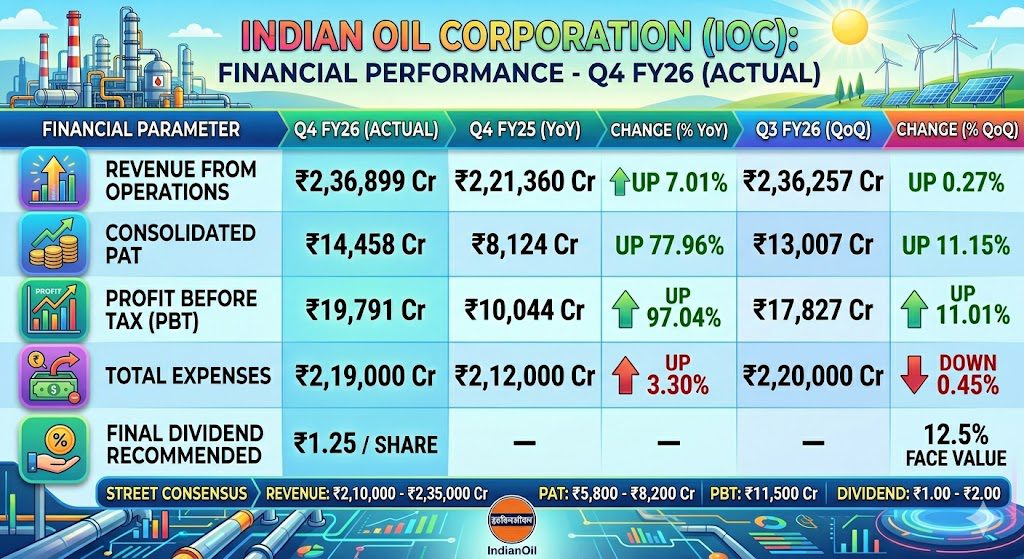
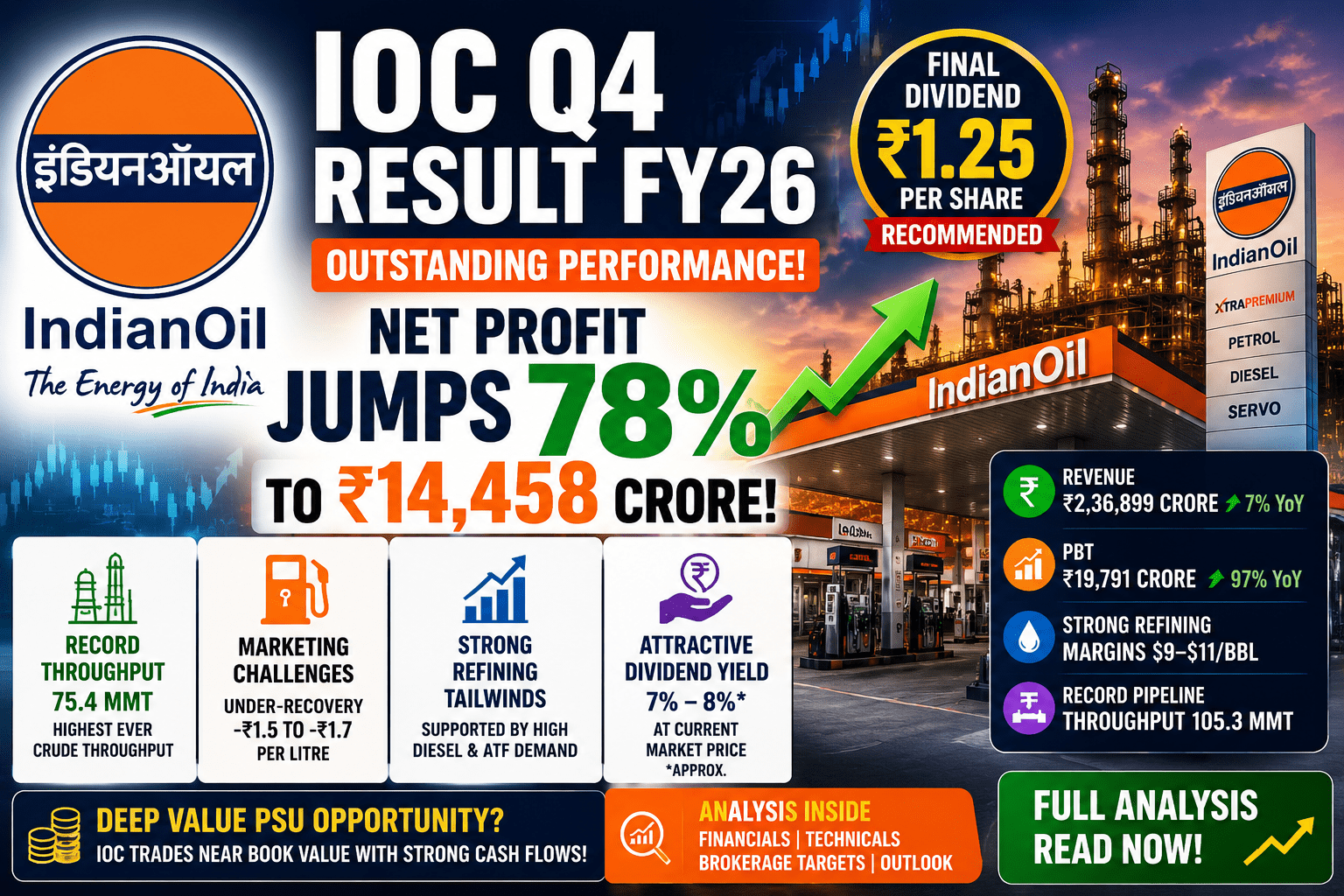
Indian Oil Corporation Limited reported consolidated revenue from operations of ₹2,36,899 crore during Q4 FY26 compared to ₹2,21,360 crore during the same quarter last year. This represented year-on-year growth of approximately 7%.
Consolidated net profit after tax surged sharply to ₹14,458 crore compared to ₹8,124 crore during Q4 FY25, reflecting extraordinary growth of nearly 78%.
Profit Before Tax (PBT) also jumped significantly to ₹19,791 crore compared to ₹10,044 crore during the same quarter last year, representing growth of around 97%.
The company also announced a final dividend of ₹1.25 per equity share, which came broadly within analyst expectations.
The biggest surprise in the earnings report was that IOC managed to deliver such strong profitability despite severe pressure on retail fuel marketing margins during the quarter.
Company Profile: India’s Largest Energy Infrastructure Giant
Indian Oil Corporation Limited remains the dominant force within India’s downstream petroleum ecosystem.
The company operates more than 80.5 MMTPA (Million Metric Tonnes Per Annum) refining capacity across 11 major domestic refineries and controls nearly half of India’s petroleum-product market share.
IOC also controls approximately 35% of India’s refining capacity and nearly 71% of the country’s downstream pipeline throughput infrastructure.
Its vast network of IndianOil petrol pumps and fuel distribution systems forms one of the most critical infrastructure backbones of the Indian economy.
Because of this enormous scale, IOC plays a strategic role not only as a commercial company but also as a national energy-security institution.
Earnings Analysis: Refining Business Saved the Quarter
The biggest story inside IOC’s Q4 FY26 earnings report was the battle between weak marketing margins and extremely strong refining profitability.
Geopolitical Tensions Hurt Fuel Marketing Margins
During the quarter, global crude oil prices surged sharply following rising geopolitical tensions in West Asia and disruptions surrounding the Strait of Hormuz.
Crude oil prices crossed above $111 per barrel, significantly increasing fuel procurement costs for Indian oil-marketing companies.
However, despite rising crude prices, IOC kept domestic petrol and diesel retail prices largely stable during March and April to protect Indian consumers from sudden inflation shocks.
Because of this, IOC’s marketing margins reportedly turned negative and remained between approximately minus ₹1.5 and minus ₹1.7 per litre on retail fuel sales.
Normally, such pressure would significantly damage profitability.
Strong Refining Margins Changed Everything
Despite weak marketing margins, IOC’s refining business delivered exceptional operational performance.
Gross Refining Margins (GRMs) remained extremely strong and hovered between approximately $9 and $11 per barrel during the quarter. Strong global demand for diesel and Aviation Turbine Fuel (ATF) helped support these elevated refining spreads.
IOC also achieved record operational throughput levels.
For the full FY26 financial year, crude throughput reached an all-time high of 75.4 million tonnes, while pipeline throughput surged to a record 105.3 million tonnes.
This strong refining performance completely transformed the company’s earnings profile and became the primary reason behind the 78% jump in quarterly profit.
Full-Year Profitability Recovery Was Extraordinary
The company’s full-year performance was even more impressive.
For FY26, consolidated net profit surged to ₹44,677 crore compared to only ₹13,789 crore during FY25.
This represents one of the strongest annual profitability recoveries seen in the PSU energy sector over recent years and clearly demonstrates the cyclical strength of IOC’s integrated business model.
Dividend Analysis: Strong Income Opportunity for Investors
Indian Oil Corporation Limited also rewarded shareholders with another dividend announcement following the strong earnings report.
The board recommended a final dividend of ₹1.25 per equity share with a face value of ₹10.
This comes in addition to interim dividends already distributed earlier during FY26.
The official record date is expected to be announced following upcoming AGM approvals, while dividend payments are expected within 30 days after declaration.
At current market prices near ₹134, IOC continues offering an attractive dividend yield profile between approximately 7% and 8%, making the stock especially attractive for long-term income-focused investors.
Fundamental Analysis: Deep Value PSU Opportunity?
From a valuation perspective, IOC currently remains one of the cheapest large-cap PSU companies in India.
Extremely Low Valuation Multiples
After correcting nearly 22% from its previous peak near ₹188.96, the stock currently trades around ₹134.
This decline has pushed IOC’s trailing Price-to-Earnings ratio into an extremely attractive value zone near 5.2x–6.4x earnings.
Compared to both historical valuations and broader market multiples, IOC currently trades at a deep discount.
Trading Near Book Value
IOC currently trades near a Price-to-Book ratio of approximately 0.99x against a book value per share near ₹135.27.
In simple terms, investors are effectively buying one of India’s largest energy infrastructure networks almost at book value.
For long-term value investors, such pricing often becomes highly attractive, especially when the company continues generating strong cash flows and maintaining dividend payouts.
IOC’s Green Energy Transition Strategy
IOC is also gradually expanding beyond traditional fossil-fuel refining.
The company has committed significant investments toward sustainable energy infrastructure, including a ₹1,063 crore Sustainable Aviation Fuel (SAF) project at Paradip.
IOC is additionally expanding EV charging infrastructure across highways and urban networks as part of India’s broader energy-transition strategy.
This diversification becomes extremely important for long-term investors because it gradually reduces dependence on conventional fuel demand growth over the coming decades.
Technical Analysis: Key Trading Levels for This Week
Technically, IOC currently presents an interesting value-reversal setup.
The stock closed near ₹134.48 before the earnings release and continues consolidating close to its recent multi-month lows.
The most important technical pivot level now remains ₹135.41. Sustaining above this level on a daily closing basis could potentially shift short-term momentum back toward the bulls.
Immediate resistance levels are positioned near ₹140.50 followed by ₹148 and ₹152.
On the downside, immediate support exists near ₹132 followed by the stronger structural support zone around ₹130.22.
The ₹130 zone currently represents one of the most important long-term demand areas for the stock.
The 14-day Relative Strength Index (RSI) also indicates near-oversold conditions, which may support the possibility of a short-covering rally after the strong earnings surprise.
From a swing-trading perspective, the combination of low valuation, oversold technical conditions, and strong profit growth creates a relatively favorable near-term setup.
Management Guidance: Expansion and Margin Stabilization
Management commentary following the earnings release focused heavily on future capacity expansion and margin normalization strategies.
IOC confirmed that multiple brownfield refinery expansion projects across Panipat, Koyali, and Barauni remain on schedule.
These projects are expected to increase refining capacity and improve long-term product yields.
Management also indicated that current fuel-marketing under-recoveries may remain temporary.
If global crude prices continue staying above $110 per barrel, gradual retail fuel-price revisions or calibrated government compensation mechanisms could eventually help normalize marketing margins.
This becomes extremely important because normalized marketing margins would significantly improve future profitability if refining margins remain supportive simultaneously.
Brokerage Outlook and Institutional Target Prices
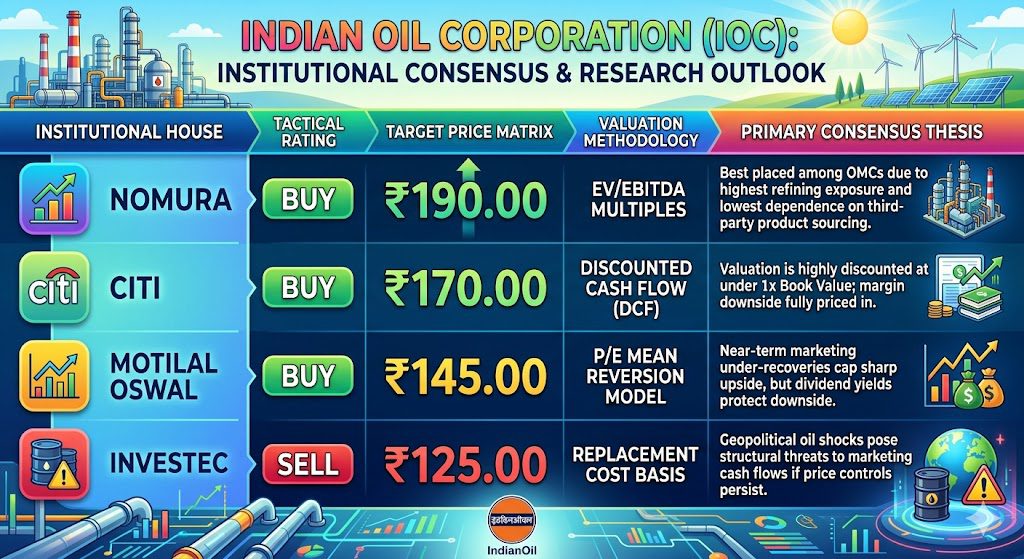
Most institutional brokerage firms currently maintain positive long-term views on Indian Oil Corporation Limited because of its extremely attractive valuation profile.
Nomura maintains a BUY rating with a target price of ₹190, highlighting IOC’s strong refining exposure and integrated infrastructure advantages.
Citi also maintains a BUY rating with a target near ₹170 based on discounted cash-flow analysis and the stock’s deep valuation discount below book value.
Motilal Oswal remains moderately bullish with a target near ₹145, arguing that near-term marketing under-recoveries may limit immediate upside but strong dividend yields protect downside risk.
However, not all institutions remain bullish.
Investec currently maintains a SELL rating with a target near ₹125 because prolonged geopolitical crude-oil shocks could continue pressuring retail marketing profitability.
Overall, the average institutional target price currently stands near ₹166.94, implying meaningful upside potential from current market levels.
Should You Buy, Hold, or Sell IOC Shares?
For long-term value investors and dividend-focused portfolios, IOC currently appears relatively attractive after the recent correction.
The stock combines several important positives including extremely low valuation multiples, strong refining profitability, attractive dividend yields, integrated infrastructure advantages, and government-backed strategic importance.
Investors looking for stable PSU dividend income may continue gradually accumulating the stock during corrections, particularly near the ₹130 support zone.
For short-term swing traders, the strong 78% profit jump combined with oversold technical conditions could potentially trigger a near-term short-covering bounce toward ₹140–₹145.
However, traders should continue monitoring global crude-oil prices and geopolitical developments carefully because sudden spikes in oil prices could once again pressure marketing margins.
Overall, IOC currently remains one of the most attractive deep-value PSU opportunities in the Indian energy sector for investors comfortable with commodity-cycle volatility.
For official exchange filings and company disclosures, investors can also track updates through NSE India Official Website.