Emami Limited announced its Q4 FY26 financial results on May 21, 2026, and the market reaction remained cautious after the company reported weaker-than-expected earnings. Revenue declined, operating margins came under pressure, and net profit slipped nearly 12% year-on-year. Immediately after the results announcement, the stock witnessed strong selling pressure and fell more than 3% intraday before stabilizing near ₹418.85.
At first glance, the quarterly performance appeared disappointing. However, investors who closely understand the FMCG sector know that Emami operates a highly seasonal business model where weather conditions can significantly influence quarterly revenue patterns. During Q4 FY26, unseasonal weather fluctuations negatively affected the company’s core summer-focused portfolio, especially cooling oils, talcum products, and heat-relief personal-care brands that normally perform strongly during this period.
Despite the weak headline numbers, the broader long-term story surrounding Emami Limited remains largely intact. The company’s non-summer domestic portfolio continued delivering healthy growth, gross margins improved meaningfully, and management maintained a confident outlook regarding rural recovery and demand normalization during FY27.
For long-term investors, the latest quarter appears more like a temporary operational slowdown rather than a structural weakness in the business. The company continues benefiting from powerful niche FMCG brands, strong pricing power, stable cash-flow generation, and a healthy dividend-distribution track record.
Emami Limited Q4 FY26 Financial Performance Snapshot
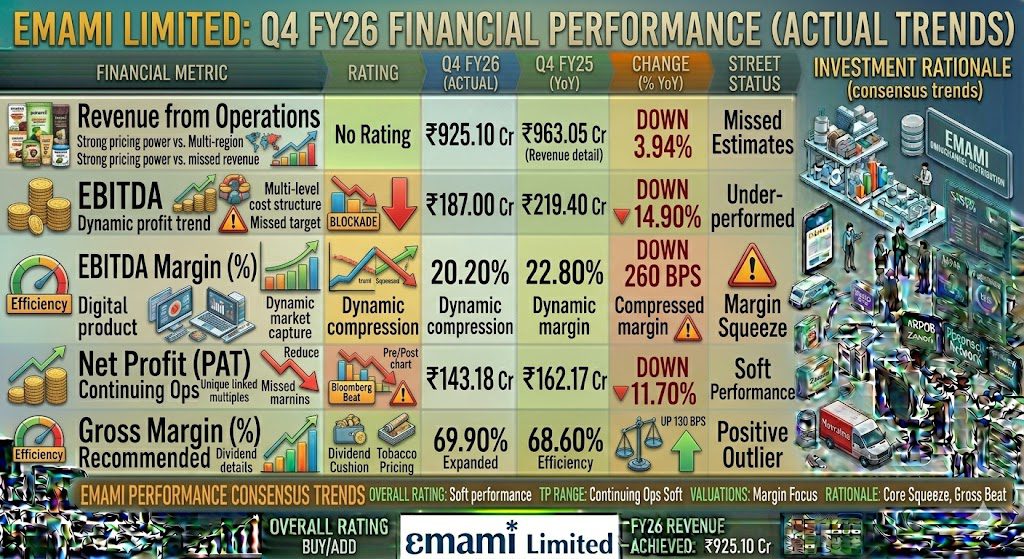
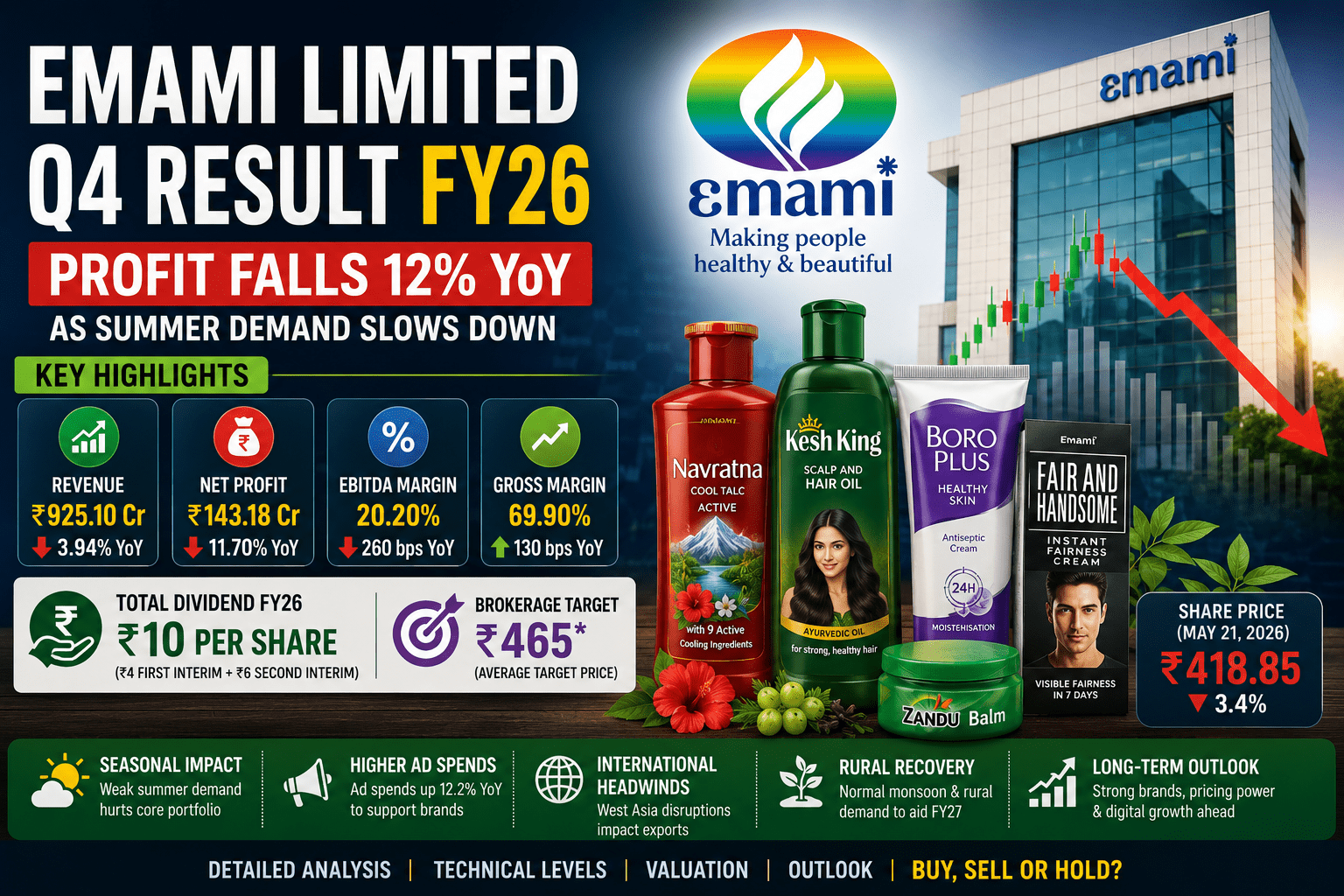
Emami Limited reported revenue from operations of ₹925.10 crore during Q4 FY26 compared to ₹963.05 crore during the corresponding quarter last year, reflecting a decline of approximately 3.94% year-on-year. The revenue performance remained below Street expectations as weak summer demand affected sales across several key product categories.
EBITDA declined sharply to ₹187 crore compared to ₹219.40 crore during Q4 FY25, reflecting a contraction of nearly 14.9%. EBITDA margins also compressed significantly to 20.2% from 22.8% during the previous year. The margin pressure mainly resulted from higher advertising and promotional expenditure, along with temporary disruptions within international operations.
Net profit after tax declined to ₹143.18 crore compared to ₹162.17 crore during Q4 FY25, reflecting a decline of approximately 11.7% year-on-year.
However, one of the biggest positives inside the earnings report was the improvement in gross margins. Gross margins expanded by nearly 130 basis points to 69.9%, indicating that the company continues maintaining strong pricing power while also benefiting from softer raw-material costs.
This gross-margin expansion is strategically important because it shows that the core brand ecosystem remains operationally healthy despite temporary demand weakness.
The company also maintained a strong shareholder-return profile. While no fresh dividend was announced alongside the quarterly results, Emami’s total dividend payout for FY26 stood at ₹10 per share, including the ₹4 first interim dividend and ₹6 second interim dividend already distributed earlier during the fiscal year.
Understanding Emami’s Business Model and Competitive Strength
Emami Operates One of India’s Strongest Niche FMCG Brand Portfolios
Emami Limited holds a unique position within India’s FMCG industry because the company dominates several highly specialized personal-care and healthcare product categories.
Unlike broader FMCG conglomerates that compete across dozens of generic categories, Emami focuses heavily on high-recognition niche brands such as Navratna, BoroPlus, Zandu Balm, Fair and Handsome, and Kesh King.
These brands enjoy deep customer loyalty across both urban and rural India and continue generating stable long-term cash flows for the company.
However, the company’s operating structure also creates dependence on seasonal demand cycles. Products such as cooling oils and talcum powders generally perform exceptionally well during extended summer seasons but may experience temporary weakness when weather conditions become unpredictable.
This makes Emami’s quarterly earnings more sensitive to seasonal changes compared to larger staple-focused FMCG businesses.
Seasonal Weakness Became the Biggest Challenge During Q4 FY26
The biggest operational challenge during the quarter came from weak performance within the company’s summer portfolio.
Management specifically highlighted that inconsistent and unfavorable weather conditions across several Indian markets negatively affected demand for key summer-focused products.
As a result, consolidated revenue growth remained weak despite stable brand positioning.
However, the broader operational picture was not entirely negative.
The company’s non-summer domestic portfolio reportedly grew approximately 11%, indicating that Emami’s wider FMCG ecosystem continues performing well despite temporary seasonal weakness.
This distinction is important because it suggests that the earnings slowdown was largely environmental rather than structural in nature.
Earnings Analysis: Why Margins and Profitability Declined
Aggressive Advertising Investments Pressured Margins
One of the major reasons behind the margin contraction during Q4 FY26 was the company’s decision to aggressively increase advertising and promotional expenditure.
Instead of reducing marketing activity during a weaker quarter, management increased advertising and promotional spending by approximately 12.2% year-on-year.
This strategy temporarily impacted profitability but reflects management’s long-term focus on strengthening brand visibility, defending market share, and supporting newer product launches.
The company is also investing aggressively into newer digital-first and direct-to-consumer FMCG categories.
Although these investments may slightly pressure near-term earnings, they could significantly strengthen Emami’s future competitive positioning within premium urban consumer markets.
International Business Faced Geopolitical Disruptions
Another important challenge emerged from geopolitical tensions across West Asia.
Management confirmed that international operations faced temporary disruptions because of regional geopolitical instability, which affected supply chains and delayed certain billing cycles.
These disruptions negatively impacted parts of the company’s export business during the quarter.
However, management clarified that alternative logistics arrangements are already being implemented and international operations are expected to stabilize gradually from Q1 FY27 onward.
This indicates that the weakness within international operations is likely temporary rather than structural.
Dividend Strength Continues Supporting Long-Term Investors
Emami Maintains a Strong Shareholder-Payout Philosophy
Despite reporting weaker quarterly earnings, Emami Limited continued maintaining its strong dividend-distribution track record.
The company’s total FY26 dividend payout stood at ₹10 per share, representing a remarkable 1,000% payout relative to the ₹1 face value.
For long-term dividend-focused investors, this remains an important indicator of strong cash-flow stability and healthy balance-sheet quality.
In a volatile economic environment, companies capable of maintaining consistent shareholder payouts often command stronger long-term investor confidence.
Fundamental Analysis: Why the Long-Term Story Still Looks Attractive
Gross Margin Expansion Reflects Strong Pricing Power
One of the most encouraging aspects of Emami’s Q4 FY26 results was the sharp improvement in gross margins.
Gross margins expanded by approximately 130 basis points to 69.9%.
This indicates that the company continues benefiting from strong pricing power, efficient cost management, and softer input costs across raw materials such as liquid paraffin and vegetable oils.
For FMCG businesses, gross-margin expansion remains one of the strongest indicators of brand strength and operational resilience.
Full-Year FY26 Performance Remained Healthy
Despite the weak quarterly performance, Emami’s broader FY26 financial performance remained operationally solid.
Full-year revenue stood near ₹3,780 crore while EBITDA reached approximately ₹964 crore and net profit remained close to ₹775 crore.
These numbers clearly demonstrate that the company continues operating as a highly profitable FMCG business despite short-term disruptions.
The long-term business model therefore remains fundamentally stable.
Digital-First Expansion Could Become a Future Growth Engine
Another important long-term development inside Emami Limited is the company’s growing investment into digital-first FMCG businesses.
Management continues expanding aggressively into premium urban-consumer categories and direct-to-consumer personal-care ecosystems.
This strategy is particularly important because Indian consumers are increasingly shifting toward online-first wellness and personal-care brands.
If executed successfully, these investments could significantly strengthen Emami’s future growth trajectory.
Technical Analysis: Key Trading Levels Investors Must Watch
Following the earnings announcement, Emami shares witnessed aggressive institutional selling pressure.
The stock briefly touched an intraday high near ₹438 before falling sharply and closing around ₹418.85.
Technically, the stock now appears weak in the short term after slipping below several near-term moving averages and trading beneath its short-term Volume Weighted Average Price structure.
The key technical pivot currently remains near ₹430. Unless the stock decisively reclaims this level on a closing basis, near-term sentiment is likely to remain cautious.
On the upside, important resistance zones remain near ₹426.50, ₹431.90, and eventually the broader supply zone near ₹438.
On the downside, important support levels remain near ₹410.10, ₹405, and the major long-term demand zone near ₹390.
If the stock decisively breaks below ₹410, traders could witness accelerated downside momentum toward the psychological ₹400 region.
For swing traders, patience may remain the better strategy until the stock stabilizes above critical support zones.
Management Guidance & FY27 Outlook
Management maintained a constructive outlook despite the softer quarterly performance.
One of the biggest reasons behind management optimism is the expectation of improving rural demand conditions following forecasts for a normal monsoon season later this year.
Rural markets remain extremely important for Emami because a large portion of its consumer brands derive significant sales from semi-urban and rural India.
Improving rural liquidity and stronger agricultural sentiment could therefore meaningfully improve volume growth during FY27.
Management also confirmed that international supply-chain disruptions linked to West Asia geopolitical tensions are gradually being addressed through re-routed logistics systems.
The company expects international business normalization to begin from Q1 FY27 onward.
Institutional View: Brokerage Ratings & Target Prices
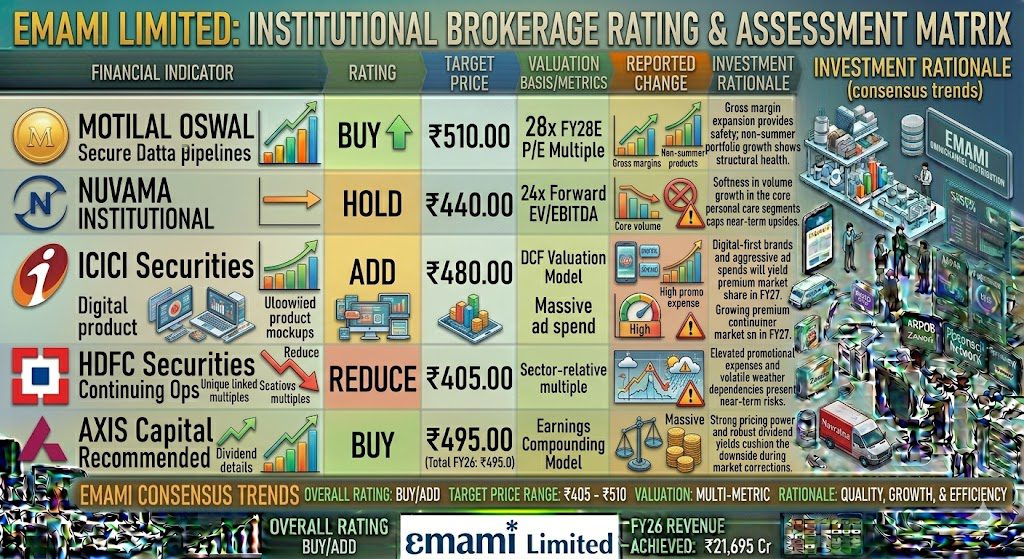
Institutional research firms delivered mixed but broadly supportive reactions following Emami’s earnings announcement.
Motilal Oswal Financial Services maintained a BUY recommendation with a target price of ₹510, highlighting strong gross-margin expansion and healthy non-summer portfolio growth.
Nuvama Wealth Management retained a HOLD recommendation with a target price of ₹440 because softness within core summer categories may continue limiting near-term upside.
ICICI Securities maintained an ADD recommendation with a target price of ₹480, citing future growth opportunities within digital-first FMCG expansion.
HDFC Securities retained a REDUCE recommendation with a target price of ₹405 due to concerns regarding weather dependency and rising promotional expenditure.
Axis Capital maintained a BUY recommendation with a target price of ₹495 because of strong pricing power and healthy dividend support.
The broader institutional consensus target currently stands near ₹465, implying meaningful upside potential if operational recovery improves during FY27.
Final Verdict: Buy, Hold, or Sell?
For long-term investors, the latest quarterly weakness should largely be viewed as a temporary operational slowdown rather than a structural deterioration in the business.
Emami Limited continues benefiting from strong brand equity, healthy gross margins, stable cash flows, attractive dividend payouts, and growing digital expansion opportunities.
The company’s long-term FMCG franchise remains fundamentally healthy.
For short-term traders, however, the current technical structure remains weak after the sharp post-results decline.
Aggressively buying the stock before stabilization may expose traders to additional downside volatility.
A more disciplined trading approach may involve waiting for the stock to stabilize above the ₹430 recovery zone or near the ₹405–₹410 support region before considering fresh positions.
Overall, Emami’s Q4 FY26 results reflected a difficult quarter shaped mainly by seasonal weakness and temporary geopolitical disruptions. Yet beneath the weak headline numbers, the company’s core brand strength, pricing power, and long-term FMCG fundamentals continue remaining firmly intact.