Introduction: The Premiumization Powerhouse
Over the last three decades, India’s telecom sector has undergone one of the most dramatic transformations in corporate history. In the early 1990s, mobile connectivity was considered a luxury service available only to a small urban elite. Today, telecom networks have become the backbone of India’s digital economy, supporting everything from online banking and digital education to artificial intelligence and cloud computing.
Among all telecom companies that participated in this evolution, Bharti Airtel has consistently remained one of the strongest long-term wealth creators in the Indian market. Airtel’s latest Q4 FY26 results announced on May 13, 2026, once again reinforce why the company is increasingly being viewed as the “premiumization king” of India’s telecom sector.
Back during the 2G era, telecom companies celebrated achieving Average Revenue Per User (ARPU) of ₹100. In 2026, Airtel is now generating an industry-leading mobile ARPU of ₹257 while continuing to attract higher-quality subscribers and premium data users. That transformation highlights the company’s long-term strategic shift from chasing subscriber quantity to maximizing customer quality and profitability.
The biggest story from the Q4 FY26 earnings is not simply revenue growth. It is the combination of massive scale, improving profitability, stronger balance sheet quality, and rising customer monetization. Airtel’s consolidated quarterly revenue crossed ₹55,000 crore for the first time in company history, demonstrating the sheer scale of India’s growing digital consumption economy.
The market reacted positively to the results announcement. The stock closed near ₹1,788.10 on the NSE, gaining approximately 1.8% after the earnings release. Investors particularly welcomed the company’s aggressive deleveraging, strong EBITDA growth, and the announcement of a massive ₹24 final dividend.
In many ways, Bharti Airtel is no longer just a telecom company. It is rapidly becoming a digital infrastructure giant deeply connected to India’s long-term data economy, financial technology ecosystem, and artificial intelligence-driven future.
Q4 FY26 Actual Performance: The Hard Numbers
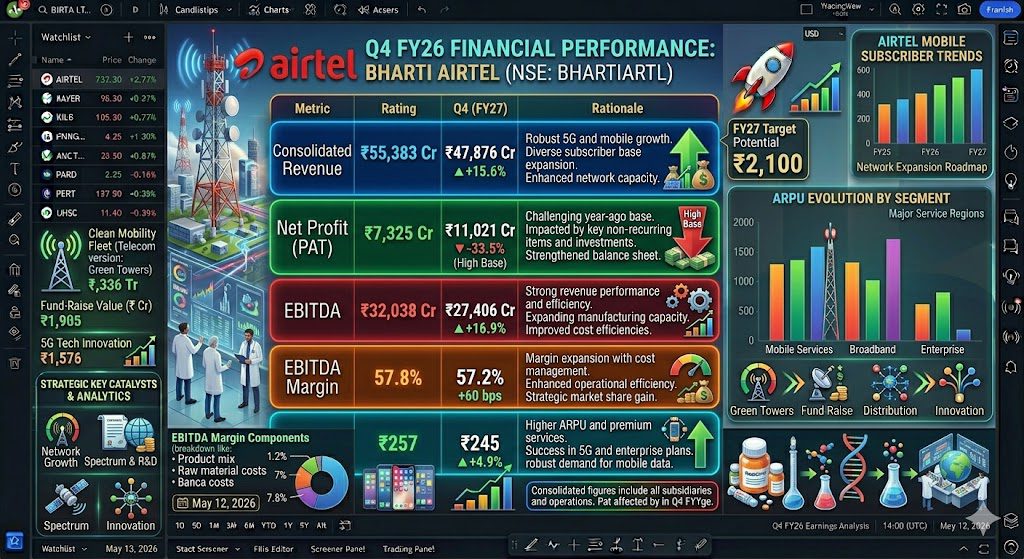
Bharti Airtel’s audited Q4 FY26 results filed with the stock exchanges showcase another quarter of strong operational execution. While headline net profit declined on a year-on-year basis, the broader operational metrics reveal a business that continues strengthening structurally.
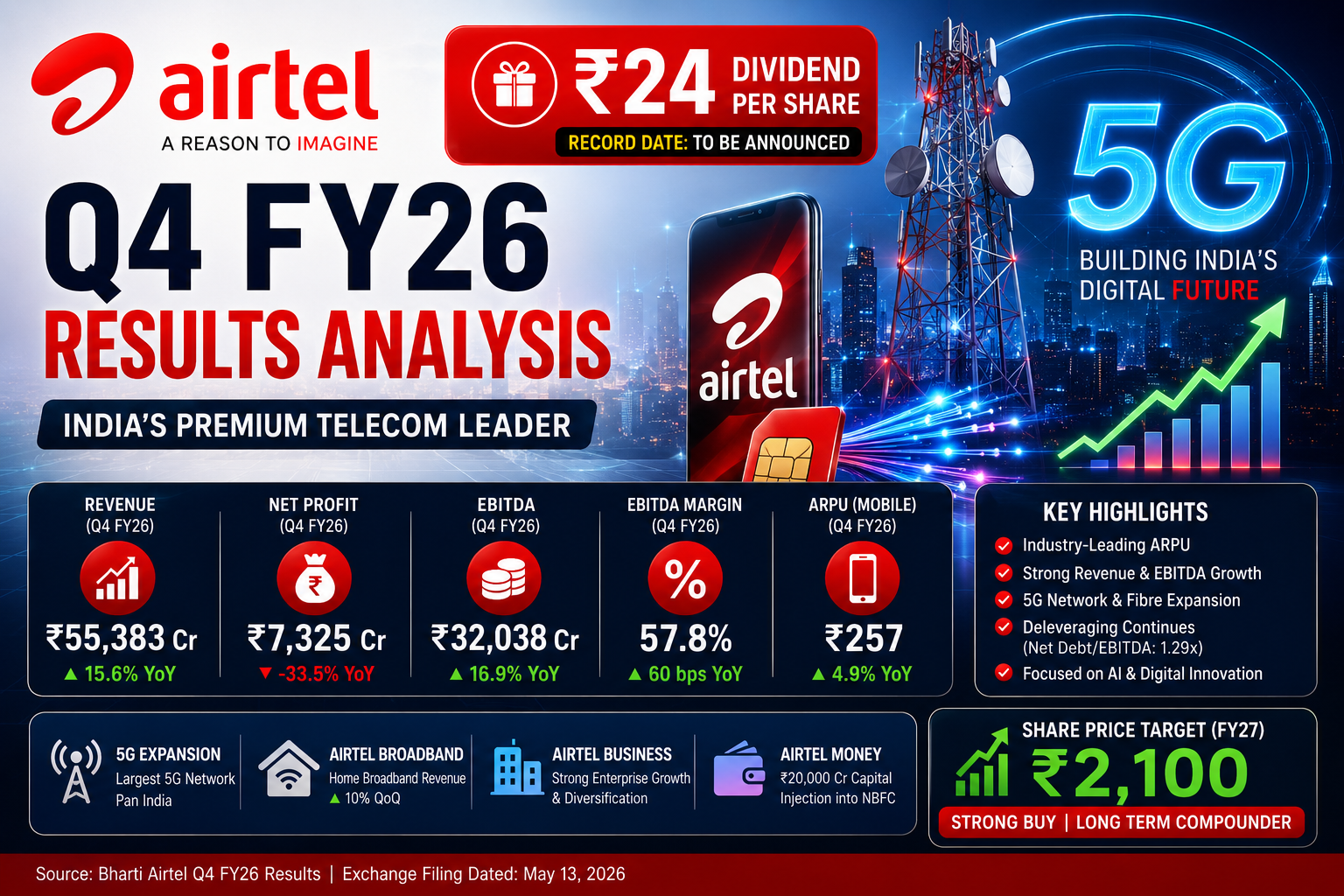
Consolidated revenue for Q4 FY26 rose sharply to ₹55,383 crore compared to ₹47,876 crore in the same quarter last year. This represents strong year-on-year growth of nearly 15.6%, driven primarily by premium subscriber additions, higher data consumption, and expanding digital services revenue.
The company’s EBITDA performance remained particularly impressive. EBITDA increased to ₹32,038 crore from ₹27,406 crore last year, representing robust growth of approximately 16.9%. EBITDA margin also improved to 57.8% compared to 57.2% last year, expanding by 60 basis points.
Airtel’s ability to consistently maintain EBITDA margins above 57% places it among the strongest telecom operators globally in terms of operational efficiency. High margins are especially important in telecom because they directly improve free cash flow generation and balance sheet strength.
Net profit for the quarter stood at ₹7,325 crore compared to ₹11,021 crore in Q4 FY25, representing a decline of approximately 33.5%. However, investors should understand that this decline was largely due to a very high base effect from the previous year rather than operational weakness.
In fact, most market analysts focused more on the company’s improving balance sheet and strong ARPU trajectory rather than reacting negatively to the profit decline.
Another major highlight from the quarter was mobile ARPU growth. Airtel reported mobile ARPU of ₹257 compared to ₹245 in the same quarter last year. Although ARPU dipped slightly from ₹259 in Q3 FY26, the broader structural uptrend remains firmly intact.
Fundamental Deep-Dive: Quality Over Quantity
ARPU Leadership Continues
One of the biggest reasons behind Airtel’s long-term success is its disciplined focus on premium customers rather than aggressively chasing low-quality subscriber additions.
The company’s mobile ARPU currently stands at ₹257, which remains significantly ahead of many industry peers. This reflects Airtel’s strong pricing power, premium brand positioning, and ability to attract higher-spending customers.
The Indian telecom market is gradually evolving from a pure subscriber growth story into a monetization-driven industry. Data consumption continues to rise rapidly due to video streaming, gaming, AI applications, digital payments, and cloud services. Airtel is strategically positioning itself at the center of this digital consumption boom.
Even though quarterly ARPU softened slightly from ₹259 to ₹257, analysts remain highly optimistic because the long-term trajectory toward ₹300 ARPU still appears achievable over the next few years.
For telecom companies, ARPU growth is one of the most important profitability drivers because it directly improves operating leverage and cash flow generation. Airtel’s structural ARPU expansion story therefore remains one of the strongest bullish arguments for the stock.
Deleveraging Victory
Another major positive from the Q4 FY26 report is Airtel’s dramatic balance sheet improvement.
The company’s Net Debt-to-EBITDA ratio improved significantly to 1.29x compared to 1.86x last year. This sharp deleveraging reflects strong free cash flow generation and disciplined financial management.
Telecom is traditionally considered a highly capital-intensive industry because companies constantly need to invest in spectrum, towers, fibre networks, and new technologies like 5G. High debt levels have historically been one of the biggest risks for telecom operators globally.
Airtel’s successful deleveraging therefore represents a major strategic achievement because it reduces financial risk while increasing long-term profitability potential. Investors typically reward telecom companies that successfully improve both cash flow and balance sheet quality simultaneously.
Segment Diversification Strengthens Business
Airtel’s growth story is now extending well beyond traditional mobile services.
Home broadband revenue surged nearly 10% quarter-on-quarter as fibre penetration and high-speed internet demand continued expanding across urban India. Remote work, digital entertainment, online education, and AI-driven applications are accelerating broadband demand structurally.
Meanwhile, Airtel Business—the company’s enterprise segment—continues to grow steadily and diversify revenue away from purely wireless competition. Enterprise solutions, cloud connectivity, cybersecurity, and data center services are becoming increasingly important revenue contributors.
This diversification strategy reduces dependence on the highly competitive retail wireless market and strengthens the company’s long-term earnings stability.
Shareholder Rewards: The Dividend Bonanza
Massive Dividend Recommendation
Bharti Airtel’s board recommended a final dividend of ₹24 per fully paid-up equity share with face value ₹5.
This announcement became one of the biggest highlights from the Q4 FY26 results because it represents one of the largest dividend payouts in the company’s history. The payout ratio currently stands near 480%, reflecting management confidence in the company’s cash flow generation and financial position.
For shareholders, such a large dividend provides a strong signal that Airtel has entered a much more mature and financially stable phase compared to the aggressive debt-heavy expansion years of the past.
Historical Significance
Historically, telecom companies globally have struggled to balance heavy capital expenditure with shareholder payouts. Airtel’s ability to simultaneously invest aggressively in 5G infrastructure while also rewarding shareholders generously demonstrates the strength of its operational cash flows.
The dividend announcement also reinforces the stock’s growing appeal among institutional investors, pension funds, and long-term wealth creators seeking both capital appreciation and stable shareholder returns.
The official record date details are expected to be announced following shareholder approval during the upcoming Annual General Meeting.
Technical Analysis: The ₹1,800 Horizon
Current Technical Setup
From a technical analysis perspective, Airtel remains one of the strongest trending large-cap stocks in the Indian market. The stock is comfortably trading above both its 50-day and 200-day moving averages, indicating a strong long-term bullish structure.
The current price action suggests sustained institutional buying interest, particularly after the strong Q4 FY26 results announcement.
Key Support Levels
The most important technical support zone currently lies between ₹1,680 and ₹1,700. This area has repeatedly acted as a strong accumulation zone where institutional investors have historically entered the stock aggressively during market corrections.
As long as Airtel holds above this support band, the broader bullish trend structure remains intact. Long-term investors often use dips toward these support areas to gradually build positions in high-quality compounder stocks.
Resistance Levels
On the upside, the immediate resistance zone lies near ₹1,900. A sustained breakout above this level could potentially trigger a fresh momentum rally toward the broader bull-case target of ₹2,100.
Technical analysts also point toward improving subscriber stability as another bullish factor. Customer churn declined from 2.9% to 2.4% quarter-on-quarter, indicating stronger customer retention and increasing network stickiness.
Lower churn is extremely important because it improves long-term revenue predictability and reduces customer acquisition costs.
Brokerage Sentiment & Targets: The Re-rating View
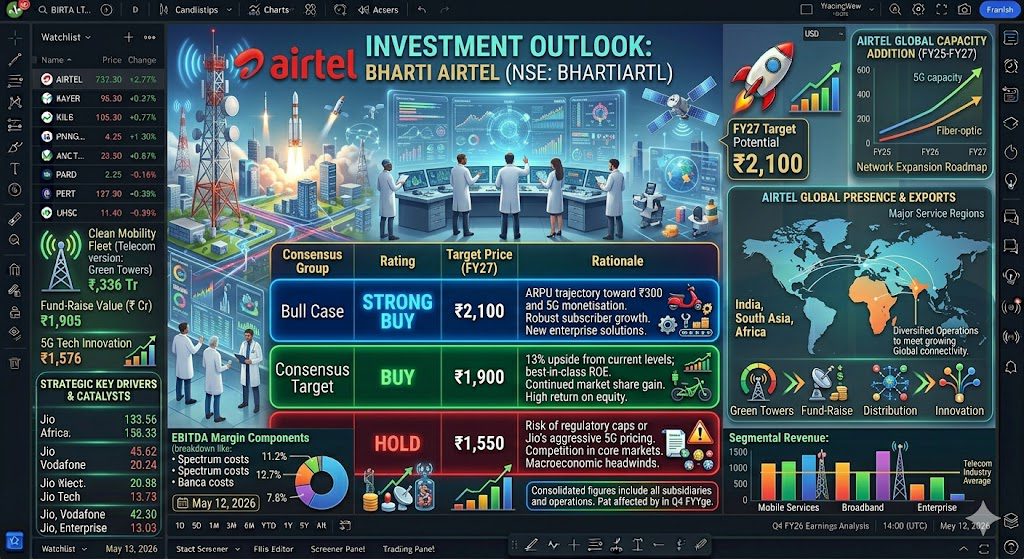
Brokerage sentiment toward Airtel remains overwhelmingly bullish following the Q4 FY26 results.
Most analysts believe the company is entering a powerful long-term monetization cycle driven by ARPU expansion, 5G adoption, enterprise growth, and digital financial services.
The broader market consensus currently maintains “Buy” or “Strong Buy” ratings on the stock. Bull-case estimates suggest targets near ₹2,100 over FY27, driven by expectations of ARPU eventually moving toward ₹300 and stronger 5G monetization.
Consensus target estimates currently stand near ₹1,900, indicating roughly 13% upside potential from current levels. Analysts continue highlighting Airtel’s industry-leading return ratios, premium subscriber base, and balance sheet strength as major positives.
However, some cautious analysts maintain “Hold” ratings due to concerns around possible regulatory interventions or aggressive pricing competition from Reliance Jio in the 5G market.
Still, the broader institutional consensus clearly continues favoring Airtel as one of India’s highest-quality telecom investments.
Management Guidance: Putting AI at the Heart
Artificial Intelligence Strategy
Executive Vice-Chairman Gopal Vittal emphasized that Airtel plans to place Artificial Intelligence at the center of its long-term future-proofing strategy.
AI-driven network optimization, predictive maintenance, personalized customer experiences, cybersecurity, and enterprise automation are expected to become major strategic growth areas over the coming years.
As India’s digital economy expands rapidly, telecom operators are increasingly evolving into broader technology and data infrastructure companies. Airtel appears determined to lead that transformation aggressively.
5G Capex & Fibre Expansion
Airtel’s Q4 capital expenditure stood at ₹16,066 crore, reflecting continued aggressive investment into 5G densification and fibre network deployment.
The company is focusing heavily on improving network quality, expanding high-speed connectivity, and preparing infrastructure capable of supporting AI-driven applications and ultra-high data consumption.
India’s 5G monetization story is still in its early stages, meaning the long-term opportunity remains enormous.
Airtel Money Expansion
Another major strategic development is Airtel’s plan to inject nearly ₹20,000 crore into its NBFC and digital financial services ecosystem through Airtel Money.
Digital finance, lending, payments, and fintech services are expected to become increasingly important growth drivers for telecom companies globally. Airtel is now positioning itself aggressively within this expanding ecosystem.
The 30-Year Analyst Verdict
For Long-Term Investors
Bharti Airtel increasingly resembles a classic “compounder” stock capable of generating long-term wealth through consistent earnings growth, improving profitability, and strong industry positioning.
The ARPU growth story is structural rather than cyclical. India’s data economy is still expanding rapidly, and Airtel remains one of the strongest beneficiaries of rising digital consumption.
Combined with improving balance sheet strength, premium customer positioning, enterprise diversification, and AI-led future expansion, Airtel continues to remain one of the most institutionally favored stocks in India.
For long-term investors building a core blue-chip portfolio, Airtel remains one of the strongest telecom plays in the Indian market.
For Active Traders
For traders, Airtel currently remains technically strong but somewhat extended near lifetime highs.
Instead of chasing rallies aggressively, swing traders may prefer waiting for pullbacks toward the ₹1,740 region near the 20-day EMA before entering fresh positions.
As long as the broader market remains stable, the probability of Airtel eventually testing the ₹1,900 zone remains relatively strong.
Conclusion & Engagement (CTA)
Bharti Airtel’s Q4 FY26 results once again demonstrate why the company remains one of the strongest blue-chip technology and telecom stories in India.
Crossing ₹55,000 crore in quarterly revenue, maintaining industry-leading ARPU, dramatically improving balance sheet quality, and announcing a massive ₹24 dividend together reflect a business operating at exceptional scale and efficiency.
The company is no longer just benefiting from India’s telecom growth. It is actively shaping the future of India’s digital economy through 5G infrastructure, enterprise services, artificial intelligence, and digital financial ecosystems.
For investors seeking a combination of growth, stability, and long-term digital transformation exposure, Airtel continues to stand out as one of the strongest large-cap opportunities in the Indian stock market.
Are you holding Airtel for its ₹24 dividend or betting on the ₹2,100 long-term target? Share your telecom investment strategy in the comments below.