1. Breaking News Summary
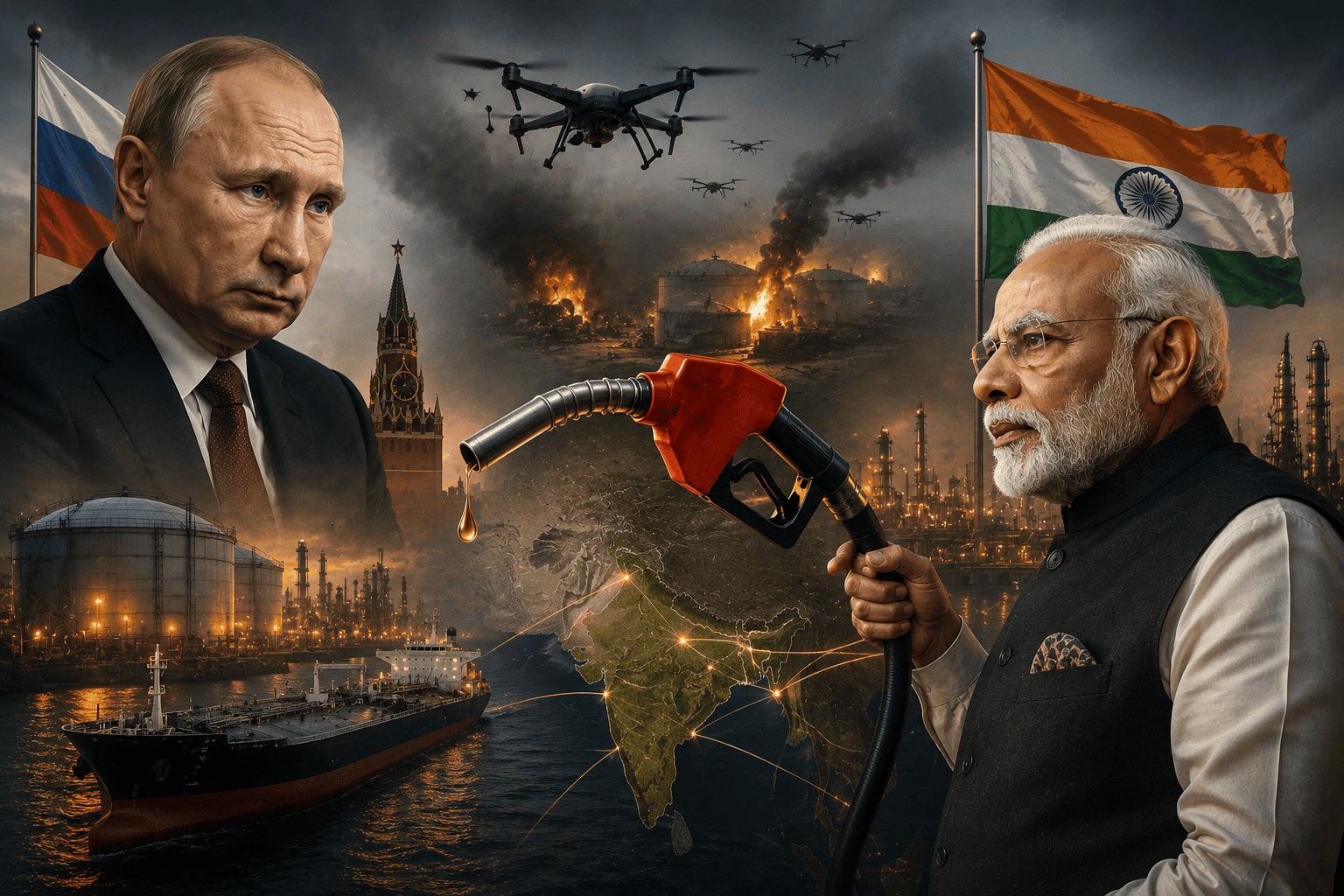
In a stunning geoeconomic reversal, market intelligence and shipping tracking logs indicate that Russia—historically one of the world’s premier crude oil exporters—has begun purchasing refined petroleum products (gasoline and diesel) from international markets, including independent channels linked to India. This unprecedented pivot follows a highly synchronized, multi-month Ukrainian drone campaign that has systematically targeted and crippled more than 18 major Russian domestic refineries, effectively knocking out an estimated 25% of the country’s refining throughput. While the Indian government maintains a stance of official non-involvement, independent maritime data reveals significant spikes in refined product movements via third-party regional hubs.
2. Executive Summary
The Core Paradox: Russia remains the world’s second-largest crude oil producer, yet it faces an acute domestic shortage of refined automotive and agricultural fuel (gasoline).
The Catalyst: A relentless Ukrainian drone campaign throughout the first half of 2026 has successfully struck over 18 Russian refineries and storage depots, causing supply to plummet from a daily demand of 110,000 metric tons down to 85,000 metric tons.
The Indian Connection: Kpler ship-tracking data indicates that while India imported a record-breaking 52% of its crude oil needs from Russia in June 2026, private and independent traders are concurrently routing thousands of metric tons of refined Indian petrol back toward Russian networks.
Denial and Cover: The Indian government has officially denied sending state-backed fuel shipments. Analysts point toward private refiners or entities like Nayara Energy (49% owned by Russian state giant Rosneft) as the probable conduits.
Infrastructure Bottleneck: Rebuilding complex refining towers damaged by drone strikes requires highly specialized components that are heavily restricted under Western technology sanctions, delaying rapid recovery.
Immediate Geopolitical Impact: Fuel shortages have hit hardest in occupied territories like Crimea, threatening Russia’s mid-2026 agricultural harvest and generating localized public unrest.
3. Timeline of Events
4. What Happened?
Throughout the first half of 2026, the structural landscape of global energy trade experienced a profound shock. Ukraine launched an aggressive, low-altitude drone offensive designed to bypass traditional Russian air defenses. By specifically targeting the fractional distillation columns of major Russian refineries—the highly complex vertical structures where crude oil is heated and separated into gasoline, diesel, and aviation fuel—Ukraine severed Russia’s ability to process its own ample reserves.
As a direct consequence, Russia’s domestic gasoline production plummeted by roughly 25%. While crude oil continues to flow abundantly out of Russian wells for export, the nation has been hit with a severe shortage of finished fuel products. Domestic pump prices have surged by 30% in multiple districts, with retail gasoline costs spiking from approximately 72.38 roubles per liter to volatile parallel-market premiums. To stabilize its domestic economy ahead of the vital summer agricultural harvest, Russia has been forced to look outside its borders, quietly procuring refined gasoline from Belarus, Kazakhstan, and through complex, independent maritime channels running out of India.
5. Reality Check
| Claim / Rumor | Verified Fact | Analytical Verdict & Context |
| “Russia has completely run out of crude oil.” | False. Russia remains one of the largest producers of crude oil globally. | The crisis is strictly a refining constraint, not a resource shortage. Russia has plenty of raw oil but lacks the operational machinery to turn it into gasoline. |
| “The Indian Government is directly exporting fuel to the Russian military.” | False. New Delhi has explicitly stated it has no record or policy supporting state-backed fuel exports to Russia. | Shipments are being managed via independent, private international energy traders or through third-party transshipment architecture like the Port of Fujairah (UAE). |
| “Russia banned its own gasoline exports.” | True. Moscow enacted an export freeze on domestic petrol products. | This freeze was implemented specifically to shield domestic consumers and protect agricultural supply chains from complete collapse. |
6. Investigation: Tracking the Shadow Energy Flow
The Mechanics of the Trade
The geoeconomic relationship between India and Russia operates as a massive, circular energy loop. In June 2026, India hit an all-time high in its energy imports, sourcing 52% of its total crude oil requirements directly from Russia. Indian maritime facilities process this cheap Russian crude through high-efficiency, coastal mega-refineries located in Gujarat.
[Russian Crude Oil Extraction] ──> Shipped via Sea ──> [Indian Mega-Refineries (Gujarat)]
                                                                  │
[Russian Domestic Market] <── Private Third-Party Traders <───────┘ (Refined into Gasoline)
Data from Kpler and maritime tracking logs show that while state-owned Indian refiners serve the domestic market, private refiners possess the legal agility to trade on international spot markets. A critical node in this investigation is Nayara Energy, based in Vadinar, Gujarat, in which Russian state-backed oil giant Rosneft holds a 49% equity stake.
While the Indian Ministry of External Affairs can accurately state that no government oil enterprises are shipping fuel to Moscow, private refiners can sell products to independent international commodity brokers. Once these cargoes clear Indian ports and arrive at mid-route transshipment destinations like Fujairah in the UAE, the documentation can be legally re-routed, directing the finished gasoline straight back into Russian-controlled ports in the Black Sea or the Sea of Azov.
7. Geopolitical Analysis
Russia & Ukraine
For Kyiv, this asymmetrical drone campaign is a clear tactical success. By degrading Russia’s internal refining infrastructure, Ukraine has forced President Vladimir Putin to spend precious hard-currency reserves on importing finished fuel. It also exposes vulnerable logistics networks in occupied Crimea, where multi-mile lines at petrol pumps have damaged the state’s narrative of complete stability.
India’s Balancing Act
New Delhi continues to steer through a complex diplomatic landscape:
Strategic Autonomy: By importing Russian crude, refining it, and allowing private networks to handle global redistribution, India successfully protects its domestic economy from inflation.
Western Diplomatic Relations: To avoid secondary sanctions from the United States and the European Union, India maintains strict structural separation between state policy and private spot-market transactions.
8. Geoeconomic Analysis & Market Impact
The impact of this refining bottleneck ripples across several interconnected global markets:
Refined Product Spreads: While global crude oil prices remain relatively anchored by steady OPEC+ supply, the crack spread—the profit margin for refining crude oil into finished gasoline—has widened significantly due to the sudden loss of Russian refining capacity.
Logistics and Shipping Pressures: The physical displacement of fuel requires double-shipping. Crude must travel from Russian Arctic or Black Sea ports to India, be refined, and then navigate back toward Europe or western Russian peripheries. This significantly increases ton-mile demand for medium-range product tankers.
Agricultural Inflation Risks: Because Russia is a primary global exporter of grain, localized shortages of diesel and gasoline for harvesting machinery raise the baseline cost of global food security heading into late 2026.
9. Data Analysis & Trade Statistics
The following table outlines the shifting balance of oil movements between India and Russia as of mid-2026, compiled from verified Kpler shipping metrics and global energy tracking data.
India-Russia Hydrocarbon Exchange Profile (June 2026 Metrics)
| Metric Category | Volume / Percentage | Primary Operational Channels |
| Indian Total Crude Sourced from Russia | 52% of total national imports | Transited via Primorsk and Novorossiysk to western Indian ports. |
| Average Daily Russian Crude Flow to India | 2.7 Million Barrels per Day (bpd) | Absorbed heavily by coastal refining complexes in Gujarat. |
| Estimated Russian Refining Deficit | 25,000–30,000 Metric Tons Daily | Resulting directly from the loss of 18+ targeted distillation towers. |
| Identified Private Indian Fuel Re-Routing | ~60,000 Metric Tons (Cumulative) | Processed via independent maritime brokers using mid-route documentation changes. |
10. Expert Perspectives
“The systematic targeting of fractional distillation units is a highly calculated strategy. Unlike simple storage tanks, these specialized refining towers cannot be quickly replaced. Because of Western sanctions on heavy industrial components, Russia faces prolonged delays in sourcing the precision equipment needed to rebuild these damaged facilities.”
— Dr. Arlan Bennett, Senior Energy Security Analyst
“India’s position remains entirely consistent with its historical trade policies. Private refiners operate within the boundaries of international maritime law. As long as transactions clear below established price caps or bypass Western banking systems via national currency settlements, these trade flows are legally insulated.”
— Ambassador K. Suresh, Former International Trade Negotiator
11. Opinion Section
Editorial Commentary by the Senior Investigative Team
The reality that Russia must quietly look to international markets for the very fuel it used to export reveals a critical vulnerability in its wartime economy. For over two years, global sanctions focused primarily on restricting Russia’s crude oil revenue. However, this investigation demonstrates that physical infrastructure damage caused by drone strikes has proven far more disruptive than financial restrictions.
India’s private energy sector is simply reacting to natural market incentives. By processing cheap crude and filling structural deficits elsewhere, these refiners prevent a much larger global energy shock. This situation underscores a key truth of modern geoeconomics: you can restrict capital flows with legislation, but when physical supply chains break, real commodities will always find a way around the barrier.
12. Future Scenarios
Best-Case Scenario
Russia rapidly deploys advanced anti-drone electronic warfare systems around its remaining infrastructure, contains further refinery damage, and relies on stable rail imports from Belarus to normalize prices by late autumn. Global oil and gasoline markets remain stable.
Worst-Case Scenario
Ukrainian drone strikes continue to expand further east, knocking out an additional 10–15% of Russia’s refining capacity. The resulting domestic fuel shortages force Moscow to curb crude oil exports to preserve internal stability, triggering a major global energy crisis that pushes crude well past $100 per barrel.
Most Likely Scenario
Russia keeps relying on a patchwork of private international fuel imports and regional supplies from Belarus to get through its high-demand harvest season. Refining capacity recovers very slowly due to sanctions on replacement parts, keeping domestic pump prices elevated but manageable through the rest of 2026.
13. What Readers Should Watch Next
Developments in Air Defense: Look for whether Russia relocates localized military hardware from front lines to protect domestic industrial sites.
U.S. Treasury Enforcement Action: Watch for any updated warnings or secondary sanctions targeting independent commodity brokers operating out of Middle Eastern and South Asian maritime hubs.
Monthly Kpler Tanker Dispatches: Pay close attention to any unusual volume spikes in clean product tankers departing western India for transshipment ports in the Mediterranean or the UAE.
14. Conclusion
This investigation clarifies that Russia is not experiencing an oil shortage, but rather an acute refining crisis brought on by targeted drone strikes on its industrial infrastructure. While the Indian government maintains a policy of official non-involvement, the global energy ecosystem has adapted through private traders. Cheap Russian crude is transformed in Indian refineries and ultimately routed back to help meet Russian fuel needs through independent channels. This circular trade highlights the deep complexity of modern energy security, where physical infrastructure vulnerabilities matter just as much as financial sanctions.