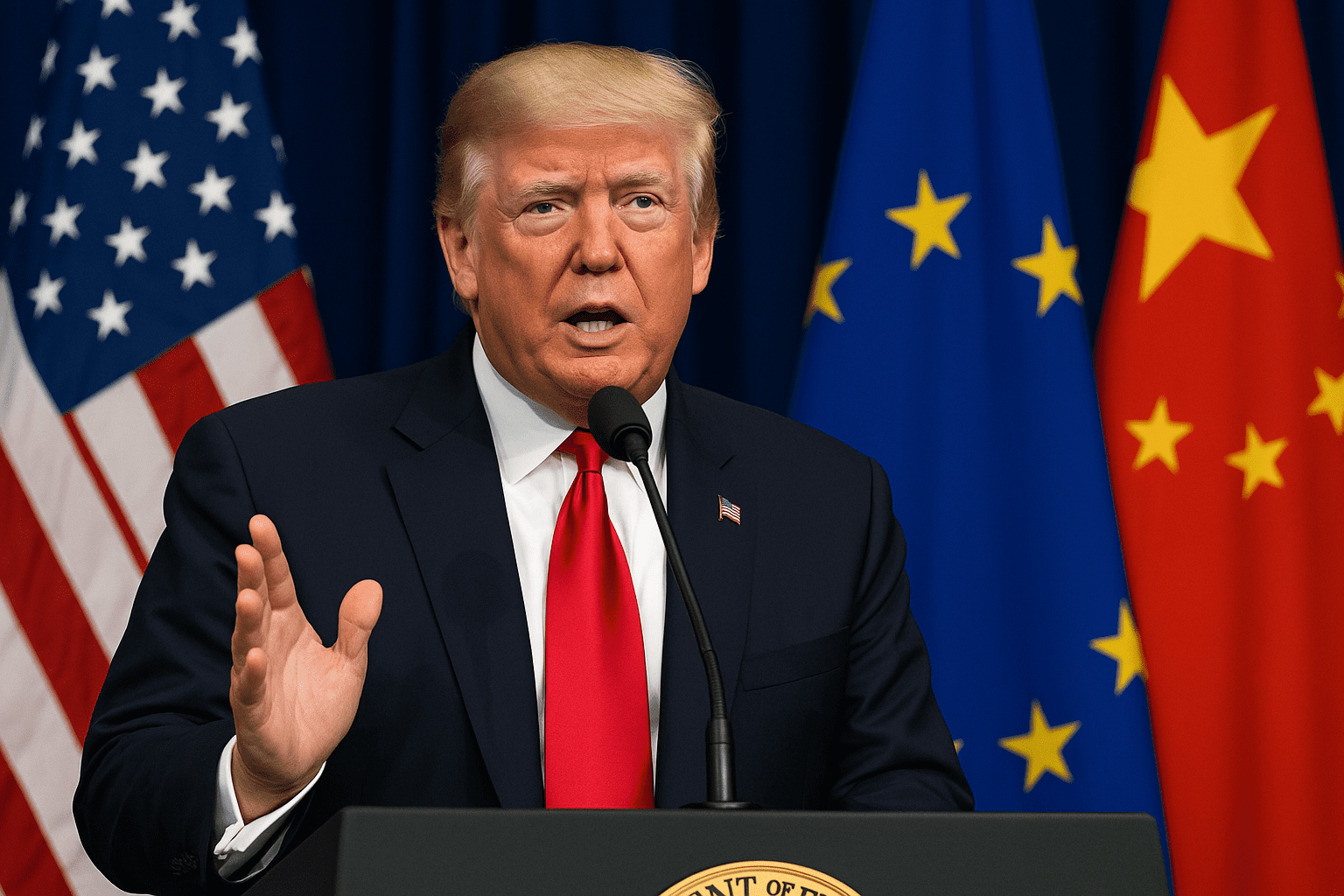
🔥 Trump’s Bold Admission: “We Need People from Outside”
When former U.S. President Donald Trump stated in a recent Fox News interview that “we need people from outside because we don’t have talent in the U.S.”, it sent shockwaves across America’s political and business landscape.
For a leader who once built his political identity on “America First” and restricting immigration, this sounded like a reversal — or at least a recognition of reality.
Trump’s comment wasn’t offhand. It was strategic — and deeply tied to the H-1B visa debate, which sits at the intersection of economics, innovation, and national identity.
His words acknowledged an uncomfortable truth: the U.S. economy depends on skilled immigrants to fill gaps in science, technology, engineering, and healthcare. Without them, American innovation — and even its global competitiveness — could stumble.
🇺🇸 Why Trump Said the U.S. “Doesn’t Have Talent”
Trump’s statement can be understood through three lenses — economic reality, political balancing, and global competition.
1️⃣ Economic Reality — The Skill Shortage Is Real
Industries like AI, semiconductors, green energy, and cybersecurity are expanding faster than domestic training programs can supply talent.
Reports show that by 2026, the U.S. may face over 2 million unfilled tech positions. Even major firms like Google, Tesla, and Pfizer rely heavily on skilled immigrants, particularly those from India and China.
The truth is not that Americans “lack talent,” but that the demand for niche, advanced skills exceeds the supply.
2️⃣ Political Balancing Act
Trump faces a dilemma: his voter base favors strict immigration, but the business community — a key Republican donor bloc — depends on global talent.
His statement attempts to balance these sides: signaling to companies that he understands their needs, while still claiming to “protect American jobs.”
It’s a rare acknowledgment that a closed-door policy could backfire economically.
3️⃣ Global Talent War — America Is Losing Ground
Countries like Canada, Germany, and China are aggressively attracting skilled professionals. They offer smoother visa systems, family-friendly policies, and paths to permanent residency — areas where the U.S. still struggles.
If the U.S. remains rigid on H-1B visas, it risks losing innovators and startups to more welcoming nations.
📉 Does America Truly Lack Talent?
Let’s be clear: the U.S. is full of smart, capable people. But there’s a skills mismatch.
STEM education gaps: While millions graduate each year, only a fraction specialize in fields like data science, robotics, or chip design.
Experience deficit: Many graduates lack hands-on experience, while employers need mid- to senior-level engineers.
Location mismatch: U.S. tech hubs like Silicon Valley and Austin attract most foreign professionals, while smaller states struggle to retain graduates.
Training lag: Corporate upskilling is slow, and universities often teach outdated technologies.
Hence, when Trump says, “we don’t have talent,” what he means is “we don’t have enough specialized professionals ready right now.”
🧳 Understanding the H-1B Visa — America’s Talent Lifeline
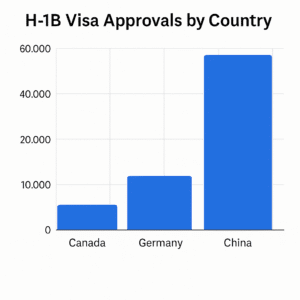
The H-1B visa allows U.S. employers to hire highly skilled foreign professionals for specialty occupations such as IT, engineering, medicine, and research.
Key Facts:
| Year | H-1B Approvals | Indian Nationals | Chinese Nationals | Other Countries |
|---|---|---|---|---|
| 2024 | ~399,000 | 73% | 12% | 15% |
| 2023 | ~389,000 | 72% | 11% | 17% |
| 2022 | ~375,000 | 70% | 12% | 18% |
(Source: U.S. Citizenship and Immigration Services, 2025)
This shows how India dominates the U.S. skilled workforce pipeline, especially in the technology and consulting sectors.
Economic Contributions:
H-1B workers boost innovation — contributing over 25% of U.S. patents annually.
They support startup ecosystems, with 40% of Silicon Valley founders being immigrants.
They create jobs indirectly, as every 100 H-1B hires generate about 180 additional local jobs.
So rather than replacing Americans, H-1B visa holders often create economic multipliers.
⚠️ What Happens If H-1B Visas Are Restricted?
If future administrations curb or disrupt the H-1B program, the consequences could be severe.
1️⃣ Tech Slowdown
Startups and Fortune 500 firms alike would face hiring shortages. Innovation could slow as companies struggle to fill critical roles in software development, AI research, and chip manufacturing.
2️⃣ Rising Costs
Without access to foreign talent, companies would have to offer higher wages to attract scarce domestic workers, raising operational costs — and ultimately prices for consumers.
3️⃣ Global Relocation
Canada’s Global Talent Stream, Germany’s Skilled Immigration Act, and China’s K-Visa programs make it easier for companies to relocate operations abroad.
If the U.S. becomes hostile to skilled immigration, expect a brain drain of startups, engineers, and scientists — the very people driving future innovation.
4️⃣ Economic Ripple Effect
H-1B visa holders contribute nearly $90 billion annually in taxes and consumer spending. Losing that inflow could weaken local economies, especially in innovation hubs like California, Texas, and New York.
🌍 How Other Nations Are Winning the Talent Game
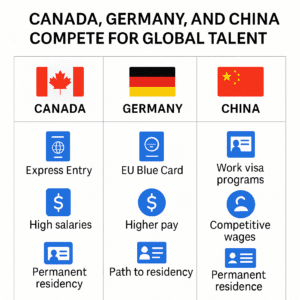
🇨🇦 Canada
Canada has turned immigration into an economic advantage.
Its Global Talent Stream allows fast-tracked visas in as little as two weeks, and permanent residency is easier to obtain. Spouses get open work permits — a big plus compared to the restrictive U.S. system.
🇩🇪 Germany
Germany reformed its Skilled Immigration Act, allowing professionals without formal degrees (but proven expertise) to enter and work. It’s a flexible model that bridges the vocational gap.
🇨🇳 China
China’s K-Visa is part of its global tech strategy. It aims to attract experts in AI, aerospace, and biotechnology, while offering tax incentives and elite housing programs.
In short, America’s competitors are outpacing it in global talent diplomacy.
🏛️ Political and Social Impact of Trump’s Statement
🔹 Political Repercussions for Republicans
Trump’s “we need outsiders” remark could spark division within the Republican Party.
The business-friendly faction may welcome it as pragmatic, while the populist base might see it as betrayal of “America First.”
If not carefully framed, it could alienate conservative voters heading into the 2026 midterms.
🔹 Social Perception and National Identity
For many Americans, the debate over H-1B is not just about jobs — it’s about identity.
If immigrants are perceived as replacing U.S. workers, resentment grows. But if they’re seen as driving innovation and complementing the domestic workforce, support rises.
The solution lies in transparency and education — showing how foreign professionals contribute to the broader economy.
💡 The Bigger Picture — America’s Future Depends on Balance
The U.S. doesn’t lack intelligence; it lacks strategic coordination between education, policy, and business.
To remain competitive, America must:
Invest in STEM education and apprenticeships.
Modernize H-1B policies — faster approvals, better fraud control, and smoother green card transitions.
Encourage skill partnerships between universities and industry.
Retain global talent by offering clear, family-friendly immigration paths.
Without these steps, even the strongest economy could lose its innovative edge.
📊 Conclusion — Trump Spoke an Uncomfortable Truth
Donald Trump’s statement — “we need people from outside” — may sound unpatriotic to some, but it reflects the real economics of the modern world.
America remains a global magnet for talent, yet it’s competing with ambitious nations ready to welcome those it turns away. The H-1B visa is not just a work permit — it’s a bridge to innovation, entrepreneurship, and global leadership.
If disrupted, it could trigger an innovation slowdown and erode U.S. dominance in technology and science.
For Trump and Republicans, the challenge will be balancing populist politics with economic pragmatism — and for America, deciding whether it wants to lead the world in ideas or lag behind in isolation.