1. Introduction: The General Insurance Giant in a High-Growth Cycle
If you have been following the Indian financial market for the last two or three decades, you would have noticed one major shift—insurance is no longer a luxury product, it has become a necessity. Earlier, most people focused only on life insurance, but today general insurance—especially health and motor insurance—is growing rapidly. In this space, ICICI Lombard General Insurance stands out as one of the most trusted and dominant private players.
As of April 2026, India’s general insurance industry is growing at around 10–12% annually, but certain segments like health insurance are growing even faster, close to 18–20% per year. This growth is supported by rising healthcare costs, increasing awareness, and government initiatives like Ayushman Bharat. At the same time, India continues to add millions of new vehicles every year, which drives demand for motor insurance.
ICICI Lombard has positioned itself very well to benefit from these trends. The company has built a strong presence across multiple channels—agents, bancassurance, digital platforms, and partnerships. Its focus on technology and data analytics has helped it stay ahead of competitors.
The Q4 FY26 results, announced on April 15, 2026, give us a clear picture of how the company is balancing growth and profitability, which is the most important factor in insurance business. This article breaks down those results in simple language so that both beginners and experienced investors can understand whether this stock deserves a place in their FY27 portfolio.
2. Q4 FY26 Result Analysis: Profit Growth and Underwriting Discipline
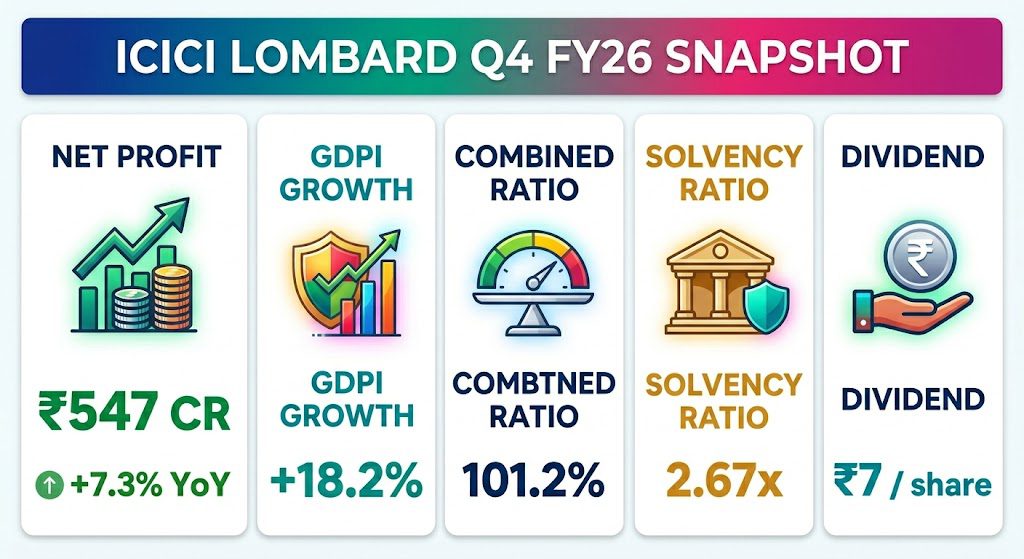
Let’s first look at the numbers, because numbers tell the real story.
In Q4 FY26, ICICI Lombard reported a net profit (PAT) of ₹547 crore, which is about 7.3% higher than last year. While this growth may look moderate, it becomes impressive when you consider the rising claim costs in sectors like motor insurance.
On the revenue side, the company performed strongly. Its Gross Direct Premium Income (GDPI) grew by 18.2%, which is significantly higher than the industry average of around 10.9%. This means ICICI Lombard is not just growing—it is gaining market share.
But the most important metric in general insurance is not profit or revenue. It is something called the Combined Ratio.
👉 What is Combined Ratio?
It measures how much the company spends on claims and expenses compared to the premium it earns.
- A ratio below 100% means profit from underwriting
- Above 100% means loss (but companies can still earn from investments)
ICICI Lombard’s combined ratio improved to 101.2% from 102.5% last year. This may look like a small change, but in insurance business, even a 1% improvement is very significant.
👉 This shows that the company is moving closer to achieving pure underwriting profit, which is a big milestone.
3. Fundamental Analysis: Strong Balance Sheet and Dividend Strength
When you invest in an insurance company, you are not just investing in its current profits—you are investing in its ability to survive and grow over long periods. This is where ICICI Lombard stands out.
The company’s Solvency Ratio is 2.67x, which is much higher than the regulatory requirement of 1.5x. In simple terms, this means the company has more than enough capital to pay claims and still expand its business.
This strong capital position gives ICICI Lombard a major advantage:
- It can grow aggressively without worrying about capital
- It can invest in new products and technology
- It can handle unexpected shocks like pandemics or natural disasters
Another important factor is Return on Equity (ROE). The company is targeting an ROE of 18–20%, which is quite strong for a financial services company. This shows that management is using shareholder money efficiently.
Now let’s talk about something many investors care about—dividends.
The company has announced a final dividend of ₹7 per share for FY26, which translates to a payout ratio of around 70%. This makes it attractive for investors who want regular income along with growth.
👉 In simple words, ICICI Lombard is not just a growth stock—it is also a stable and reliable income-generating stock.
4. Technical Analysis: Signs of a Bullish Trend Emerging
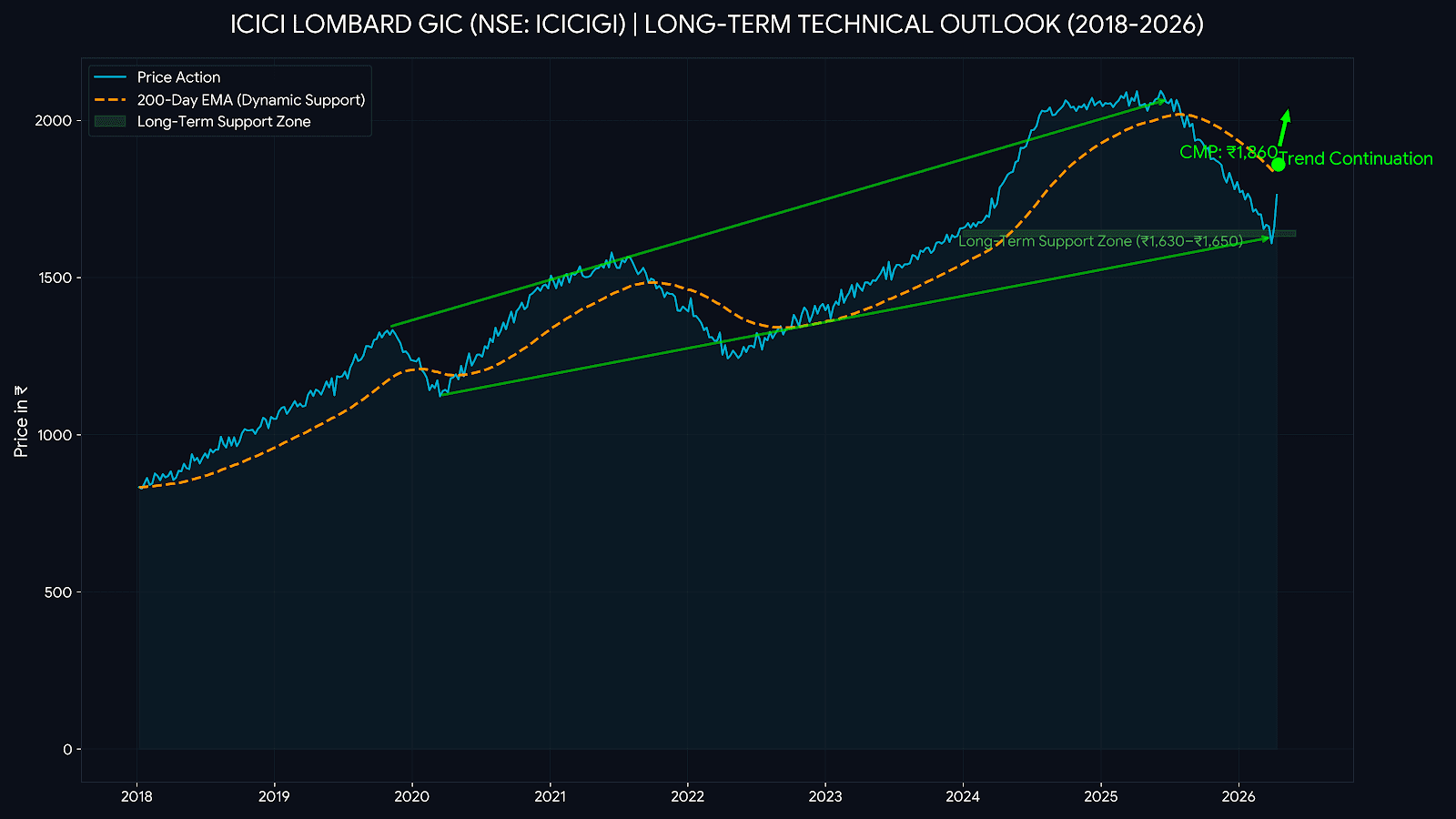
Now let’s look at what the charts are telling us.
After the Q4 results, the stock reacted positively and closed at around ₹1,864, showing a strong one-day gain of 4.5%+. This kind of move usually indicates that the market liked the results.
Over the past few months, the stock had been moving in a range, with strong support around ₹1,630–₹1,650. Every time the stock came near this level, buyers stepped in. This shows that institutional investors were accumulating at lower levels.
Currently, the stock is trading above both its 50-day and 200-day moving averages, which is considered a bullish signal.
The next important level to watch is ₹1,950. If the stock breaks above this level with strong volume, it could move towards its 52-week high of ₹2,074.
Momentum indicators like MACD are also showing a bullish crossover, which supports the possibility of a continued uptrend.
👉 For investors, this means the stock is shifting from a sideways phase to a potential upward trend.
5. Segment Performance: Health Leading, Motor Stabilizing
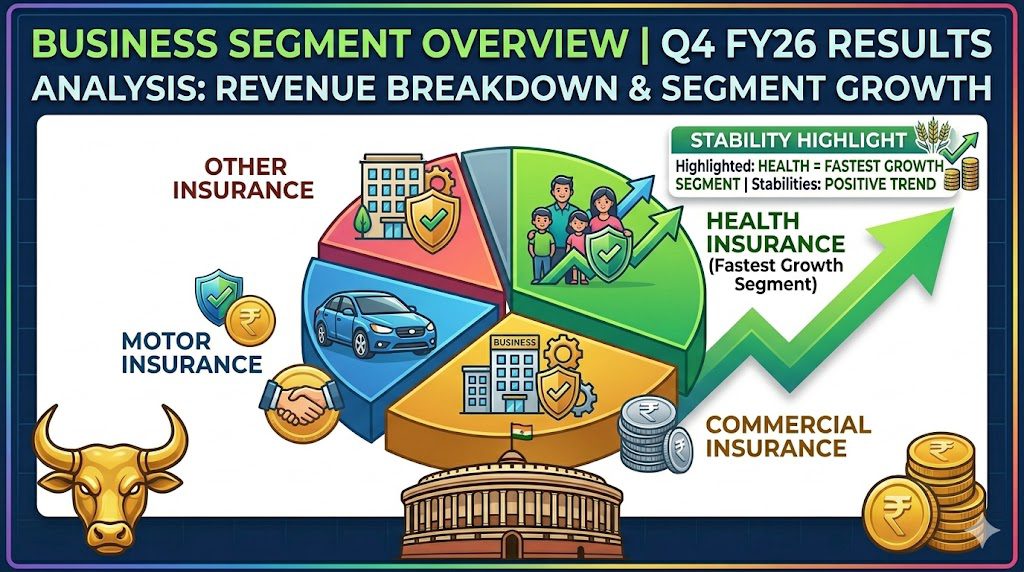
To really understand an insurance company, you need to look at its different business segments.
Health Insurance
This is currently the fastest-growing segment for ICICI Lombard. Rising medical costs and increasing awareness are driving demand. Recent policy changes, like GST relief on certain health insurance products, have also helped.
Motor Insurance
Motor insurance is still a large part of the business, but it faces challenges like higher claim costs. However, ICICI Lombard is using AI-based pricing models to manage risk better. This helps the company maintain margins even in a competitive market.
Commercial Insurance (Fire & Engineering)
This segment grew by around 15%, which reflects the broader India infrastructure and capex cycle. As more factories, buildings, and projects come up, the demand for commercial insurance increases.
👉 Overall, the company has a balanced portfolio, which reduces risk and ensures stable growth.
6. Forward Outlook FY27: Growth Triggers and Price Targets
| Brokerage | Rating | Target Price | Upside View | Key Trigger |
|---|---|---|---|---|
| ICICI Securities | BUY | ₹2,250 | Strong | Growth + underwriting |
| Motilal Oswal | BUY | ₹2,260 | Strong | Margin discipline |
| JM Financial | BUY | ₹2,333 | Very Strong | Health + ROE growth |
| Consensus (26 Analysts) | BUY | ₹2,115 avg | Moderate | Sector tailwinds |
| Global Brokers | Neutral–Buy | ₹1,975–₹2,340 | Mixed | Valuation watch |
Looking ahead to FY27, the outlook for ICICI Lombard appears positive.
Several factors are expected to drive growth:
- Continued expansion in health insurance
- Better pricing discipline in motor insurance
- Growth in commercial insurance due to infrastructure spending
- Increasing digital adoption
Brokerages like Motilal Oswal and JM Financial have maintained a “Buy” rating, with target prices ranging between ₹2,150 and ₹2,230.
👉 What can drive the stock higher?
- Combined ratio moving closer to 100% or below
- Strong growth in health insurance segment
- Stable interest rates supporting investment income
👉 Risks to watch:
- Regulatory changes in motor insurance pricing
- Unexpected increase in claims
- Economic slowdown affecting demand
7. Final Verdict: Should You Buy ICICI Lombard Now?
After analyzing the results, fundamentals, and technicals, one thing is clear—ICICI Lombard is a high-quality business operating in a growing sector.
It is not a “cheap” stock, but it offers something more important—consistency, stability, and long-term growth visibility.
👉 Positives:
- Strong premium growth
- Improving combined ratio
- High solvency and strong balance sheet
- Consistent dividend payout
👉 Concerns:
- Valuation not very cheap
- Dependence on claim trends
👉 Final Call:
BUY for long-term investors (12–24 months horizon)
Ideal for those who want stable compounding with lower risk compared to midcaps.