Quick Snapshot: The Raw Numbers
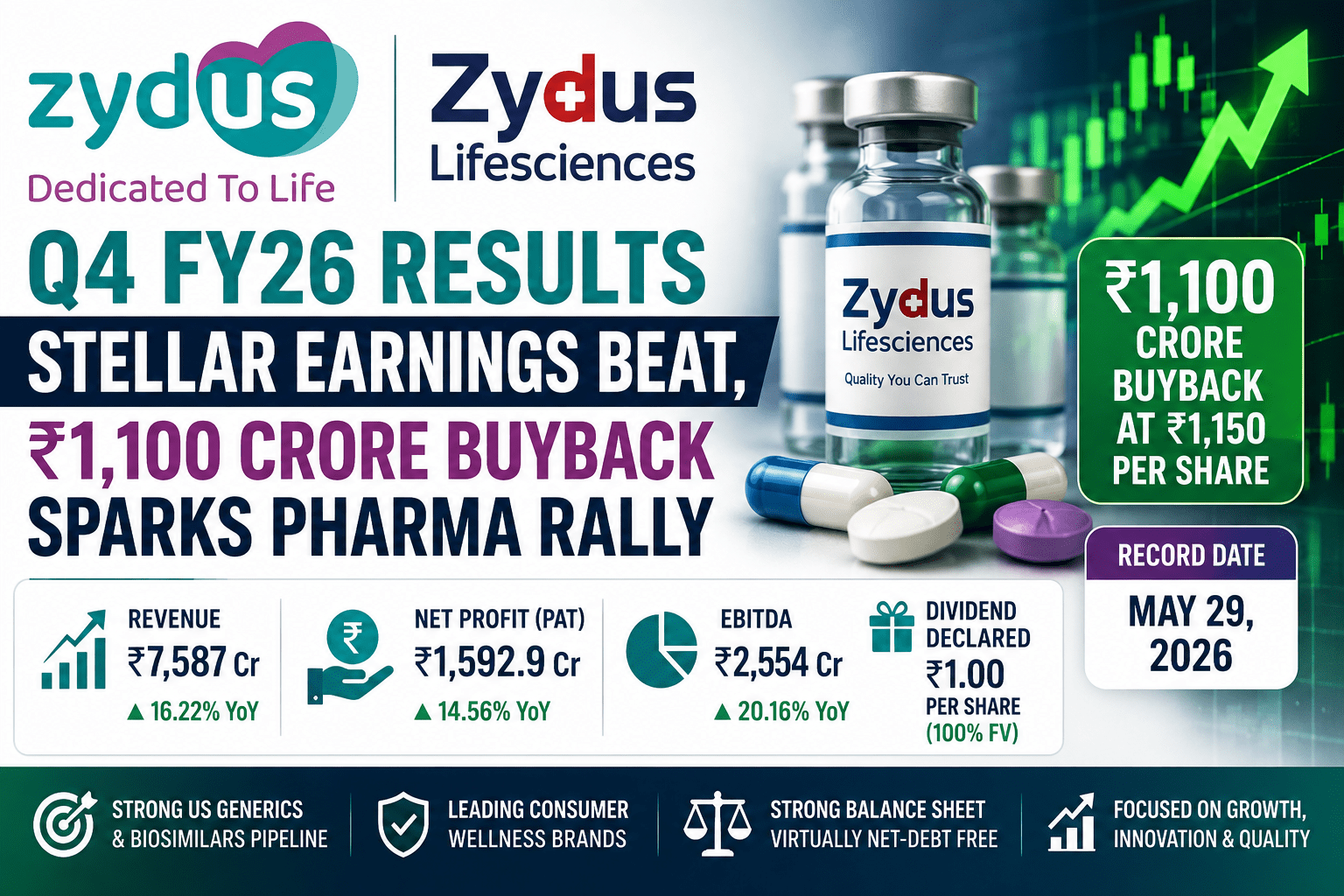
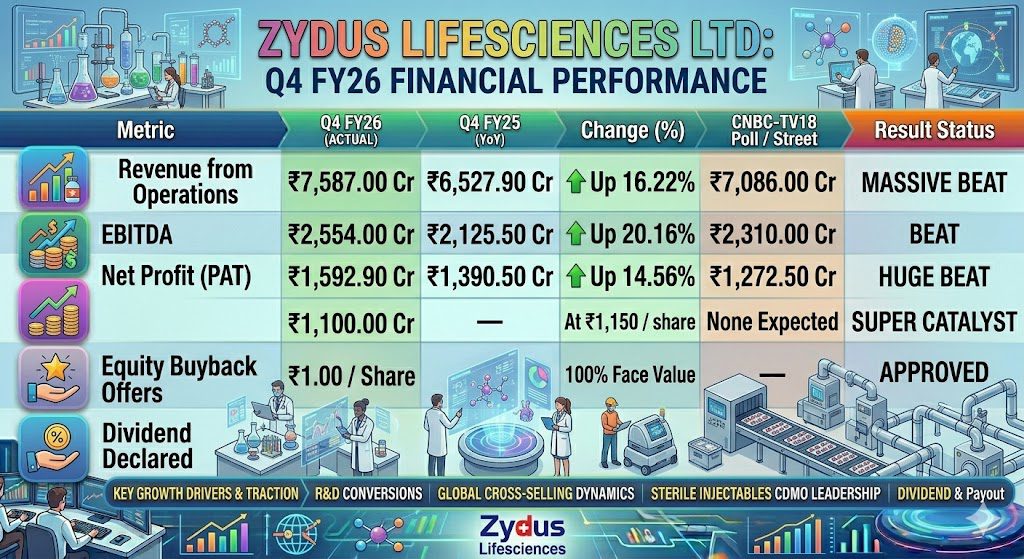
| Metric | Q4 FY26 (Actual) | Q4 FY25 (YoY) | Change % | Street Estimate | Result Status |
|---|---|---|---|---|---|
| Revenue from Operations | ₹7,587.00 Cr | ₹6,527.90 Cr | +16.22% | ₹7,086.00 Cr | 🎯 Massive Beat |
| EBITDA | ₹2,554.00 Cr | ₹2,125.50 Cr | +20.16% | ₹2,310.00 Cr | ✅ Beat |
| Net Profit (PAT) | ₹1,592.90 Cr | ₹1,390.50 Cr | +14.56% | ₹1,272.50 Cr | 🚀 Huge Beat |
| Equity Buyback | ₹1,100.00 Cr | @ ₹1,150 / Share | None Expected | 💥 Super Catalyst | |
| Dividend Declared | ₹1.00 / Share | 100% Face Value | — | ✨ Approved | |
The Dual-Engine Pharma Giant: Understanding Zydus’s Moat
Before we dive into the earnings meat, let’s understand what makes Zydus Lifesciences special. This isn’t your garden-variety generic drug maker churning out commodity products and fighting a race to the bottom on price. Instead, Zydus operates two distinct, highly profitable cash-generating machines that feed off different market dynamics—and both are firing on all cylinders.
The US Complex Generics & Biosimilars Engine
The first engine is the company’s fortress in the United States. Zydus isn’t just another player in the crowded US generic space. They’ve carved out a specialized niche supplying complex, high-margin generic medications to institutional buyers—hospitals, pharmacy benefit managers, and healthcare systems. Think specialized cardiovascular drugs, complex injectable formulations, and biosimilar alternatives to expensive biologic therapies. This business segment commands pricing power because the competition is far thinner than in simple, off-patent tablets.
The US market remains the crown jewel for most Indian pharma players, and for Zydus, this segment delivered consistent traction through FY26. What makes it even better? The company maintains FDA-grade manufacturing standards while producing from India, which means lower cost of production compared to Western competitors—a huge structural advantage that translates directly to bottom-line profit.
The Domestic Consumer Wellness Powerhouse
The second engine—and this is where things get really interesting—is their dominance in India’s consumer wellness segment. Zydus Wellness isn’t a side business or a diversification gamble. It’s a certified money-printing machine that owns some of the most iconic Indian consumer staples.
Let’s talk brand dominance: Glucon-D commands 58.9% market share in India’s powdered glucose drink category—a product that’s synonymous with hydration and energy recovery in every Indian household. Then there’s Sugar-Free, which owns a staggering 96.1% market share in the tabletop sweetener segment. Throw in Nycil (the trusted talc-free powder brand) and Everyuth (their growing beauty and personal care play), and you have a portfolio that prints cash like a government mint. These aren’t niche products—they’re household staples that Indians reach for dozens of times a month.
Cracking Open Q4 FY26: Where Did the Beat Come From?
The headline numbers look stellar, but smart investors don’t just glance at the topline and move on. Let’s dissect where the actual growth engine is firing hardest.
Revenue Growth Decomposition: The Tale of Two Segments
Pharma Segment: The core pharmaceutical business—generics, complex injectables, and API exports—came in with Q4 FY26 revenue of ₹5,643.6 Crore, showing a modest but steady 4.9% year-on-year growth. On the surface, this might look pedestrian. But here’s the thing: in a highly competitive generic market plagued by pricing pressures and heightened API costs, 4.9% growth with expanded margins is actually solid execution. The company maintained pricing discipline in the US complex generics space while managing input cost inflation carefully.
Consumer Wellness Segment—The Dark Horse: Now here’s where the real surprise lives. The Consumer Wellness vertical absolutely exploded in Q4, scaling revenue up to ₹1,463.3 Crore from just ₹908.1 Crore in the previous fiscal year. That’s a jump of 61.1% year-on-year. What drove this? The answer is simple: India’s summer arrived with unusual intensity this year, and every Indian household doubled down on hydration products, energy drinks, and immunity supplements. Glucon-D’s off-take hit record levels as the temperature climbed. Retail distribution expanded aggressively, and e-commerce channels saw explosive demand for powdered mixes and wellness products.
The Financial Catalysts: Buyback + Dividend
Beyond operational performance, the real market-mover today was capital allocation. The board approved a tender-route equity buyback of ₹1,100 Crore at ₹1,150 per share. Let that sink in: the company is buying back shares at ₹1,150 when the stock was trading in the ₹980–₹1,000 zone heading into today’s announcement. That’s a 15-16% immediate premium to market price.
Why does this matter? First, it signals management’s confidence in future cash generation. You don’t burn ₹1,100 Crores on buybacks unless you’re convinced the underlying business can sustain profits and generate free cash flow. Second, the record date is Friday, May 29, 2026—meaning any shareholder holding the stock through that date gets tendering rights. This creates a natural support level and a floor for the share price in the near term.
The board also recommended a final dividend of ₹1.00 per share (100% of face value), to be finalized on August 11, 2026. For a company trading at around ₹990, this means a 0.1% dividend yield on that specific payment, plus the recurring nature of dividend distributions signals healthy cash generation.
Fundamental Analysis: Is Zydus a Long-Term Wealth Compounder?
Valuation Multiple Comfort & Profitability Reality
Let’s talk valuation, because at the end of the day, that’s what separates a good investment from a dangerous one. At a current market price (CMP) of approximately ₹990, Zydus is trading at a trailing price-to-earnings (P/E) multiple of 21x–22x. Now, for a company growing its full-year FY26 net profit by 15% (to ₹5,456.4 Crore), a 21–22x multiple is actually significantly attractive.
Why? Because the Indian pharmaceutical sector averages are higher. Large-cap peers in the space typically trade at 24–28x trailing P/E, especially those with strong US exposure. Zydus is offering better quality (dual-engine growth, consumer staples leverage) at a discount valuation. Moreover, that 15% profit growth isn’t one-time fireworks—it represents real operational leverage from both rising pharma volumes in the US and the explosive consumer wellness segment. The company has room to expand margins further as the Consumer Wellness segment scales.
Balance Sheet Fortress: Net-Debt-Free Firepower
Here’s where Zydus really separates itself from the competition. The company operates with a virtually net-debt-free balance sheet. In plain English: they have more cash than debt, and that’s not counting working capital flexibility. Managing Director Sharvil Patel explicitly highlighted in today’s earnings call that this financial fortress gives them the tactical flexibility to pursue strategic global bio-pharma acquisitions in FY27.
A net-debt-free balance sheet in the pharmaceutical industry is like a fighter pilot with unlimited fuel. It means the company can:
✓ Pursue bolt-on acquisitions without diluting shareholders
✓ Weather cyclical downturns without covenant pressure
✓ Invest aggressively in R&D and manufacturing capacity
✓ Maintain and increase dividend payouts without stress
Technical Analysis: Reading the Chart Setup for Traders
The Breakout Setup: Chart Momentum & Trend Structure
For momentum traders and swing players, today’s earnings announcement and buyback news have created a compelling technical setup. Let’s break down the chart structure.
The stock has been grinding inside a long-term consolidation wedge—a pattern where the price keeps making lower highs and higher lows, essentially getting squeezed. That wedge range lived between ₹920 and ₹970 over the past several months. Today’s result announcement and the surprise buyback announcement have violently broken this consolidation to the upside. The intraday jump of over 5% post-announcement is exactly the kind of volume and momentum breakout that technical traders live for.
Support & Resistance Architecture
| Immediate Resistance Walls (Upside Targets) | |
|---|---|
| R1 (First Resistance) | ₹1,030 |
| R2 (Second Resistance) | ₹1,085 |
| R3 (Ultimate Target / Magnet) | ₹1,150 (Buyback Floor Price) |
| Strong Buying Supports (Downside Cushions) | |
|---|---|
| S1 (First Support) | ₹960 |
| S2 (Second Support) | ₹920 |
| S3 (Major 52-Week Structural Floor) | ₹880 |
The Big Picture: The ₹1,150 buyback floor price will act as a powerful magnet for the stock price. Why? Because the company is committed to buying back shares at that price. That’s essentially a “wall of support” that the market knows about. Smart traders often accumulate into weakness when a buyback floor exists, because they know the company’s own buying power will protect the downside. This creates a very favorable risk-reward setup for swing longs targeting ₹1,085–₹1,150.
Management Guidance & Future Growth Engines for FY27
Quality & Consistency in US Pharma Operations
During today’s earnings call, Managing Director Sharvil Patel laid out the strategic priorities for FY27. The first pillar is maintaining and improving operational quality. In the FDA-regulated US market, any warning letter is a headwind. Zydus has committed to zero FDA warning letters through focused capital expenditure and process improvements. This is a quality-obsessed stance that Wall Street and domestic institutional investors respect.
Cost Synergies from Domestic Acquisitions
The second pillar centers on capturing swift cost synergies from recent domestic brand acquisitions. Zydus has been buying up smaller wellness and pharmaceutical brands in India to expand distribution and leverage the company’s manufacturing and supply chain infrastructure. Patel indicated that FY27 will see meaningful cost-synergy realization from these bolt-on acquisitions, which should flow through the income statement as margin expansion.
Tariff Safeguards & US Trade Dynamics
The final strategic point addresses the elephant in the room: US-India trade tensions and the 26% reciprocal tariffs on certain pharmaceutical inputs. Management highlighted that Zydus’s localized US distribution networks and manufacturing partnerships help mitigate tariff impact. Unlike companies fully reliant on Indian API imports, Zydus has spread its supply chain across multiple geographies, reducing tariff exposure. This is a real competitive moat in an increasingly protectionist trade environment.
Institutional Radar: Brokerage Coverage & New Target Matrices
Following today’s structural beat, major institutional research desks are rushing to re-rate their valuation targets upward. Here’s what the big money is thinking:
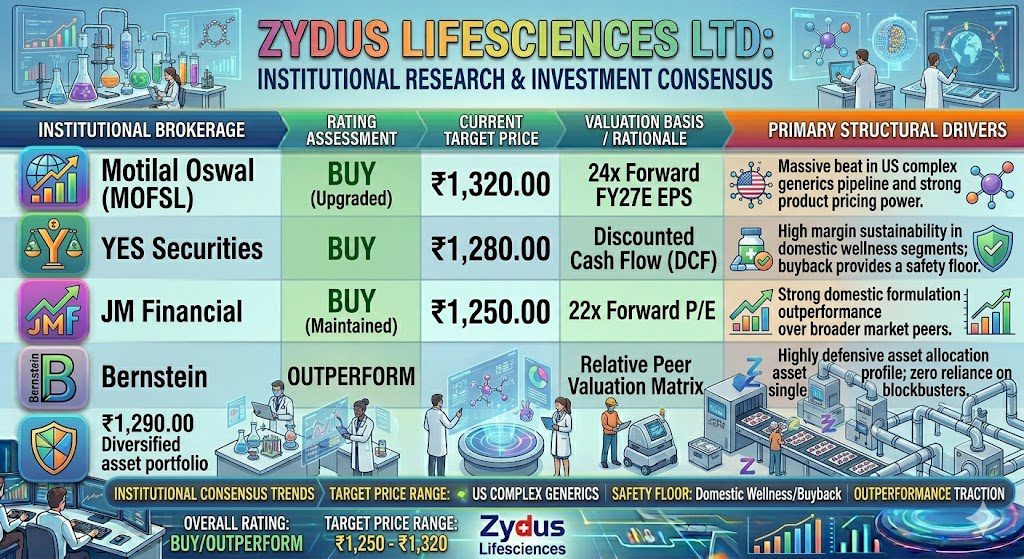
| Institutional Brokerage | Rating | Target Price | Valuation Basis | Primary Structural Drivers |
|---|---|---|---|---|
| Motilal Oswal (MOFSL) | BUY (Upgraded) | ₹1,320.00 | 24x Forward FY27E EPS | Massive beat in US complex generics pipeline; strong product pricing power |
| YES Securities | BUY | ₹1,280.00 | Discounted Cash Flow (DCF) | High margin sustainability in domestic wellness segments; buyback provides safety floor |
| JM Financial | BUY (Maintained) | ₹1,250.00 | 22x Forward P/E | Strong domestic formulation outperformance over broader market peers |
| Bernstein | OUTPERFORM | ₹1,290.00 | Relative Peer Valuation Matrix | Highly defensive asset allocation profile; zero reliance on single blockbuster |
Notice something important: every single research desk is sitting on BUY or OUTPERFORM ratings. No HOLD, no SELL. The consensus is unified—the stock deserves a re-rating. The average target across these brokerages sits around ₹1,285, which implies 30%+ upside from today’s levels. That’s not a typo.
The Veteran’s Verdict: Buy, Hold, or Sell Zydus Life?
For the Long-Term Investor (Strategic Buy)
🎯 Action: ACCUMULATE
If you’re building a portfolio for the long haul—think 3, 5, or 10-year horizon—Zydus Lifesciences is a phenomenal wealth-building candidate. Here’s why:
1. Proven Execution: Full-year FY26 net profit growth of 15% demonstrates that management can actually deliver on growth. This isn’t promise—it’s performance.
2. Dual-Engine Safety: Unlike pure-play generics companies, Zydus has insulated itself with consumer staples exposure. When pharma margins compress, the Wellness engine can compensate. This diversification is a wealth-preservation feature.
3. Buyback Floor Protection: At ₹1,150, the company’s own buyback offers an iron-clad safety net. You’re not just relying on market sentiment; you have corporate buying power supporting the valuation.
4. Reasonable Valuation at 21–22x P/E: For a company growing profits at 15% annually with a net-debt-free balance sheet and a ₹1,100 Crore buyback program, this is a bargain relative to quality.
Portfolio Action: If you don’t own Zydus yet, start accumulating on any dips toward ₹950–₹980. If you already own it, hold tight and add on weakness. This is a long-term compounder.
For the Short-Term Trader (Ride the Momentum)
📈 Action: TRADE THE UPSIDE
If you’re a swing or short-term trader looking for a 2–4 week trade setup, Zydus offers compelling momentum mechanics:
1. Strong Structural Tailwinds: The stock has broken out of a multi-month consolidation wedge with positive earnings and a surprise buyback. This combination is a classic fuel for sustained upside.
2. Record Date Buying Catalyst: May 29, 2026 is the record date for buyback entitlement. Smart money often accumulates into this date, creating demand headwinds for shorts and shorts squeezes for traders who picked the wrong side.
3. Clear Technical Targets: R1 at ₹1,030, R2 at ₹1,085, and R3 (the buyback floor) at ₹1,150 provide clear profit-taking levels. This is the type of defined technical structure that traders live for.
Trading Plan: Accumulate or add on any temporary cool-off toward ₹980–₹990 with a stop loss at ₹950. Target initial profit-taking at ₹1,085, with a stretch target toward the ₹1,150 buyback floor. The risk-reward is heavily skewed to the upside.