Scope Outline
Introduction: The Defense Maverick Faces a Reality Check
Over the last three decades, the Indian defense sector has evolved from a slow-moving, government-driven ecosystem into a dynamic, technology-led opportunity space. Zen Technologies has been one of the standout beneficiaries of this transformation, especially with the rise of simulation systems, anti-drone platforms, and AI-enabled combat training. However, even the most promising companies face phases of volatility. The Q4 FY26 results, announced on May 1, 2026, serve as a reminder that high-growth defense businesses are not immune to execution challenges and timing mismatches.
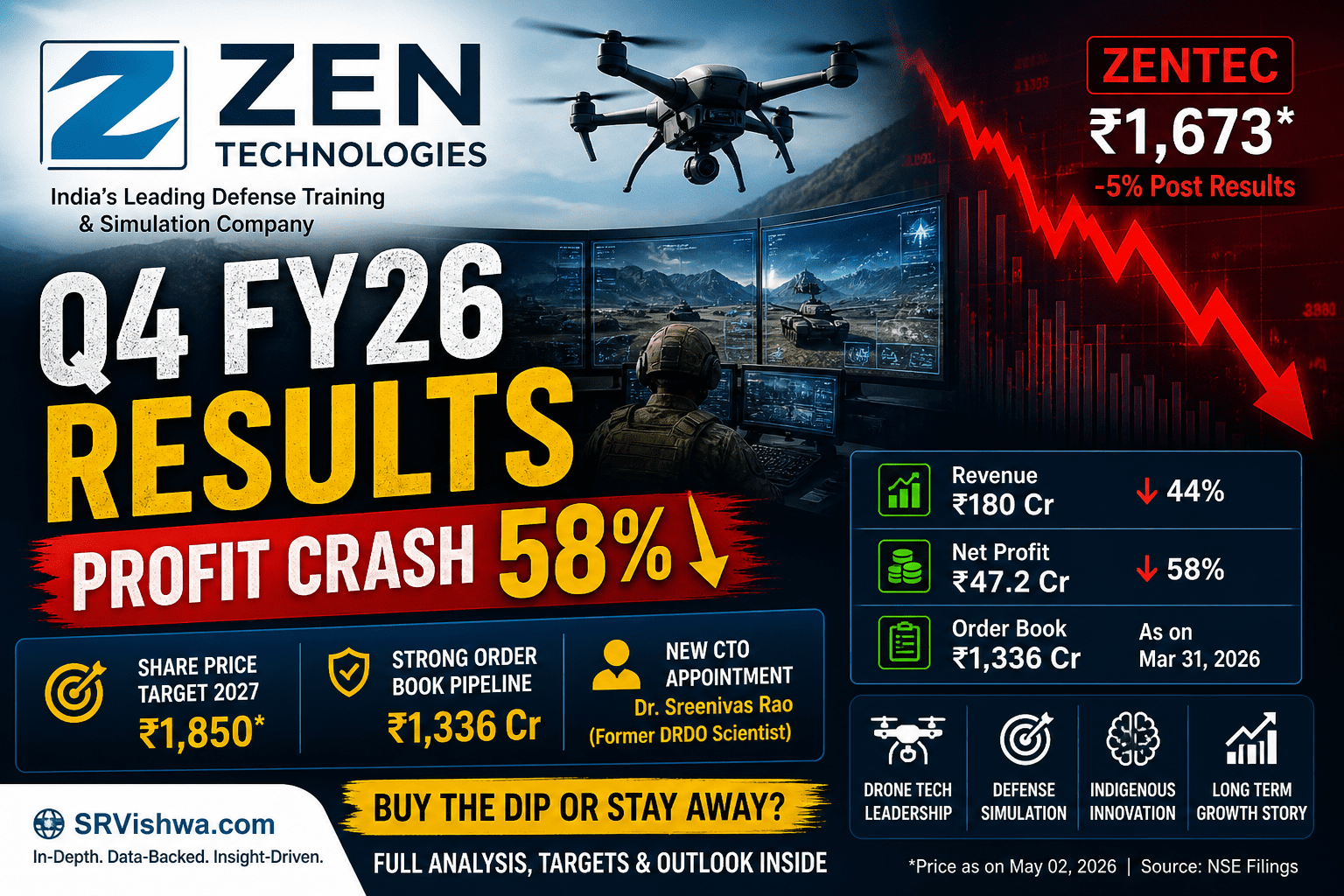
The headline number is hard to ignore—net profit has dropped sharply by 58% year-on-year to ₹47.2 crore. This kind of contraction naturally raises concerns among retail investors who have seen the stock perform strongly in recent years. At the same time, the broader market reaction has been relatively controlled, with the stock trading around ₹1,673 and correcting about 5% after the announcement. This suggests that while sentiment has weakened, the long-term story is not yet being dismissed. Instead, the market appears to be recalibrating expectations, shifting from aggressive optimism to cautious evaluation.
Q4 FY26 Financial Scorecard: The Actual NSE Numbers
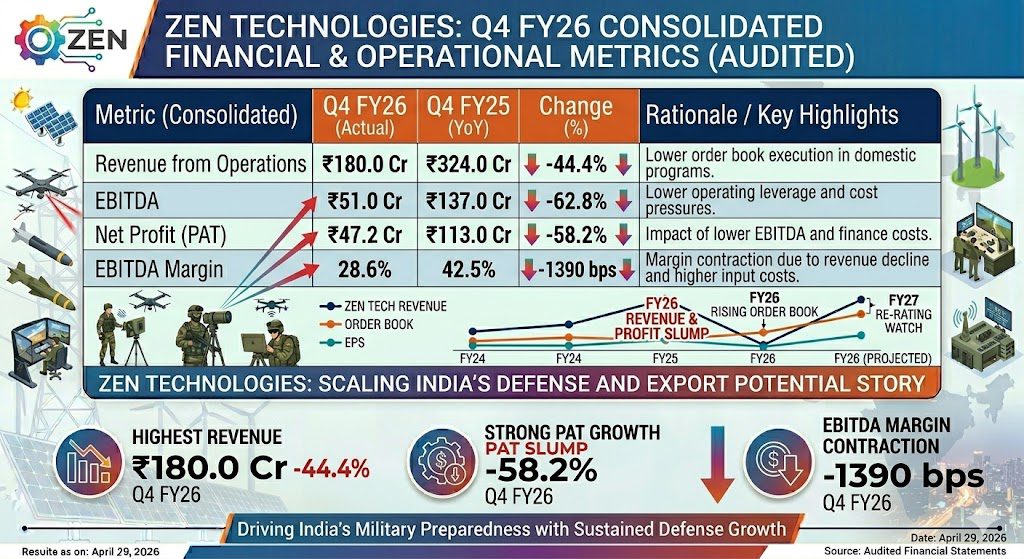
The financial performance for Q4 FY26 clearly reflects a quarter of sharp contraction across all key metrics. Revenue from operations came in at ₹180 crore, significantly lower than ₹324 crore reported in the same quarter last year, marking a decline of 44.4%. This steep fall in revenue indicates that either key project executions were delayed or high-value contracts were pushed into the next financial year. In sectors like defense, where order execution can be uneven, such fluctuations are not unusual, but the magnitude here is noteworthy.
EBITDA for the quarter stood at ₹51 crore, compared to ₹137 crore in Q4 FY25, representing a decline of 62.8%. This sharper drop in operating profit compared to revenue suggests that the company faced negative operating leverage during the quarter. In simpler terms, fixed costs remained relatively stable while revenue declined, leading to a disproportionate impact on profitability. Net profit followed a similar trend, falling 58.2% to ₹47.2 crore from ₹113 crore in the previous year.
Margins also came under pressure, with EBITDA margin declining from 42.5% to 28.6%, a contraction of 1,390 basis points. For a company known for high-margin defense contracts, this level of margin compression is significant and points toward either a change in project mix or delays in high-margin deliveries. These numbers, sourced from NSE filings dated May 1, 2026, present a clear picture of a challenging quarter that demands deeper analysis.
Fundamental Analysis: Cyclical Dip or Systemic Stall?
The key question investors must answer is whether this sharp decline is a temporary disruption or an indication of a deeper structural issue. In defense contracting, revenue visibility often depends on milestone-based execution, which can lead to uneven quarterly performance. The 44% drop in revenue strongly suggests that certain large orders, possibly export-driven or high-margin domestic contracts, were deferred rather than lost. This distinction is critical because deferred revenue can reappear in subsequent quarters, whereas lost orders signal weakening demand.
Despite the weak quarterly performance, Zen Technologies continues to maintain a strong consolidated order book of ₹1,336 crore as of March 31, 2026. This provides a significant cushion and reinforces confidence in future revenue visibility. A robust order book indicates that demand for the company’s products and solutions remains intact, even if execution timelines have shifted. For long-term investors, this is often a more important indicator than a single quarter’s earnings performance.
Another important development is the appointment of Dr. Sreenivas Rao Yellamanchali, a former scientist from Defence Research and Development Organisation, as the new Chief Technology Officer effective May 6, 2026. This move highlights the company’s strategic focus on strengthening its research and development capabilities and advancing indigenous technology solutions. In a sector where innovation and technological superiority play a critical role, leadership changes at the R&D level can have a meaningful long-term impact.
Technical Analysis: The Support Zones
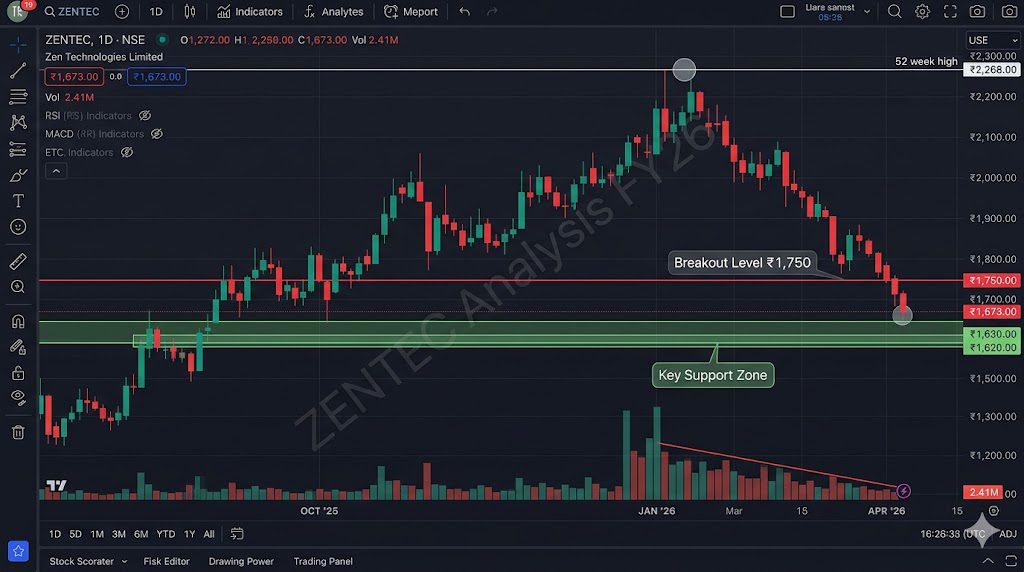 From a technical perspective, the stock has entered a short-term bearish phase following the Q4 results. After reaching higher levels earlier in the year, the price has corrected and is now testing key support zones. The immediate area of interest for investors is the ₹1,620–₹1,630 range, which acts as both a psychological and structural support level. If the stock manages to hold above this zone, it could indicate stability and potential for consolidation before the next move.
On the upside, ₹1,750 serves as the immediate resistance level. A decisive close above this level would be required to regain bullish momentum and signal renewed buying interest. Until then, the stock may continue to trade in a range with a cautious bias. It is also important to note that the 52-week high of ₹2,268 still provides a broader context—despite the recent correction, the stock remains in a long-term uptrend.
For experienced market participants, such corrections are often viewed as healthy, allowing valuations to cool off after sharp rallies. However, the key risk lies in a breakdown below ₹1,600, which could trigger further downside. Therefore, both investors and traders need to closely monitor price action around these critical levels before making any aggressive moves.
Dividend & Shareholder Value
Even in a challenging quarter, the company has demonstrated its commitment to shareholder returns by recommending a final dividend of ₹1 per equity share for FY26. While the dividend yield may not be particularly high, it reflects management’s confidence in the company’s financial stability and cash flow position. Consistent dividend payouts, even during periods of earnings volatility, often signal disciplined capital allocation and a long-term approach to value creation.
The record date for the dividend has been set as August 21, 2026, and the 33rd Annual General Meeting is scheduled for August 29, 2026. These timelines are important for investors tracking income opportunities and corporate governance milestones. Although Zen Technologies is primarily viewed as a growth-oriented stock rather than a dividend play, such payouts add an element of stability and reinforce investor confidence during uncertain periods.
Brokerage Sentiment & Targets: The Path Ahead
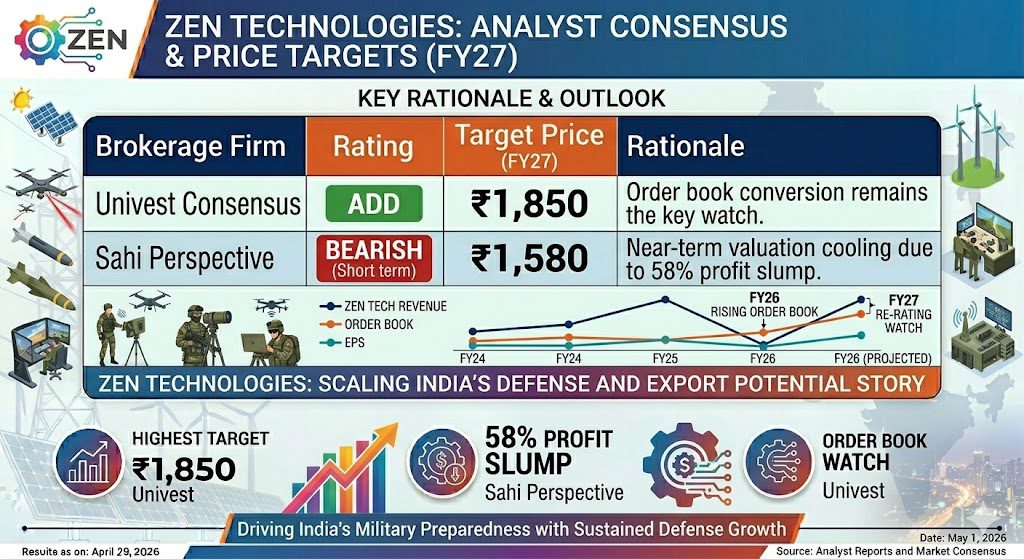
Market sentiment following the Q4 results remains mixed, reflecting the uncertainty surrounding near-term performance. According to consensus views, some brokerages maintain an “Add” rating with a target price of ₹1,850 for FY27, emphasizing that the key trigger will be the conversion of the existing order book into actual revenue. This perspective assumes that the current weakness is temporary and that execution will improve in the coming quarters.
On the other hand, more cautious analysts have adopted a short-term bearish stance, with target prices around ₹1,580. Their concerns are primarily centered on the sharp decline in profitability and the potential for further valuation correction if earnings do not recover quickly. This divergence in views highlights the importance of monitoring upcoming quarters closely, as they will provide clarity on whether the company can deliver on its growth expectations.
The “30-Year” Analyst Verdict
From a long-term investment perspective, it is important not to overreact to a single quarter’s performance, especially in a sector as complex and cyclical as defense. Revenue recognition in this industry is often uneven, and quarterly numbers can be misleading if viewed in isolation. Investors should instead focus on broader trends such as order inflow, execution efficiency, and margin recovery over the next few quarters.
For traders, however, the current setup demands caution. The stock is exhibiting a bearish trend in the short term, and attempting to enter prematurely could lead to losses. Waiting for confirmation of support around ₹1,600 or a breakout above resistance levels would be a more disciplined approach. In volatile markets, patience often proves to be more valuable than aggressive positioning.
Conclusion & Engagement (CTA)
The Q4 FY26 results of Zen Technologies present a mixed picture. On one hand, the sharp 58% decline in profit and significant revenue contraction highlight immediate challenges. On the other hand, a strong order book of ₹1,336 crore and strategic leadership changes indicate that the long-term growth story remains intact. The company appears to be in a transitional phase, where execution will play a crucial role in determining future performance.
Ultimately, the coming quarters will be decisive. If the company successfully converts its order book into revenue and restores margins, the current correction could turn out to be a valuable entry opportunity. However, if execution delays persist, the market may reassess its expectations and valuations.
This brings us to the key question for investors—are you willing to ride out short-term volatility for long-term gains, or do you prefer the relative stability of larger defense players like Hindustan Aeronautics Limited and Bharat Electronics Limited? The answer will depend on your risk appetite, investment horizon, and conviction in India’s evolving defense ecosystem.