Introduction: The Digital Signal of a New Era
If you have tracked India’s telecom and infrastructure journey since the 1990s, you would know how dramatically things have changed. Back then, telecom was a privilege. Today, it is the backbone of safety, governance, and economic growth. And right at the center of this transformation stands RailTel Corporation of India—a company that has quietly evolved from a railway support entity into a full-fledged digital infrastructure powerhouse.
The Q4 FY26 results, announced on April 30, 2026, are not just another quarterly update. They represent a structural shift in how the market should view RailTel. The company is no longer just laying fiber along railway tracks; it is building the digital nervous system of India.
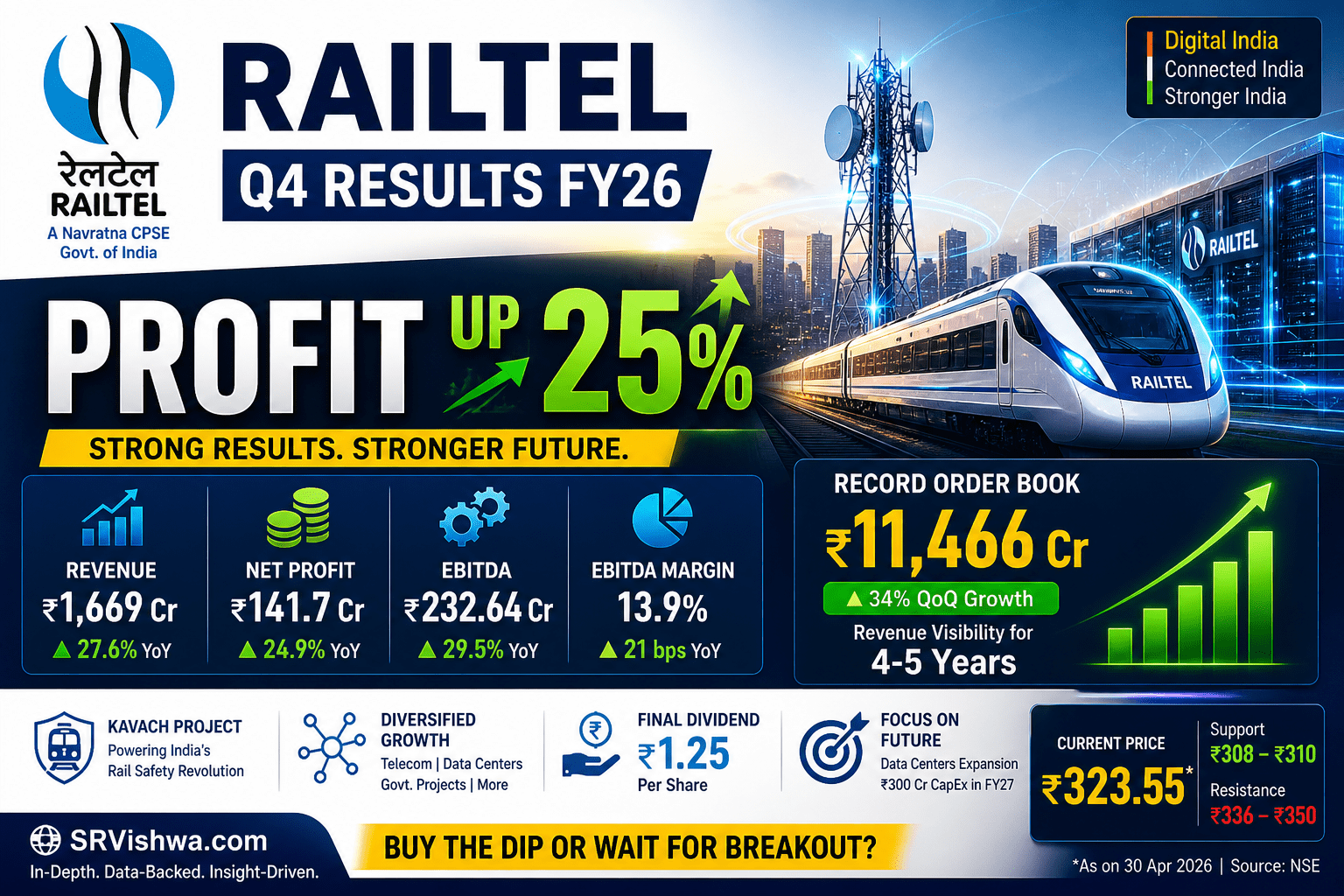
The headline number is strong and clear—net profit has grown 25% year-on-year to ₹141.7 crore, supported by robust revenue growth and improved execution. This kind of consistent performance from a Navratna PSU signals stability combined with growth potential, which is rare in the public sector space.
However, markets don’t always move in line with fundamentals in the short term. Despite strong results, the stock closed slightly lower at around ₹323.55, reflecting a classic “buy the rumor, sell the news” reaction. This creates an interesting dilemma for investors—should you chase growth or wait for better valuations?
Q4 FY26 Financial Scorecard (Actual NSE Data)
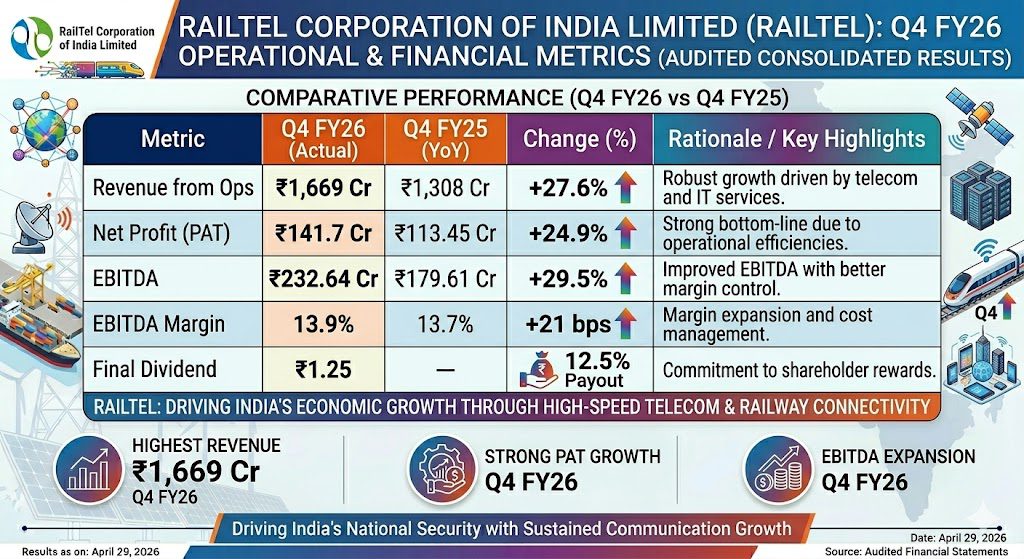
The financial performance of RailTel in Q4 FY26 reflects a company that is scaling up efficiently while maintaining margin discipline. Revenue from operations came in at ₹1,669 crore, up from ₹1,308 crore in Q4 FY25, marking a solid 27.6% growth. This growth is driven by strong execution in system integration projects, telecom services, and digital infrastructure initiatives.
Net profit stood at ₹141.7 crore, compared to ₹113.45 crore last year, translating into a 24.9% increase. This indicates that the company is not just growing its top line but also maintaining profitability—a critical factor for long-term investors.
EBITDA rose to ₹232.64 crore, up from ₹179.61 crore, registering a 29.5% growth. Margins remained stable, with EBITDA margin improving slightly to 13.9% from 13.7%, showing that the company is managing cost pressures effectively despite scaling operations.
In addition, the company has recommended a final dividend of ₹1.25 per share, reinforcing its commitment to shareholder returns. For investors looking at PSU stocks as income-generating assets, this adds another layer of attractiveness.
Overall, these numbers present a picture of consistent growth, operational efficiency, and financial stability—three pillars that define a fundamentally strong company.
Fundamental Analysis: The “Navratna” Moat
When evaluating a PSU like RailTel, the real strength lies not just in quarterly numbers but in its long-term business visibility and strategic positioning. One of the most powerful indicators of this strength is its order book.
RailTel currently holds a record order book of ₹11,466 crore, which has grown approximately 34% quarter-on-quarter. This is not just a number—it represents revenue visibility for the next 4 to 5 years. In a volatile market, such visibility acts as a strong cushion against uncertainty and provides confidence to long-term investors.
A key growth driver for RailTel is its involvement in the Kavach system, India’s indigenous railway safety technology. Developed with support from Indian Railways, Kavach is designed to prevent train collisions and improve operational efficiency. RailTel’s role in deploying and supporting this system positions it as a critical player in one of India’s most important infrastructure upgrades.
Beyond railways, the company is actively diversifying into other sectors. Recent contract wins include a ₹145.47 crore project from Eastern Coalfields and a ₹20.35 crore project for the Himachal Pradesh Higher Education department. These wins indicate that RailTel is expanding its footprint into non-railway domains such as education, mining, and government digital services.
This diversification reduces dependency on a single sector and enhances long-term growth potential. It also aligns with India’s broader digital transformation agenda, where connectivity, data centers, and system integration services are becoming increasingly important.
Technical Analysis: Navigating the PSU Volatility
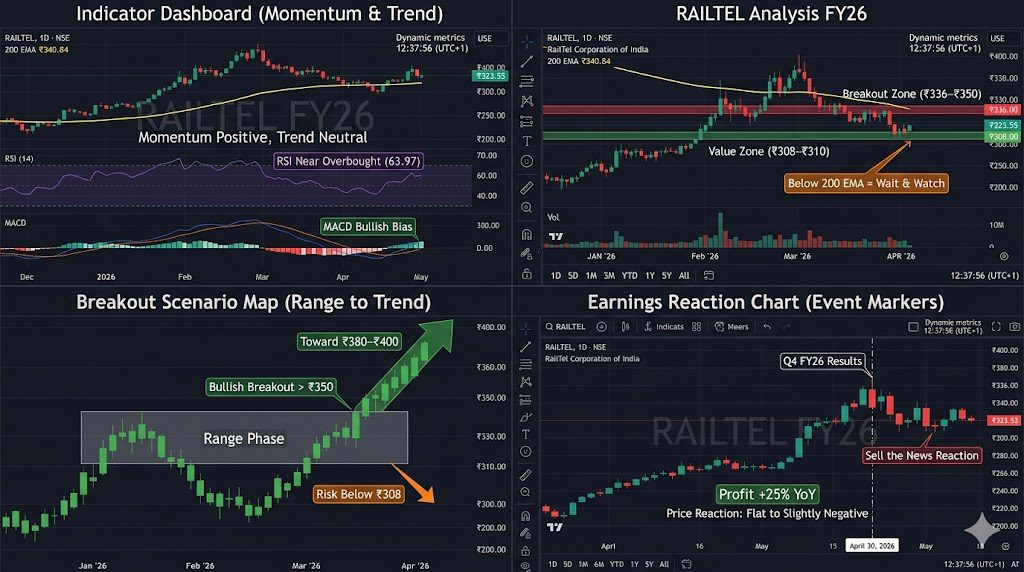
While fundamentals paint a strong picture, technical analysis helps us understand how the market is reacting to these developments. Currently, RailTel’s stock is trading below its 200-day exponential moving average (EMA) of around ₹340.84, indicating that the long-term trend is still in a consolidation phase.
The stock appears to be moving within a defined range, which suggests that investors are waiting for a clear trigger before taking decisive positions.
The major support zone lies between ₹308 and ₹310, which acts as a strong base. Historically, such levels attract value buyers who see long-term potential in the stock. If the price holds above this zone, it indicates stability and accumulation.
On the upside, the resistance zone between ₹336 and ₹350 is critical. A breakout above this range, especially with strong volumes, could signal a fresh bullish trend and attract momentum investors.
From an indicator perspective, the Relative Strength Index (RSI) is around 63.97, suggesting that the stock is approaching overbought territory in the short term. However, the MACD remains bullish, indicating that the underlying trend still has positive momentum.
This combination of indicators suggests a cautious optimism—while the stock is not in a strong uptrend yet, it is not showing signs of weakness either.
Management Guidance & FY27 Outlook
Looking ahead, the management has provided clear guidance for FY27, which offers valuable insight into the company’s growth trajectory. RailTel expects to achieve around 20% revenue growth in the coming financial year. This is a healthy target, especially considering the already strong base of FY26.
To support this growth, the company has planned a capital expenditure (CapEx) of ₹300 crore, primarily focused on expanding its data center capabilities. Data centers are a high-growth segment, driven by increasing demand for cloud services, digital storage, and enterprise solutions.
The company also aims to maintain stable margins despite increasing its focus on system integration projects, which typically have lower margins compared to telecom services. This indicates a balanced approach—prioritizing growth while ensuring profitability does not take a hit.
Overall, the guidance reflects confidence in both demand and execution capabilities, which is encouraging for long-term investors.
Brokerage Sentiment & Targets
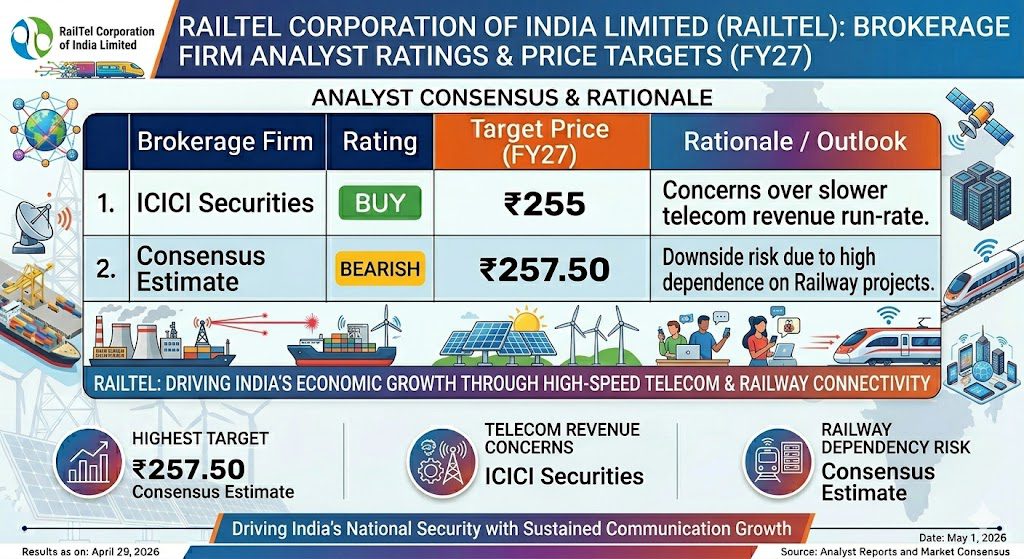
Despite strong fundamentals, brokerage sentiment around RailTel remains cautious. Some analysts have issued a “Sell” rating with target prices around ₹255, citing concerns over slower growth in the core telecom segment and high dependence on railway-related projects.
The broader consensus estimate also leans bearish, with average target prices around ₹257.50. The key concern here is valuation—after a strong rally in PSU stocks over the past few years, many analysts believe that much of the growth is already priced in.
This divergence between strong fundamentals and cautious market sentiment creates what I call a “PSU paradox.” The company is performing well operationally, but the market is hesitant due to valuation concerns and sector-specific risks.
The “30-Year” Analyst Verdict
From a long-term perspective, RailTel stands out as a quality PSU with strong fundamentals and clear growth visibility. Its large order book, strategic role in national infrastructure, and diversification into digital services make it a compelling story.
However, valuation remains a key factor. Investors need to balance growth potential with entry price. The ₹1.25 final dividend, along with interim payouts, makes the stock attractive for income-focused investors who prefer stable returns.
For traders, the stock is currently in a range between ₹310 and ₹350, which can be described as a “no-man’s land.” Entering within this range without confirmation of a breakout can be risky. A disciplined approach would be to wait for either a strong support bounce or a breakout above resistance with volume confirmation.
Conclusion & Engagement (CTA)
RailTel’s Q4 FY26 results clearly show that the company is fundamentally stronger than ever. With 25% profit growth, a record ₹11,466 crore order book, and expanding digital capabilities, it is well-positioned to benefit from India’s ongoing infrastructure and digital transformation.
At the same time, the market’s cautious stance highlights the importance of valuation and execution consistency. The coming quarters will be crucial in determining whether RailTel can sustain its growth momentum and justify its current pricing.
So, the big question remains—are you buying the dip for the steady dividend and long-term growth, or are you waiting for a breakout above ₹350 before making a move?
Let’s discuss this “PSU paradox” in the comments—because in markets, the biggest opportunities often come when conviction meets patience.