Introduction: The Silent Guardian of 5G
Over the last three decades, India’s telecom story has evolved dramatically—from the first mobile call in the mid-1990s to today’s ultra-fast 5G networks. But while most of the spotlight has been on telecom operators and smartphones, the real backbone of this transformation lies elsewhere. Indus Towers is one such silent giant that powers the entire ecosystem.
When you stream a video, attend a video call, or browse the internet at lightning speed, it is these steel towers that make it possible. And now, with the Q4 FY26 results released on April 30, 2026, Indus Towers has firmly moved from what can be called a “survival phase” into a strong, cash-generating “dividend powerhouse.”
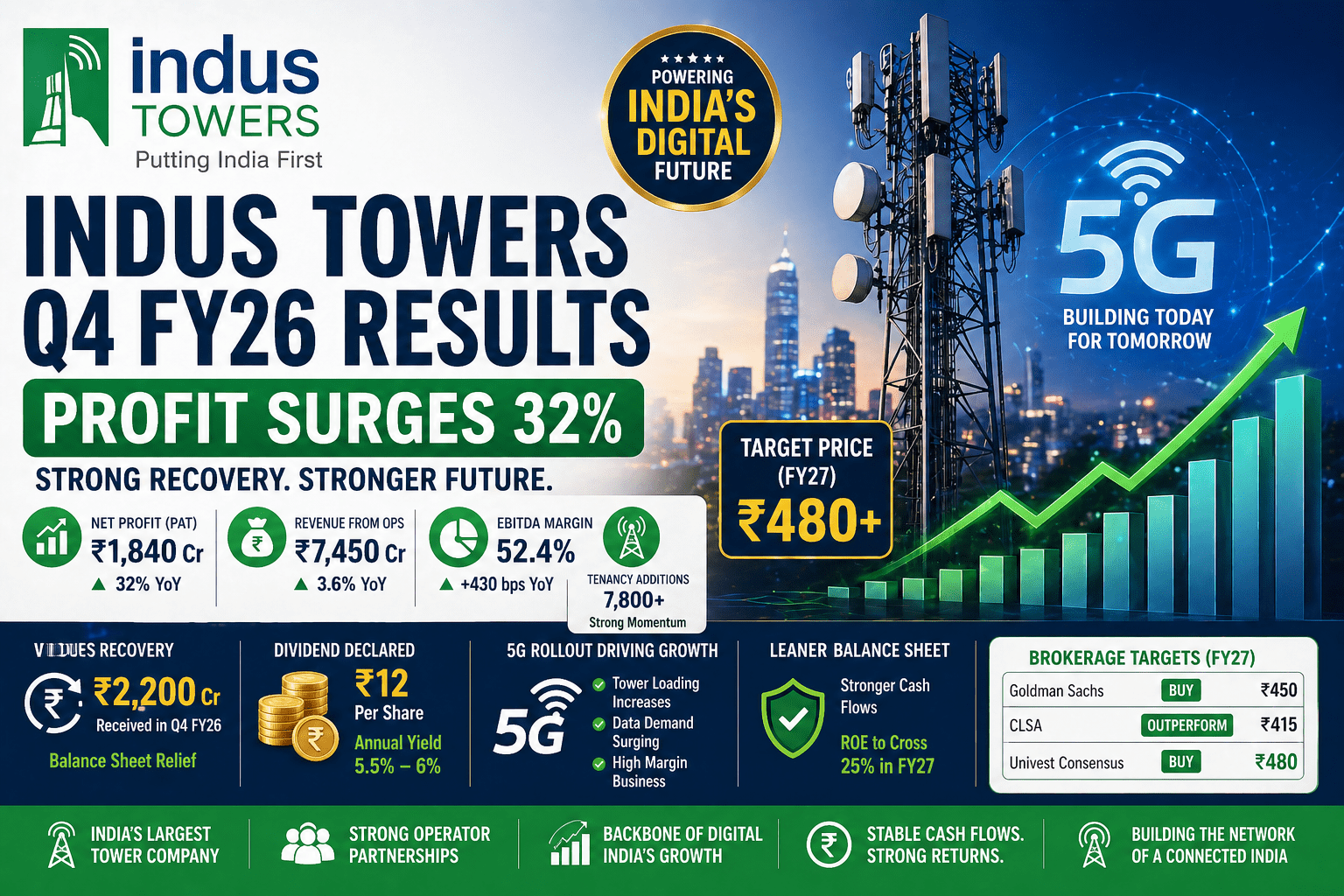
The biggest highlight this quarter is not just profit growth—it’s the ₹2,200 crore recovery from Vodafone Idea (Vi). This recovery signals a turning point for the company, as long-standing receivable concerns begin to ease. At the same time, the stock is trading near ₹365, attracting investors who are looking for stability and income in a volatile market.
Q4 FY26 Financial Scorecard: The Cash-Flow Comeback
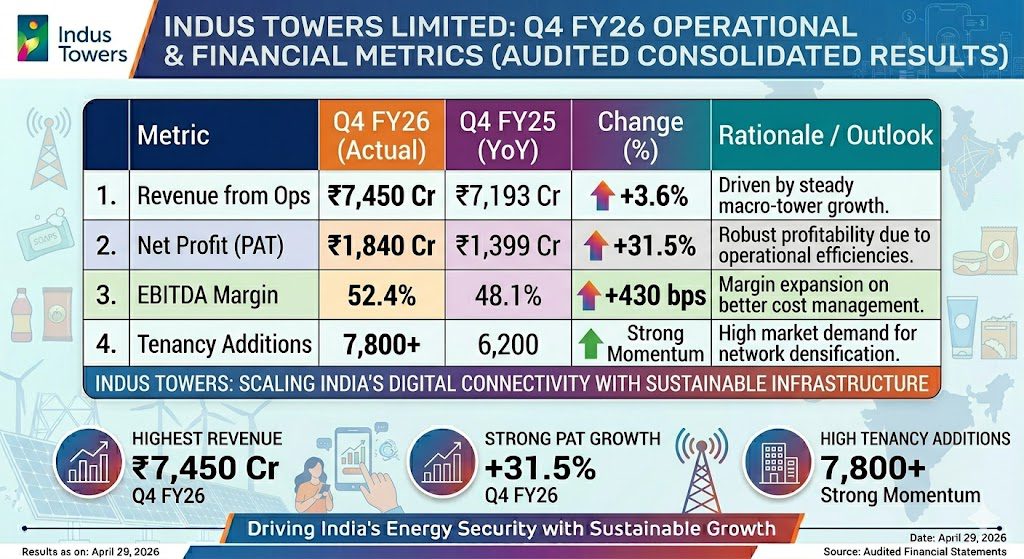
The financial performance of Indus Towers in Q4 FY26 reflects a clear turnaround in cash flows and profitability. Revenue from operations stood at ₹7,450 crore, up from ₹7,193 crore in the same quarter last year, showing a modest but stable growth of 3.6%.
However, the real highlight is net profit, which jumped significantly to ₹1,840 crore from ₹1,399 crore, marking a strong 31.5% increase. This surge is largely driven by improved collections and operating efficiencies.
EBITDA margins also expanded to 52.4% from 48.1%, indicating better cost control and higher operational leverage. In addition, the company added more than 7,800 tenancies during the quarter, compared to around 6,200 last year, showing strong demand for tower infrastructure.
Overall, the numbers reflect a business that is not only stable but also improving in quality.
Fundamental Analysis: The “Vi” Factor & 5G Rollout
The Recovery: Turning Point for Receivables
One of the most critical developments this quarter is the ₹2,200 crore payment received from Vodafone Idea. For years, delayed payments from Vi were a major overhang on Indus Towers’ financials.
This recovery is not just about cash—it represents a shift in sentiment. It indicates that the worst of the receivable risk may be behind the company, which could significantly improve investor confidence.
The 5G Tailwinds: Growth Beyond Towers
The rollout of 5G services by operators like Bharti Airtel and Reliance Jio is creating strong demand for tower infrastructure.
Interestingly, the growth is not just about building new towers. A large part of the opportunity lies in “loading,” which means adding more equipment to existing towers. This is a high-margin business because it requires minimal additional investment while generating incremental revenue.
As data consumption continues to grow, this trend is expected to sustain strong earnings growth for Indus Towers.
Leaner Balance Sheet: Improving Returns
With receivables coming down and cash flows improving, Indus Towers is now operating with a much leaner balance sheet. This is expected to push return on equity (ROE) beyond 25% in FY27.
For a large-cap infrastructure company, this level of return is highly attractive and could lead to a valuation re-rating.
Technical Analysis: Breaking the Multi-Year Ceiling
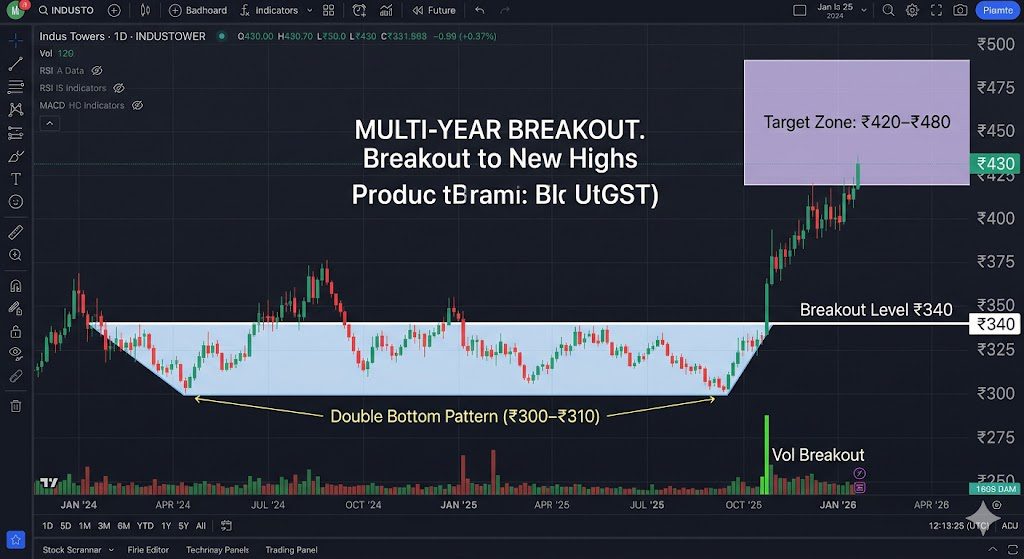
From a technical perspective, Indus Towers has recently shown a strong breakout. The stock has formed a double bottom pattern on the weekly chart and successfully crossed the ₹340 resistance level with high volumes.
This breakout is significant because it marks the end of a prolonged consolidation phase.
The ₹310–₹325 range now acts as a strong support zone, where institutional investors are likely to accumulate the stock. On the upside, ₹385 is the immediate resistance level. A sustained move above this could push the stock toward ₹420 and beyond.
The RSI is currently around 62, indicating bullish momentum without being excessively overbought. Additionally, with a price-to-earnings ratio of around 14x, the stock remains relatively undervalued compared to other infrastructure plays.
Corporate Action: The Dividend Bonanza
The Reward: A Strong Payout
Indus Towers has announced a final dividend of ₹12 per share, which is a significant payout. This reflects the company’s strong cash flow position and management’s confidence in future earnings.
Annual Yield: A Key Attraction
When combined with interim dividends, the total yield comes to around 5.5% to 6% at current prices. This makes Indus Towers one of the most attractive dividend-paying stocks in the large-cap space.
For income-focused investors, this level of yield is hard to ignore.
Brokerage Sentiment & Targets: The Re-Rating View
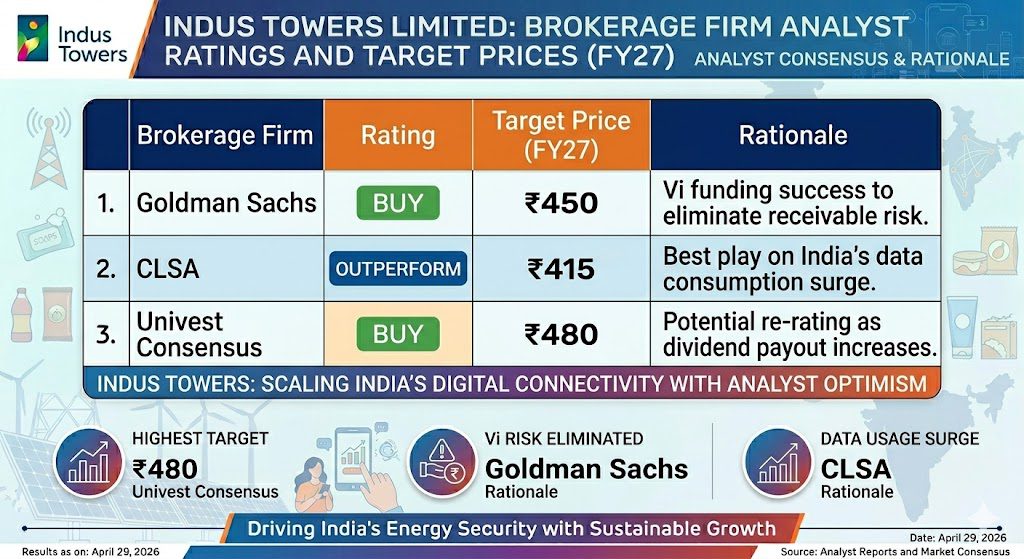
Brokerage firms have turned increasingly bullish on Indus Towers.
Goldman Sachs has given a “BUY” rating with a target price of ₹450, citing reduced receivable risks.
CLSA has assigned an “OUTPERFORM” rating with a target of ₹415, highlighting the company’s strong positioning in India’s data consumption growth.
The broader consensus suggests a target of up to ₹480, driven by improving fundamentals and higher dividend payouts.
Management Guidance: Building for 6G and Beyond
Capex Outlook: Focus on Future Infrastructure
Management has indicated that future capital expenditure will focus on small cells and urban densification. These are critical for improving network quality in densely populated areas.
As India moves toward 6G and more advanced technologies, this infrastructure will become even more important.
Non-Telco Revenue: Diversification Strategy
Indus Towers is also exploring new revenue streams beyond telecom operators. These include EV charging stations and smart city infrastructure.
Such diversification reduces dependence on telecom companies and opens up new growth opportunities.
The “30-Year” Analyst Verdict
For Long-Term Investors: Value Meets Growth
Indus Towers represents a unique combination of value and growth. It offers a high dividend yield along with the potential for capital appreciation.
For long-term investors, this makes it an attractive addition to a diversified portfolio.
For Traders: Riding the Momentum
For traders, the stock is currently in a strong uptrend. Any dip toward the ₹345 level can be seen as a buying opportunity.
With clear support and resistance levels, the risk-reward setup remains favorable.
Conclusion: The Backbone of Digital India
Indus Towers has delivered a performance that marks a clear turning point. With strong profit growth, improved cash flows, and a generous dividend, the company has established itself as a key player in India’s digital infrastructure.
As the demand for data continues to rise, Indus Towers is well-positioned to benefit from this long-term trend.
What’s Your View? (CTA)
Are you investing in Indus Towers for its high dividend yield, or are you betting on the long-term growth of India’s telecom infrastructure? Share your thoughts and let’s discuss where this stock is headed next. 🚀