Introduction: The Global Bottling Powerhouse
If you’ve followed India’s consumption story over the last two decades, you’ll notice a pattern—companies that master distribution and scale tend to dominate for years. Varun Beverages is a perfect example of this trend. What started as a regional bottler has now evolved into a global beverage powerhouse, closely tied to the growth engine of PepsiCo.
The Q1 2026 results, announced on April 27, 2026, reinforce this transformation. The company reported a net profit of ₹879 crore, marking a strong 20.1% year-on-year growth. But if you look closely, the real story isn’t just about profit—it’s about how VBL is expanding beyond India and building a global footprint, especially in Africa.
At the same time, India continues to play a crucial role. An early onset of summer has boosted beverage consumption across the country, helping the company maintain strong margins despite rising global finance costs. This combination of domestic strength and international expansion makes VBL one of the most interesting growth stories in the FMCG space today.
The stock is currently trading in the ₹480–₹500 range, showing resilience even as the broader FMCG sector faces challenges related to high valuations and slowing premium consumption trends.
Q1 2026 Financial Scorecard: Volume-Led Growth
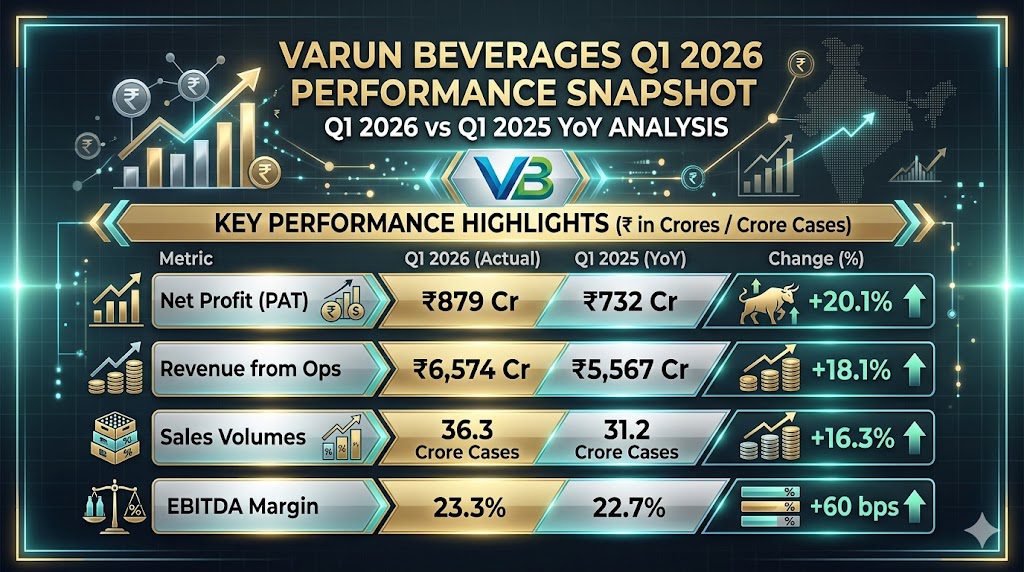
The financial performance of Varun Beverages in Q1 2026 reflects a company that is growing both in scale and efficiency. Net profit increased to ₹879 crore from ₹732 crore in Q1 2025, registering a growth of 20.1%. This level of growth is impressive, especially in a high-interest-rate environment where many companies are facing margin pressure.
Revenue from operations rose to ₹6,574 crore, compared to ₹5,567 crore last year, marking an 18.1% increase. This growth was primarily driven by higher sales volumes rather than price hikes, which indicates genuine demand expansion.
Sales volumes reached 36.3 crore cases, up from 31.2 crore cases, representing a 16.3% growth. This is a key metric for beverage companies, and such strong volume growth highlights the effectiveness of VBL’s distribution network.
EBITDA margin also improved to 23.3% from 22.7%, showing that the company is not only growing but also managing its costs efficiently.
Fundamental Analysis: The “South Africa” Catalyst
The African Frontier: A New Growth Engine
One of the most exciting developments for Varun Beverages is its aggressive expansion into Africa. The acquisition of companies like Twizza and Crickley Dairy in South Africa is no longer just a strategic plan—it is now contributing to the company’s revenue and volumes.
International volumes grew by 21.4%, significantly outpacing domestic growth. This indicates that VBL is successfully replicating its India playbook in new markets.
Africa offers a huge opportunity due to its young population, rising urbanization, and increasing consumption of packaged beverages. If executed well, this expansion could become a major growth driver over the next decade.
Product Mix Shift: Adapting to Changing Consumer Preferences
One of the biggest challenges for beverage companies globally is the shift toward healthier options. Consumers are increasingly moving away from sugary drinks and looking for low-sugar or no-sugar alternatives.
Varun Beverages has responded well to this trend. Currently, 63% of its volumes come from low-sugar or no-sugar beverages. This transition is critical because it ensures long-term sustainability of demand.
By adapting its product mix, VBL is not only protecting its existing business but also positioning itself for future growth.
The Sting Effect: Driving Higher Margins
Another key growth driver for VBL is its energy drink brand, Sting. Unlike traditional carbonated drinks, energy drinks offer higher margins due to better pricing power.
Sting has become a significant contributor to the company’s revenue and profitability. Its popularity among younger consumers and its strong distribution network make it a powerful growth engine.
In many ways, Sting is acting as a “margin multiplier,” helping the company offset rising costs in other areas.
Technical Analysis: The Multi-Year Support Test
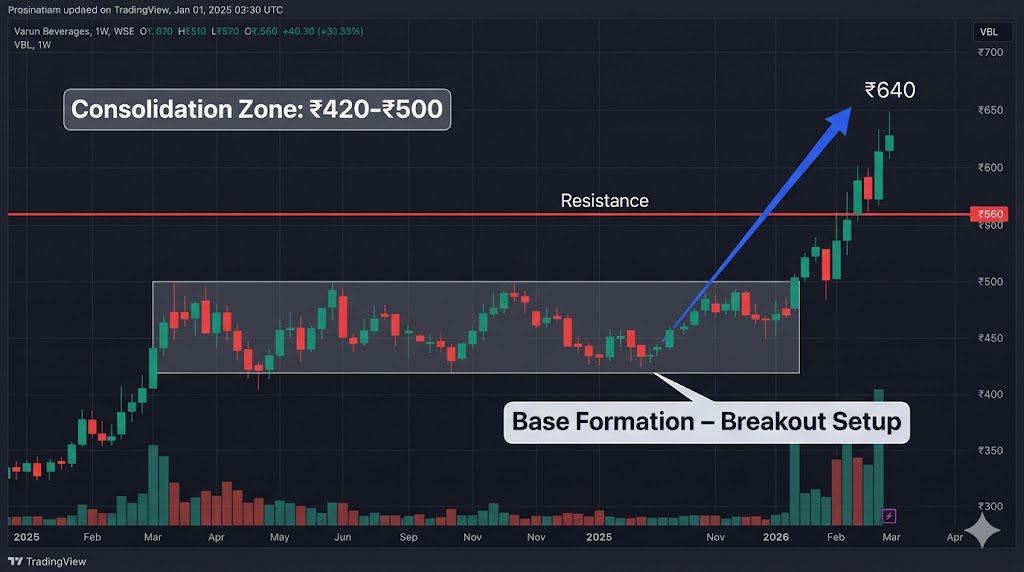
From a technical perspective, Varun Beverages’ stock has undergone a healthy correction from its 52-week high of around ₹680. After this correction, the stock has formed a strong base in the ₹420–₹450 range.
This zone has acted as a support level, where long-term investors are accumulating the stock. The current price range of ₹480–₹500 suggests that the stock is gradually moving out of its consolidation phase.
On the upside, ₹560 is the key resistance level. A breakout above this level could signal a trend reversal and open the path toward ₹640.
Another interesting indicator is the rise in Open Interest (OI), which increased by around 18% on the day of the results. This suggests that institutional investors are building fresh long positions, indicating confidence in the stock’s future performance.
Dividend & Corporate Actions
Varun Beverages has a consistent track record of rewarding its shareholders. The company has maintained a steady dividend payout policy, which reflects its strong cash flow generation.
In addition, the company recently undertook a stock split, reducing the face value from ₹5 to ₹2. This move improves liquidity and makes the stock more accessible to retail investors.
Management has indicated that it will continue to balance shareholder rewards with the need for capital expenditure, especially for its international expansion.
Brokerage Sentiment & Targets: The Path to ₹640
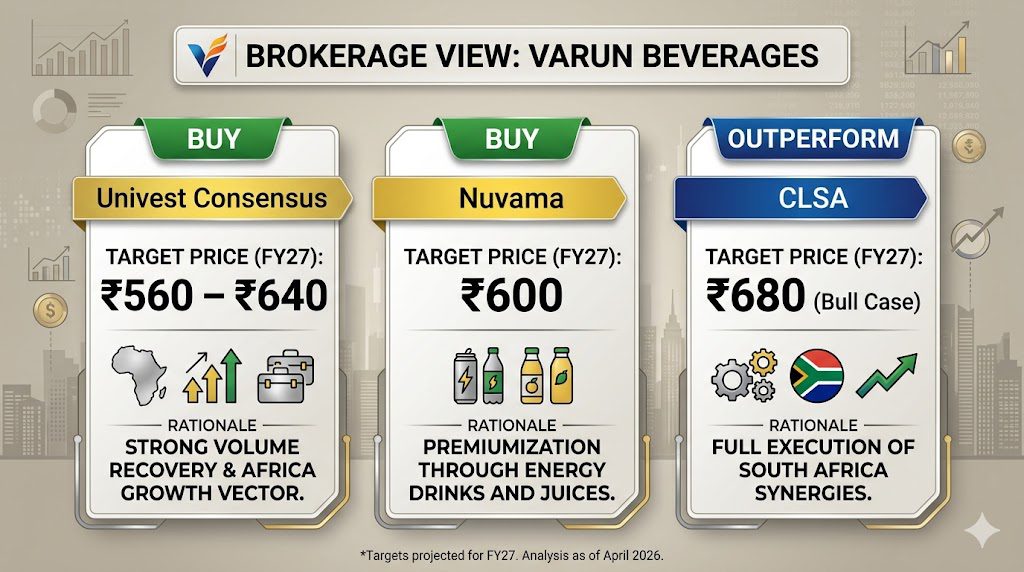
Brokerage firms are largely optimistic about Varun Beverages’ growth prospects. The consensus target price range is between ₹560 and ₹640, indicating significant upside from current levels.
Nuvama Institutional Equities has maintained a bullish stance, highlighting the company’s strong volume growth and premiumization strategy.
CLSA has an even more optimistic view, with a bull-case target of ₹680, assuming successful execution of its African expansion strategy.
Overall, the market sentiment suggests that VBL is entering a new phase of growth, driven by both domestic and international factors.
The “30-Year” Analyst Verdict
For Long-Term Investors
Varun Beverages can be described as the “HDFC of FMCG”—a company that consistently delivers 20% growth in a sector where double-digit growth is considered strong.
The African expansion represents a once-in-a-decade opportunity. If executed well, it could significantly increase the company’s revenue and profitability.
For long-term investors, this is a stock that offers both stability and growth, making it a strong candidate for a core portfolio holding.
For Traders
For traders, the current price level offers an attractive risk-reward setup. The stock is coming out of a long consolidation phase, which often precedes a strong upward move.
Buying near ₹480 with a stop-loss at ₹410 provides a controlled downside. On the upside, the stock has the potential to reach ₹560 in the short term and ₹640 over the medium term.
Conclusion: Growth Beyond Borders
Varun Beverages’ Q1 2026 results highlight a company that is successfully balancing domestic growth with international expansion. The 20% profit growth, strong volume increase, and improving margins reflect a robust business model.
The shift toward Africa and the focus on high-margin products like energy drinks position the company for sustained growth. At the same time, its strong performance in India provides a solid foundation.
What’s Your View? (CTA)
Do you believe Varun Beverages can achieve its ₹640 target, or do you think the stock is already fully valued? Share your thoughts and let’s discuss the future of India’s consumption story.