
Introduction: The “Bajaj Way” of Mortgages
If you have tracked India’s financial sector over the last three decades, one thing becomes clear—some names don’t just participate in cycles, they define them. Bajaj Housing Finance belongs to that category. The “Bajaj” philosophy has always been about disciplined growth, risk management, and consistent execution. And the Q4 FY26 results prove that this philosophy is alive and working.
At a time when liquidity was tight across the NBFC sector and borrowing costs were rising, Bajaj Housing Finance managed to grow its loan book aggressively without compromising asset quality. The company reported a standalone net profit of ₹669 crore for Q4 FY26, marking a 14% year-on-year growth.
What makes this performance even more impressive is the scale of expansion. Assets Under Management (AUM) jumped to ₹1.40 lakh crore, reflecting a strong 22.7% growth. In a challenging macro environment, such growth is not accidental—it is the result of a well-structured funding strategy and strong parentage.
The stock is currently trading near ₹123, recovering from its recent lows as institutional investors gradually return after the earnings announcement. This signals that the market is beginning to recognize the strength of the underlying business.
Q4 FY26 Financial Scorecard: The Power of Efficiency
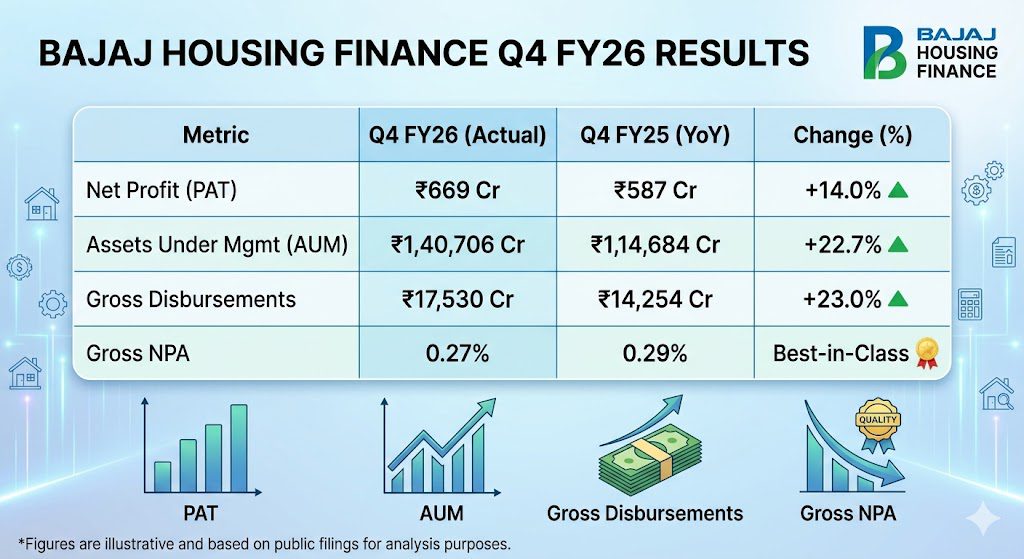
The Q4 FY26 numbers of Bajaj Housing Finance highlight a company that is growing efficiently rather than aggressively. Net profit rose to ₹669 crore from ₹587 crore in the same quarter last year, showing a steady 14% increase.
The most important metric for a housing finance company—AUM—grew to ₹1,40,706 crore compared to ₹1,14,684 crore last year. This 22.7% growth indicates strong demand for housing loans and effective distribution capabilities.
Gross disbursements for the quarter stood at ₹17,530 crore, up 23% year-on-year. This shows that the company is not just maintaining its existing portfolio but actively expanding it.
Asset quality remains one of the strongest aspects of the business. Gross NPA stands at just 0.27%, slightly improved from 0.29% last year. In an industry where NPAs can quickly rise during economic stress, such low levels highlight the company’s strong underwriting standards.
Fundamental Analysis: Quality Meets Sourcing
The “Sambhav” Catalyst: A Hidden Growth Engine
One of the key drivers of Bajaj Housing Finance’s growth is its “Sambhav” platform. This initiative focuses on affordable and near-prime housing loans, which typically offer higher yields compared to prime home loans.
These loans generate 1.25% to 1.5% higher returns, helping the company maintain its Net Interest Margins (NIMs) even when borrowing costs rise. This is a strategic advantage because it allows the company to balance growth and profitability.
In a competitive market, where many lenders are chasing the same prime borrowers, Sambhav gives Bajaj Housing access to a wider and more profitable customer base.
Operating Leverage: Scaling Without Losing Efficiency
Another important aspect of the company’s performance is its ability to improve efficiency while expanding. The operating expense to net total income ratio has improved to 19.2%.
This means the company is managing costs effectively even as it expands its branch network to over 250 locations. Such operating leverage is critical for long-term profitability.
As the business grows, fixed costs are spread over a larger base, leading to higher margins. This is a classic example of scale working in favor of profitability.
Liability Strength: The Cost of Funds Advantage
One of the biggest advantages Bajaj Housing Finance enjoys is its strong liability profile. With a Capital Adequacy Ratio of 22.46%, the company is well-capitalized.
This allows it to borrow funds at lower interest rates compared to many of its peers. Lower cost of funds directly translates into higher margins, giving the company a competitive edge.
In a high-interest-rate environment, this advantage becomes even more important.
Technical Analysis: The Recovery Rally
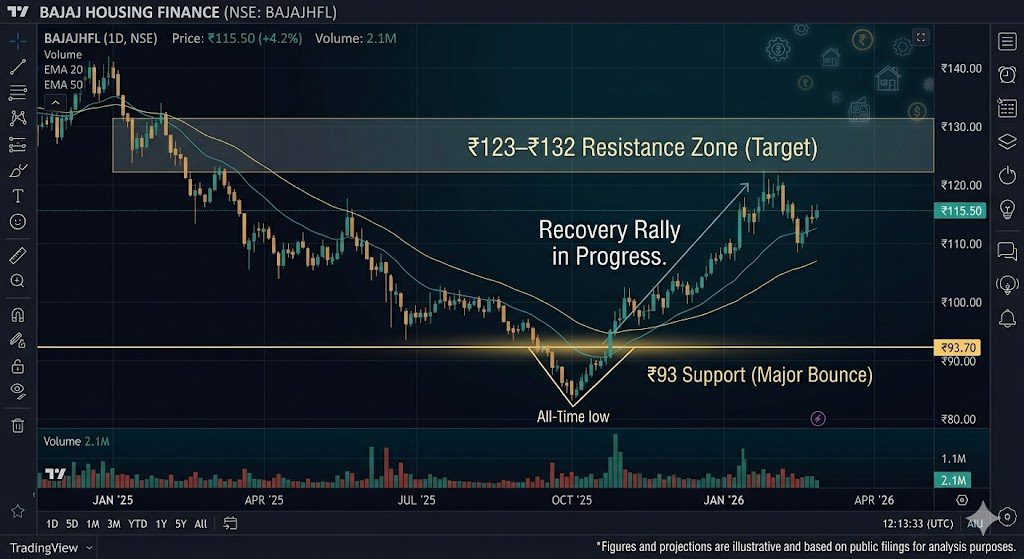
From a technical perspective, Bajaj Housing Finance’s stock is showing early signs of recovery. The stock recently bounced from its strong support level around ₹93, which can be considered its “iron floor.”
Currently, the stock is trading near ₹123 and is testing its 50-day moving average. This level is important because a sustained move above it can signal a change in trend.
The immediate support lies in the ₹115–₹120 range. This zone is likely to attract buyers on any dips, making it a key accumulation area.
On the upside, ₹148 is the next major resistance. If the stock breaks this level with strong volume, it could trigger a rally toward ₹173.
Another key level to watch is ₹132, which represents the 50% Fibonacci retracement of the recent fall. A close above this level would confirm that the bearish phase is over.
Brokerage Sentiment & Targets: The Path to ₹173
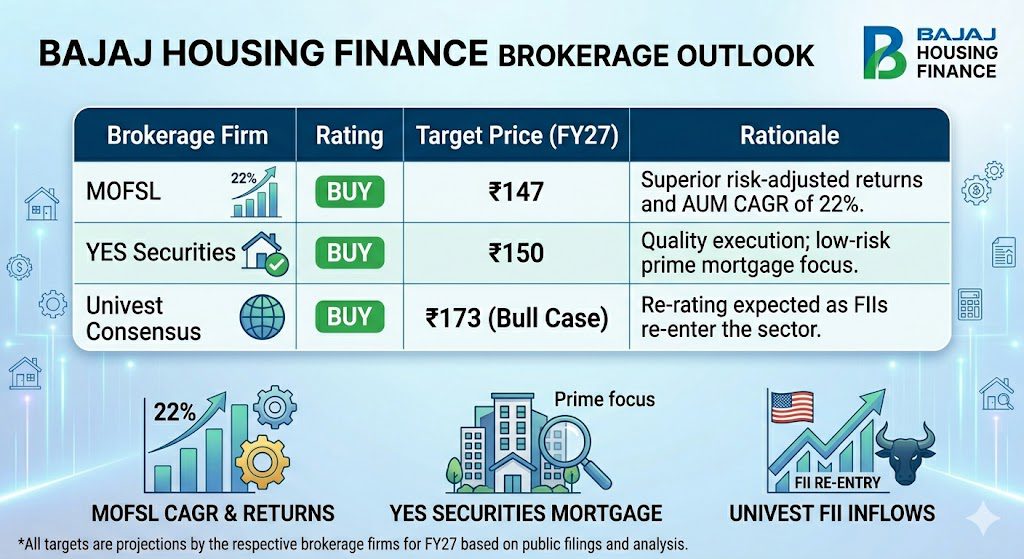
Brokerage firms have a positive outlook on Bajaj Housing Finance, reflecting confidence in its business model and growth prospects.
Motilal Oswal Financial Services has given a “BUY” rating with a target price of ₹147, citing strong risk-adjusted returns and consistent AUM growth.
YES Securities also maintains a bullish view, highlighting the company’s focus on quality lending and low-risk mortgage portfolio.
The consensus among analysts suggests a potential upside toward ₹173 in a bullish scenario, driven by improving investor sentiment and strong fundamentals.
Management Guidance: Double the Run Rate?
Growth Vision: Accelerating Disbursements
Management has indicated that the company aims to double its disbursement run rate over the next 12–15 months. This is an ambitious target, but given the company’s track record, it appears achievable.
The housing finance sector in India continues to benefit from strong demand, driven by urbanization and rising incomes. Bajaj Housing Finance is well-positioned to capture this growth.
Margin Outlook: Balancing Costs and Yields
While management expects some pressure on margins due to rising borrowing costs, the impact is likely to be limited. Net Interest Margins may see a compression of 8–20 basis points in FY27.
However, this is expected to be offset by higher yields from the Sambhav portfolio. This balance between cost and yield will be crucial for maintaining profitability.
The “30-Year” Analyst Verdict
For Long-Term Investors
Bajaj Housing Finance is a classic compounder. It may not deliver explosive short-term returns, but it offers consistent growth with low risk.
With a Net NPA of just 0.11%, the safety of capital is one of its biggest strengths. For investors looking for stability in the mid-cap space, this stock stands out.
For Traders
For traders, the current setup offers a favorable risk-reward. Buying near ₹123 with a target of ₹148 provides a good upside potential.
A breakout above ₹148 could lead to a stronger rally, while the downside risk remains limited if proper stop-loss levels are maintained.
Conclusion: Stability in a Volatile Market
Bajaj Housing Finance’s Q4 FY26 results highlight a company that has successfully navigated a challenging environment. Strong AUM growth, excellent asset quality, and efficient cost management make it one of the most reliable players in the housing finance sector.
As interest rates stabilize and demand for housing continues to grow, the company is well-positioned to deliver consistent performance.
What’s Your View? (CTA)
Do you believe Bajaj Housing Finance can reach ₹173 in the coming year, or do you prefer established players like HDFC Bank for stability? Share your thoughts and let’s discuss the best mortgage investment opportunities.