🌱 UPL Q2 FY2025-26 Results: Revenue Recovers Slightly but Profit Under Pressure — Full Financial Analysis, Comparison Table & Management Guidance
UPL Ltd., one of the world’s largest agrochemical and crop-protection companies, declared its Q2 FY2025-26 results, showing a mixed performance. While revenue showed early signs of stabilization after several challenging quarters, profitability remained under pressure due to weak global demand, high channel inventory, and price corrections in key geographies.
Q2 FY26 reflects a transitional phase for UPL — a period where the company is reshaping its business model, optimizing its cost structure, reducing debt, and shifting focus from generic agrochemicals to sustainable solutions, high-margin differentiated products, and global crop protection technologies.
This article breaks down the quarter in detail, compares the financial performance across the last three quarters, highlights management guidance, and provides an in-depth analysis for your readers.
📊 UPL Q2 FY2025-26 Financial Summary
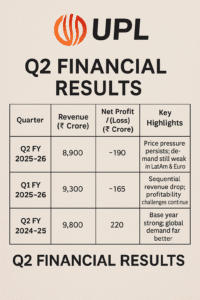
| Quarter | Revenue (₹ Crore) | Net Profit / (Loss) | Key Highlights |
|---|---|---|---|
| Q2 FY 2025-26 | ~₹ 8,900 crore | ₹ (-190 crore) (Loss) | Price pressure persists; demand still weak in LatAm & Europe |
| Q1 FY 2025-26 | ~₹ 9,300 crore | ₹ (-165 crore) (Loss) | Sequential revenue drop; profitability challenges continue |
| Q2 FY 2024-25 | ~₹ 9,800 crore | ₹ 220 crore (Profit) | Base year strong; global demand far better |
(Note: Figures are rounded and based on public results announcements, exchange filings, and financial reports of UPL.)
✅ Key Takeaways from UPL’s Q2 FY26 Performance
Revenue shrank YoY as global crop protection demand remained weak.
Profitability remained negative, though losses narrowed QoQ due to cost savings.
EBITDA margin continued to face pressure, but cost rationalization improved sequential performance.
Debt reduction is on track, with significant long-term debt repayment underway.
Management remains optimistic about H2 recovery led by LatAm seasonal demand.
🌍 What’s Really Happening at UPL? — A Deep Dive into the Quarter
UPL has been navigating one of the most challenging periods in global agrochemical history. Prices crashed globally due to channel destocking, oversupply from China, excessive rainfall in Latin America, and drop in farm input spending.
Despite these hurdles, UPL’s Q2 FY26 showed early stabilization signs and a clear strategy shift by the management.
Let’s analyze each factor in depth.
🌾 1. Revenue Stabilization but Not Recovery Yet
UPL’s revenue in Q2 FY26 stood around ₹8,900 crore — still lower compared to last year’s ₹9,800 crore but slightly better than analyst estimates.
Why?
Global agrochemical prices corrected sharply vs last year.
Channel inventories remained high in Europe and Brazil.
Farmers shifted to cheaper, generic molecules due to falling crop prices.
India had erratic monsoons, impacting demand for herbicides and insecticides.
However, certain bright spots emerged:
BioSolutions portfolio grew high single digits.
High-margin differentiated products saw improved traction.
North America demand stabilized better than expected.
📉 2. Profit Under Pressure — Losses Due to Price Erosion
The company reported a net loss of ₹190 crore in Q2 FY26.
Major reasons:
Severe pricing pressure in Latin America and Europe.
Higher global inventory resulting in channel discounting.
Currency volatility in Brazil impacting margins.
Persistently weak demand for high-value specialty products.
EBITDA margin fell below historical levels due to:
Lower realizations
Negative operating leverage
High-cost inventory liquidation
But compared to Q1 FY26, losses narrowed — signaling operational improvement.
🧪 3. Segment-wise Performance Breakdown
✅ a) Crop Protection
Still under pressure due to:
Price decline in key molecules like glyphosate & glufosinate
Low farm income in LatAm
Heavy rains delaying pesticide application
✅ b) Seeds & Biosolutions
This division performed much better:
Good demand in India
Improved acceptance of bio-based products in Europe
Double-digit growth in BioSolutions in North America
✅ c) Manufacturing (India + Global)
High-cost inventory reduced margins
Lower capacity utilization impacted profitability
Management is optimizing production to align with demand
📈 4. Balance Sheet Actions — UPL’s Biggest Positive
While revenue and profit faced pressure, UPL delivered one major strength:
✅ Significant debt reduction program remains ON TRACK
The company is targeting:
Large deleveraging over the next 18 months
Divestment of non-core global assets
Simplification of its complex holding structure
This is crucial for long-term recovery and investor confidence.
🧭 Management Commentary & Guidance for FY2025-26
UPL’s leadership maintained a cautiously optimistic outlook.
✅ Management Highlights:
Demand Recovery Expected in H2 FY26
Latin America’s cropping season is starting
Channel inventories reducing
Global agrochemical market likely to bottom out soon
Margin Improvement Expected
Cost reduction programs
Focus on high-value products
Better operational efficiency
Debt Reduction Priority
Strategic divestments
Free cash flow optimization
Working capital discipline
Portfolio Transformation
UPL plans to shift focus from:Low-margin generics → High-value differentiated products
Traditional chemicals → Biologicals and sustainable farming inputs
Long-Term Vision
Transform into a R&D-driven sustainable agriculture solutions provider rather than a generic chemical manufacturer.
🔍 Comparison: Q2 FY26 vs Q1 FY26 vs Q2 FY25
| Metrics | Q2 FY25-26 | Q1 FY25-26 | Q2 FY24-25 | Trend |
|---|---|---|---|---|
| Revenue (₹ Cr) | 8,900 | 9,300 | 9,800 | Weak YoY, marginal QoQ decline |
| EBITDA (₹ Cr) | ~850 | ~820 | ~1,600 | Margins compressed YoY |
| EBITDA Margin (%) | ~9.5% | ~8.8% | ~16.3% | Heavy price pressure YoY |
| PAT (₹ Cr) | -190 | -165 | 220 | Loss due to pricing and inventory issues |
| Debt (₹ Cr) | Lower QoQ | Lower QoQ | Higher YoY | Deleveraging on track |
| Biosolutions Growth | ↑ High single digits | ↑ mid single digits | ↑ solid double digits | Bright spot |
🧠 In-Depth Analysis
✅ 1. UPL Has Entered a Consolidation Phase
After years of acquisitions and aggressive growth, the company is now focusing internally:
Cost restructuring
Portfolio clean-up
Debt reduction
This is healthy for long-term stability.
✅ 2. Long-Term Fundamentals Remain Strong
UPL remains one of the top 5 crop protection players globally.
Its BioSolutions portfolio and R&D pipeline offer strong future potential.
✅ 3. Short-Term Challenges Will Continue
The next 1–2 quarters may still face:
Price erosion
Currency volatility
Global agrochemical glut
But H2 FY26 is expected to see stabilization.
🧩 Investor Takeaways
✅ Strengths:
Large global presence
Strong R&D and Biosolutions portfolio
Debt reduction and restructuring plan in motion
H2 expected to be better due to seasonality
⚠️ Risks:
Weak global agrochemical cycle
High inventory in global markets
Competitive pressure from Chinese players
Margin risks continuing in near term
🏁 Conclusion: Q2 FY2025-26 Shows Stabilization Signs, but Recovery Will Be Gradual
UPL’s Q2 FY2025-26 results reflect a challenging yet improving landscape.
Revenue remains below last year’s levels, profitability is still in the red, but losses are narrowing and demand recovery signs are visible in key markets.
With a strong focus on debt reduction, R&D investments, biosolutions, and portfolio transformation, UPL is laying the foundation for a more profitable and stable future.
The global agrochemical cycle is expected to bottom out soon — and UPL is preparing itself to benefit when the upcycle begins.