India’s railway manufacturing sector has been one of the biggest wealth creators of the last three years. Massive government investments in railway infrastructure, freight corridor expansion, modernization projects, and wagon procurement programs transformed several railway stocks into multi-bagger opportunities. Among the biggest beneficiaries was Jupiter Wagons Limited (JWL), a company that emerged as one of the fastest-growing players in India’s rolling stock and freight wagon ecosystem.
However, every growth story eventually encounters challenges.
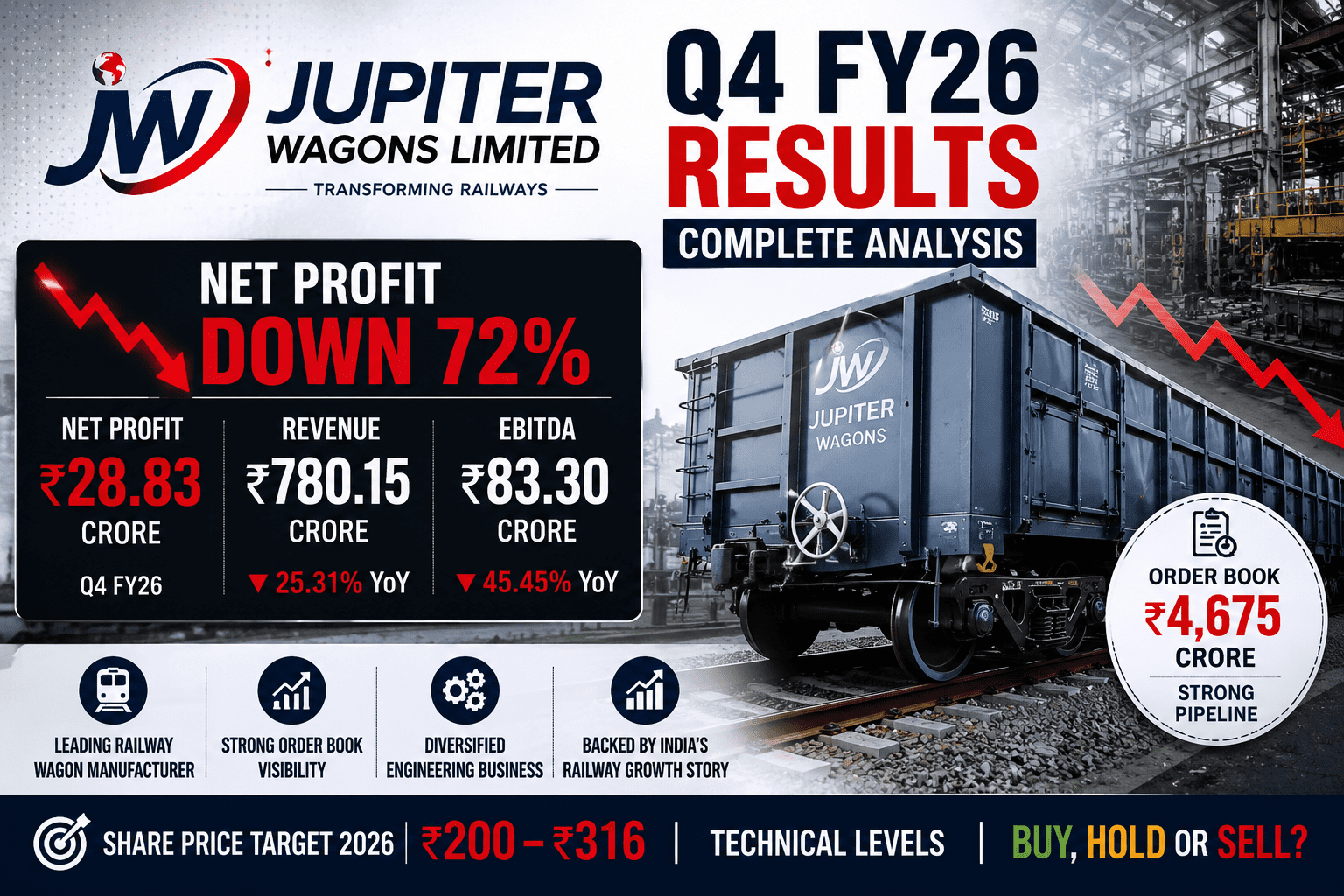
Jupiter Wagons’ Q4 FY26 results, announced on May 30, 2026, delivered a major disappointment to investors. The company reported a sharp decline in revenue, severe margin compression, and a staggering 72% fall in net profit. The earnings miss immediately raised concerns about execution challenges, operational bottlenecks, and whether the company’s premium valuation remains justified.
The market reaction was swift. Investors who had become accustomed to rapid earnings growth suddenly found themselves reassessing expectations. Yet despite the disappointing quarter, Jupiter Wagons continues to hold a substantial order book and remains strategically positioned within one of India’s strongest long-term infrastructure themes.
The key question investors now face is whether the latest earnings decline represents a temporary operational setback or a deeper structural problem. To answer that question, it is important to examine the numbers, management commentary, order book visibility, valuation metrics, and future growth opportunities.
Q4 FY26 Financial Performance: A Quarter That Shocked Investors
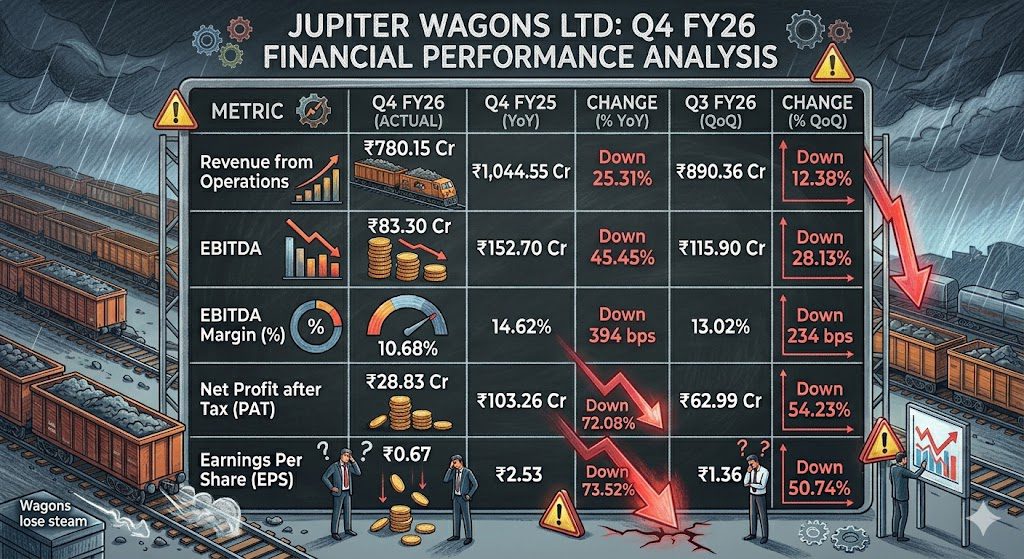
Jupiter Wagons reported consolidated revenue from operations of ₹780.15 crore during Q4 FY26 compared with ₹1,044.55 crore in the corresponding quarter of the previous year. This represents a decline of 25.31% year-on-year and reflects a significant slowdown in execution compared with the strong growth seen throughout FY24 and FY25.
The weakness became even more visible at the operating level. EBITDA declined to ₹83.30 crore from ₹152.70 crore reported during Q4 FY25. The 45.45% decline indicates that lower production volumes had a significant impact on profitability.
EBITDA margins contracted sharply to 10.68% from 14.62% a year earlier. The decline of 394 basis points highlights the severity of operating leverage challenges faced during the quarter. When manufacturing companies experience lower production utilization, fixed costs become more difficult to absorb, resulting in margin pressure.
Net profit after tax came in at just ₹28.83 crore compared with ₹103.26 crore reported during the same quarter last year. The 72.08% decline in profit was significantly worse than many market participants had anticipated.
Earnings per share also declined sharply to ₹0.67 from ₹2.53, confirming that the operational challenges directly impacted shareholder earnings.
The sequential comparison was equally disappointing. Revenue fell 12.38% from Q3 FY26 levels, while net profit declined 54.23% quarter-on-quarter, suggesting that operational issues intensified during the final quarter of the fiscal year.
Company Overview: A Key Player in India’s Railway Manufacturing Ecosystem
Jupiter Wagons has built a strong position within India’s railway manufacturing sector through its integrated engineering and manufacturing capabilities. The company manufactures freight wagons, passenger coaches, brake systems, alloy steel castings, commercial vehicle load bodies, and specialized railway components.
One of Jupiter Wagons’ key competitive advantages is its backward integration strategy. The company operates its own foundry and casting facilities, enabling it to manufacture critical railway components internally. This reduces dependence on external suppliers and provides better quality control while improving operating efficiency during normal business conditions.
The company’s customer base includes Indian Railways, private freight operators, logistics companies, industrial customers, and infrastructure-related businesses. Over the past decade, management has gradually diversified beyond traditional wagon manufacturing into adjacent transportation and engineering segments.
This diversification strategy is important because railway procurement cycles can sometimes be uneven. By expanding into complementary product categories, Jupiter Wagons aims to reduce earnings volatility while creating multiple growth drivers.
Despite the latest earnings setback, the company remains one of the most recognized names in India’s rapidly expanding railway manufacturing ecosystem.
Why Did Jupiter Wagons’ Profit Collapse by 72%?
The dramatic decline in profitability was not caused by weak demand. Instead, management attributed the majority of the challenges to operational bottlenecks and temporary disruptions affecting production schedules.
One of the primary issues involved interruptions in industrial LPG availability. According to management commentary, geopolitical tensions impacting international energy transportation routes created supply-side disruptions that affected manufacturing operations.
These disruptions resulted in lower production efficiency and delayed product deliveries. When manufacturing volumes decline, companies face operational deleveraging because fixed costs remain largely unchanged regardless of output levels.
The impact became particularly visible in EBITDA margins, which fell significantly as production efficiency deteriorated.
Another factor affecting profitability was the lower contribution from specialized wagon deliveries. These products typically generate higher margins than standard manufacturing contracts. During Q4 FY26, the mix shifted away from higher-margin deliveries, further reducing profitability.
The result was a situation where profits declined much faster than revenue. While revenue dropped 25%, net profit plunged more than 72%, demonstrating the powerful impact of operational leverage in manufacturing businesses.
Importantly, management indicated that these challenges were primarily execution-related rather than demand-related, suggesting that future quarters could see improvement if operational conditions normalize.
Fundamental Analysis: The Order Book Remains the Biggest Strength
Despite the disappointing quarterly numbers, Jupiter Wagons continues to possess one major strength that long-term investors cannot ignore: its order book.
As of March 31, 2026, the company reported an order book worth approximately ₹4,675 crore. This represents nearly 1.6 times its trailing twelve-month revenue and provides substantial visibility for future business activity.
A large order book is particularly important in capital goods and railway manufacturing businesses because it offers predictable revenue streams and reduces uncertainty regarding future production schedules.
The broader industry backdrop also remains highly supportive. Indian Railways is currently pursuing one of the largest modernization programs in its history. Government plans include approximately ₹40,000 crore worth of freight wagon procurement over the coming years.
As an established supplier within the ecosystem, Jupiter Wagons remains well positioned to participate in future tender opportunities.
However, valuation remains a concern. Even after correcting approximately 26% from its 52-week high of ₹419.40, the stock continues trading at a trailing price-to-earnings multiple of around 51.6x.
Such valuations require strong earnings growth and flawless execution. The latest quarter clearly demonstrates how sensitive premium valuations can become when operational challenges emerge.
Technical Analysis: Critical Levels Traders Must Watch
From a technical perspective, Jupiter Wagons currently remains in a bearish trend.
The stock closed at ₹290.75 before the earnings release and has already corrected approximately 14% on a year-to-date basis. Price action continues to reflect a lower-high and lower-low structure, indicating that sellers remain in control.
The most important support level is ₹284. A breakdown below this level could trigger additional selling pressure and potentially push the stock toward the next major support zone near ₹268.
This ₹268 area represents a stronger structural demand zone where long-term investors may begin evaluating fresh entry opportunities.
Below that, the final major support level exists near ₹235.65, which corresponds to the stock’s broader long-term accumulation zone.
On the upside, immediate resistance is positioned around ₹298. The stock must close above this level before any meaningful trend reversal can be considered.
Additional resistance zones are located near ₹305 and ₹318.50. Until these levels are reclaimed, traders are likely to remain cautious.
Short-term momentum currently favors the bears, and technical indicators suggest further volatility may persist following the earnings disappointment.
Management Strategy: Fixing Operational Weaknesses
Management has already outlined several initiatives aimed at preventing similar disruptions in the future.
The first priority involves strengthening fuel sourcing resilience. The company is building backup fuel procurement arrangements to reduce dependence on any single supply chain channel. This should help minimize future production interruptions caused by energy-related disruptions.
The second major initiative focuses on business diversification.
Management plans to expand higher-growth segments such as brake systems, specialized engineering products, and commercial vehicle fabrication businesses. The goal is to reduce dependence on wagon manufacturing and lower the contribution of wagon-related revenue below 60% by FY28.
This diversification strategy could improve earnings stability while reducing exposure to procurement cycle fluctuations within the railway sector.
If executed successfully, these initiatives may help restore margins and support long-term earnings growth.
Brokerage Views and Target Prices
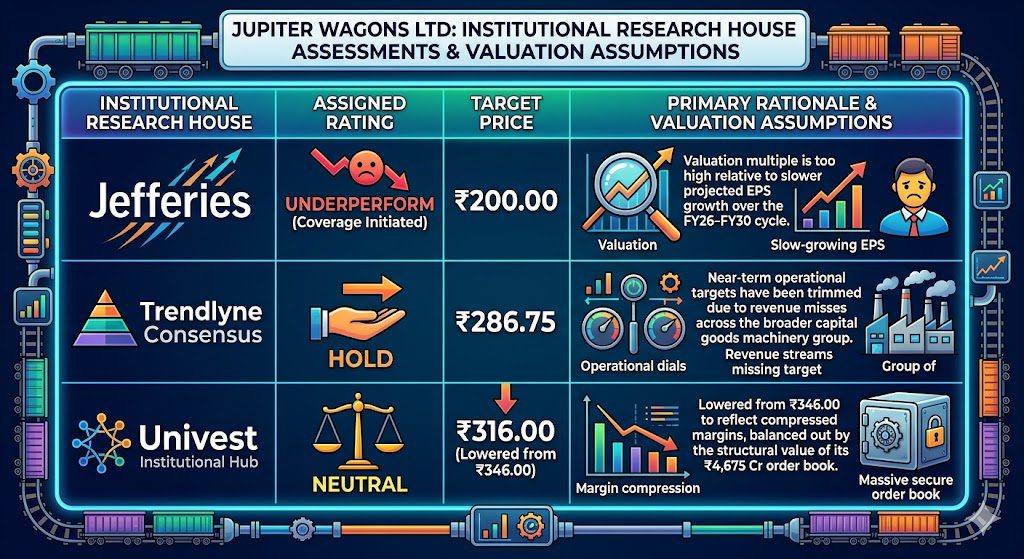
Institutional sentiment toward Jupiter Wagons has become increasingly cautious following the Q4 earnings miss.
Jefferies recently initiated coverage with an Underperform rating and assigned a target price of ₹200. The brokerage believes current valuations remain elevated relative to expected earnings growth over the coming years.
Trendlyne’s consensus estimate currently stands near ₹286.75, reflecting a broadly neutral outlook among analysts.
Univest Institutional Hub remains somewhat more constructive with a Neutral rating and a target price of ₹316. However, even this target was reduced from previous expectations due to weaker margins and slower execution.
The divergence among brokerage targets highlights the uncertainty surrounding near-term earnings recovery.
While most analysts continue recognizing the strength of the company’s order book, concerns regarding valuation and execution remain significant.
Final Verdict: Buy, Hold, or Sell?
For long-term investors, Jupiter Wagons remains an interesting but increasingly complex investment story.
The company continues to benefit from strong railway sector tailwinds, a sizeable ₹4,675 crore order book, and long-term government infrastructure spending. These factors provide confidence that demand remains intact.
However, the latest quarter exposed operational vulnerabilities and demonstrated how quickly profitability can deteriorate when execution challenges emerge.
Investors already holding the stock at lower levels may consider maintaining their positions while closely monitoring margin recovery and execution improvements over the next few quarters.
For new investors, patience may be the better strategy. The stock’s valuation remains relatively demanding despite recent corrections. Waiting for evidence of margin stabilization and operational normalization could offer a more favorable risk-reward opportunity.
For short-term traders, the technical setup remains weak. Unless the stock successfully reclaims ₹298 and sustains higher levels, downside risks cannot be ignored.
Overall, Jupiter Wagons remains a strong company operating within a promising industry. However, after the disappointing Q4 FY26 results, management must now prove that the earnings slowdown is temporary and that the long-term growth story remains firmly on track.