
1. Introduction: The Unstoppable Mid-Cap Engine
If you’ve spent years tracking the Indian IT sector, you’ll know that very few companies manage to consistently outperform both expectations and their larger peers. Persistent Systems (PERSISTENT) is one of those rare exceptions. Over the last three decades, I’ve seen it transform from a niche product engineering company into a serious mid-cap powerhouse. And now, with the Persistent Systems Q4 Results FY26 Analysis, it’s clear that the company is no longer just a fast-growing mid-cap—it’s becoming a legitimate challenger to the industry giants.
The Hook
At a time when most large IT firms are struggling to maintain even single-digit growth due to global macro pressures, Persistent Systems has quietly delivered something remarkable—its 24th consecutive quarter of sequential revenue growth. That kind of consistency is rare in the IT sector, especially in an environment where clients are cutting discretionary spending and delaying projects. This is not just growth—it’s disciplined, repeatable execution.
The Big Picture
FY26 can be seen as the year when Persistent Systems officially stepped into a new league. It is no longer just competing with other mid-cap IT firms; it is increasingly taking market share from large players like TCS and Infosys. Its ability to combine digital engineering, cloud, and AI-led solutions has allowed it to win bigger deals and deepen relationships with global clients. In simple terms, Persistent is evolving from a “vendor” into a strategic technology partner.
Real-Time Data
From a market perspective, the stock has been on a strong run. After delivering a sharp 20% rally in the month leading up to the results, the share price is currently hovering around ₹5,330, showing signs of consolidation. This kind of price behavior typically indicates that the market is digesting gains before the next move, rather than signaling weakness.
2. Q4 FY26 Financial Scorecard: The Earnings Beat
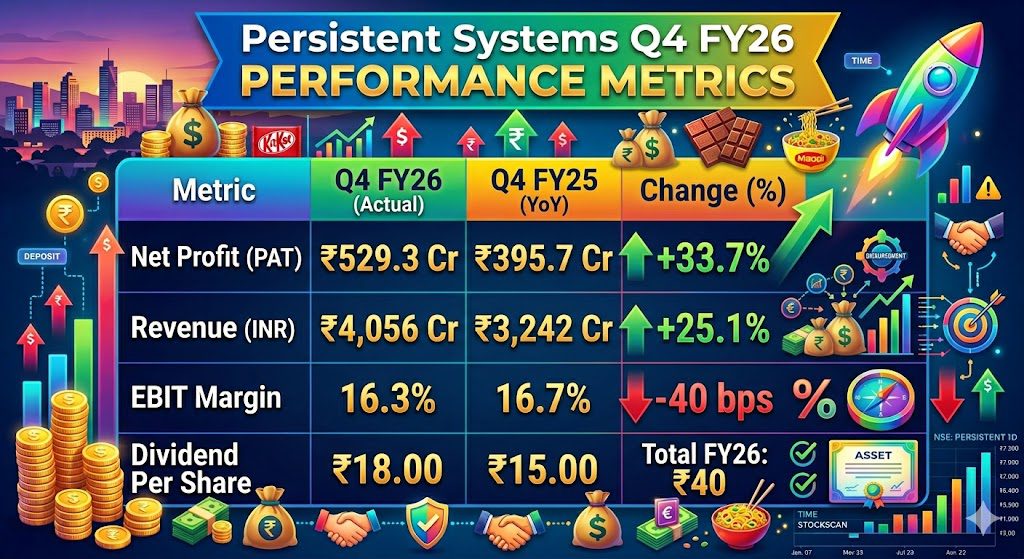
The financial performance of Persistent Systems in Q4 FY26 reinforces its position as one of the fastest-growing IT companies in India. The company reported a net profit of ₹529.3 crore, which represents a strong 33.7% year-on-year growth compared to ₹395.7 crore in Q4 FY25. This kind of profit expansion, especially in a challenging environment, highlights strong operational efficiency and high-quality revenue growth.
Revenue for the quarter came in at ₹4,056 crore, reflecting a 25.1% YoY increase, which is significantly higher than most peers in the IT sector. This clearly shows that Persistent is not just growing—it is growing faster than the industry.
On the margin front, the EBIT margin stood at 16.3%, slightly down from 16.7% last year, indicating a 40 basis point decline. This minor contraction is largely due to continued investments in talent, AI capabilities, and platform development. However, such investments are essential to sustain long-term growth and should not be seen as a negative.
The company also rewarded shareholders with a dividend of ₹18 per share, compared to ₹15 last year, taking the total FY26 dividend to ₹40 per share. This reflects strong cash flows and management’s confidence in the business.
3. Fundamental Analysis: The “Unfair” Share of Wallet
Order Book Strength
One of the most powerful indicators of future growth in IT services is deal wins, and Persistent Systems has delivered strongly on this front. The company reported a Total Contract Value (TCV) of $600.8 million for the quarter, which is a massive number for a mid-cap IT firm. This strong order book provides clear revenue visibility for the coming quarters and supports the company’s premium valuation.
Vertical Performance
Persistent’s growth is being driven by strong performance across key verticals, particularly BFSI and Healthcare. The BFSI segment continues to grow despite global economic uncertainty, driven by demand for digital banking, cloud transformation, and cybersecurity solutions. Large financial institutions are still investing in technology to improve efficiency and customer experience, and Persistent is benefiting from this trend.
In the Healthcare and Life Sciences segment, growth is even more impressive. The rapid adoption of AI and data-driven solutions is leading to larger deal sizes and longer contracts. Persistent’s expertise in digital engineering and data platforms is helping it win high-value projects in this space.
The AI Pivot
A major part of Persistent’s growth strategy is its shift toward AI-led solutions under the leadership of CEO Sandeep Kalra. The company is moving from a traditional human-driven services model to a technology-driven platform model, with solutions like the SASVA AI platform.
This shift is critical because it allows the company to scale faster, improve margins, and deliver more value to clients. Instead of simply providing manpower, Persistent is now offering intelligent, automated, and scalable solutions, which command higher pricing and deeper client engagement.
4. Technical Analysis: The ₹5,200 Launchpad
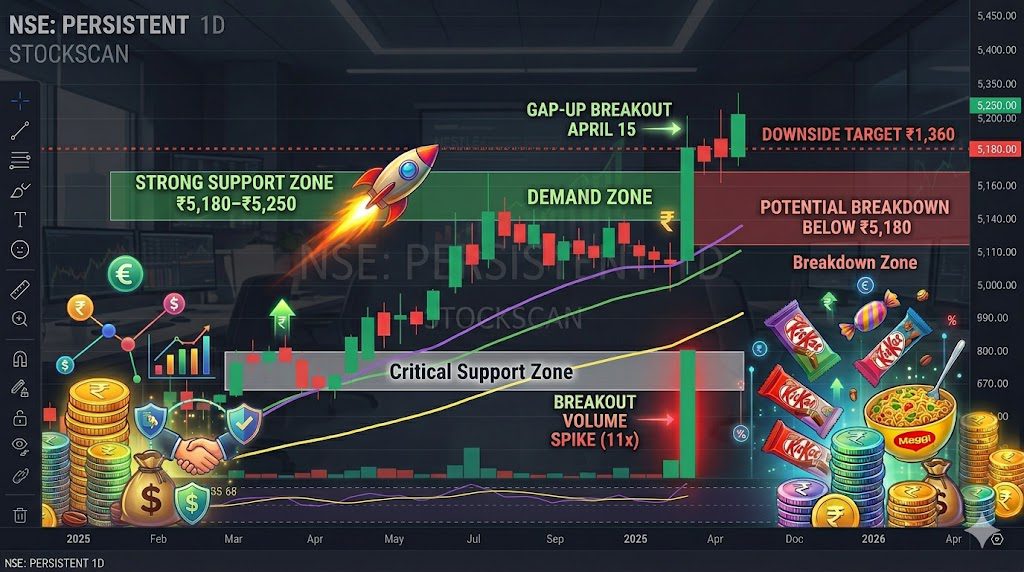
From a technical standpoint, Persistent Systems is currently in a strong bullish trend, supported by both price action and indicators.
The Current Chart
The stock recently formed a “gap-up” reversal pattern on April 15, which is typically seen as a bullish signal. This indicates strong buying interest and positive sentiment following the results.
Support & Resistance
The immediate support zone lies between ₹5,180 and ₹5,250, which also represents the recent breakout base. As long as the stock holds above this level, the overall trend remains positive.
On the upside, the immediate resistance is around ₹5,512, while the next major hurdle is the 52-week high of ₹6,788. A sustained move above these levels could open the door for further upside.
Analyst Pro-Tip
Technically, the stock is trading above its 50-day and 100-day exponential moving averages (EMA), which indicates strong medium-term momentum. However, the Relative Strength Index (RSI) is around 68, which is close to the overbought zone. This suggests that the stock may enter a short period of consolidation or sideways movement before continuing its upward trend.
5. Management Guidance & The $2 Billion Dream
Looking ahead, Persistent Systems has laid out an ambitious yet achievable growth roadmap.
FY27 Outlook
The company is on track to achieve a $1 billion revenue run rate by the end of FY27, which would mark a significant milestone in its growth journey. This target reflects management’s confidence in its business model and market positioning.
Inorganic Growth
In addition to organic growth, the company is actively exploring 1–2 strategic acquisitions, particularly in the GenAI space. These acquisitions are expected to enhance capabilities, expand client offerings, and accelerate growth.
Margin Guidance
Management has guided for EBIT margins in the range of 16% to 18%, indicating stability despite ongoing investments. As operational efficiencies improve and AI-driven solutions scale up, margins are expected to remain healthy.
6. Brokerage Outlook: Where is the Smart Money Going?
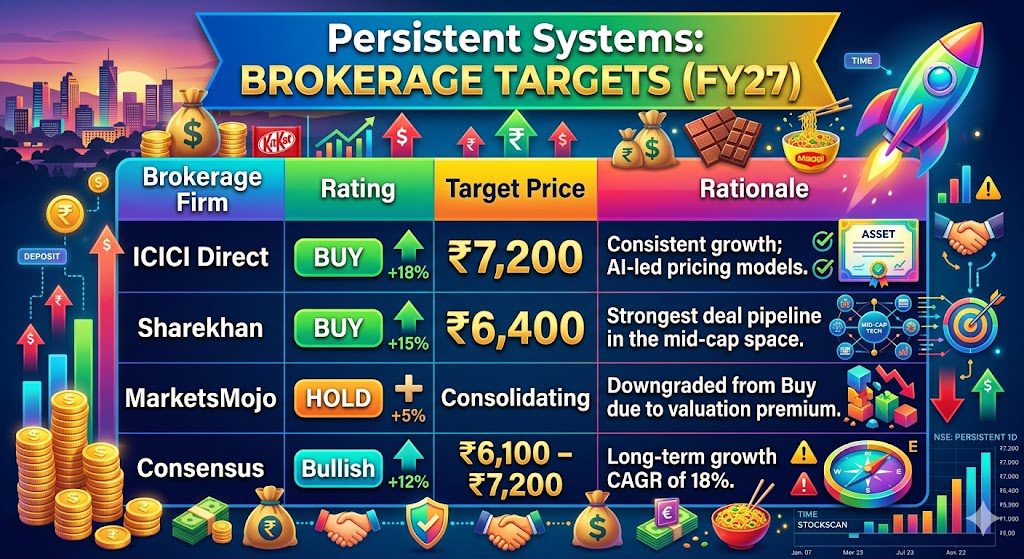
Brokerage firms remain largely bullish on Persistent Systems, reflecting strong confidence in its growth trajectory. ICICI Direct has given a “BUY” rating with a target price of ₹7,200, citing consistent growth and AI-led pricing advantages. Similarly, Sharekhan has also maintained a “BUY” rating with a target of ₹6,400, highlighting the company’s strong deal pipeline.
However, not all views are uniformly positive. MarketsMojo has downgraded the stock to “HOLD,” primarily due to its premium valuation after the recent rally. Despite this, the overall consensus remains bullish, with target prices ranging between ₹6,100 and ₹7,200, and a long-term growth CAGR of around 18%.
7. The 30-Year Analyst Verdict
After decades of analyzing market cycles, one thing becomes clear—companies that combine strong execution with consistent growth tend to outperform over the long term. Persistent Systems fits this profile perfectly.
For the Long-Term Investor
Persistent can be classified as a “growth compounder.” While its valuation, with a P/E ratio of around 48x, may appear high, it reflects the market’s confidence in its growth potential and execution capability. Investors are not just buying current earnings—they are investing in future growth.
For the Trader
From a trading perspective, the trend remains clearly bullish. The ideal strategy would be to buy on dips near the ₹5,250 level, with a short-term target of around ₹5,800. The risk-reward ratio remains favorable as long as key support levels hold.
The Risk
No investment is without risk. Any delay in converting GenAI opportunities into revenue or geopolitical tensions, such as US-Iran conflicts affecting FII flows, could lead to temporary profit booking and volatility in the stock.
8. Conclusion & Engagement (CTA)
The Persistent Systems Q4 Results FY26 Analysis clearly shows that the company is outperforming its larger peers on multiple fronts—revenue growth, profit expansion, deal wins, and strategic positioning. With a strong order book, a clear AI strategy, and consistent execution, Persistent Systems is well-positioned for sustained growth.
At the same time, its attractive ₹40 total dividend for FY26 ensures that investors are rewarded not just through capital appreciation but also through income.
Now the big question is—
👉 Are you buying Persistent Systems for its GenAI-driven future growth, or are you booking profits and shifting to large-cap IT stocks?
💬 Share your target price and strategy in the comments—let’s discuss where this mid-cap powerhouse is headed next.