Trump’s New H-1B Moves: Why This Isn’t Just a Visa Story—It’s a Geo-economic Shock for India and the U.S.
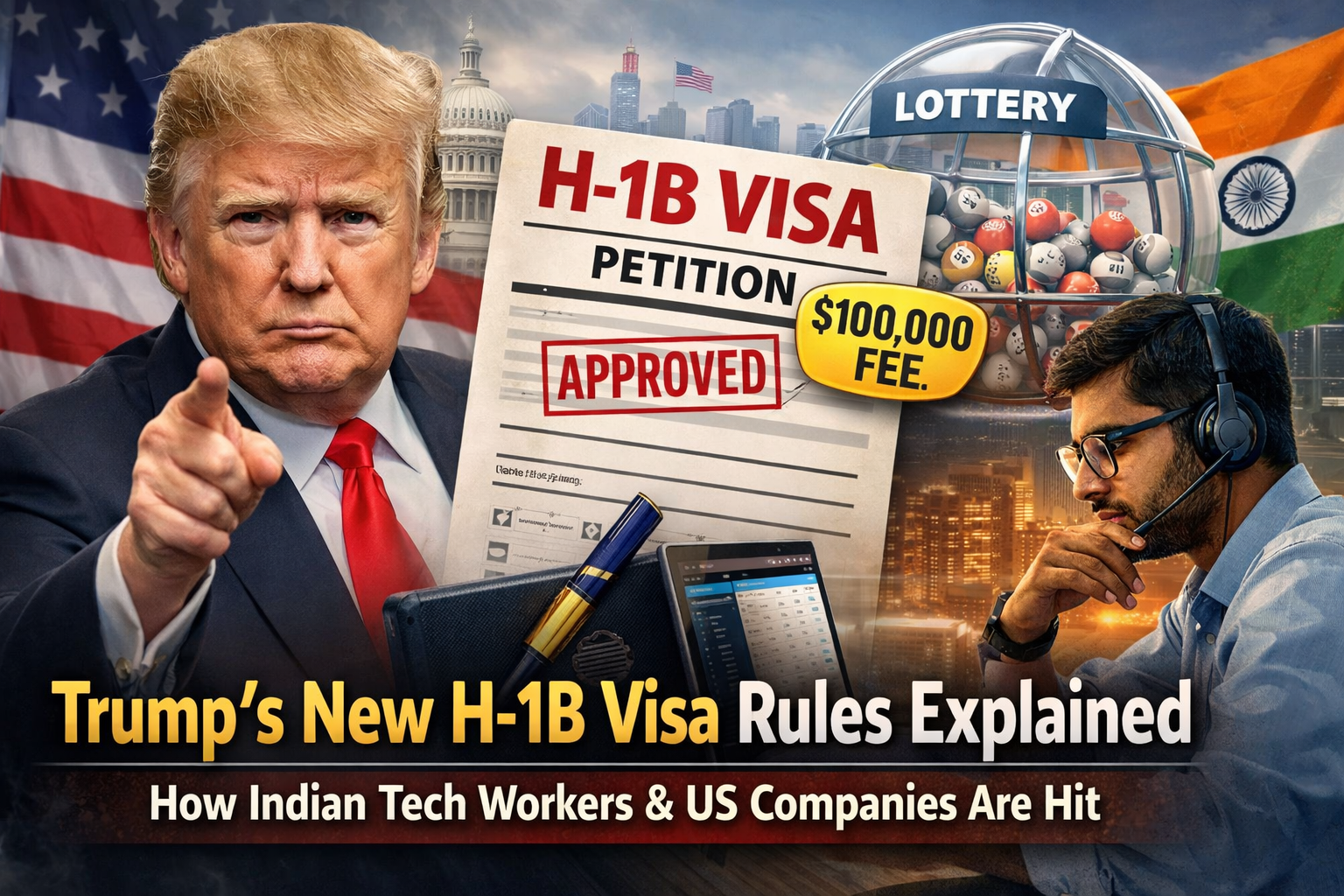
The H-1B visa has always been more than paperwork. For India, it’s tied to middle-class dreams, tech jobs, remittances, and the global reputation of Indian talent. For the U.S., it’s linked to innovation, startup speed, and filling skill gaps in a tight labour market. That’s why the latest Trump-era changes—especially a $100,000 fee on new H-1B petitions and a push to reshape the lottery into a wage-weighted selection—feel like a direct hit to a living economic bridge between the two countries. A U.S. federal judge has now refused to scrap the $100,000 fee, strengthening the policy’s staying power and making companies plan around it, not “wait it out.”
What Exactly Changed: The $100,000 Fee + A New “Weighted” Selection Push
Two big policy signals are driving today’s headline. First, the administration introduced a requirement that new H-1B petitions filed after September 21, 2025 must include a $100,000 payment, according to USCIS guidance and reporting around the rule. Second, the Trump administration has also announced a major shift away from a pure random lottery toward a “weighted” selection approach that prioritises higher-paid / higher-skilled applicants, with reporting indicating it is planned to begin soon.
Even if you ignore politics, the economics are blunt: a $100,000 add-on is not a minor “compliance cost.” It can change whether a company hires at all, whether it hires in the U.S. or outside it, and whether a role becomes remote-from-India instead of on-site in America.
A Quick Reality Check: How Big the H-1B Pipeline Really Is
The H-1B cap is limited, but the system affects a huge number of lives and business plans. The headline cap most people quote is 65,000 regular slots plus 20,000 for U.S. advanced degree holders. The registration system also matters because it shapes who even gets a chance at a petition, and USCIS notes the FY2026 registration fee is $215 (up from the earlier $10 era), which already raises the cost of simply entering the process.
And here’s the key India angle: India dominates H-1B approvals. A widely cited FY2024 dataset summary puts India at 283,397 approvals, about 71% of 399,395 total approvals that year. That is why any major H-1B shock is, in practice, a major India-U.S. talent shock.
Why This Is Geo-economics: Immigration Policy as an Economic Weapon

When a superpower changes immigration rules, it’s not only about borders—it’s about competitiveness. In geo-economic terms, skilled visas are a tool that shapes where talent goes, where companies build teams, and where innovation clusters form. A fee this large effectively acts like a “tariff” on importing skilled labour. Unlike a normal tariff on goods, this one hits people and skills, which are the inputs for modern growth sectors like AI, chips, cybersecurity, cloud, and biotech.
The judge’s decision matters because it reduces uncertainty. Reuters reported that a U.S. District Judge Beryl Howell rejected a challenge led by business groups like the U.S. Chamber of Commerce and described the move as within the executive’s broad immigration powers—meaning companies now have to treat the fee as real, not temporary noise.
Impact on Indian Workers: The “American Dream” Just Got Pricier (and Narrower)
For Indian professionals, the direct impact is obvious: fewer employers will sponsor, and those that do may sponsor only for roles that clearly justify very high costs. A $100,000 fee will push companies to reserve H-1Bs for niche specialists—think senior AI engineers, chip designers, quantitative researchers—while shutting out many early-career and mid-career profiles who historically used the H-1B route to enter the U.S. workforce.
There’s another layer too: uncertainty causes “life pauses.” Families delay home purchases, kids’ education plans, and long-term settlement choices when immigration policy swings. Bloomberg’s framing of “immigration chaos” captures that mood from the India side, especially when policy changes stack up quickly.
Impact on Indian IT and Outsourcing Firms: The Delivery Model Takes a Hit

Indian IT giants don’t just send people abroad for the thrill of it. The old outsourcing model relied on a mix of on-site staff (for client interaction, implementation, compliance) and offshore staff (for scale and cost efficiency). If it becomes drastically more expensive to move new staff to the U.S., companies will have to rebalance—either hire more local Americans (costly), shift more work offshore (client resistance for sensitive projects), or expand “nearshore” centres in friendlier countries.
One recent data point that signals pressure: NDTV reported that new H-1B approvals for major Indian IT companies fell to 4,573, described as the lowest in 10 years, and down sharply versus earlier peaks. Even if you treat this as one slice of the overall H-1B world, it shows the direction: Indian IT firms are already operating in a tighter U.S. visa environment.
Impact on the U.S.: Higher Costs, Slower Hiring, and a Potential Innovation Tax
The political claim behind strict H-1B policy is usually “protect U.S. workers.” But the economic counter-argument is: if you restrict skilled inflow too hard, you don’t magically create skilled workers overnight—you often create project delays, wage spikes in narrow skill categories, and slower scaling for startups and fast-growing teams.
Reuters noted critics warned the $100,000 fee could force employers to reduce jobs or services, and the business challenge argued it conflicts with the program design set by Congress. In plain language: if hiring a specialised engineer suddenly costs an extra $100,000 in visa fees, some companies will cancel the hire, shift it abroad, or delay the project. That can reduce total output in the U.S.—which is exactly the opposite of what “America First” economics claims to want.
The “Weighted Lottery” Idea: Winners, Losers, and a Quiet Wage Shock
A wage-weighted selection system sounds simple: pick the higher-paid jobs first, because those are “higher value.” The Financial Times reported the administration’s plan to replace the random lottery with a weighted system favouring higher-paid/higher-skilled applicants.
But the real-world effect is complicated. Yes, it could discourage low-wage misuse. At the same time, it may push companies to inflate offered wages just to compete in selection, which can raise costs across the industry. Big firms with deep pockets could win more slots, while smaller firms and startups—often the most innovative—could lose out because they can’t bid wages up as aggressively.
From India’s perspective, it could shift the profile of who migrates: fewer early-career candidates, more senior candidates, and a more “elite funnel.” That changes remittance patterns, career ladders, and even the skills India brings back when professionals return.
Global Lessons From the Past: When the U.S. Tightens, Others Recruit
This isn’t the first time visa tightening reshaped flows. Over the last decade, whenever the U.S. signalled hostility or uncertainty around skilled migration, countries like Canada, the UK, Germany, and Australia marketed themselves as stable alternatives. The pattern is simple: talent hates uncertainty. If the U.S. becomes volatile or too costly, skilled workers do not stop moving—they just move elsewhere.
In geo-economic competition, that matters because tech ecosystems are path-dependent. Once a city becomes a hub for AI or fintech, it attracts more firms, more capital, and more talent. If U.S. policy pushes even a fraction of Indian talent to alternative hubs, the U.S. risks slowly “exporting” innovation capacity.
Three Scenarios for 2026: What India, the U.S., and Companies Might Do Next
One scenario is policy hardening: the fee remains, the weighted selection expands, and compliance scrutiny increases. In that world, Indian IT firms accelerate local U.S. hiring and expand non-U.S. centres, while Indian professionals look more to Canada/Europe and to India’s own growing startup ecosystem.
A second scenario is partial roll-back via courts or politics, but the Reuters coverage suggests the legal path is uncertain after this ruling, and businesses may have to plan for durability, not reversal.
A third scenario is adaptation without reversal: companies simply redesign work—more remote delivery, more automation, more “follow-the-sun” global teams—and the U.S. still gets output, just with fewer people physically inside the country. That outcome would be ironic: strict immigration intended to keep jobs “in America” could indirectly encourage companies to keep work outside America.
What India Can Do: A Practical Policy Response (Not Just Complaints)
India’s smartest response is not emotional—it’s strategic. First, strengthen domestic high-end job creation so fewer careers depend on U.S. visas. Second, negotiate mobility frameworks in trade and tech partnerships, because talent movement is now part of economic diplomacy. Third, diversify markets for Indian IT beyond the U.S., because concentration risk is real when one country’s policy can shake your entire service export model.
And finally, India can treat this as a wake-up call to build deeper tech sovereignty—skills, chips, AI infrastructure, cybersecurity capacity—so the country is less exposed to external policy swings. In geo-economic terms, resilience beats dependence.
Conclusion: A Visa Policy Today, A Power Shift Tomorrow
The H-1B system sits at the intersection of jobs, innovation, and global influence. A $100,000 fee and a shift toward wage-weighted selection are not just administrative edits—they are signals about how the U.S. wants to compete and who it wants inside its economy.
For India, this is a stress test of a decades-old growth pathway built on exporting talent and services. For the U.S., it’s a gamble: protect some jobs in the short run, but risk slowing the talent engine that helped build its tech dominance. The reader takeaway is simple: whenever immigration policy becomes a blunt economic tool, both sides pay a price—just in different currencies.
To visit US Embassy & Consulate in India click here
📌 Frequently Asked Questions (FAQ)
1. What are Trump’s new H-1B visa rules?
Trump’s new H-1B visa policy includes a $100,000 fee on new H-1B petitions and plans to move away from a random lottery toward a wage-weighted or merit-based selection system. The aim is to prioritise higher-paid, high-skill roles.
2. When will the new H-1B visa fee apply?
The $100,000 fee applies to new H-1B petitions filed after September 21, 2025, following recent court decisions that allowed the policy to continue.
3. Why is the $100,000 H-1B fee controversial?
The fee is controversial because it dramatically raises hiring costs for U.S. companies. Critics argue it could reduce hiring, slow innovation, and push jobs outside the U.S., rather than protecting American workers.
4. How will Indian tech workers be affected by the new rules?
Indian tech professionals may face fewer visa opportunities, especially at entry and mid-career levels. Companies are likely to sponsor only high-value or senior roles, making it harder for younger professionals to enter the U.S. job market.
5. How will Indian IT companies like TCS, Infosys, and Wipro be impacted?
Indian IT firms rely heavily on H-1B visas for on-site client work. Higher fees and stricter selection could force them to:
Hire more local U.S. workers
Shift work offshore
Expand operations in Europe or Canada
This could increase costs and reduce margins.
6. Will US companies also be hurt by H-1B visa changes?
Yes. Many U.S. tech firms depend on global talent to fill skill shortages. Higher visa costs can lead to delayed projects, higher wages, and slower innovation, especially for startups and mid-sized companies.
7. What does a wage-weighted H-1B lottery mean?
A wage-weighted system prioritises applicants with higher salary offers, assuming higher pay equals higher skill. While it may reduce misuse, it could disadvantage startups and smaller firms that cannot offer very high salaries.
8. Can this policy push talent away from the US?
Yes. Countries like Canada, the UK, Germany, and Australia offer more predictable skilled-migration systems. Stricter U.S. rules may divert Indian talent to these countries instead.
9. Has India been affected by H-1B restrictions before?
Yes. During earlier periods of visa tightening (2017–2020), Indian IT firms saw lower approvals, increased localisation in the U.S., and faster expansion in non-U.S. markets. The current changes could intensify that trend.
10. Is this policy permanent or can it be reversed?
The policy could change with future court rulings or political shifts. However, recent judicial decisions suggest companies should plan for these rules to stay, at least in the medium term.
11. What should Indian professionals do now?
Indian professionals should:
Build high-value, niche skills (AI, chips, cybersecurity, cloud)
Explore global opportunities beyond the U.S.
Track immigration policy updates carefully before planning moves
12. Why is this a geopolitical issue, not just an immigration issue?
Because talent mobility affects economic power, innovation leadership, and global competitiveness. H-1B policy now acts as a geo-economic tool, influencing where skills, companies, and capital finally settle.
click here
🔍 People Also Ask (PAA)
1. How will Trump’s H-1B visa changes affect Indians?
Trump’s new H-1B rules may reduce opportunities for Indian professionals by increasing visa costs and prioritising only high-salary roles. This makes it harder for early-career and mid-level Indian tech workers to secure U.S. jobs.
2. What is the new H-1B visa fee introduced by Trump?
The new H-1B visa fee is $100,000 per new petition, introduced to discourage mass hiring of foreign workers and push companies to prioritise high-skill, high-pay roles.
3. Will Indian IT companies lose business due to H-1B changes?
Indian IT firms could face higher costs, fewer on-site staff, and project delays. This may impact revenues from U.S. clients and force companies to shift work offshore or expand in other countries.
4. Why does the US depend so much on H-1B workers?
The U.S. depends on H-1B workers because of skill shortages in technology, engineering, AI, and healthcare. Skilled immigrants help fill gaps and support innovation and productivity.
5. What is a wage-based H-1B lottery system?
A wage-based or weighted H-1B lottery selects visa applicants based on salary levels instead of random selection, giving priority to higher-paid jobs assumed to require higher skills.
6. Can Trump’s H-1B policy hurt US startups?
Yes. Startups often rely on global talent but cannot afford high visa fees. The new rules may limit hiring, slow innovation, and reduce the competitiveness of smaller U.S. tech firms.
7. Is the H-1B visa lottery ending completely?
No. The random lottery may be replaced or modified with a weighted selection system, but the H-1B program itself continues under revised rules.
8. Which countries benefit if the US restricts H-1B visas?
Countries like Canada, the UK, Germany, Australia, and Singapore may benefit by attracting skilled professionals who find U.S. immigration too costly or uncertain.
9. How much do Indian workers contribute to the US tech sector?
Indian professionals make up over 70% of H-1B approvals, playing a major role in U.S. software development, cloud services, AI research, and IT services delivery.
10. Can H-1B restrictions increase outsourcing outside the US?
Yes. If on-site hiring becomes too expensive, companies may move work offshore to India or near-shore to other countries, reducing job creation within the U.S.
11. Is Trump’s H-1B policy legally challenged?
Yes, business groups challenged the policy, but recent court rulings allowed the $100,000 fee to remain, signalling that companies should prepare for long-term impact.
12. What does this mean for India–US relations?
While strategic ties remain strong, stricter visa rules add economic friction and highlight how immigration policy is now closely linked to geopolitics and trade relations.
13. Will H-1B visa changes affect salaries in the US tech industry?
They could push salaries higher for certain skills due to reduced supply, but may also reduce total hiring and slow growth in the tech sector.
14. Is this policy about jobs or politics?
It is both. Politically, it appeals to domestic voters. Economically, it reshapes global talent flows, making it a geo-economic policy tool rather than just immigration reform.
15. What should Indian tech professionals focus on now?
Indian professionals should focus on high-demand skills, global mobility options, and long-term career planning beyond dependence on a single country’s visa system.