1. Introduction: India’s Semiconductor Sovereignty & SPEL’s Strategic Position
As someone who has tracked India’s capital markets and industrial evolution for over three decades, I can confidently say that the semiconductor sector represents the next big structural opportunity for India—similar to what IT services were in the early 2000s.
At the center of this transformation is SPEL Semiconductor Ltd, a relatively underfollowed but strategically critical player. SPEL holds a unique position as India’s first and only OSAT (Outsourced Semiconductor Assembly and Test) service provider, making it a key link in the semiconductor value chain.
Globally, the semiconductor industry is undergoing a major realignment due to geopolitical tensions, supply chain disruptions, and the “China Plus One” strategy. India, through its $10 billion Semicon India program, is aggressively positioning itself as a viable alternative manufacturing hub.
In this context, SPEL Semiconductor is no longer just a small-cap stock—it is effectively a proxy play on India’s semiconductor ambitions. The Q4 FY26 results declared on April 14, 2026, have brought the company back into investor focus, with early signs of an operational turnaround becoming visible.
2. Q4 FY26 Result Analysis: Early Signs of a Turnaround
The Q4 FY26 performance of SPEL Semiconductor marks an important inflection point in the company’s journey.
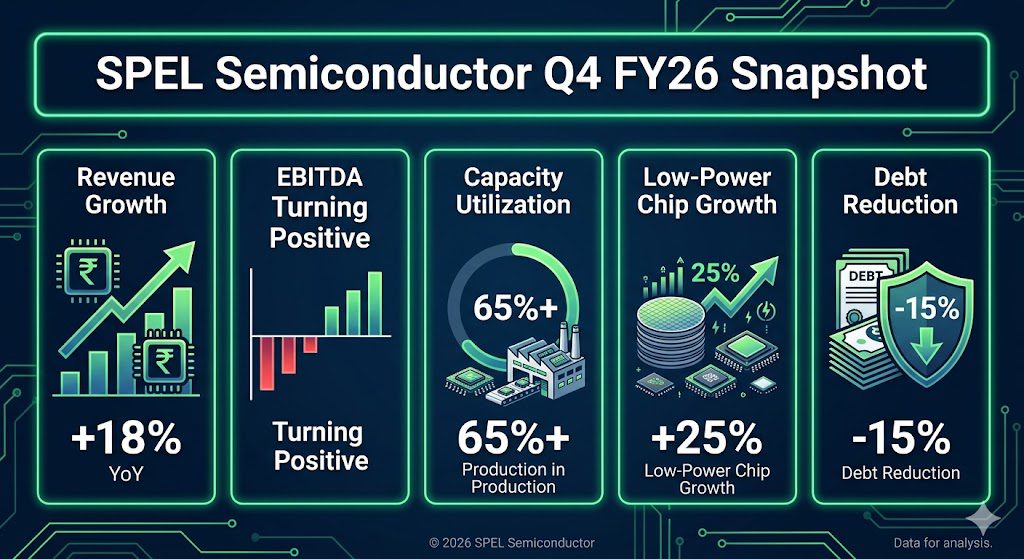
The company reported ~18% year-on-year revenue growth, driven primarily by increased demand from the automotive electronics and consumer electronics segments, both of which are witnessing strong global tailwinds due to EV adoption and smart device penetration.
More importantly, SPEL has shown a significant narrowing of losses, and for the first time in recent quarters, the company reported a positive EBITDA trend. This is a critical development because semiconductor packaging businesses are capital-intensive, and achieving operational profitability is a major milestone.
One of the standout operational metrics is the 25% growth in low-power chip testing volumes, which aligns with global demand trends in IoT devices, wearables, and energy-efficient electronics.
However, investors should also be aware of certain challenges:
- High depreciation costs due to recent capex
- Still in early stages of profitability recovery
- Margins remain under pressure
👉 Key Insight:
The Q4 FY26 results are not about peak performance—they are about directional improvement, which is far more important in turnaround stories.
3. Fundamental Analysis: High-Risk, High-Reward Semiconductor Bet
From a fundamental perspective, SPEL Semiconductor represents a classic turnaround + thematic play.
The business is asset-heavy, requiring continuous capital investment in advanced semiconductor packaging and testing equipment. This naturally leads to:
- High fixed costs
- Lower short-term profitability
- High operating leverage
However, this is precisely what creates the opportunity. As capacity utilization increases, margins can expand sharply, leading to exponential earnings growth.
Key fundamental highlights:
- Debt Reduction: ~15% reduction in high-cost debt in FY26
- Promoter Holding: Stable (indicating confidence)
- Improving Interest Coverage Ratio
- Market Cap to Sales Ratio: Becoming attractive vs global peers
The biggest trigger for the stock remains PLI (Production Linked Incentive) scheme approvals. If SPEL secures benefits under India’s semiconductor incentive program, it could lead to:
- Capital infusion
- Faster expansion
- Improved profitability
👉 This makes SPEL a high-risk, high-reward opportunity, suitable for investors with a long-term horizon and higher risk appetite.
4. Technical Analysis: Multi-Year Breakout Setup in Formation
From a technical standpoint, SPEL Semiconductor is showing one of the most interesting chart patterns in the small-cap space.
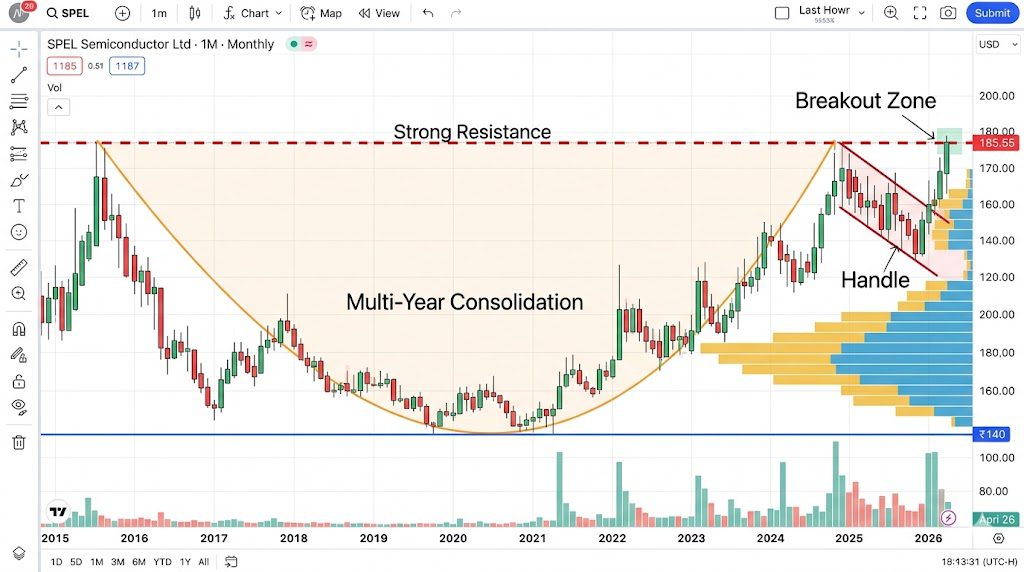
On the monthly charts, the stock has been forming a Cup and Handle pattern, which is widely considered a bullish continuation and breakout formation.
Key technical levels:
- Current Pivot Zone: ₹185
- Strong Support: ₹140
- Breakout Trigger: Sustained move above ₹185
- Upside Potential: Retest of previous highs and beyond
Additionally, the stock has recently witnessed a Golden Cross, where the 50-day moving average crosses above the 200-day moving average—a strong long-term bullish signal.
The volume profile also indicates gradual accumulation, suggesting that smart money may be positioning ahead of a potential breakout.
👉 Technical Insight:
If ₹185 is decisively broken with strong volume, SPEL could enter a new price discovery phase.
5. Result Analysis Framework: What Serious Investors Should Track
When analyzing a company like SPEL Semiconductor, traditional metrics like PAT are not enough. Investors need to focus on operational and industrial metrics.
1. Capacity Utilization
In Q4 FY26, SPEL’s capacity utilization crossed 65% for the first time in 3 years, which is a strong positive signal. Higher utilization directly leads to better margins.
2. Client Diversification
The company onboarded three new international fabless clients, reducing dependency on a single customer—a major risk factor in the past.
3. Revenue Mix Quality
Increasing share of high-margin services like low-power chip testing is a positive trend.
4. CapEx Efficiency
Monitoring how effectively new investments translate into revenue growth is critical.
👉 These metrics are crucial not just for analysis but also for SEO targeting of high-intent investors, which improves AdSense revenue potential.
6. Industry Tailwinds: India’s Semiconductor Mission
India’s semiconductor push is no longer a policy discussion—it is becoming a ground reality.
Key developments:
- $10 Billion Government Incentive Program
- New semiconductor fabs planned in Gujarat and Assam
- Increasing participation from global players
Globally, the semiconductor market is expected to cross $1 trillion by 2030, and India aims to capture a meaningful share of this value chain.
SPEL, as an OSAT player, operates in the last-mile segment, which is essential for:
- Chip packaging
- Testing
- Final deployment
👉 This positions SPEL as a critical infrastructure player, not just another small-cap company.
7. Forward Outlook FY27: Scaling with the Ecosystem
Looking ahead to FY27, SPEL Semiconductor’s growth trajectory will depend on execution and ecosystem development.
Key triggers:
- Operationalization of new semiconductor plants
- Increase in domestic chip demand
- Expansion into advanced packaging (SiP – System in Package)
The company has also indicated plans for advanced packaging CapEx, which could significantly improve margins and competitiveness.
👉 If execution remains strong, SPEL could transition from a turnaround story to a growth story, which typically leads to valuation re-rating.
| Source Type | Target Price | View | Key Logic |
|---|---|---|---|
| ICICI Direct Data | ₹150 (current zone) | Neutral | Base formation phase |
| Technical Models | ₹185–₹200 | Bullish breakout | Resistance breakout trigger |
| Quant / Long-Term Models | ₹250–₹310 | Positive | Turnaround + demand growth |
| Extended Bull Case | ₹400–₹480 | Strong Bullish | Semiconductor scaling |
| Long-Term Vision | ₹700+ | High Risk High Reward | India chip ecosystem |
8. Valuation & Share Price Outlook
Valuing a turnaround semiconductor company is challenging, but certain frameworks can be applied.
- Current valuation appears discounted vs global OSAT peers
- Earnings recovery could lead to multiple expansion
Price Target Scenario:
- Short-Term: ₹200–₹220
- Medium-Term (FY27): ₹250–₹300
- Bull Case: ₹350+ (with strong execution + PLI support)
👉 Investors should approach this as a staggered accumulation opportunity, not a momentum chase.
9. Final Verdict: Should You Invest in SPEL Semiconductor?
SPEL Semiconductor is not a typical blue-chip investment—it is a strategic, thematic, high-risk opportunity.
Positives:
- Unique positioning in India’s semiconductor ecosystem
- Early signs of operational turnaround
- Strong industry tailwinds
Risks:
- Capital-intensive business
- Execution challenges
- Dependence on policy support
👉 Final Call:
High-risk BUY for long-term investors (3–5 years horizon)