1. Introduction: The Price of Progress
If you have followed India’s telecom and digital infrastructure space closely, you’ll know that Tata Communications (TATACOMM) has always played a unique role. It is not just another telecom company—it is a global digital backbone, connecting enterprises across continents. The Tata Communications Q4 Results FY26 Analysis is a classic example of what I call an “earnings paradox.”
The Hook
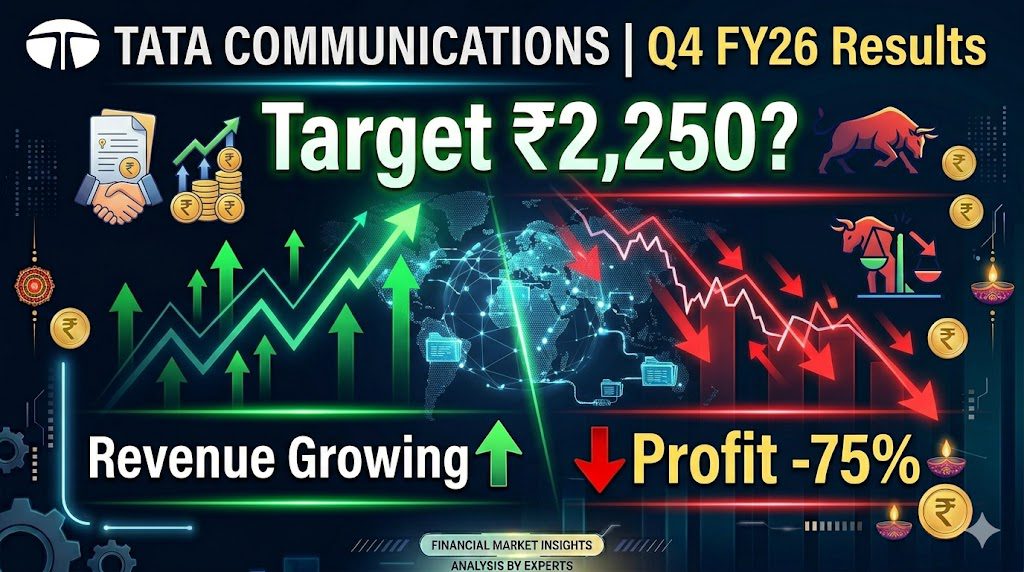
At first glance, a 75% drop in net profit sounds alarming and would typically trigger panic selling. But here’s the twist—the stock remained relatively stable around ₹1,527. This tells you something important: the market is not reacting to short-term profit numbers. Instead, it is betting on the company’s long-term transformation into a data and digital platform powerhouse.
The Big Reward
Despite the sharp fall in profit, the company has announced a final dividend of ₹17.50 per share, slightly higher than last year. This reflects strong confidence from management and signals that cash flows remain healthy.
Analyst Insight
This quarter should be seen as a “consolidation phase before the next growth leap.” The profit decline is largely due to higher interest costs and integration expenses from recent acquisitions. In simple terms, the company is spending today to build a stronger, more scalable business for tomorrow.
2. Q4 FY26 Financial Scorecard: Revenue vs. Profit
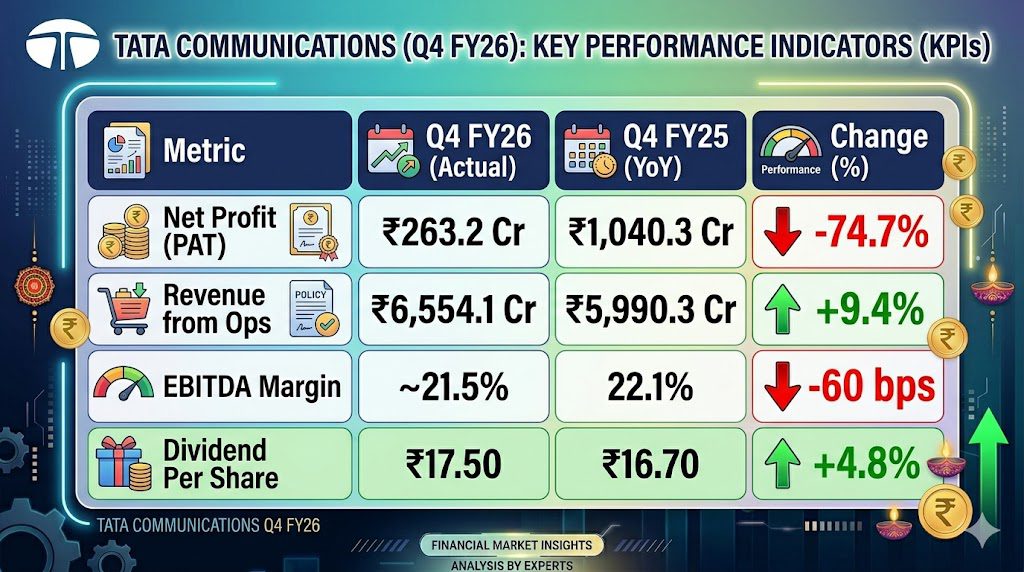
The numbers clearly show the contrast between growth and profitability. Tata Communications reported a net profit of ₹263.2 crore, which is a sharp 74.7% decline compared to ₹1,040.3 crore in Q4 FY25.
However, revenue tells a different story. The company generated ₹6,554.1 crore in revenue, reflecting a solid 9.4% year-on-year growth. This indicates that demand for its services remains strong.
The EBITDA margin came in at around 21.5%, slightly lower than 22.1% last year, showing a 60 basis points decline. This margin pressure is mainly due to higher costs associated with expansion and acquisitions.
On the positive side, the company has increased its dividend to ₹17.50 per share, up from ₹16.70 last year, reinforcing its commitment to shareholder returns.
Overall, the financial scorecard shows that while profits are under pressure, the core business continues to grow steadily.
3. Fundamental Analysis: The “Data” Engine
Doubling Data Revenue
One of the most exciting aspects of Tata Communications’ strategy is its goal to double its data revenue to ₹28,000 crore by FY27. This is not just an ambitious target—it is backed by strong execution.
Currently, the company’s digital portfolio contributes nearly 40% of total revenue, and this share is expected to increase further. This shift toward digital services is critical for long-term growth.
The ASPIIRE Strategy
At the heart of this transformation is the company’s ASPIIRE strategy, which focuses on moving up the value chain. Instead of just selling connectivity or bandwidth, Tata Communications is now offering integrated platforms such as cloud services, cybersecurity, and IoT solutions.
This transition is important because platform-based services typically offer higher margins and recurring revenue, making the business more resilient.
Debt & M&A
One of the key concerns for investors is the rising interest cost, driven by acquisitions such as Switch. While these acquisitions increase short-term expenses, they also expand the company’s global footprint and capabilities.
In simple terms, Tata Communications is using its balance sheet strategically to build a global digital ecosystem, even if it means temporary pressure on profits.
4. Technical Analysis: The ₹1,500 “Battleground”
The Pivot Point
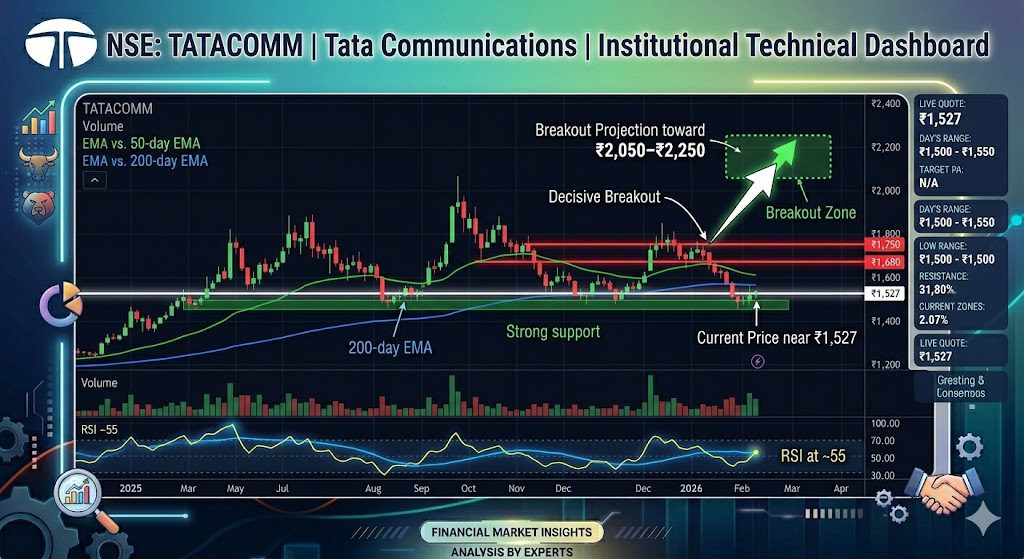
From a technical perspective, the stock is currently trading near a crucial support zone of ₹1,480 to ₹1,510. This range has acted as a strong base over the past few years.
As long as the stock holds above this level, the long-term bullish structure remains intact.
Targets & Resistance
On the upside, the immediate resistance is around ₹1,680, which aligns with the 200-day moving average. A breakout above this level could open the door for further gains.
The next major breakout zone lies above ₹1,750, which could push the stock toward its 52-week high of ₹2,085.
Analyst Pro-Tip
The Relative Strength Index (RSI) is currently around 48, indicating that the stock is neither overbought nor oversold. This suggests a consolidation phase, where the market is waiting for clearer signals before making the next move.
5. Brokerage Sentiment & Targets
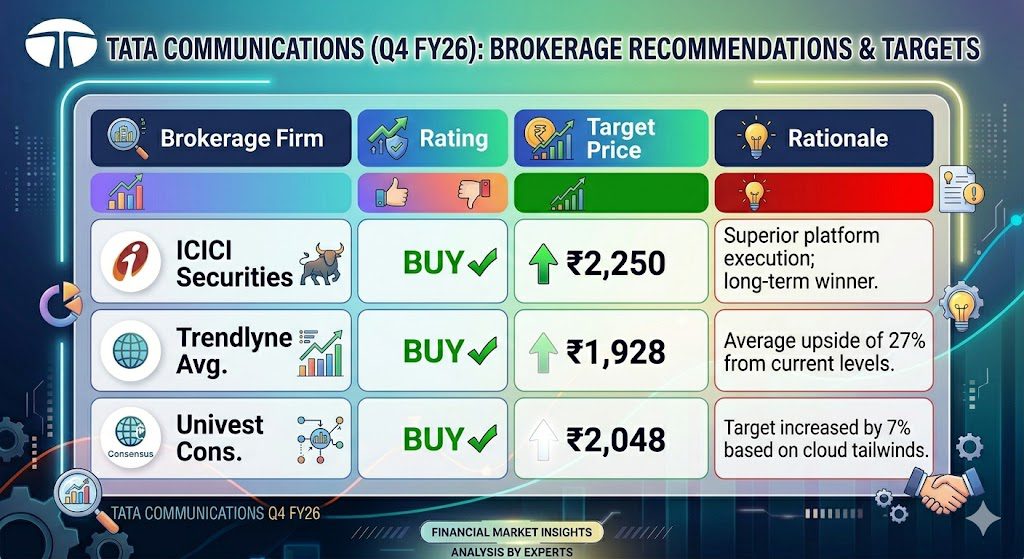
Brokerages remain largely optimistic about Tata Communications’ long-term prospects.
ICICI Securities has given a “BUY” rating with a target price of ₹2,250, highlighting the company’s strong execution in digital platforms.
The Trendlyne average target stands at ₹1,928, suggesting an upside of around 27% from current levels.
Meanwhile, Univest consensus estimates a target of ₹2,048, reflecting confidence in cloud and digital growth trends.
Overall, the consensus view is that the company is well-positioned for long-term growth, despite short-term profit volatility.
6. Management Guidance for FY27
Digital Pivot
Management expects the digital portfolio to contribute more than 50% of data revenue by FY27. This is a key milestone that will define the company’s future growth trajectory.
Margin Guardrail
Despite ongoing investments, the company aims to maintain EBITDA margins in the range of 23–25%. This indicates that management is focused on balancing growth with profitability.
7. The 30-Year Analyst Verdict
For the Investor
Tata Communications is no longer just a telecom company—it is a structural growth story in the digital infrastructure space. The shift toward high-margin digital services makes it a compelling long-term investment.
Investors should focus on metrics like return on equity (ROE), which is expected to remain above 40%, rather than short-term profit fluctuations.
For the Trader
For traders, the stock is currently range-bound. Buying near ₹1,500 with a stop-loss at ₹1,440 offers a favorable risk-reward ratio for a potential move toward ₹1,700.
8. Conclusion & Engagement (CTA)
The Tata Communications Q4 Results FY26 Analysis highlights a company that is deliberately sacrificing short-term profits to build long-term value. The strong revenue growth, expanding digital portfolio, and strategic investments all point toward a promising future.
The ₹17.50 dividend serves as a reminder that the company remains committed to rewarding its shareholders, even during this investment phase.
🔥 Final Thought (CTA)
So here’s the big question for you 👇
👉 Are you buying Tata Communications for its long-term digital growth story, or are the sharp profit declines a red flag?
💬 Share your view and target price in the comments—let’s discuss your telecom and tech portfolio strategy!