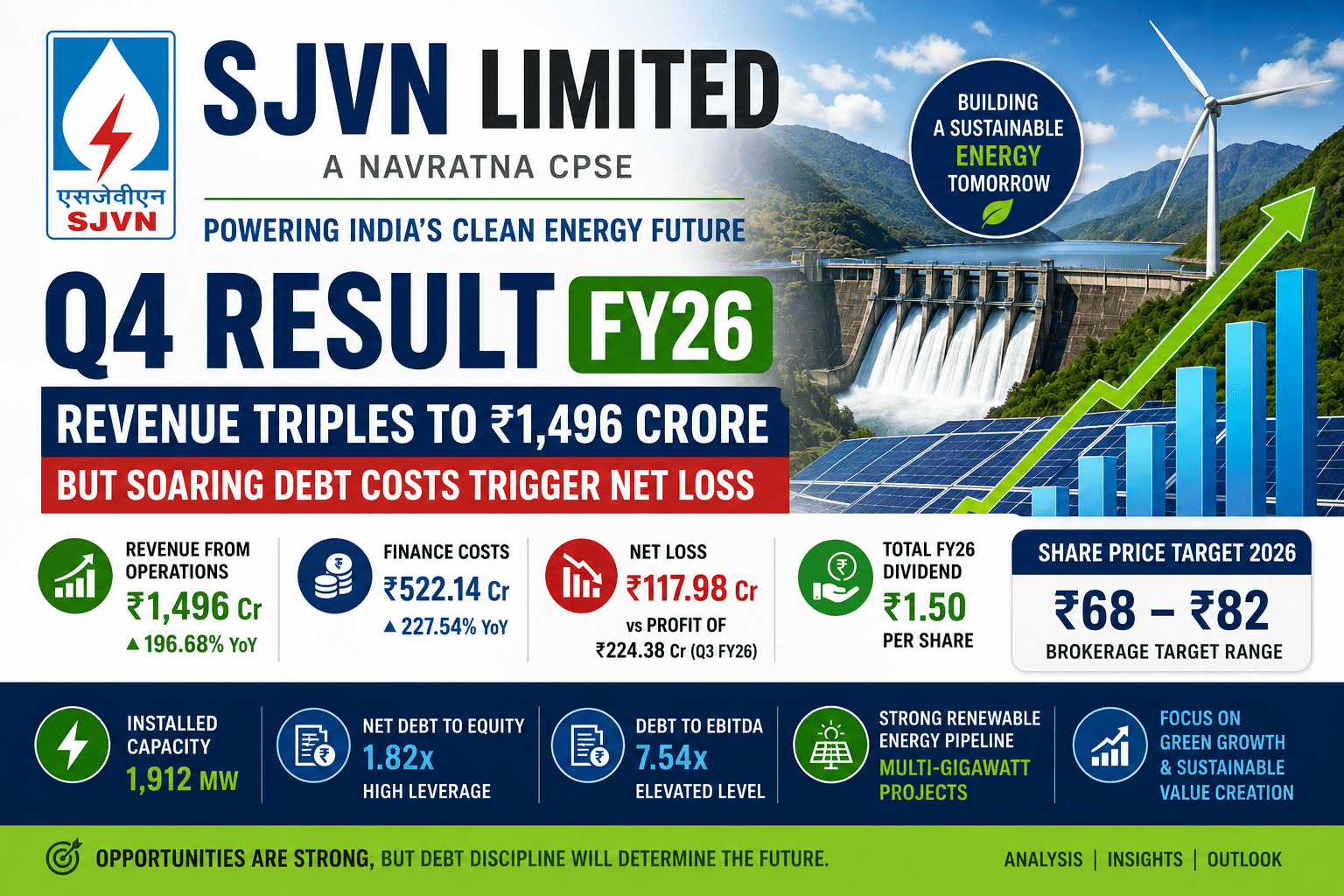
SJVN Limited delivered one of the most surprising and complicated earnings reports in the PSU energy sector during Q4 FY26. The company reported its results on May 15, 2026, and at first glance the numbers looked extremely impressive. Revenue from operations almost tripled year-on-year and reached the highest quarterly level in the company’s history. However, despite this explosive growth in top-line revenue, SJVN still slipped into a quarterly net loss because of a sharp increase in debt-related finance costs.
This unusual combination of record revenue and bottom-line weakness has created confusion among investors. Many traders are now asking whether the company is entering a dangerous financial phase or whether this is simply a temporary pressure period before its large renewable energy projects start generating stronger long-term cash flows. For investors tracking India’s renewable energy transition and PSU stocks, the latest quarterly report offers a very important insight into the challenges and opportunities facing aggressive green energy expansion companies today.
Quick Summary of SJVN Q4 FY26 Results
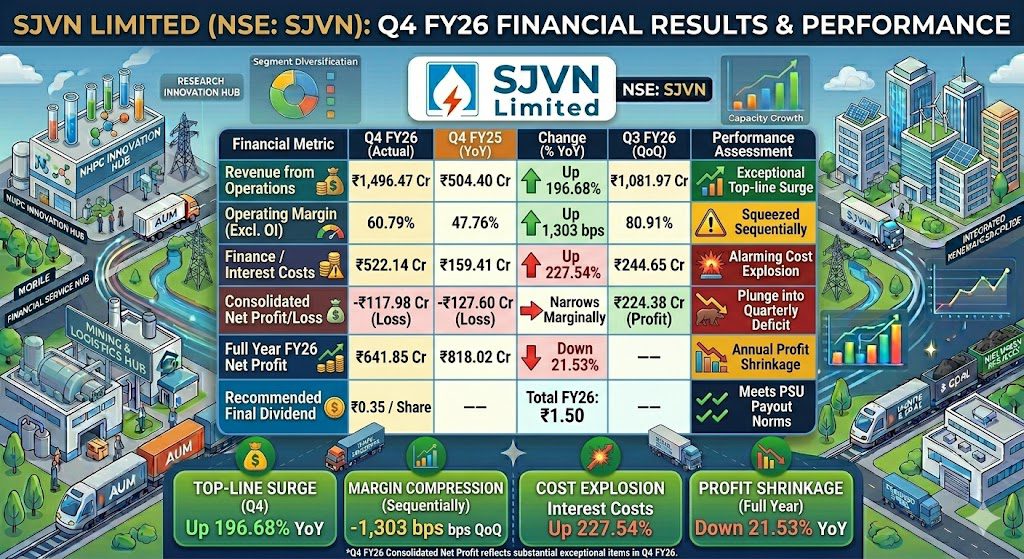
SJVN Limited reported consolidated revenue from operations of ₹1,496.47 crore during Q4 FY26 compared to only ₹504.40 crore in the same quarter last year. This represents an extraordinary 196.68% year-on-year increase and marks the strongest quarterly revenue performance in the company’s history. Operating margins also improved significantly on a yearly basis, rising from 47.76% to 60.79%.
However, the major problem came from interest and finance costs. Quarterly finance expenses surged to ₹522.14 crore compared to ₹159.41 crore in Q4 FY25. Because of this massive increase in borrowing costs, the company reported a consolidated net loss of ₹117.98 crore during the quarter. This was a sharp reversal compared to the ₹224.38 crore profit reported during Q3 FY26.
On a full-year basis, FY26 consolidated net profit stood at ₹641.85 crore compared to ₹818.02 crore during FY25, showing a decline of nearly 21.5%. The board also recommended a final dividend of ₹0.35 per share, taking the total FY26 dividend payout to ₹1.50 per share including interim dividends announced earlier during the year.
Corporate Profile: SJVN’s Transformation into a Renewable Energy Powerhouse
SJVN Limited was originally established as Satluj Jal Vidyut Nigam with a primary focus on hydroelectric power generation. Over the years, the company built a strong reputation through large hydroelectric projects including the famous 1,500 MW Nathpa Jhakri Hydroelectric Plant.
Today, however, SJVN is transforming itself into a diversified renewable energy company. Along with hydroelectric generation, the company is now aggressively investing in solar energy, wind power, and transmission infrastructure. The company currently operates around 1,912 MW of installed generation capacity while simultaneously developing one of the largest renewable energy project pipelines among Indian PSU power companies.
This transformation directly aligns with India’s clean energy mission. The Indian government is aggressively pushing renewable energy expansion to reduce dependence on fossil fuels and improve long-term energy security. SJVN is expected to play a major role in this transition over the coming decade.
Earnings Analysis: Why Revenue Tripled but the Company Reported a Loss
The most important aspect of SJVN’s Q4 FY26 report is understanding why the company reported a net loss despite extraordinary revenue growth.
The revenue performance itself was extremely strong. Revenue from operations jumped nearly 197% year-on-year to ₹1,496.47 crore. This dramatic increase was mainly driven by aggressive billing from newly commissioned solar projects along with improved hydroelectric tariff realization. The numbers clearly indicate that the company’s expanding renewable energy asset base is now starting to generate meaningful operational revenue.
However, the company’s debt burden has become the central concern. Finance and interest costs surged to a record ₹522.14 crore during the quarter. This represented a massive 227% increase compared to the same quarter last year and more than double the finance costs reported during Q3 FY26.
As a result, despite strong operational performance, total expenses rose sharply to ₹1,603.33 crore. This completely erased operational profitability and pushed the company into a quarterly net loss of ₹117.98 crore.
From an analytical perspective, this is the biggest issue investors must focus on. The company’s assets are clearly generating revenue, but the debt used to build those assets is currently consuming a very large portion of earnings. This creates a difficult balancing situation where long-term growth remains attractive, but near-term financial pressure continues rising.
Dividend Analysis: Stable PSU Payout Despite Quarterly Loss
Despite the weak bottom-line performance, SJVN Limited continued following the standard PSU dividend distribution policy.
The board recommended a final dividend of ₹0.35 per equity share with a face value of ₹10. Earlier during FY26, the company had already distributed an interim dividend of ₹1.15 per share in February 2026.
This brings the total FY26 dividend payout to ₹1.50 per share. At the current market price near ₹77.40, this translates into a dividend yield of approximately 1.9%.
For long-term investors focused on stable dividend income from government-backed companies, this payout provides some support even during a difficult operational quarter. It also indicates that management remains reasonably confident regarding the company’s long-term cash-flow generation ability.
Fundamental Analysis: Strong Renewable Expansion but Rising Financial Risk
SJVN’s long-term growth potential remains very large because of its expanding renewable energy pipeline. However, the financial risks associated with this expansion are also becoming increasingly visible.
To aggressively fund new solar parks, hydroelectric projects, and transmission assets, the company has significantly increased borrowing over the last few years. As a result, SJVN’s net debt-to-equity ratio has now climbed to approximately 1.82 times, while debt-to-EBITDA stands at a very elevated 7.54 times.
These leverage levels indicate that debt pressure has become materially high. Infrastructure businesses generally operate with high debt because renewable energy projects require huge upfront investments. However, investors now need to closely monitor whether future operational cash flows will grow fast enough to stabilize these debt ratios.
Capital efficiency also remains relatively weak. A large portion of the company’s investments still remains under Capital Work-in-Progress (CWIP), meaning many projects are not yet fully operational and therefore not generating sufficient earnings. Because of this, return ratios remain subdued. Return on Equity stands near 7.94% while Return on Capital Employed remains around 6.45%.
Valuation also remains a concern. Even after correcting nearly 21% over the last 12 months, the stock still trades at a trailing P/E ratio above 48 times earnings. This makes SJVN significantly more expensive than hydroelectric peer NHPC Limited, which trades at a much lower valuation multiple. This premium valuation is one of the reasons why institutional brokerages remain cautious despite the company’s strong renewable growth story.
Technical Analysis: Key Trading Levels for Monday
SJVN shares closed around ₹77.40 on Friday with marginal gains before investors fully processed the impact of rising finance costs. Technically, the stock remains trapped inside a medium-term corrective structure and continues trading below important daily moving averages.
The most important technical level remains the ₹81.50 pivot zone. The stock will need a strong and sustained closing above this level to break the current bearish trend structure.
Immediate resistance levels are positioned near ₹79.80, ₹82.50, and ₹86. On the downside, immediate support exists around ₹75.50 followed by ₹72.10. The strongest structural support zone remains near the 52-week low area around ₹63.
From a trading perspective, Monday’s session could remain highly volatile because institutional investors are likely to react strongly to the sharp increase in debt servicing costs. If the stock breaks below ₹75.50, short-term selling pressure may intensify toward ₹72. However, aggressive bullish positions may remain risky unless the stock convincingly stabilizes above ₹81.50.
Management Guidance and Future Strategy
Management commentary following the earnings announcement focused heavily on project commissioning speed and debt optimization.
The company’s primary objective is to rapidly convert debt-funded projects into operational revenue-generating assets. Several large solar parks, hydroelectric facilities, and transmission projects are expected to gradually become fully operational over the next 12 to 18 months.
This transition is extremely important because only operational assets can generate stable tariff-based income capable of offsetting rising debt costs.
Management also highlighted plans to refinance expensive domestic infrastructure loans through lower-cost green bonds and External Commercial Borrowings (ECBs). If these refinancing plans succeed, quarterly finance costs could gradually decline over the coming years, improving overall profitability and cash-flow stability.
Brokerage Outlook and Institutional Target Prices
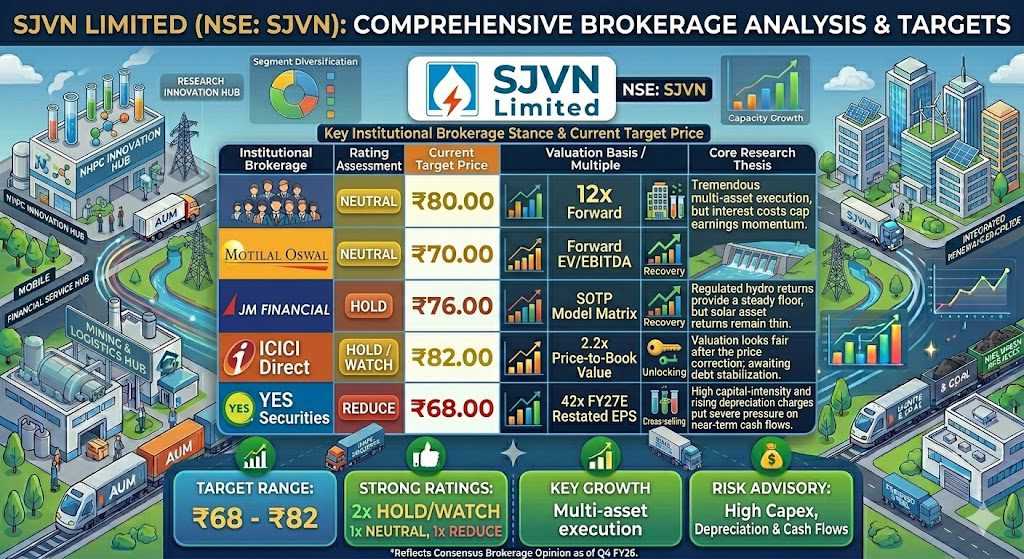
Most institutional research firms currently maintain neutral or cautious views on SJVN Limited because of the balance between strong revenue growth and rising financial pressure.
Motilal Oswal maintains a NEUTRAL rating with a target price of ₹80, citing excellent project execution but weak earnings visibility because of high interest expenses. JM Financial also maintains a HOLD rating with a target of ₹76, arguing that hydroelectric operations provide downside support while solar project profitability remains under pressure.
ICICI Direct currently has a HOLD/WATCH approach with a target price of ₹82, waiting for clearer evidence of debt stabilization before becoming more bullish. YES Securities remains the most cautious brokerage with a REDUCE rating and a target price of ₹68 because of concerns regarding elevated leverage, rising depreciation costs, and weak near-term cash-flow visibility.
Overall, institutional consensus currently remains concentrated within the ₹75–₹80 range, suggesting that the market views the stock as fairly valued until operational profitability improves more substantially.
Should You Buy, Hold, or Sell SJVN?
For long-term investors, panic selling based purely on this quarter’s net loss may not be the right strategy. The company’s revenue nearly tripled during the quarter, clearly proving that its renewable energy asset base is becoming operational and revenue-generating.
However, the equally important reality is that finance costs are rising extremely rapidly. Because of this, aggressive fresh buying may still be premature until the company demonstrates better control over debt servicing obligations during upcoming quarters.
Investors interested in long-term renewable energy exposure may consider gradual accumulation closer to stronger support zones near ₹63–₹65 if broader market conditions weaken further.
For short-term traders, the technical structure remains mildly bearish. Any short-term relief rallies toward the ₹80–₹82 zone could continue witnessing selling pressure unless the stock decisively improves its operational cash-flow profile.
The next few quarters will be extremely important for determining whether SJVN can successfully convert its aggressive renewable expansion strategy into sustainable long-term profitability.
For official exchange filings and corporate disclosures, investors can also track updates through NSE India Official Website.