Introduction: The Global SaaS Pivot
If you have followed India’s capital market infrastructure journey since the 1990s, you would remember a time when physical share certificates dominated the system. Over the years, that ecosystem has transformed into a highly digitized, technology-driven network. Few companies represent this transformation as clearly as KFin Technologies. What began as a domestic registrar and transfer agent (RTA) business has now evolved into a global SaaS-driven financial infrastructure platform.
As of May 2, 2026, the market is still reacting to the Q4 FY26 results announced on April 30. The numbers present what I call a “Tale of Two Cities.” On one side, you have strong revenue growth and aggressive global expansion. On the other, a noticeable dip in profitability due to rising employee costs. This contrast is exactly why investors are divided right now.
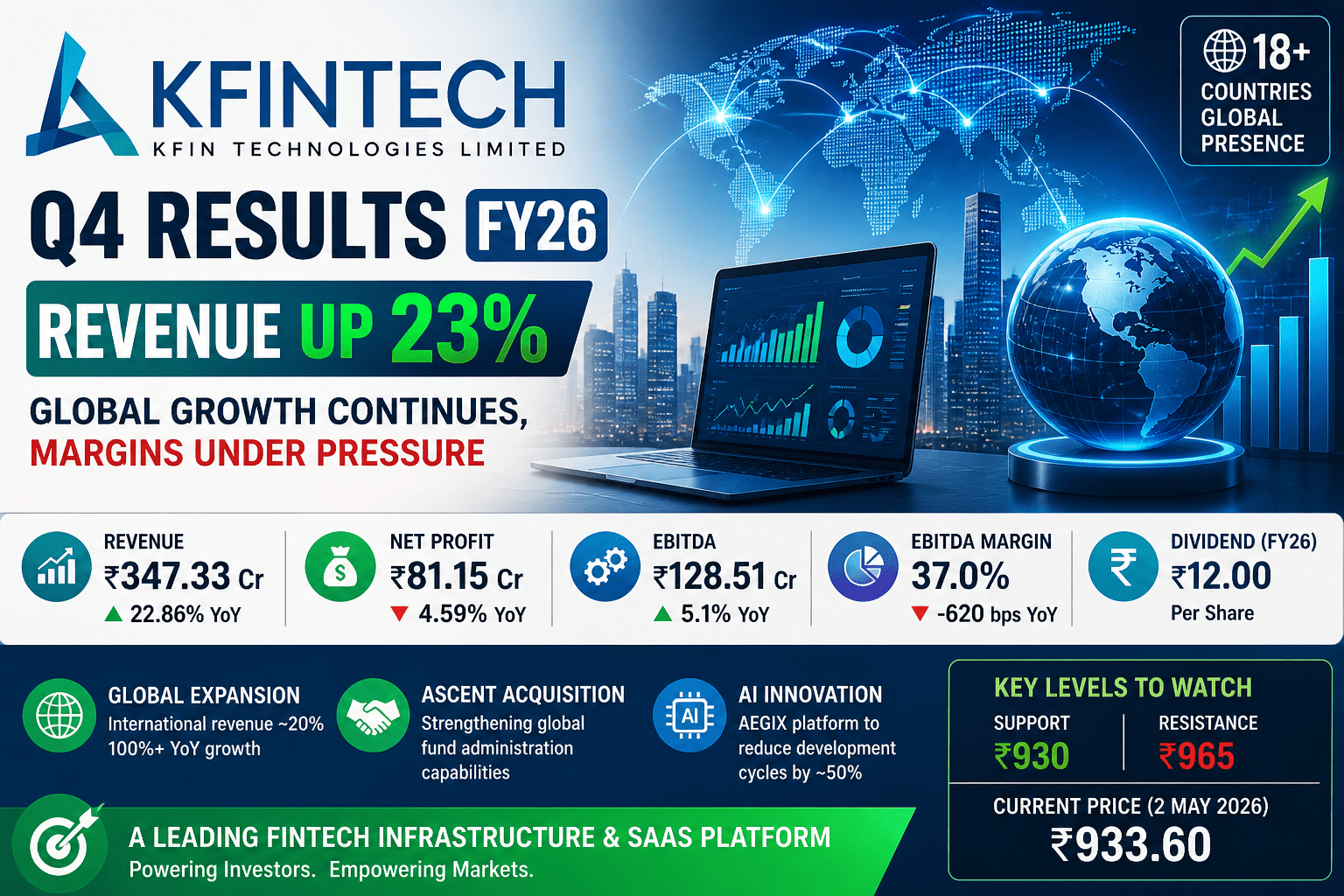
The headline numbers tell the story clearly. For the full year FY26, revenue reached ₹1,301.49 crore, reflecting a healthy 19.3% growth. However, in Q4 alone, net profit declined by 4.6% year-on-year to ₹81.15 crore, which has made the market cautious.
The immediate reaction was visible in the stock price. Shares corrected nearly 4.5% to ₹933.60 after the results, indicating that investors are concerned more about margins than growth. This is a classic case where strong fundamentals meet short-term sentiment pressure.
Q4 FY26 Financial Scorecard (The Actual NSE Numbers)
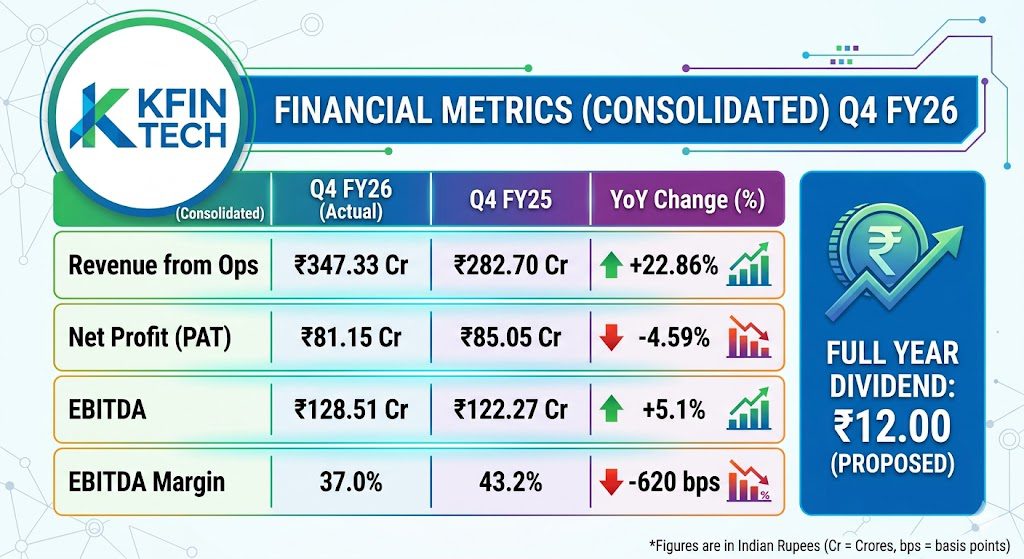
The Q4 FY26 numbers highlight a company that is still growing strongly at the top line but facing pressure at the margin level. Revenue from operations stood at ₹347.33 crore, up from ₹282.70 crore in Q4 FY25, registering a 22.86% growth. This is a strong indicator that demand for KFin’s services—both in India and globally—remains robust.
However, net profit came in at ₹81.15 crore, compared to ₹85.05 crore last year, marking a 4.59% decline. This divergence between revenue and profit is the key takeaway from this quarter. It tells us that while the business is expanding, costs are rising faster than expected.
EBITDA increased slightly to ₹128.51 crore from ₹122.27 crore, reflecting a 5.1% growth. But the real concern lies in margins. EBITDA margin dropped from 43.2% to 37.0%, a sharp contraction of 620 basis points. For a SaaS-like business known for high operating leverage, this kind of margin compression stands out.
On a positive note, the company has proposed a full-year dividend of ₹12 per share, reinforcing its commitment to shareholder returns. This adds an income component to what is otherwise seen as a growth-oriented fintech stock.
Fundamental Analysis: The “Ascent” to Global Dominance
To truly understand what is happening with KFin Technologies, you need to look beyond the headline numbers and focus on the underlying drivers. The biggest factor behind the margin pressure is the sharp increase in employee costs.
The Employee Cost Spike
Employee expenses surged by 49.2% to ₹151.76 crore, which is significantly higher than revenue growth. This is not a random increase—it is a deliberate investment. As the company expands globally and integrates new businesses, it needs skilled talent in technology, compliance, and operations.
In simple terms, KFin is spending today to build capabilities for tomorrow. While this impacts margins in the short term, it is essential for long-term scalability.
The International Growth Engine
One of the most important developments for the company is the acquisition of Ascent Fund Services. This acquisition has transformed KFin into a global player in fund administration. International revenue now contributes around 20% of total revenue, and this segment is growing at over 100% year-on-year.
This is a game changer. It reduces dependency on the Indian market and opens up access to global asset managers. The company is now targeting fund managers with assets exceeding $100 million, which significantly expands its addressable market.
Market Leadership in India
Despite its global ambitions, KFin continues to dominate its domestic segment. The company holds a 52.3% market share among NSE 500 companies in issuer solutions. This kind of market dominance creates a strong moat, ensuring steady revenue streams even as the company expands internationally.
In essence, KFin is building a dual-engine growth model—stable domestic leadership combined with high-growth international expansion.
Technical Analysis: Navigating the Bearish Pressure
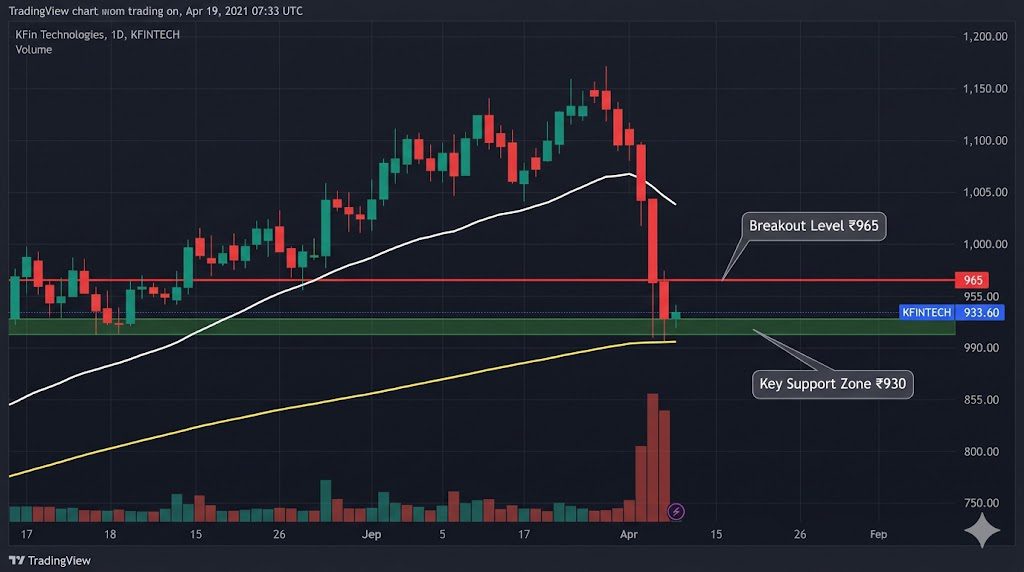
From a technical perspective, the stock is currently under mild bearish pressure following the Q4 results. It is trading below its key moving averages, indicating that short-term sentiment is weak.
The immediate support level is around ₹931.74. If the stock breaks below this level, it could test the ₹910 zone, which acts as the next support. This makes the ₹930 range extremely important for traders and short-term investors.
On the upside, the major resistance level is ₹965.01. A strong breakout above this level is required to regain bullish momentum and attract fresh buying interest.
Looking at indicators, the Relative Strength Index (RSI) is at 40.99, suggesting that the stock is approaching oversold territory but has not yet reached a clear bottom. This indicates that there may still be some downside or consolidation before a reversal.
The overall setup suggests caution in the short term, with a potential opportunity forming if the stock stabilizes near support levels.
Management Guidance: The FY27 Vision
Despite the short-term challenges, management remains confident about the company’s growth trajectory. For FY27, KFin Technologies has guided for 23–24% revenue growth, which is in line with its long-term expansion strategy.
A major focus area will be international business, where the company is targeting a 70%+ growth in revenue. This will be driven by deeper penetration into global markets and onboarding of large asset managers.
Another key initiative is the launch of ‘AEGIX’, an AI-driven investor relations platform. This platform is expected to reduce development cycles by nearly 50%, improving efficiency and scalability. In a SaaS business, such productivity gains can significantly enhance margins over time.
Overall, the guidance reflects a clear strategy—invest in growth now, optimize margins later.
Brokerage Sentiment & Targets (Buy the Dip?)
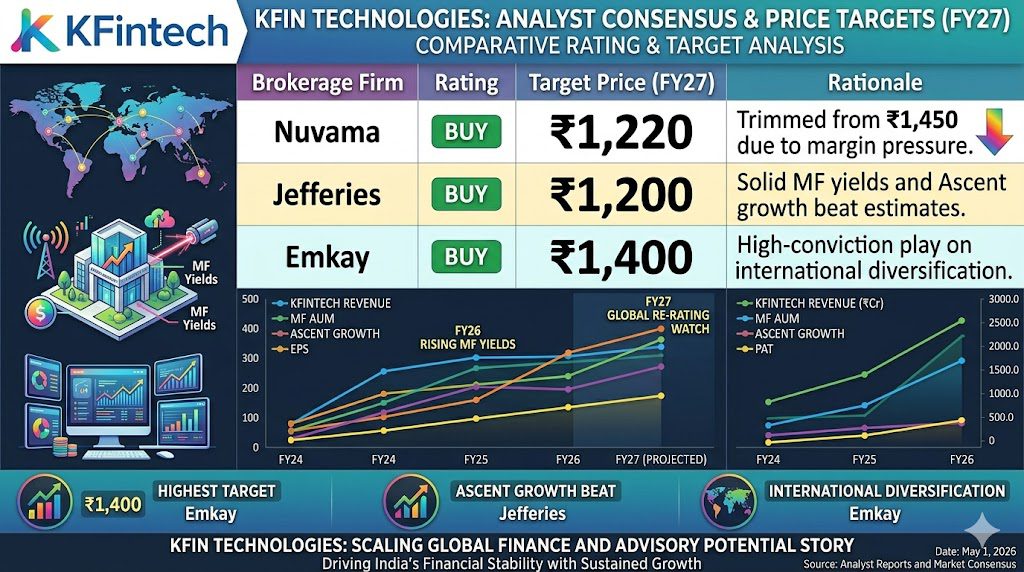
Brokerages remain largely positive on KFin Technologies, despite the recent margin pressure.
- Nuvama has maintained a “Buy” rating with a target price of ₹1,220, although it has trimmed its earlier estimates due to margin concerns.
- Jefferies also rates the stock as a “Buy” with a target of ₹1,200, citing strong mutual fund yields and successful integration of Ascent Fund Services.
- Emkay remains the most bullish, with a target price of ₹1,400, viewing the company as a high-conviction play on global diversification.
This consensus indicates that while short-term concerns exist, the long-term story remains intact.
The “30-Year” Analyst Verdict
From a long-term investment perspective, this is what I would call a “quality reset.” The margin compression is not a sign of weakness but a result of strategic investments in global expansion and talent acquisition.
For investors with a 2–3 year horizon, this phase could present an opportunity to accumulate a high-quality fintech infrastructure stock at relatively better valuations. The combination of domestic dominance, global expansion, and SaaS scalability makes KFin a compelling story.
For traders, however, caution is necessary. The stock is still under pressure, and attempting to enter too early can be risky. A more disciplined approach would be to wait for stabilization near ₹930 or a breakout above ₹965 before taking positions.
Conclusion & Engagement (CTA)
KFin Technologies is at a critical juncture. It is consciously trading short-term margins for long-term global market share. With a ₹12 dividend, strong revenue growth, and ambitious international targets, the fundamentals remain solid.
At the same time, rising employee costs and margin pressure have introduced near-term uncertainty. The market is watching closely to see how quickly the company can convert its investments into profitability.
So the big question for investors is simple—are you willing to bet on KFin’s global SaaS expansion story, or are you concerned about the rising cost structure?
Let’s discuss this “platform moat” story in the comments, because in businesses like these, the real returns are often made by those who understand the long-term vision early.