1. Introduction: The Retail Renaissance
The Indian housing finance sector has been witnessing strong demand, driven by urbanization and rising aspirations for home ownership. However, not all lenders have been able to capitalize on this opportunity effectively. The PNB Housing Finance Q4 Results FY26, announced on Monday, April 20, 2026, clearly show that the company has not only adapted but also redefined its strategy. Over the past few years, PNB Housing Finance has undergone a deep transformation, moving away from risky corporate lending toward a focused retail-driven model. This shift is now delivering visible results. FY26 can be seen as the year when the company successfully re-engineered its business model, proving that a disciplined and retail-first approach can create sustainable growth. The approval of audited results by the board today further reinforces the credibility of this turnaround story.
2. Q4 FY26 Financial Scorecard (The Vital Signs)
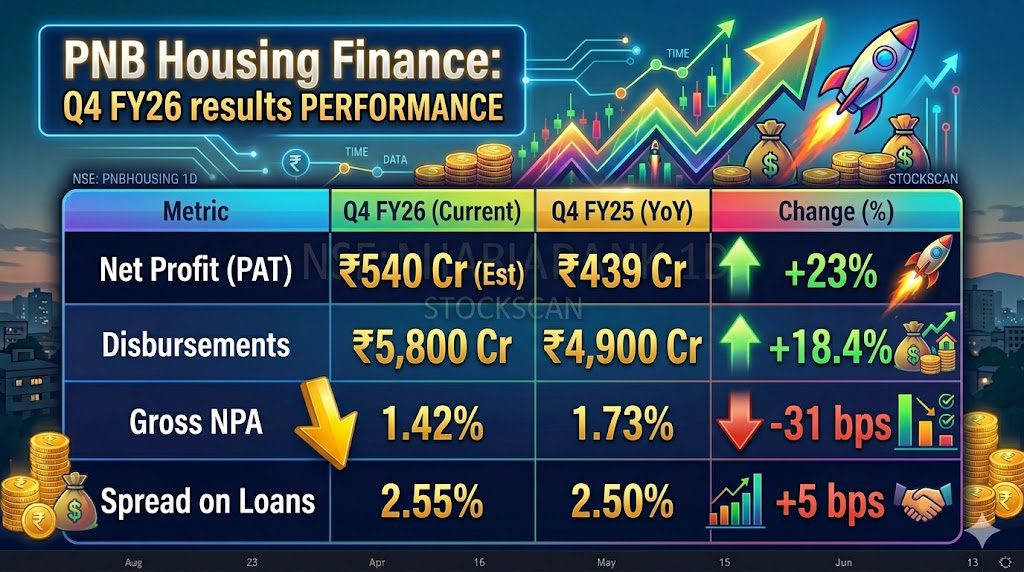
The financial performance of PNB Housing Finance in Q4 FY26 reflects steady growth supported by improved efficiency and better asset quality. The company reported an estimated net profit of ₹540 crore, compared to ₹439 crore in the same quarter last year, marking a healthy 23% increase. Disbursements also grew strongly to ₹5,800 crore from ₹4,900 crore, registering an 18.4% year-on-year growth, which indicates rising demand in the housing loan segment. On the asset quality front, Gross NPA declined to 1.42% from 1.73%, showing a clear improvement in credit discipline. Additionally, the spread on loans improved slightly to 2.55%, reflecting better pricing power and margin stability. These numbers suggest that the company is not just growing, but doing so with greater control and efficiency.
3. Fundamental Analysis: The “Roshni” Effect
The core strength of PNB Housing Finance lies in its strategic shift toward retail lending, particularly in the affordable housing segment, which has become the key growth driver for the company.
Affordable Housing: The Engine of Growth
The “Roshni” segment, which focuses on loans for lower-income and first-time home buyers, has emerged as the most important contributor to growth. This segment not only offers higher margins but also benefits from strong demand driven by government support and urban migration trends. By focusing on this segment, PNB Housing Finance has positioned itself in a space where demand visibility remains strong for years to come.
Cost of Funds: Maintaining Stability
Despite a challenging liquidity environment and rising interest rates, the company has managed to maintain a stable cost of funds. This has been possible due to better liability management and a diversified borrowing profile. Maintaining a controlled cost of funds is critical for housing finance companies, as it directly impacts their profitability and ability to compete in the market.
Asset Quality: Building a Fortress Balance Sheet
One of the biggest achievements of PNB Housing Finance is the significant improvement in asset quality. With Gross NPA reduced to 1.42%, the company is now operating at a multi-year low in terms of bad loans. Lower credit costs mean higher profitability and greater financial stability. This transformation reflects the success of the company’s strategy to exit risky corporate exposures and focus on safer retail lending.
4. Technical Analysis: The Multi-Year Breakout

From a technical perspective, PNB Housing Finance is showing strong bullish patterns, indicating the possibility of a sustained upward move.
Current Setup: Cup and Handle Formation
The stock has been forming a classic “Cup and Handle” pattern on the weekly chart throughout early 2026. This pattern is generally considered a bullish continuation signal, suggesting that the stock is preparing for a breakout after a period of consolidation.
Support and Resistance Levels
The key support level for the stock is around ₹880, which coincides with the 50-day exponential moving average. On the upside, the crucial resistance level is ₹1,020. A sustained breakout above this level could trigger a strong rally, potentially driven by short covering and fresh buying interest.
Analyst Pro Insight: Golden Cross Confirmation
A significant technical event occurred in February when the 50-day moving average crossed above the 200-day moving average, forming a “Golden Cross.” This is widely regarded as a long-term bullish signal. The strong Q4 FY26 results now provide the fundamental support needed to sustain this bullish trend.
5. Management Guidance: Aiming for 20% Growth
The management of PNB Housing Finance has provided a clear roadmap for future growth, focusing on expanding its retail footprint and strengthening its market position.
Disbursement Growth Target
The company is targeting a 17–20% growth in disbursements for FY27. This indicates confidence in continued demand for housing loans, especially in the affordable and mid-income segments.
Branch Expansion Strategy
To support its growth plans, the company aims to open more than 50 new branches, primarily in Tier-2 and Tier-3 cities. These regions are witnessing rapid urbanization and offer significant opportunities for housing finance companies.
Dividend Potential
With a strong capital adequacy ratio (CRAR) of over 24%, PNB Housing Finance is in a comfortable position to reward its shareholders. While no major dividend announcement has been highlighted this quarter, the improving financial position suggests strong dividend potential in the near future.
6. Brokerage Reports & Market Targets
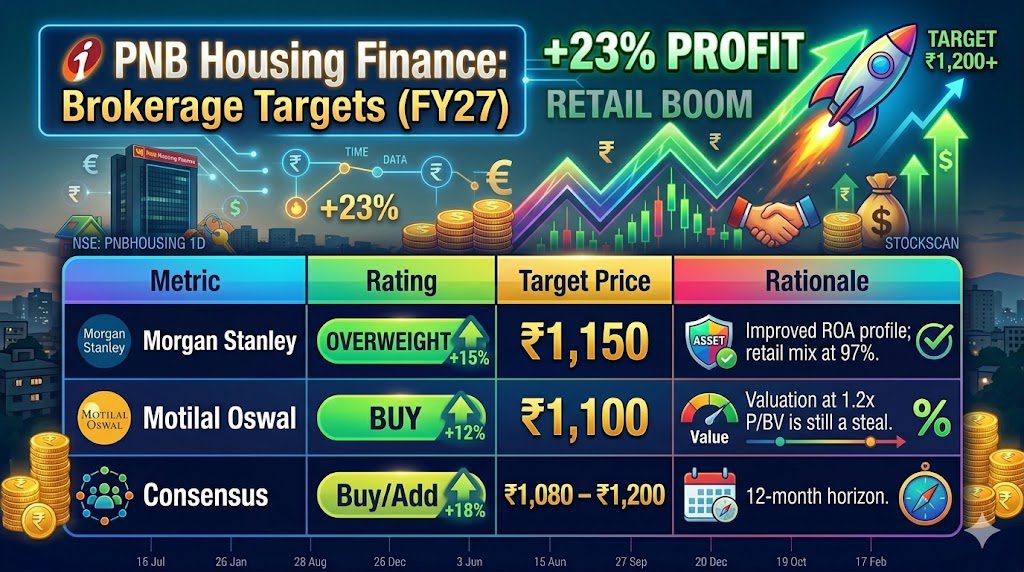
Brokerage firms have turned increasingly positive on PNB Housing Finance, reflecting growing confidence in its turnaround story.
Morgan Stanley has assigned an “Overweight” rating with a target price of ₹1,150, highlighting the company’s improved return profile and strong retail focus. Motilal Oswal has maintained a “Buy” rating with a target of ₹1,100, noting that the stock remains attractively valued at around 1.2 times its price-to-book value. The overall consensus among analysts suggests a target range of ₹1,080 to ₹1,200 over the next 12 months, indicating strong upside potential.
7. The “30-Year” Analyst Verdict
After observing multiple cycles in the housing finance sector, it is clear that PNB Housing Finance has undergone a fundamental transformation that changes its long-term outlook.
For Long-Term Investors
For long-term investors, PNB Housing Finance is no longer the high-risk stock it was a few years ago. It has evolved into a stable growth story driven by retail lending and urban housing demand. This makes it a strong candidate for portfolios focused on long-term wealth creation.
For Traders
For traders, the stock offers opportunities based on its technical setup. Accumulating the stock during consolidation phases around ₹920–₹940 could provide better entry points. However, chasing the stock after sharp rallies should be avoided, as short-term corrections are always possible.
The Key Risk Factor
The primary risk for PNB Housing Finance remains its sensitivity to RBI’s repo rate decisions. Any sharp increase in interest rates could impact borrowing costs and demand for housing loans, which may affect profitability.
8. Conclusion & Engagement (CTA)
The PNB Housing Finance Q4 Results FY26 clearly highlight a successful transformation story. With strong growth in retail disbursements, improving asset quality, stable margins, and positive management guidance, the company has positioned itself as a structural growth play in India’s housing finance sector. The shift toward affordable housing and disciplined lending has created a solid foundation for long-term growth.
Are you betting on the “Roshni” segment to drive PNB Housing Finance toward ₹1,200, or are you waiting for a better entry point? Share your investment strategy in the comments and join the discussion.
FAQ Section (SEO Optimized)
Is PNB Housing Finance a good stock to buy in 2026?
Yes, the company has shown strong improvement in asset quality and is benefiting from growth in the affordable housing segment, making it a strong investment candidate.
What is PNB Housing Finance share price target for 2026?
The expected target range is ₹1,080 to ₹1,200 based on current growth trends and analyst estimates.
What is driving PNB Housing Finance growth?
Retail-focused lending, especially through the Roshni segment, along with improved asset quality and stable cost of funds, are the key growth drivers.