1. Introduction: Navigating the G-Sec Storm
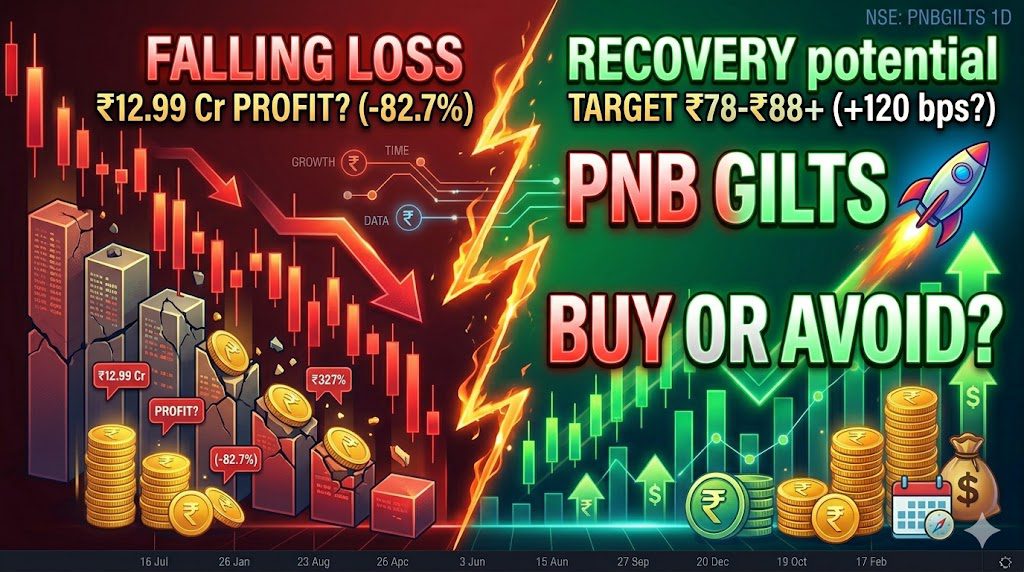
If you have followed India’s debt markets over the last few decades, you would know that PNB Gilts has always acted as a mirror to interest rate movements. The PNB Gilts Q4 Results FY26, announced on April 20, 2026, are not just about profits or losses—they are about understanding how volatility in government securities (G-Secs) impacts business models. This quarter reflects a challenging phase where shifting yield curves and rising borrowing costs have created pressure across the primary dealer segment. The headline number, an 82.7% drop in profit, may look alarming at first glance, but it needs to be seen in context. This is not necessarily a collapse in fundamentals; rather, it appears to be a cyclical correction driven by macroeconomic factors. As interest rates stabilize in the coming quarters, the same volatility that hurt earnings today could become an opportunity tomorrow.
2. Q4 FY26 Financial Scorecard (The Volatility Map)
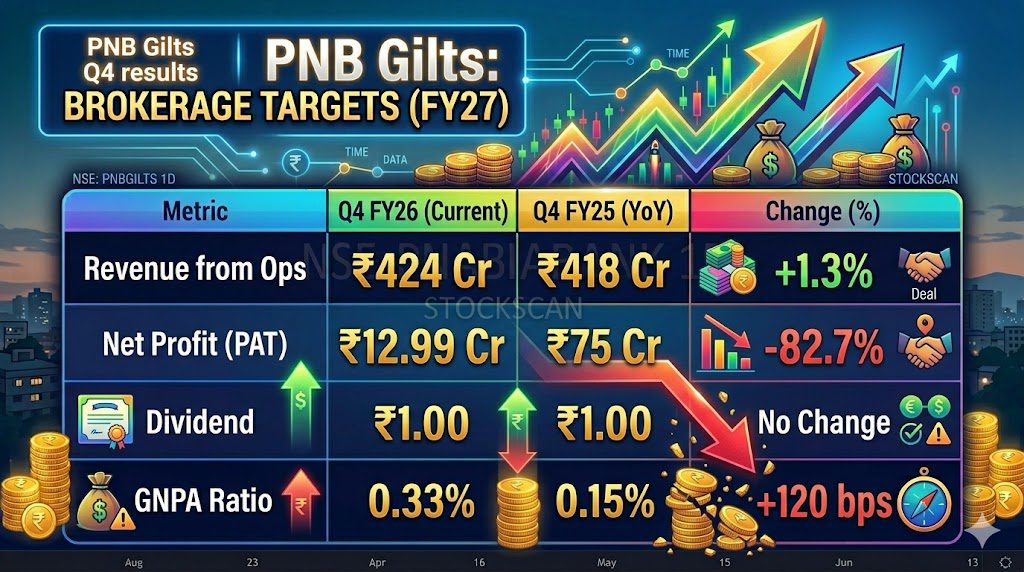
The financial performance of PNB Gilts in Q4 FY26 clearly highlights the impact of market volatility on profitability. The company reported a net profit of ₹12.99 crore, compared to ₹75.02 crore in the same quarter last year, reflecting a sharp decline of 82.7%. Interestingly, revenue from operations remained largely stable at ₹424.11 crore, showing a marginal increase of 1.3% year-on-year. This divergence between stable revenue and falling profits is explained by a sharp drop in profitability margins. The PAT margin fell drastically to 3.06% from 17.91%, indicating severe margin compression. Despite this, the company maintained its dividend at ₹1.00 per share, signaling confidence in its cash flows and financial resilience. These numbers highlight that while income streams remain intact, profitability is highly sensitive to market conditions.
3. Fundamental Analysis: The Yield Curve Pressure
The core issue in PNB Gilts’ performance lies in the dynamics of the yield curve and interest rate environment, which directly influence its margins and trading profitability.
Stable Revenue, Lower Margins
One of the most important questions investors are asking is why revenue remained stable while profits declined sharply. The answer lies in operating margins. The company’s operating margin dropped significantly from around 92% to 77%, mainly due to higher borrowing costs and trading losses in government securities. As yields moved unpredictably, mark-to-market losses increased, impacting profitability. This is a classic example of how treasury-driven businesses can experience sharp swings in earnings despite stable revenue.
The Primary Dealer Advantage
PNB Gilts holds a unique position as India’s only listed primary dealer, and this gives it a significant strategic advantage. Being a subsidiary of Punjab National Bank, which holds around 74% stake, provides a strong liquidity backstop and operational support. This relationship ensures that even during volatile periods, the company has access to funding and stability that standalone players might lack. This structural advantage acts as a cushion during downturns.
Valuation: Cheap or Value Trap?
At current levels, PNB Gilts is trading at a price-to-earnings ratio of around 6x, which is significantly lower than the industry average of approximately 22x. On the surface, this makes the stock appear undervalued. However, investors must be cautious, as low valuations in cyclical businesses can sometimes indicate a value trap. The key question is whether earnings will recover as interest rate conditions stabilize. If they do, the current valuation could offer a strong opportunity; if not, the stock may remain under pressure.
4. Technical Analysis: Hovering Near the Floor

From a technical perspective, PNB Gilts is currently in a weak position, reflecting the broader uncertainty in its business environment.
Current Trend Analysis
The stock is trading around ₹74.41 and is struggling to maintain momentum above its short-term moving averages. The price action suggests a lack of strong buying interest, with the stock moving sideways within a narrow range.
Bearish Long-Term Structure
One of the key concerns is that the stock is trading below its 200-day simple moving average, which is currently around ₹87.96. This indicates a bearish long-term trend and suggests that any upward movement may face resistance. Until the stock reclaims this level, the overall structure remains weak.
Key Levels to Watch
The immediate support for the stock lies at ₹68.16, which is also its 52-week low. A breakdown below this level could lead to further downside toward ₹62. On the upside, the resistance zone lies between ₹77.60 and ₹80.00. A breakout above this range is necessary to signal any meaningful recovery.
Analyst Insight: Wait for a Base
The Relative Strength Index (RSI) is currently in neutral territory, indicating that the stock is neither oversold nor overbought. This suggests that the stock is in a consolidation phase. For investors, this is not yet a “buy the dip” situation but rather a “wait and watch” phase until a clear base is formed.
5. Shareholder Updates & Management Guidance
Despite the challenging quarter, PNB Gilts has taken steps to reassure investors and prepare for future growth.
The Dividend Comfort
The company has maintained its dividend at ₹1.00 per share, even in a weak profit environment. This indicates that management is confident about the company’s liquidity position and long-term prospects. While the dividend yield may not be very high, it provides some comfort to investors during volatile periods.
Leadership Changes and Strategy
The recent appointment of Mr. Pankaj Kumar as Deputy CEO on March 27 reflects a strategic move toward strengthening leadership and preparing for the next phase of growth. Such changes often signal a shift in focus and can play a crucial role in navigating challenging market conditions.
Future Guidance
Management is increasingly focusing on diversifying its treasury operations and reducing reliance on traditional government securities trading. By expanding into a broader range of financial instruments, the company aims to hedge against volatility and stabilize earnings in FY27.
6. Brokerage Sentiment & Market Outlook
Market sentiment toward PNB Gilts remains cautious, reflecting concerns about earnings volatility and uncertain interest rate trends.
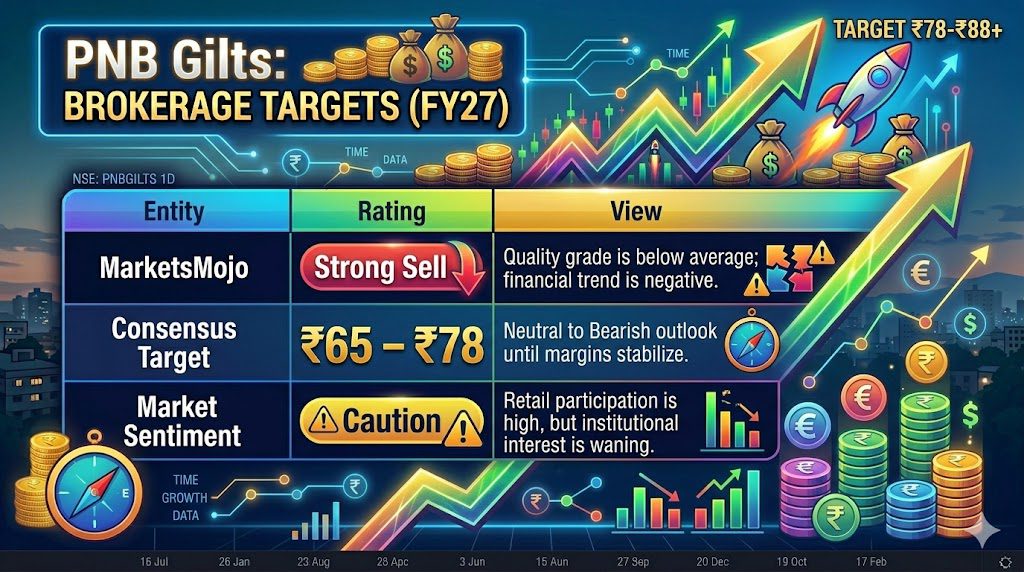
MarketsMojo has assigned a “Strong Sell” rating, citing weak financial trends and below-average quality metrics. The consensus target range for the stock lies between ₹65 and ₹78, indicating limited upside in the near term. Retail participation in the stock remains relatively high, but institutional interest appears to be declining, which could limit strong upward momentum in the short term.
7. The “30-Year” Analyst Verdict
After observing multiple interest rate cycles over the past three decades, it is clear that PNB Gilts operates in a highly cyclical environment, making timing crucial for investors.
For Long-Term Investors
For long-term investors, PNB Gilts can be seen as a proxy for RBI policy and interest rate movements. If interest rates begin to decline in late 2026, the company’s earnings could improve significantly. However, until there is clarity on rate direction, the stock remains a high-risk, high-reward play.
For Traders
For traders, the stock is currently in what can be described as a “no man’s land.” There is no clear trend or momentum, making it difficult to take directional bets. A better strategy would be to wait for either a breakdown below ₹68 or a breakout above ₹82 before taking positions.
The Key Risk
The biggest risk for PNB Gilts remains continued volatility in 10-year government bond yields. Sharp fluctuations in yields can lead to further mark-to-market losses, impacting quarterly earnings.
8. Conclusion & Engagement (CTA)
The PNB Gilts Q4 Results FY26 highlight a challenging quarter marked by sharp profit decline but stable revenue. While the numbers may appear weak, they reflect a cyclical phase rather than a structural problem. The company’s strong backing, stable operations, and strategic adjustments provide a foundation for future recovery. However, investors must remain cautious and closely track interest rate trends.
Is the 1% dividend enough reason to stay invested in PNB Gilts, or are you shifting your capital toward more stable banking stocks? Share your thoughts in the comments and join the discussion.
FAQ Section (SEO Optimized)
Is PNB Gilts a good stock to buy in 2026?
PNB Gilts is a cyclical stock dependent on interest rate movements. It may offer opportunities during falling interest rate cycles but remains volatile in the short term.
What is PNB Gilts share price target for 2026?
The expected range is ₹65 to ₹78, with upside potential depending on interest rate stability.
Why did PNB Gilts profit fall in Q4 FY26?
The decline was mainly due to margin compression caused by rising borrowing costs and trading losses in government securities.