1. Introduction: The Balanced Giant
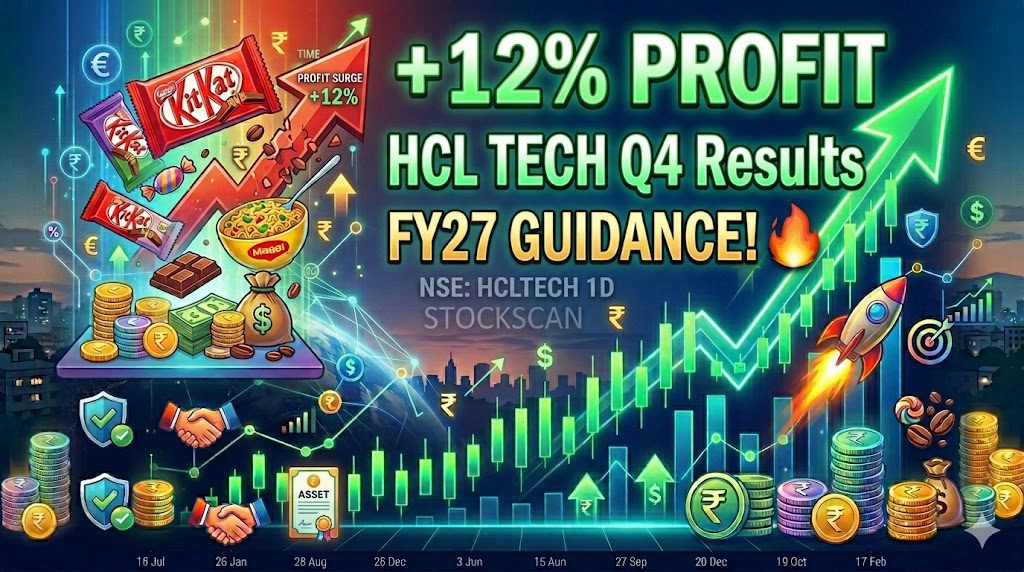
Over the last three decades of observing the Indian IT sector closely, one pattern has consistently stood out—every major IT company has a distinct DNA. Some are aggressive growth chasers, some are innovation leaders, but HCL Technologies (HCLTECH) has carved its niche as an efficiency-driven, execution-focused organization. The HCL Technologies Q4 Results FY26, released on April 21, 2026, reinforce this identity in a powerful way. At a time when global IT spending remains uneven and many firms are struggling to balance cost pressures with innovation demands, HCL Tech has managed to stay stable, profitable, and strategically positioned.
The current environment can best be described as a “two-speed tech economy.” On one side, IT services—especially discretionary spending—are slowing down due to global macro uncertainty, while on the other side, high-margin segments like software products and platform-based revenues continue to show resilience. HCL Tech sits right at the intersection of these two worlds, and that positioning is now becoming its biggest strength. While many pure-play IT services companies are feeling the heat of AI disruption and cautious enterprise spending, HCL Tech is quietly leveraging its diversified model to maintain balance.
From a market standpoint, the stock has remained relatively stable, trading around ₹1,441 ahead of the earnings announcement, which indicates that investors are already pricing in stability rather than aggressive growth. FY26, therefore, can be seen as a “year of consolidation” for HCL Tech—a period where the company focused on strengthening its fundamentals, improving operational efficiency, and preparing for the next phase of growth rather than chasing short-term expansion at any cost.
2. Q4 FY26 Financial Scorecard: The Margin Defense
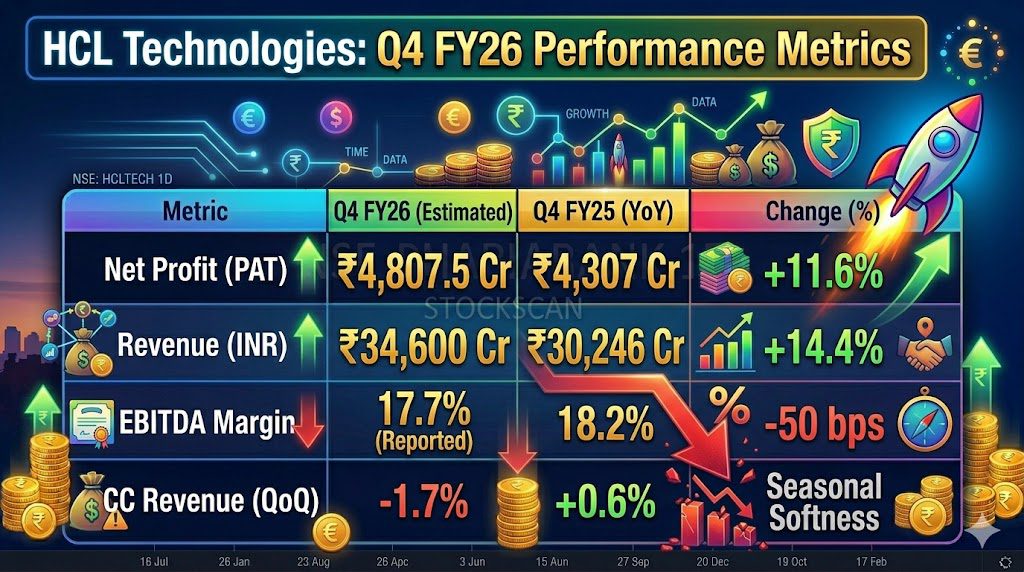
The financial performance of HCL Tech in Q4 FY26 clearly highlights its ability to protect profitability even in a challenging environment. The company reported a net profit of ₹4,807 crore, which represents a strong 11.6% year-on-year growth compared to ₹4,307 crore in the same quarter last year. This growth in profit is particularly significant because it comes at a time when many global IT firms are facing margin pressures and slowing revenue growth.
Revenue for the quarter stood at ₹34,600 crore, reflecting a healthy 14.4% YoY increase, which shows that demand has not disappeared but has become more selective and value-driven. However, on the margin front, there was a slight decline, with EBIT margins coming in at 17.7% compared to 18.2% last year, indicating a contraction of about 50 basis points. This decline was largely due to restructuring costs and investments in future growth areas such as AI and cloud capabilities.
Sequentially, the picture shows some softness, as constant currency revenue declined by 1.7% quarter-on-quarter, compared to a modest growth of 0.6% in the previous quarter. This decline reflects typical seasonal weakness along with cautious client spending. Despite this, the company’s ability to maintain strong profit growth indicates a disciplined approach to cost management and operational efficiency, which remains one of HCL Tech’s core strengths.
3. Fundamental Analysis: The “Software + Service” Edge
The Software Cushion
One of the most important differentiators for HCL Tech is its hybrid business model, which combines traditional IT services with a strong portfolio of software products. Over the years, the company has acquired several enterprise software assets from IBM, including platforms like Lotus, Domino, and Volt MX, which generate recurring revenue streams. These software products operate at significantly higher margins compared to IT services, providing a stable income base even when service revenues fluctuate.
This “software cushion” plays a critical role during periods of slowdown in IT services demand. While many competitors struggle with declining deal sizes and delayed decision-making, HCL Tech continues to benefit from predictable, subscription-based revenue. This not only stabilizes cash flows but also enhances overall profitability, making the company more resilient in uncertain times.
BFSI Recovery
Another key positive emerging from the Q4 FY26 results is the gradual recovery in the Banking, Financial Services, and Insurance (BFSI) segment, which is one of the largest contributors to IT spending globally. HCL Tech reported around 1.1% growth in its core IT services, largely driven by the ramp-up of large deals, particularly those exceeding $100 million in value.
This trend indicates that while smaller discretionary projects may be slowing down, large enterprises are continuing to invest in long-term digital transformation initiatives. This shift toward large, multi-year deals benefits companies like HCL Tech, which have strong execution capabilities and a proven track record in handling complex projects.
Restructuring Impact
The company’s recent organizational restructuring had an impact of around 80 basis points on margins, which might appear negative in the short term. However, this move is part of a broader strategy to realign the business with future growth areas such as artificial intelligence, cloud computing, and engineering services.
In simple terms, this restructuring can be seen as a short-term sacrifice for long-term gains. By investing in capabilities that will drive future growth, HCL Tech is positioning itself to remain competitive in an industry that is rapidly evolving due to technological disruption.
4. Technical Analysis: The ₹1,420 Launchpad
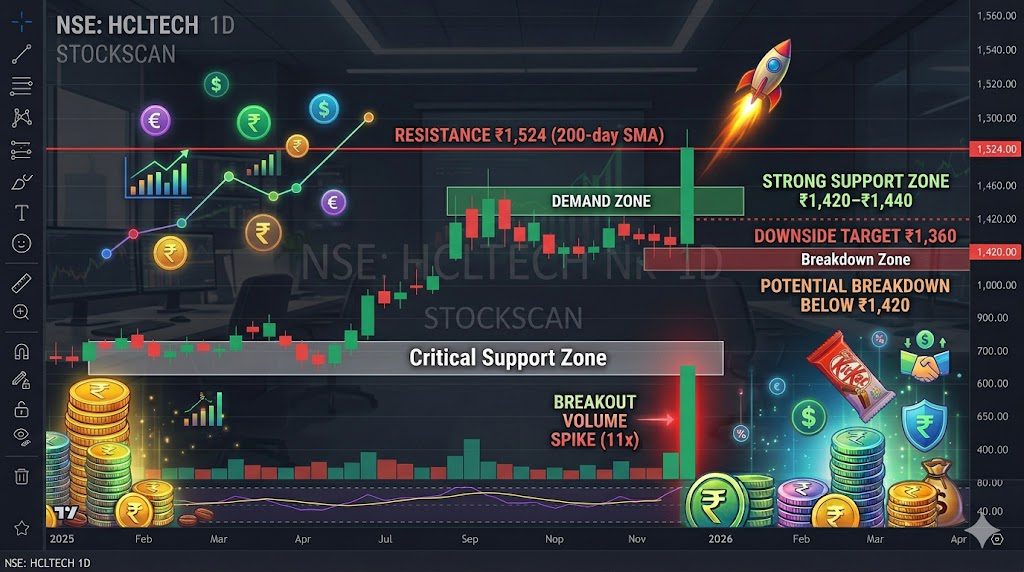
From a technical analysis perspective, HCL Tech’s stock is currently at a very interesting stage. Over the past few months, the stock has formed a strong base in the ₹1,420 to ₹1,440 range, which indicates solid support and accumulation by investors at these levels. This range is acting as a foundation for potential upward movement, provided broader market conditions remain supportive.
Key Levels
The immediate resistance for the stock lies around ₹1,524, which coincides with the 200-day moving average, a key technical indicator watched by traders and institutional investors. A decisive move above this level would signal strength and could open the door for further upside.
The Breakout Zone
If the stock manages to break above the ₹1,550 mark, it could trigger a breakout rally, potentially pushing the price toward the ₹1,650 to ₹1,720 range in the near to medium term. Such a move would likely be supported by improved sentiment in the IT sector and continued stability in the company’s earnings.
Analyst Pro-Tip
One of the most compelling aspects of HCL Tech at current levels is its valuation. The stock is trading at around 17 times its FY27 earnings, which is significantly lower than its peers such as TCS (around 21x) and Infosys (around 20x). This valuation gap suggests that the stock may be undervalued relative to its fundamentals, offering an attractive opportunity for investors looking for value in the IT sector.
5. Shareholder Rewards: The Dividend Story
HCL Tech has consistently rewarded its shareholders through regular dividend payouts, and Q4 FY26 is no exception. The company has announced an interim dividend of ₹18 per share, reinforcing its commitment to delivering value to investors. At current price levels, this translates to an annualised dividend yield of approximately 4.5%, making it one of the most attractive dividend-paying stocks in the Nifty IT index.
For investors, especially those seeking steady income, this high dividend yield provides a cushion against market volatility. It ensures that even if stock price appreciation remains moderate, investors continue to earn a stable return on their investment.
Important Dates
The record date for the interim dividend is typically announced within a few days of the declaration and is usually set about 10 days later. Investors need to hold the shares before this record date to be eligible for the dividend, making timing an important factor for those looking to benefit from the payout.
6. Brokerage Outlook & FY27 Guidance
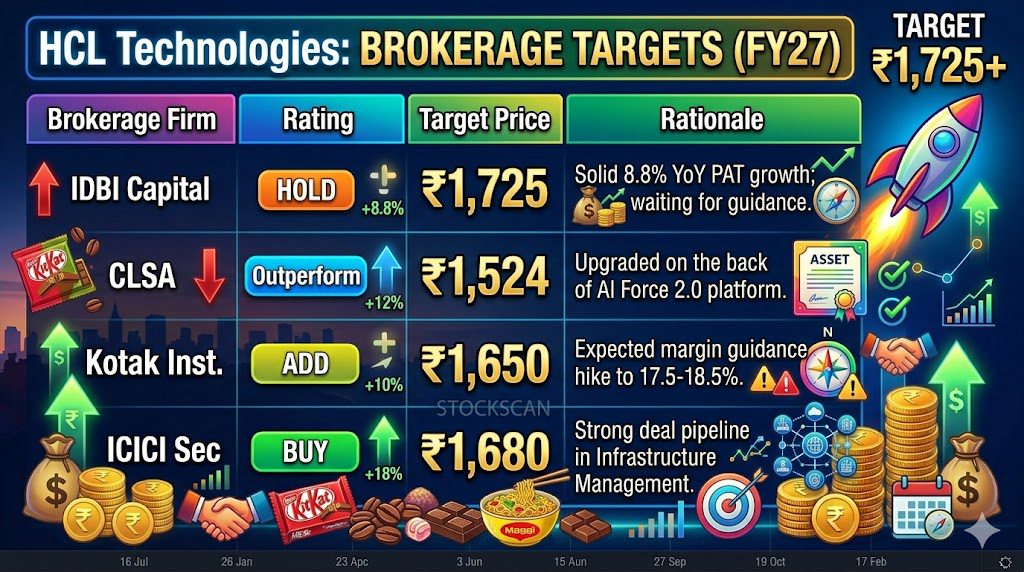
Brokerage firms have maintained a generally positive outlook on HCL Tech following its Q4 FY26 results, although their views reflect a mix of optimism and caution. IDBI Capital has given a “HOLD” rating with a target price of ₹1,725, citing strong profit growth but waiting for clearer guidance from management. On the other hand, CLSA has upgraded the stock to “Outperform,” with a target of ₹1,524, driven by confidence in the company’s AI initiatives.
Kotak Institutional Equities has assigned an “ADD” rating with a target of ₹1,650, expecting margins to improve in the coming quarters, while ICICI Securities remains bullish with a “BUY” rating and a target price of ₹1,680, supported by a strong deal pipeline in infrastructure management services.
Overall, the consensus among brokerages is that while near-term growth may remain moderate, HCL Tech’s strong fundamentals, strategic positioning, and focus on future technologies make it a solid investment option.
7. Management Guidance & AI Strategy
Looking ahead to FY27, HCL Tech has provided a growth guidance of 3% to 6% in constant currency terms, which reflects a cautious yet realistic outlook given the current global economic conditions. This guidance also incorporates the impact of recent acquisitions and strategic partnerships, which are expected to contribute to growth over time.
One of the most significant developments is the company’s focus on artificial intelligence through its AI Force 2.0 platform. Unlike many competitors that are adopting a generic approach to AI, HCL Tech is focusing on an engineering-led AI strategy, integrating AI directly into infrastructure, operations, and enterprise workflows.
This approach is likely to resonate well with clients who are looking for practical, results-driven AI solutions rather than experimental or standalone tools. By embedding AI into core business processes, HCL Tech is positioning itself as a partner in digital transformation rather than just a service provider.
8. The 30-Year Analyst Verdict
After analyzing the IT sector for decades, it becomes clear that companies that prioritize stability, efficiency, and long-term strategy tend to outperform over time. HCL Tech fits this profile perfectly. For long-term investors, the company represents a steady compounder, offering consistent growth, reliable dividends, and relatively low volatility compared to its peers.
For traders, the current technical setup presents an attractive opportunity, with the ₹1,420 level acting as a strong support base. As long as this level holds, the downside risk remains limited, while the potential upside could range between 10% to 15%, making it a favorable risk-reward scenario.
9. Conclusion & Engagement (CTA)
In conclusion, the HCL Technologies Q4 Results FY26 highlight a company that is navigating a challenging environment with confidence and discipline. While there are signs of seasonal softness in revenue, the overall performance remains strong, supported by healthy profit growth, a robust dividend payout, and a resilient software business.
The company’s focus on AI, combined with its diversified business model, positions it well for future growth, even as the IT industry undergoes significant transformation. For investors looking for stability, value, and consistent returns, HCL Tech continues to stand out as a compelling option.
So the real question now is—is HCL Tech’s ₹18 dividend enough to keep you invested, or are you waiting for the stock to hit the ₹1,650 target before making your move? Let me know your thoughts.