India’s energy sector rarely produces a quarterly earnings report as fascinating and strategically important as the latest results announced by Oil and Natural Gas Corporation Limited on May 26, 2026. At first glance, the numbers looked confusing. Standalone profits remained almost flat and sequential earnings dropped sharply, creating initial concerns among traders. But once investors moved beyond the headline volatility, the deeper story became far more powerful.
The reality is that ONGC’s consolidated business delivered one of its strongest performances in recent years. While exploration write-offs hurt the standalone upstream business, the company’s downstream refining ecosystem — particularly subsidiaries like Hindustan Petroleum Corporation Limited and Mangalore Refinery and Petrochemicals Limited — generated exceptional profitability and transformed the group-level earnings picture completely.
This contrast perfectly reflects ONGC’s evolving identity. The company is no longer simply an oil exploration PSU dependent entirely on crude extraction. It is gradually becoming a fully integrated energy conglomerate with exposure across upstream drilling, downstream refining, petrochemicals, gas monetization, and offshore international energy assets.
For long-term investors, dividend-focused portfolios, crude oil traders, and PSU energy enthusiasts, the latest Q4 FY26 earnings report from Oil and Natural Gas Corporation Limited provides an extremely important roadmap for understanding where India’s energy economy is heading during the next decade.
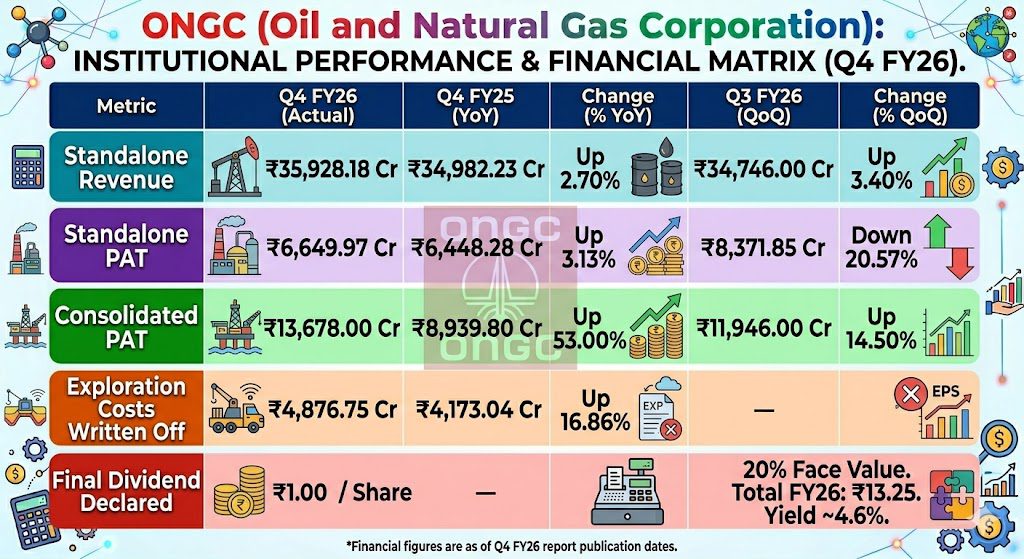
The company reported standalone revenue of ₹35,928.18 crore during Q4 FY26 compared to ₹34,982.23 crore during the same quarter last year, reflecting modest year-on-year growth of approximately 2.7%. Sequentially, revenue also improved by roughly 3.4% compared to Q3 FY26. Stable crude realizations and higher gas monetization helped support the topline despite production complexities across certain offshore assets.
Standalone profit after tax came in at ₹6,649.97 crore compared to ₹6,448.28 crore during Q4 FY25, representing only a mild year-on-year increase of approximately 3.13%. However, on a sequential basis, standalone profits fell sharply by more than 20% compared to Q3 FY26, immediately triggering market concerns.
The biggest reason behind the sequential decline was not operational weakness but rather exploration-related accounting pressure. During the quarter, ONGC wrote off approximately ₹4,876.75 crore in dry-well exploration costs compared to ₹4,173.04 crore during the same quarter last year. In the oil and gas industry, if a well fails to produce commercially viable hydrocarbons, the entire drilling and exploratory expenditure must be written off. These non-cash write-offs heavily impacted standalone profitability during the quarter.
However, the real story emerged at the consolidated level.
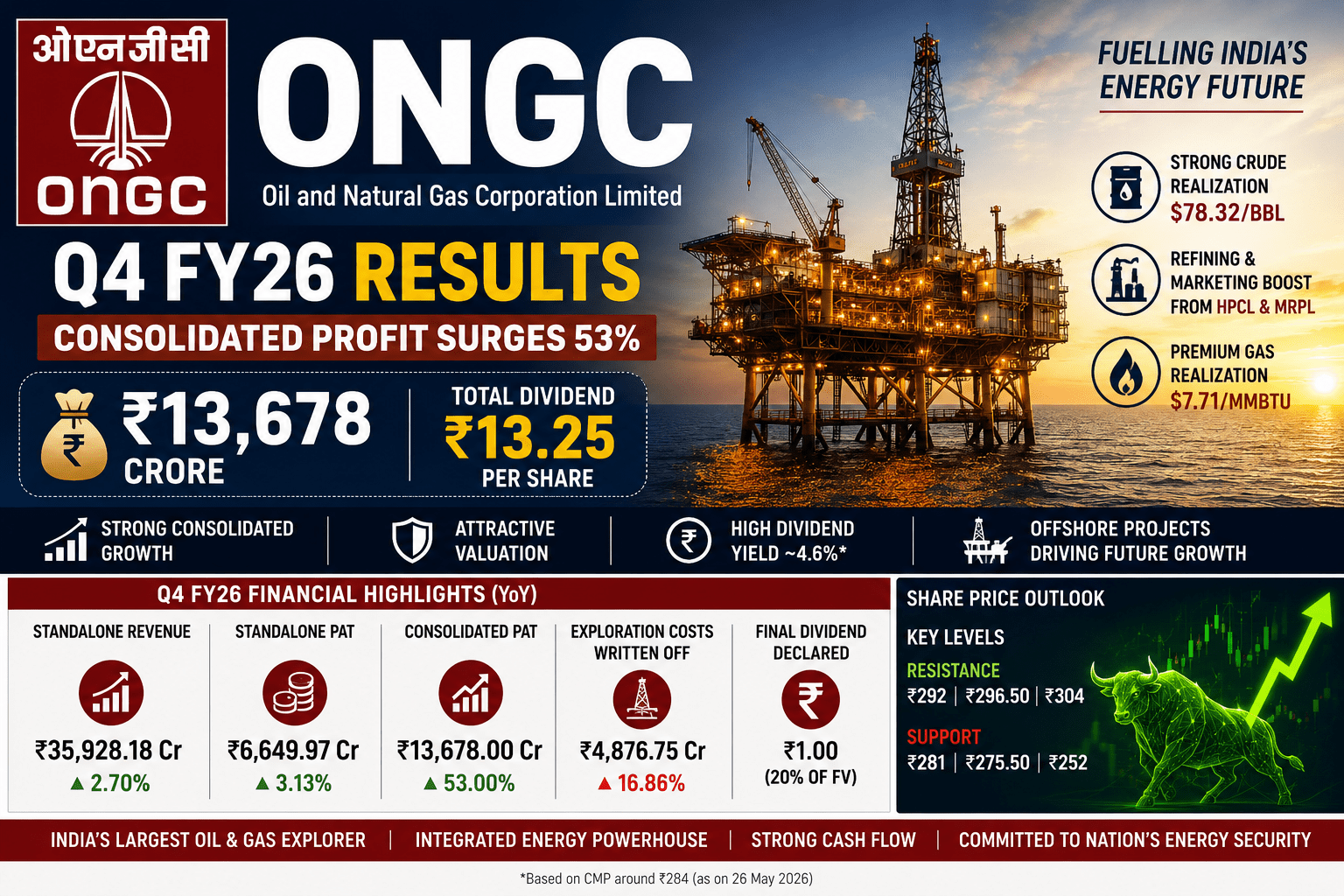
Consolidated net profit surged dramatically to ₹13,678 crore compared to ₹8,939.8 crore during Q4 FY25, reflecting explosive year-on-year growth of approximately 53%. Even sequentially, consolidated profits increased by nearly 14.5% compared to Q3 FY26. This massive earnings expansion clearly demonstrated the growing importance of ONGC’s downstream subsidiaries within the overall group structure.
The refining and marketing businesses of Hindustan Petroleum Corporation Limited and Mangalore Refinery and Petrochemicals Limited benefited significantly from strong refining margins and favorable fuel marketing spreads during the quarter. As global crude prices stabilized and product cracks improved, downstream profitability expanded sharply and compensated for upstream exploration volatility.
One of the strongest operational positives during the quarter was crude realization. ONGC achieved net realization of approximately $78.32 per barrel during Q4 FY26 compared to $73.72 during Q4 FY25. This improvement provided substantial revenue support despite production fluctuations and exploratory write-offs.
The company also continued strengthening its reputation as one of India’s strongest dividend-paying PSUs. The board recommended a final dividend of ₹1 per share, representing 20% of face value. Combined with interim dividends already distributed during FY26 amounting to ₹12.25 per share, the total annual dividend payout now stands at ₹13.25 per share. This translates into an aggregate system payout exceeding ₹16,669 crore and reinforces ONGC’s position as one of India’s most attractive dividend yield stocks.
One of the most important structural developments currently happening within Oil and Natural Gas Corporation Limited is the increasing contribution from premium-priced gas production. During FY26, newly commissioned wells contributed approximately 17% of total production and nearly 21% of total revenue. These newer gas allocations achieved premium pricing near $7.71 per mmbtu compared to approximately $6.40 for standard APM gas.
This shift is extremely important because higher-priced gas production significantly improves future margin profiles and reduces dependence on pure crude oil earnings volatility. Over time, this could gradually transform ONGC into a more stable and diversified energy cash-flow generator.
From a valuation perspective, ONGC continues appearing deeply undervalued relative to broader market indices. The stock currently trades near a trailing Price-to-Earnings (P/E) multiple of roughly 8.2x–8.5x compared to nearly 22x for the broader Nifty 50 index. This large valuation discount continues attracting value investors seeking stable dividend yield, cash-flow strength, and commodity-linked inflation protection.
The company also remains strategically important for India’s long-term energy security. Oil and Natural Gas Corporation Limited contributes nearly 70% of India’s domestic crude oil and natural gas production. Through subsidiaries like HPCL, MRPL, ONGC Videsh (OVL), and OPaL, the company now possesses exposure across refining, petrochemicals, offshore international assets, and integrated energy infrastructure.
Management commentary during the earnings call also focused heavily on offshore production revival strategies.
One major operational achievement came from the Mumbai High redevelopment effort, where ONGC partnered with BP p.l.c. as a technical consultant. This collaboration has already improved production performance to nearly 102% of target baselines. Management indicated that this technical partnership model may now gradually expand across broader Western Offshore assets.
Another major growth trigger is the Daman Upside Development Project (DUDP), where commercial gas monetization has already begun. Management expects the project to contribute approximately 9% incremental growth to ONGC’s gas segment during the coming quarters. If execution remains successful, DUDP could become one of the company’s most important future production catalysts.
From a technical analysis perspective, the stock currently trades near the ₹284–₹290 range and continues protecting major long-term moving averages despite commodity market volatility.
The most important short-term technical breakout pivot currently stands near ₹296.50.
y=296.50y=296.50
A decisive daily close above this level could potentially invalidate the recent consolidation structure and open the path toward higher resistance zones. Immediate resistance levels currently remain near ₹292, ₹296.50, and ₹304 respectively, while critical support levels remain visible near ₹281, ₹275.50, and ₹252.
Importantly, many institutional desks are likely to treat any temporary weakness toward the ₹275 support region as a potential accumulation opportunity because the standalone earnings pressure mainly reflected non-cash exploratory write-offs rather than structural business deterioration.
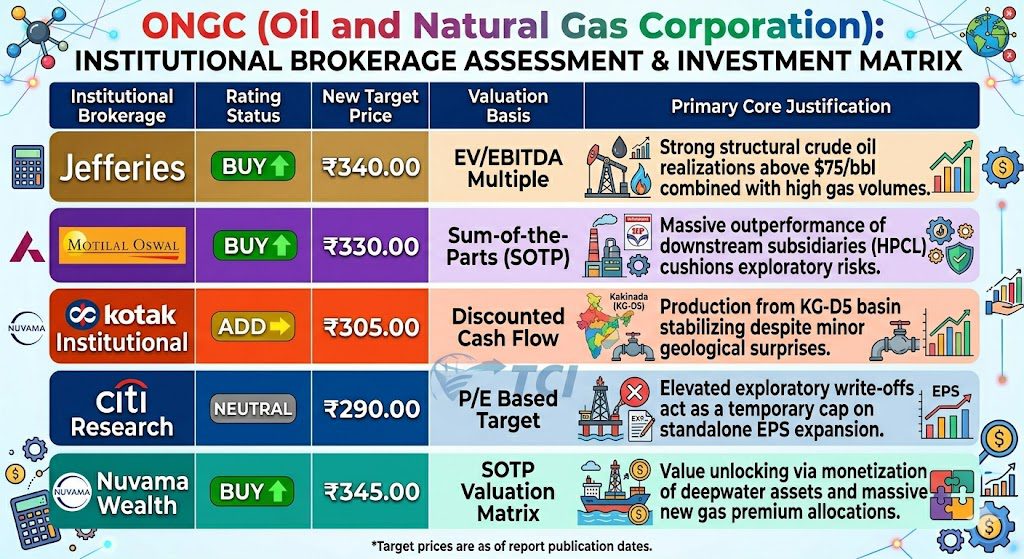
Institutional brokerages continue maintaining broadly constructive outlooks on the stock. Jefferies maintained a BUY rating with a target price of ₹340 based on strong crude realizations and improving gas economics. Motilal Oswal assigned a target near ₹330 because of the strong downstream subsidiary performance cushioning upstream volatility. Nuvama Wealth maintained one of the highest targets near ₹345 due to the company’s deepwater monetization potential and improving premium gas allocations. The broader institutional consensus currently stands near ₹322, implying potential upside of approximately 12%–15% from current levels.
Overall, the Q4 FY26 earnings report from Oil and Natural Gas Corporation Limited revealed a company undergoing an important structural transition. While standalone upstream earnings faced temporary pressure due to dry-well exploration write-offs, the consolidated business delivered exceptional growth supported by downstream refining strength, strong crude realizations, and improving gas economics. Combined with a dividend payout of ₹13.25 per share, premium gas monetization opportunities, offshore production revival projects, and deeply discounted valuations, ONGC continues appearing as one of the strongest long-term value and dividend plays within India’s energy sector today.