Introduction: The Pharma Giant’s “One-Time” Reset
The Hook
Over the last three decades, the Indian pharmaceutical sector has transformed from a low-cost generic manufacturing industry into one of the world’s most influential healthcare ecosystems. Since the mid-1990s, global pharma cycles have repeatedly shifted between patent expiries, blockbuster drugs, specialty therapies, and generic competition. During this long transition, Dr. Reddy’s Laboratories evolved from a regional generic manufacturer into a globally respected pharmaceutical giant with strong operations across North America, Europe, India, and several emerging markets. However, every major pharmaceutical company eventually experiences a difficult transition period, especially when a high-margin product opportunity begins fading. Dr. Reddy’s Q4 FY26 performance represents one such “reset quarter” where short-term accounting pain may actually help prepare the company for a healthier long-term growth cycle.
The Big Headline
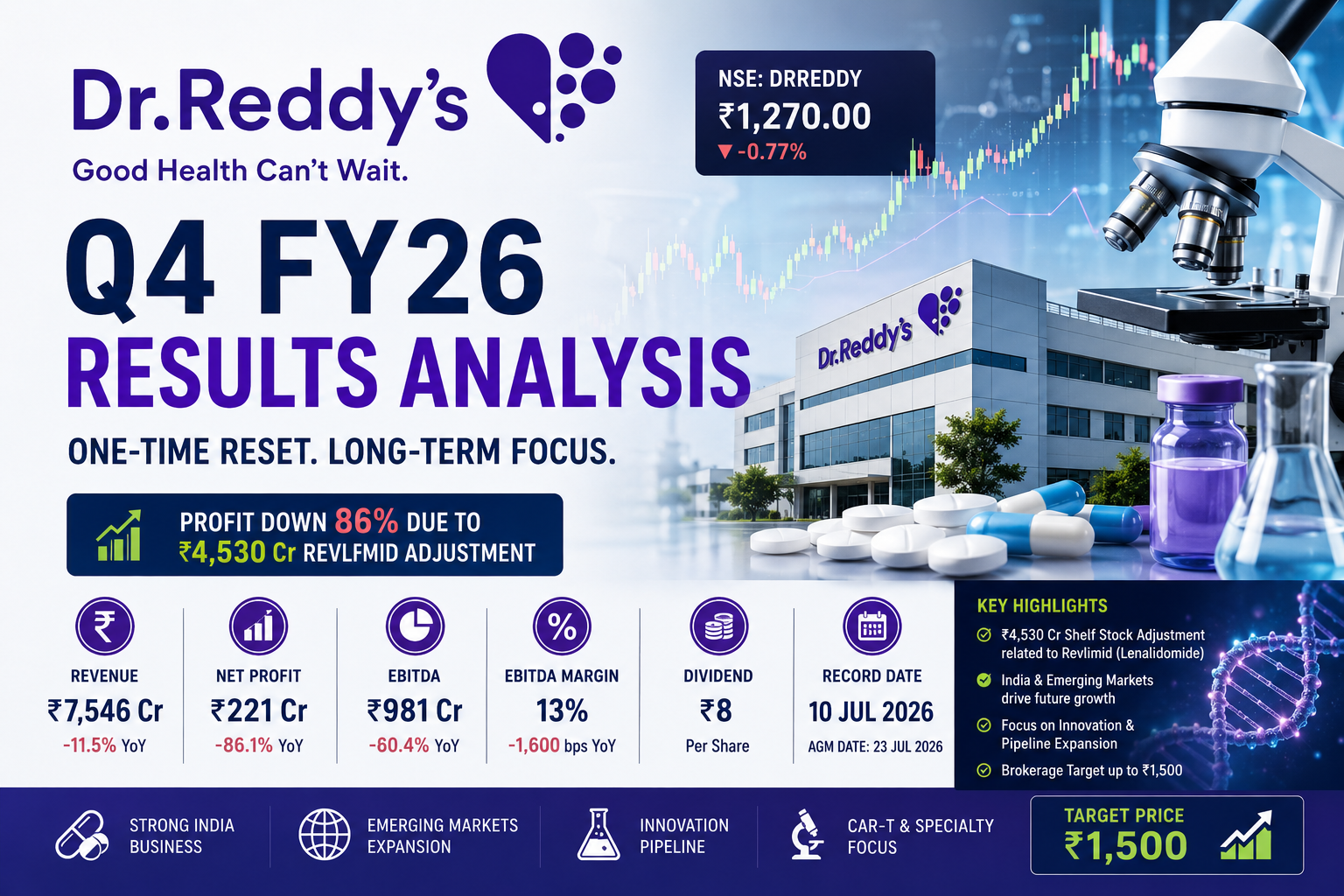
Dr. Reddy’s Laboratories reported a sharp 86.1% year-on-year decline in consolidated net profit to approximately ₹221 crore during Q4 FY26. The dramatic fall was mainly caused by a massive ₹4,530 crore Shelf Stock Adjustment (SSA) linked to lenalidomide, the generic version of blockbuster cancer drug Revlimid. Although the headline profit numbers initially appeared alarming, experienced market participants understand that such “kitchen-sinking” quarters are not unusual in the pharmaceutical industry. Companies often choose to recognize one-time adjustments aggressively in a single quarter to clean up future earnings visibility and reset expectations for the next growth phase.
Current Market Pulse
As of May 12, 2026, shares of Dr. Reddy’s Laboratories closed near approximately ₹1,270 on the NSE, declining around 0.77% after the results announcement. Interestingly, despite the massive profit collapse, the stock did not witness panic selling because investors largely recognized that the weakness was caused by exceptional accounting adjustments rather than a structural breakdown of the core business. Institutional investors are now focusing more on the company’s long-term pipeline, India business, emerging-market growth, specialty therapies, and future product launches rather than the temporary Revlimid-related adjustments.
Q4 FY26 Performance: The “Hard Numbers” (NSE Actuals)
Revenue from Operations
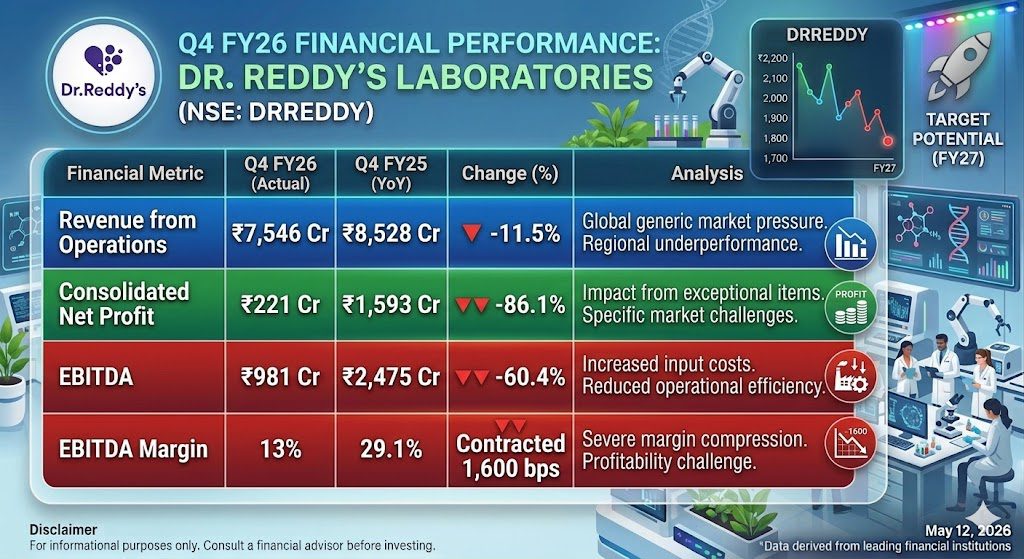
Dr. Reddy’s Laboratories reported revenue from operations of approximately ₹7,546 crore during Q4 FY26 compared to nearly ₹8,528 crore during the same quarter last year. This reflects a year-on-year decline of approximately 11.5%. The decline was primarily driven by lower contribution from lenalidomide sales in North America along with continuing pricing pressure across the US generics market. The pharmaceutical industry globally continues facing intense competition in mature generic categories, where aggressive pricing erosion impacts both revenues and margins.
Net Profit Collapse
Consolidated Net Profit After Tax during Q4 FY26 stood at approximately ₹221 crore compared to nearly ₹1,593 crore during Q4 FY25, representing a massive year-on-year decline of approximately 86.1%. However, the sharp decline was largely caused by exceptional one-time accounting adjustments associated with the Shelf Stock Adjustment for lenalidomide inventory. Excluding these extraordinary adjustments, the company’s underlying operational performance remained significantly more stable than the headline numbers suggest.
EBITDA Performance
EBITDA during Q4 FY26 declined sharply to approximately ₹981 crore compared to nearly ₹2,475 crore during the same period last year.
EBITDA Margin=EBITDARevenue×100EBITDA\ Margin = \frac{EBITDA}{Revenue} \times 100
The EBITDA decline mainly reflects lower profitability from high-margin Revlimid sales, inventory-related adjustments, and pricing pressure within the North American generics business.
EBITDA Margin Compression
EBITDA margins contracted sharply from approximately 29.1% during Q4 FY25 to nearly 13% during Q4 FY26. This represents contraction of nearly 1,600 basis points. The sharp margin decline reflects the fading profitability of the extraordinary Revlimid opportunity, which had significantly boosted margins during previous quarters. Such normalization was expected eventually because exceptional generic-drug opportunities rarely maintain peak profitability permanently.
Fundamental Deep-Dive: Beyond the Lenalidomide Shadow
Understanding the Shelf Stock Adjustment (SSA)
The most important factor impacting Q4 FY26 earnings was the massive ₹4,530 crore Shelf Stock Adjustment related to lenalidomide inventory. Essentially, the adjustment reflects changes in expected future inventory realization and pricing dynamics as competition intensifies within the generic Revlimid market. Accounting adjustments of this scale can significantly distort quarterly profits even when the core operational business remains fundamentally stable. Excluding the SSA and other one-time costs, normalized Q4 revenue would have been closer to approximately ₹7,970 crore.
Experienced pharmaceutical investors understand that these “cleanup quarters” often occur after companies benefit from unusually profitable patent-expiry opportunities. Once competition increases, companies typically reset accounting assumptions to reflect more realistic future earnings.
North America Market Challenges
The North American market remained the biggest area of weakness during Q4 FY26. The region faced pressure because of declining lenalidomide profitability, aggressive generic competition, inventory adjustments, and broader pricing erosion within the US healthcare system. Historically, North America contributed significantly to Dr. Reddy’s profitability because of high-margin specialty opportunities. However, as competition intensifies, pharmaceutical companies must continuously launch new products to sustain growth and offset pricing pressure.
India & Emerging Markets Growth
While North America remained weak, Dr. Reddy’s India and Emerging Markets businesses continued showing resilience. These segments are increasingly becoming the company’s long-term growth engine because of rising healthcare demand, expanding chronic disease treatment, growing middle-class healthcare spending, and stronger domestic pharmaceutical brands. India remains one of the fastest-growing pharmaceutical markets globally, supported by rising insurance penetration, healthcare awareness, and increasing government healthcare spending.
Gross Margin Reality
Gross margins during Q4 FY26 contracted to approximately 44.8%, declining nearly 1,074 basis points year-on-year. The reduction mainly reflects lower contribution from high-margin lenalidomide sales and increasing generic pricing pressure within North America. Although short-term margin pressure may continue, investors are now focusing more on how successfully the company diversifies beyond Revlimid over the next several years.
Shareholder Rewards: The Dividend Story
Recommended Dividend
Despite the difficult quarter, the board of Dr. Reddy’s Laboratories recommended a final dividend of approximately ₹8 per equity share with face value ₹1 for FY26. The dividend announcement reflects management’s confidence regarding long-term cash-flow generation despite short-term accounting disruptions.
Important Dividend Dates
The company announced July 10, 2026, as the Record Date for dividend eligibility, while the Annual General Meeting (AGM) is scheduled for July 23, 2026. Investors closely monitor dividend decisions because they often provide insight into management confidence regarding future operational stability.
Dividend Confidence Signal
Many analysts believe the dividend payout itself sends an important positive signal. Companies facing structural weakness typically reduce payouts aggressively to preserve cash. Dr. Reddy’s decision to maintain shareholder rewards suggests management views the current quarter primarily as a temporary transitional phase rather than a long-term business deterioration.
Technical Analysis: Navigating the ₹1,260 Floor
Current Technical Setup
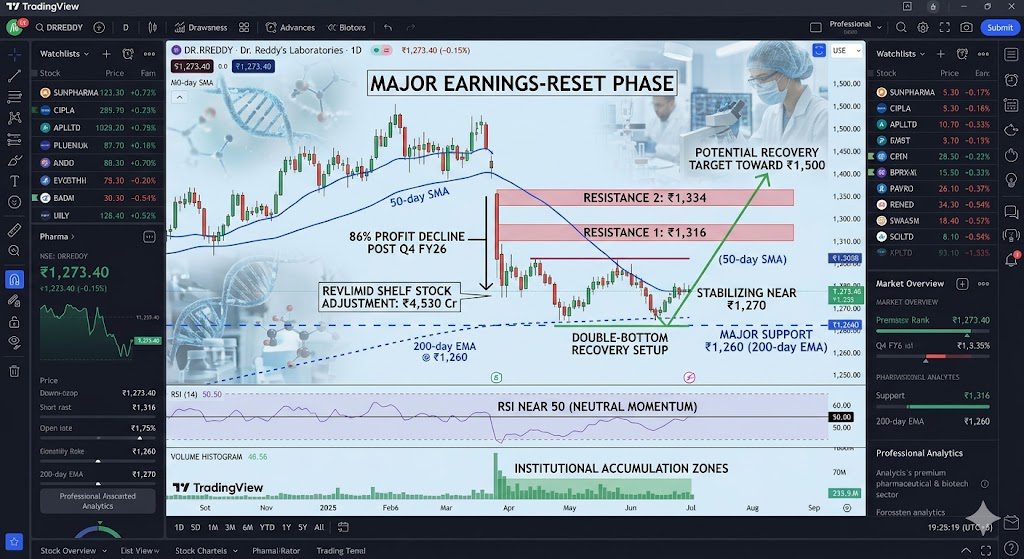
Technically, Dr. Reddy’s stock is currently trading slightly above its 200-day Exponential Moving Average near approximately ₹1,264.30. Long-term moving averages often act as major institutional support zones, especially for fundamentally strong companies experiencing temporary earnings volatility.
Immediate Support Levels
The first major support zone currently exists near approximately ₹1,264, which aligns closely with the 200-day EMA. Secondary support remains near approximately ₹1,250, which previously acted as a major brokerage target zone. If the stock decisively breaks below these levels, additional downside pressure could emerge in the short term.
Resistance Levels
The stock currently faces resistance near approximately ₹1,316 and ₹1,334. A sustained breakout above these levels could potentially trigger stronger recovery momentum toward the ₹1,400 region, especially if future management guidance improves investor sentiment.
RSI Momentum Analysis
The Relative Strength Index (RSI) currently remains near approximately 49.89, indicating neutral market momentum. This suggests the stock is neither overbought nor oversold and remains within a “wait-and-watch” phase while investors evaluate future earnings recovery and pipeline execution.
Brokerage Sentiment & Targets
BOB Capital Markets View
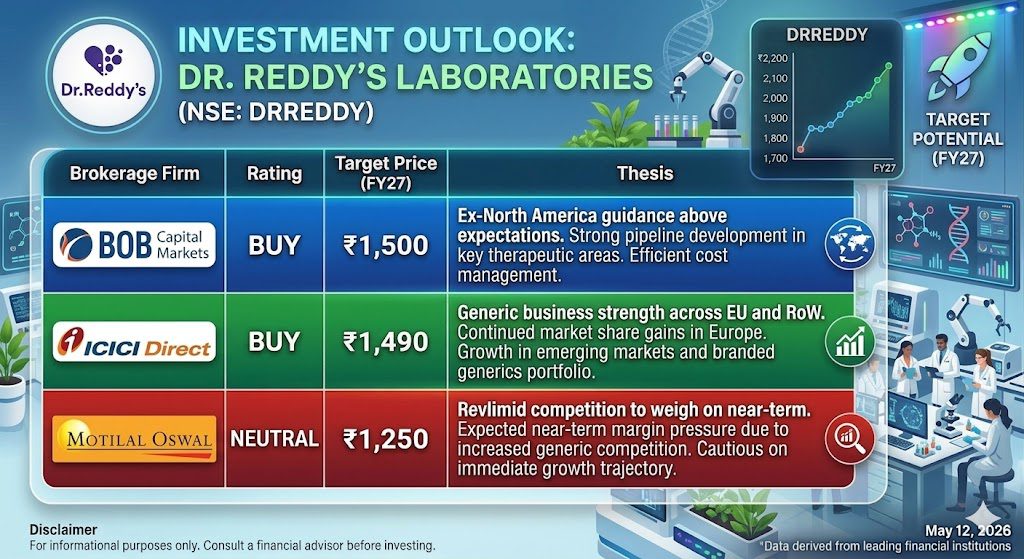
BOB Capital Markets currently maintains a BUY rating with a target price near ₹1,500. Analysts remain optimistic regarding the company’s growth potential outside North America and expect future product launches to gradually offset Revlimid-related weakness.
ICICI Direct Outlook
ICICI Direct also maintains a BUY recommendation with target price near ₹1,490. Analysts continue highlighting the company’s strong India operations, diversified generic business across Europe and Rest-of-World markets, and growing specialty-drug opportunities.
Motilal Oswal’s Cautious View
Motilal Oswal currently maintains a NEUTRAL rating with target price near ₹1,250 because of concerns regarding intensifying competition within the Revlimid market and ongoing pressure on North American profitability.
Management Guidance: The Pipeline Focus
Beyond Revlimid
Management guidance increasingly focuses on reducing dependence on the Revlimid opportunity and strengthening growth through diversified new launches, specialty products, emerging-market expansion, and India branded formulations. Diversification remains critical because excessive dependence on a single blockbuster opportunity often creates long-term earnings volatility.
R&D and Innovation Strategy
Investors are also closely monitoring updates regarding Dr. Reddy’s research pipeline, including CAR-T assets, Eftilagimod Alfa, oncology products, specialty therapies, and complex injectables. Although the company recognized some impairment-related costs during the quarter, long-term investment in research and innovation continues remaining one of its most important strategic strengths.
The “30-Year” Analyst Verdict
For Long-Term Investors
Long-term investors should avoid overreacting to the 86% profit decline because the quarter was heavily distorted by exceptional accounting adjustments related to Revlimid inventory normalization. The company’s India and Emerging Markets businesses remain fundamentally strong, and future pipeline diversification may gradually reduce dependence on North American generic cycles. Historically, many pharmaceutical companies emerge stronger after completing such accounting cleanup phases.
For Active Traders
From a trading perspective, the stock currently remains near a critical technical support zone around its 200-day EMA. A decisive break below ₹1,260 could potentially trigger deeper correction toward lower levels. However, if the stock successfully stabilizes above this region, traders may begin viewing the setup as a potential “double-bottom” recovery opportunity toward ₹1,400.
Conclusion & Engagement (CTA)
Final Word
Dr. Reddy’s Laboratories appears to have aggressively “kitchen-sinked” its FY26 results by recognizing major one-time adjustments related to the fading Revlimid opportunity. Although the headline numbers appear weak, the underlying long-term business remains significantly healthier than the 86% profit decline suggests. With strong India operations, expanding emerging-market presence, diversified pipeline investments, and ongoing R&D focus, Dr. Reddy’s Laboratories may now be positioning itself for a cleaner and potentially stronger FY27 recovery phase.
Investor Discussion
Are you buying the sharp correction in Dr. Reddy’s Laboratories for the long-term ₹1,500 opportunity, or do you believe the US generics pricing war will continue hurting profitability? Share your pharma-sector investment strategy and DRREDDY outlook in the comments below.