India’s organized fashion retail industry is entering one of the most competitive yet structurally promising phases in its history, and Aditya Birla Fashion and Retail Limited has once again delivered a quarterly result that perfectly captures this transformation. The company announced its Q4 FY26 earnings on May 25, 2026, and the numbers revealed a fascinating contrast between aggressive revenue expansion and continued bottom-line pressure. While headline net losses widened sharply during the quarter, the deeper operational story suggests that ABFRL may now be positioning itself for one of the largest long-term retail restructuring opportunities in India’s fashion industry.
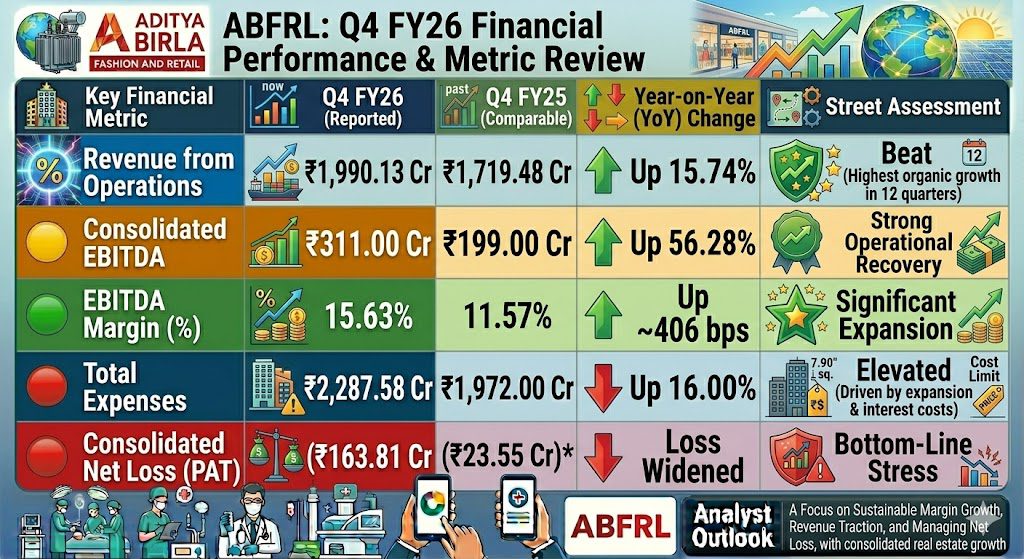
At first glance, investors looking only at the profit-and-loss statement may feel disappointed. The company reported a consolidated net loss of ₹163.81 crore during Q4 FY26 compared to a loss of ₹23.55 crore during the same period last year. However, beneath the headline loss figure, the business actually delivered one of its strongest operational growth quarters in recent years. Revenue growth accelerated sharply, EBITDA margins improved significantly, premium fashion categories expanded rapidly, and the company continued executing one of the biggest structural retail reorganizations in the Indian apparel sector.
The most important development shaping the future of Aditya Birla Fashion and Retail Limited is the historic demerger of its Madura Fashion & Lifestyle business into a separate listed entity called Aditya Birla Lifestyle Brands Limited (ABLBL). Effective May 1, 2025, the company fundamentally transformed its business structure. The older ABFRL model built around brands like Louis Philippe, Van Heusen, Allen Solly, and Peter England has now evolved into a new retail-focused growth engine targeting scalable fashion segments, digital-first brands, ethnic luxury categories, and mass-market expansion opportunities.
The “new ABFRL” now focuses aggressively on four strategic pillars. The first is value retail expansion led by Pantaloons and the fast-growing Style Up format targeting India’s tier-2 and tier-3 consumption markets. The second pillar is the TMRW digital ecosystem, which focuses on acquiring and scaling D2C (Direct-to-Consumer) fashion brands. The third pillar is premium ethnic and designer fashion featuring brands and partnerships including Tasva, TCNS Clothing, Sabyasachi, House of Masaba, Shantnu & Nikhil, and Tarun Tahiliani. The fourth pillar is the company’s international luxury strategy through businesses like The Collective and Galeries Lafayette.
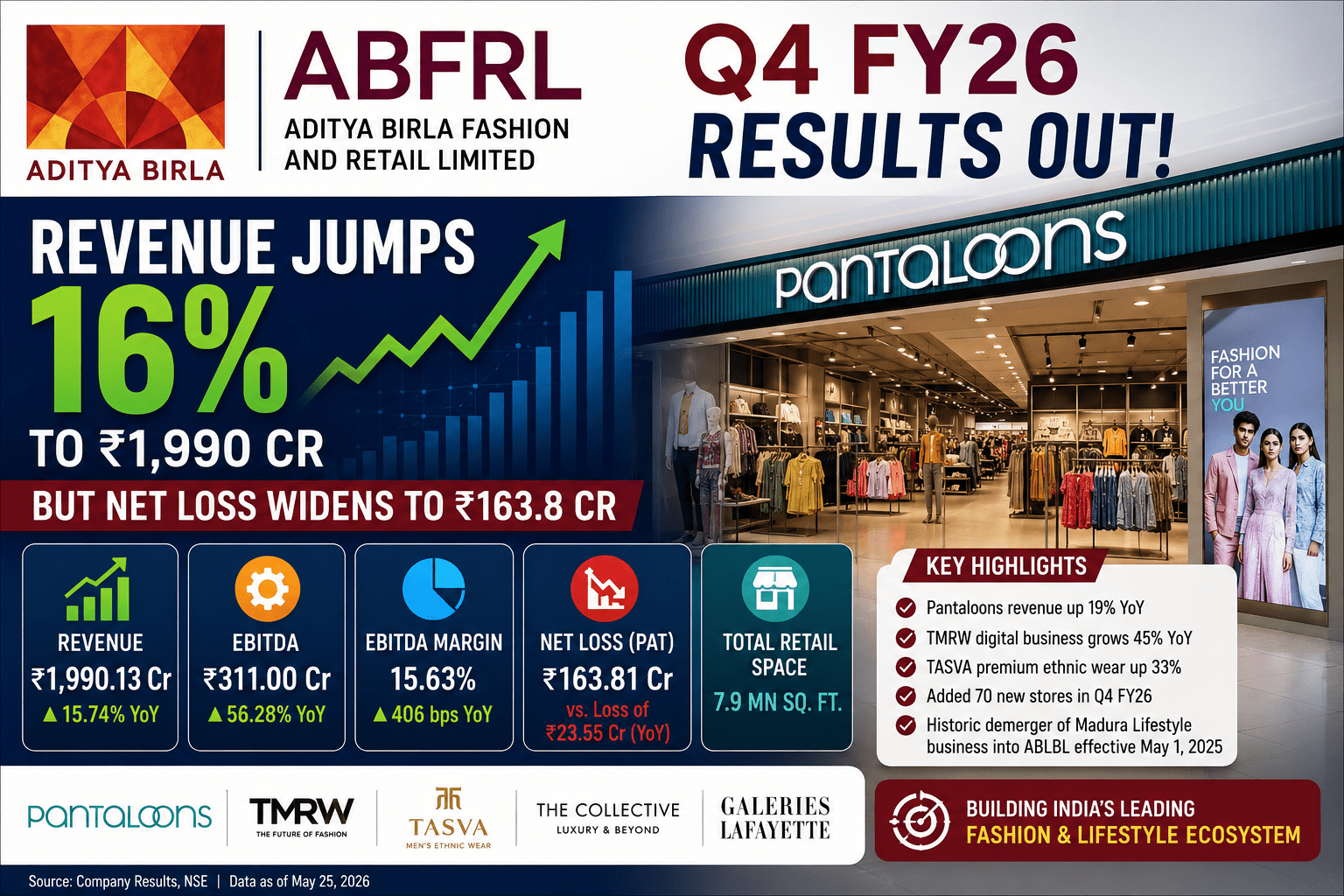
Financially, the company reported revenue from operations of ₹1,990.13 crore during Q4 FY26 compared to ₹1,719.48 crore during Q4 FY25, reflecting strong year-on-year growth of 15.74%. This represented the company’s fastest organic revenue growth rate in nearly three years and significantly exceeded most Street expectations. The strong top-line performance clearly indicates that organized fashion demand in India remains resilient despite inflationary pressure and competitive intensity across the retail sector.
Operational performance improved even more strongly than revenues. Consolidated EBITDA surged to ₹311 crore compared to ₹199 crore during the same quarter last year, representing massive growth of 56.28%. EBITDA margins expanded sharply from 11.57% to 15.63%, showing margin improvement of nearly 406 basis points. This indicates that operational efficiency, premium category mix, and scaling benefits are gradually improving across multiple segments of the business.
One of the biggest operational highlights came from the Pantaloons business, which continues acting as the backbone of the company’s retail expansion strategy. Pantaloons revenue increased 19% year-on-year to approximately ₹1,048 crore during the quarter. Even more importantly, Like-for-Like (LTL) store growth reached an impressive 14%, indicating strong same-store demand recovery and improving consumer footfall trends.
The company’s digital-first TMRW business also delivered explosive growth, recording approximately 45% year-on-year expansion during the quarter. This segment remains strategically important because India’s digital fashion ecosystem is expected to become one of the fastest-growing retail categories over the coming decade. By aggressively building a portfolio of digitally native brands, ABFRL is attempting to create a future-ready fashion commerce platform capable of competing with both traditional retailers and emerging online fashion ecosystems.
The premium ethnic wear vertical also continued demonstrating strong momentum. Tasva, the company’s premium men’s wedding and occasion-wear brand, reported approximately 33% sales growth despite fewer wedding dates during the March quarter. High-end designer collaborations and premium ethnic categories continue benefiting from India’s rising aspirational consumption patterns and growing demand for luxury Indian fashion.
However, despite strong operational momentum, the company still reported a large net loss. The primary reason behind this profitability disconnect lies in aggressive expansion costs and financing overheads. During Q4 FY26 alone, the company added nearly 70 new stores, taking its total retail footprint to approximately 7.9 million square feet across India. Such rapid expansion naturally increases depreciation charges, rental obligations, employee costs, and financing expenses, all of which heavily pressure short-term profitability.
This is a classic example of a retail company prioritizing market share capture and long-term scale over immediate earnings optimization. Management appears willing to tolerate temporary losses in order to build one of India’s largest integrated fashion retail ecosystems capable of competing against giants like Reliance Retail and Trent Limited.
From a balance sheet perspective, the company still maintains relatively healthy liquidity. ABFRL ended FY26 with a gross cash position of approximately ₹1,545 crore, including ₹1,144 crore available at the standalone level. This liquidity buffer remains important because it gives management operational flexibility during the current expansion and restructuring cycle.
Another important long-term positive is the ongoing turnaround within the acquired TCNS Clothing portfolio. Management indicated that operational cash losses within the TCNS business have already reduced significantly through cost rationalization and integration efficiencies. If the company successfully stabilizes this portfolio, it could become an important future profitability driver.
From a valuation perspective, the stock currently trades near ₹66–₹67 levels with a market capitalization of approximately ₹8,070 crore. Importantly, the stock remains nearly 30% below its 52-week high of ₹94.95. Many analysts now believe the market is valuing the company primarily on its current balance sheet and short-term losses rather than fully pricing the long-term strategic value of its massive retail footprint and multi-brand ecosystem.
Technically, the stock currently appears to be consolidating after the sharp post-demerger repricing phase. Following the earnings release, the stock declined modestly and closed near ₹66.12 with approximately 2% daily weakness.
The most important short-term technical pivot currently stands near ₹72.40.
y=72.40y=72.40
The stock needs to close decisively above this level in order to break its ongoing lower-high consolidation structure. Immediate resistance zones currently remain near ₹69.80, ₹72.50, and ₹75.10 respectively, while major support levels remain visible near ₹64.50, ₹61, and ₹54. The Relative Strength Index (RSI) currently hovers near oversold territory around 34–36, suggesting that selling pressure may gradually be exhausting. If the ₹64.50 support zone remains intact, traders may witness a short-covering bounce toward the ₹70–₹72 region during upcoming sessions.
Management’s future strategy now focuses heavily on improving capital efficiency. After an aggressive expansion phase, the company plans to increasingly shift toward franchise-led store expansion models instead of capital-intensive company-owned formats. This could gradually reduce future capex pressure and improve return ratios over time.
Digital and omnichannel retail integration also remains a major priority. E-commerce and digital channels now contribute approximately 16% of total company revenue and continue growing at roughly 30% annually. Management aims to improve logistics integration and inventory optimization across physical and digital retail channels in order to reduce operating costs and improve customer retention.
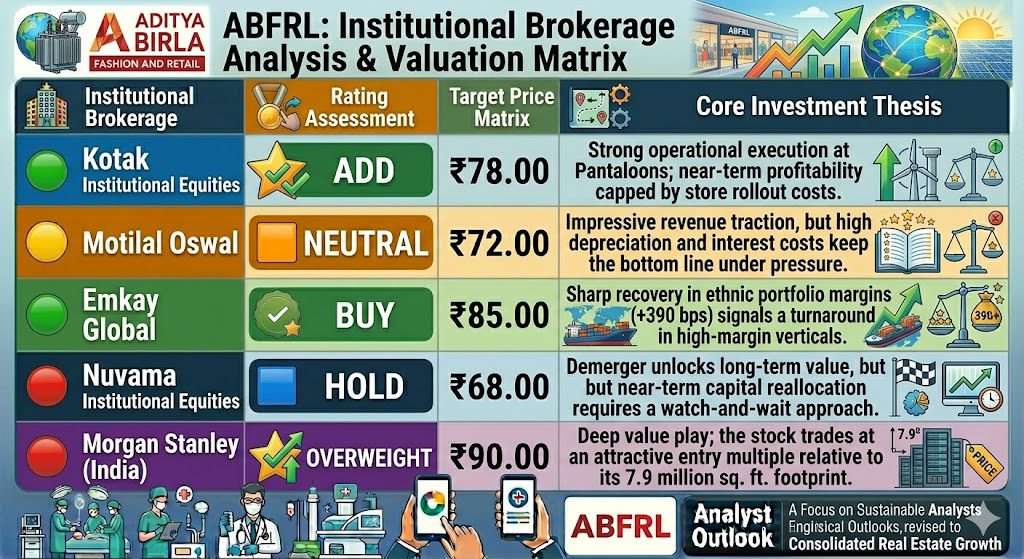
Institutional brokerages currently maintain mixed but gradually improving outlooks on the stock. Kotak Institutional Equities maintained an ADD rating with a target price of ₹78, highlighting strong Pantaloons execution but acknowledging near-term financing pressure. Emkay Global maintained a BUY rating with a target near ₹85 because of improving premium ethnic margins and long-term restructuring potential. Morgan Stanley India assigned an OVERWEIGHT rating with a target price of ₹90, arguing that the company’s 7.9 million square foot retail footprint is currently undervalued relative to long-term consumption growth opportunities. The broader consensus target currently stands near ₹78.60, implying potential upside of nearly 16% from current market levels.
Overall, the Q4 FY26 earnings report from Aditya Birla Fashion and Retail Limited reflects a company deeply engaged in a large-scale retail transformation cycle rather than a business facing structural demand weakness. The widening losses mainly reflect expansion costs, financing pressure, and strategic investment intensity, while the core operating engine continues showing strong revenue momentum, improving margins, and accelerating category growth. If management successfully executes its demerger strategy, improves capital efficiency, and gradually scales profitability across Pantaloons, TMRW, and premium ethnic fashion, ABFRL could potentially emerge as one of India’s most important long-term organized retail turnaround stories over the coming years.