Ola Electric Mobility Limited delivered one of its most closely watched quarterly earnings reports after announcing its Q4 FY26 results amid growing investor concerns over profitability, rising competition, and continuous stock-price weakness. The company’s shares have corrected sharply from their 52-week high near ₹71.25 to the current ₹35 zone, making this earnings report extremely important for both institutional investors and retail traders trying to evaluate the future of India’s largest pure-play electric two-wheeler company.
Despite continuing losses, the latest quarterly results indicate that Ola Electric may finally be entering the early phase of operational stabilization. Revenue growth remained strong, gross margins improved sharply, and EBITDA losses narrowed significantly compared to previous quarters. More importantly, management hinted that the company’s heavy capital-expenditure cycle could now be nearing completion, which may eventually reduce financial pressure on the business.
The earnings report comes at a time when India’s electric vehicle market is becoming increasingly competitive with strong expansion from legacy automobile giants like TVS Motor Company and Bajaj Auto Limited. Because of this, investors are now focusing less on raw sales growth and more on whether Ola Electric can eventually become a sustainable and profitable business.
Quick Summary of Ola Electric Q4 FY26 Results
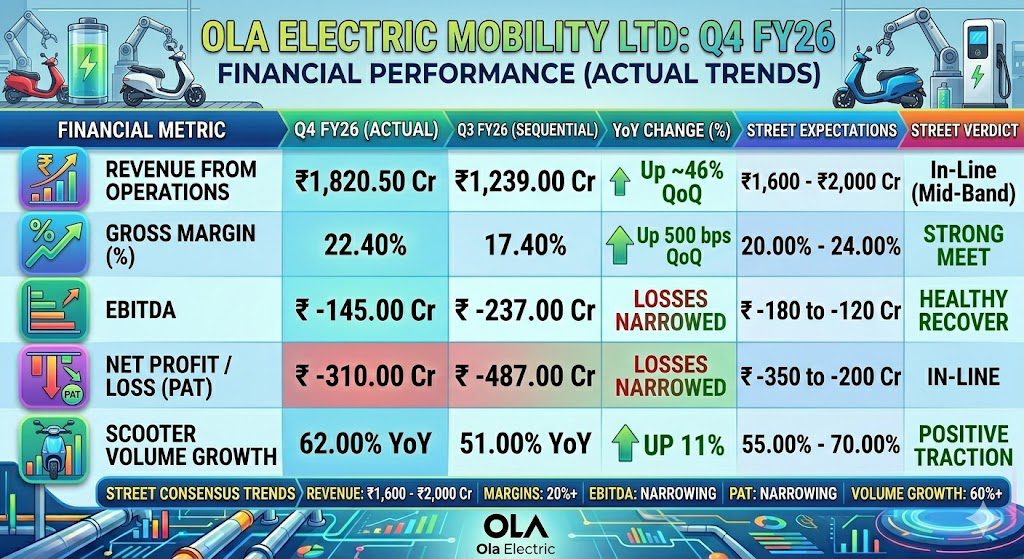
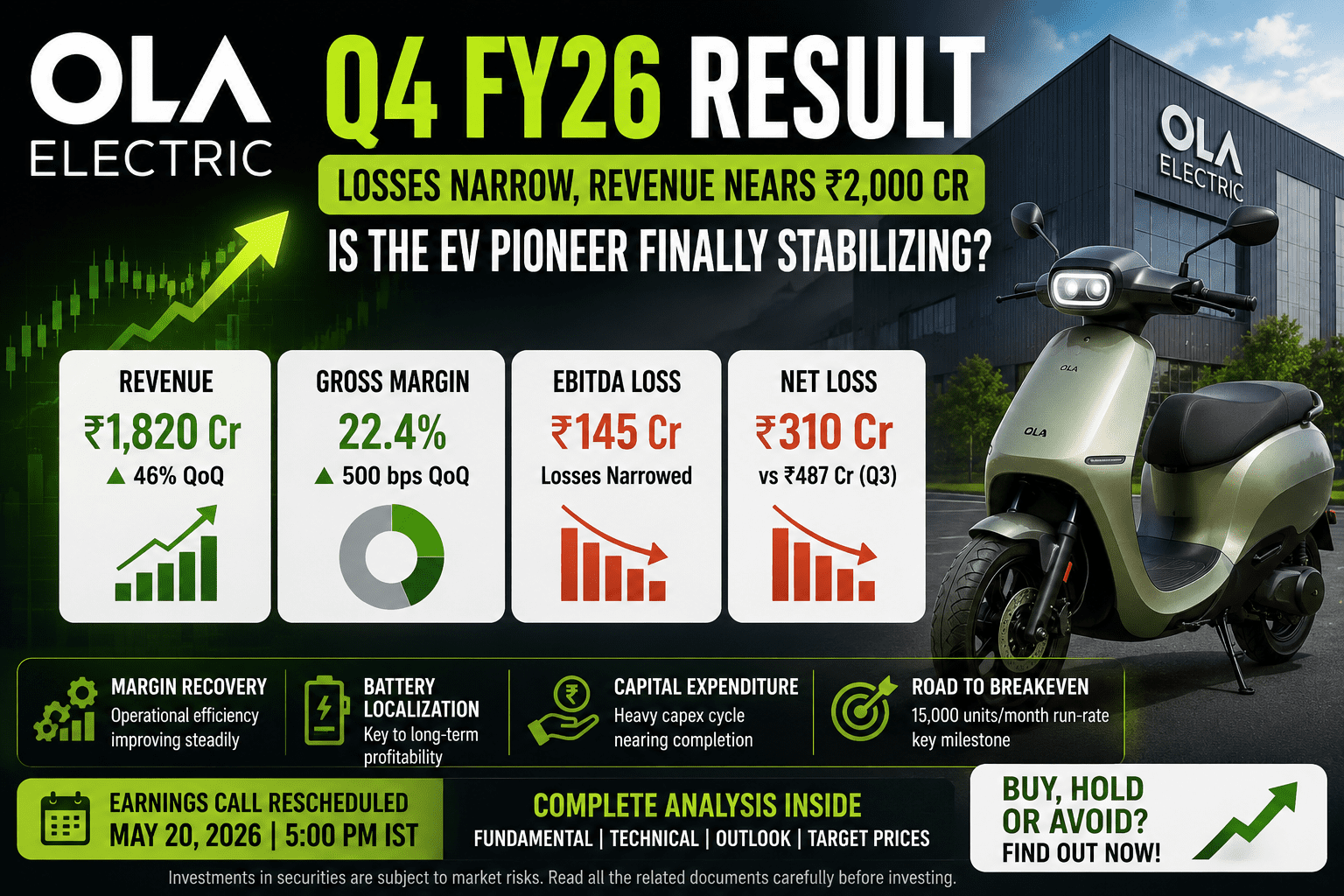
Ola Electric Mobility Limited reported revenue from operations of approximately ₹1,820.50 crore during Q4 FY26 compared to ₹1,239 crore during Q3 FY26. This represented strong sequential growth of nearly 46% and broadly matched market expectations.
The most important positive development came from gross-margin recovery. Gross margins improved sharply to 22.40% compared to 17.40% during the previous quarter, reflecting an improvement of nearly 500 basis points. This suggests that the company is gradually benefiting from operating leverage, lower input costs, and improving production efficiency.
EBITDA losses narrowed meaningfully to approximately ₹145 crore compared to ₹237 crore during Q3 FY26. Net loss after tax also improved to around ₹310 crore compared to ₹487 crore during the previous quarter.
The company additionally reported around 62% year-on-year growth in scooter volumes, indicating that customer demand remains relatively strong despite rising market competition.
Company Profile: India’s Largest Pure-Play EV Two-Wheeler Company
Ola Electric Mobility Limited was founded by Bhavish Aggarwal and rapidly emerged as India’s largest dedicated electric two-wheeler manufacturer.
Unlike traditional automobile companies that later entered the EV industry, Ola Electric was built entirely around electric mobility infrastructure from the beginning. The company’s business model relies heavily on vertical integration, where it controls multiple parts of the EV manufacturing and distribution ecosystem.
Its automotive division focuses on direct-to-consumer electric scooter sales, software integration, servicing, and manufacturing through the Ola Futurefactory ecosystem located in Tamil Nadu.
At the same time, Ola Electric is aggressively investing in battery-cell manufacturing through its Gigafactory strategy. This is extremely important because battery costs remain the single biggest expense in electric vehicle production. If successful, local battery-cell manufacturing could significantly reduce long-term production costs and improve future profitability.
Today, Ola Electric remains one of the most influential companies shaping India’s electric two-wheeler ecosystem and EV manufacturing ambitions.
Earnings Analysis: Margin Recovery Became the Biggest Positive Signal
The most important takeaway from Ola Electric’s Q4 FY26 earnings report was not simply revenue growth but the sharp improvement in operational efficiency and margin recovery.
Revenue Growth Continued Strongly
Quarterly revenue climbed toward ₹1,820.50 crore mainly because of strong festive demand, aggressive promotional campaigns, and rising adoption of the company’s S1 scooter portfolio.
Scooter volume growth reached approximately 62% year-on-year, indicating that Ola Electric still maintains strong customer traction despite increasing competition from traditional automobile manufacturers entering the EV space.
The strong sales growth also highlights that India’s electric two-wheeler adoption story remains structurally strong over the long term.
Gross Margin Recovery Was the Biggest Highlight
The sharp recovery in gross margins from 17.40% to 22.40% became the single most encouraging development inside the quarterly report.
This improvement indicates that the company is beginning to benefit from operating leverage, lower battery input prices, improved supply-chain stability, and stronger manufacturing efficiency.
Importantly, the margin expansion also shows that Ola Electric is gradually offsetting the impact of reduced government EV subsidies, which had earlier pressured profitability across the industry.
Losses Continue Narrowing
The company’s EBITDA losses narrowed significantly from ₹237 crore to approximately ₹145 crore sequentially.
Net losses also improved from ₹487 crore to ₹310 crore.
Although the company remains loss-making, the pace of operational improvement strongly suggests that Ola Electric may gradually move closer toward breakeven over the coming years if margin expansion continues successfully.
Important Corporate Update: Earnings Call Rescheduled
Ola Electric Mobility Limited informed stock exchanges that its Q4 FY26 earnings conference call has been officially rescheduled to May 20, 2026, at 5:00 PM IST because of unforeseen corporate exigencies.
Founder Bhavish Aggarwal and CFO Deepak Rastogi are expected to directly address institutional investors regarding the company’s future profitability roadmap, gross-margin targets, and long-term EBITDA breakeven plans.
The conference call is being closely monitored because investors are now focusing heavily on the company’s ability to eventually generate sustainable profits and stabilize cash flows.
Fundamental Analysis: High-Growth Opportunity with High Risk
From a long-term investment perspective, Ola Electric continues representing a classic high-growth but high-risk business model.
Valuation Compression Has Reduced Speculative Excess
After correcting nearly 58% from its peak near ₹71.25, the stock currently trades around ₹35.
This sharp decline has significantly reduced speculative valuation excess that existed after the company’s IPO.
At current levels, Ola Electric trades near a Price-to-Sales ratio of approximately 3.1x, which is much lower compared to earlier valuation levels.
For aggressive growth investors, this valuation compression improves the long-term risk-reward profile.
Heavy Capital-Expenditure Phase Nearing Completion
Management indicated that the company’s largest capital-expenditure cycle may now be nearing completion.
Existing manufacturing capacity reportedly possesses the capability to support annual revenues up to ₹15,000 crore without requiring immediate large-scale equity dilution.
This becomes extremely important because repeated fundraising and heavy cash burn had been major investor concerns over recent quarters.
Liquidity Risks Appear Manageable for Now
The company still remains loss-making on a full-year basis. However, shareholders recently approved authorization for raising approximately ₹1,500 crore through convertible securities.
This additional liquidity support significantly reduces short-term solvency concerns and provides management with financial flexibility for the next 18 months.
Technical Analysis: Key Trading Levels Investors Must Watch
Technically, Ola Electric currently remains one of the most volatile EV stocks in the Indian market.
The stock is presently consolidating near ₹35 after recovering from its 52-week low near ₹22.25.
The most important immediate pivot level remains ₹35.86. A decisive daily close above this level could potentially shift short-term momentum from bearish toward neutral-bullish territory.
Immediate resistance zones are positioned near ₹38.40 followed by ₹41.20 and ₹44.50.
On the downside, immediate support exists near ₹33.10 followed by ₹29.20.
The strongest long-term support zone remains near the 52-week low around ₹22.25.
High trading volumes combined with relatively low delivery percentages currently indicate aggressive speculative activity within the stock.
From a trading perspective, if the ₹33 support zone continues holding after the earnings release, traders may witness a short-term mean-reversion rally toward ₹38–₹41 levels.
Management Guidance: Profitability Roadmap Becomes the Main Focus
Management commentary and operational guidance highlighted three major strategic priorities for the company’s future.
Gross Margin Expansion Remains the Core Objective
Management is targeting long-term structural gross margins between approximately 35% and 40% through FY27.
This improvement depends heavily on the successful commercialization of the company’s battery-cell manufacturing operations and supply-chain localization efforts.
EBITDA Breakeven Strategy
According to internal management calculations, achieving a consistent monthly delivery run-rate near 15,000 units could potentially bring the automotive business toward structural EBITDA breakeven.
This remains one of the most closely watched future milestones for investors.
Service-Network Expansion and Customer Satisfaction
Following earlier criticism regarding customer service and after-sales support, management is aggressively restructuring its service infrastructure.
The company aims to achieve customer-satisfaction levels above 90% through specialized service centers, improved response times, and stronger operational execution.
Brokerage Outlook and Institutional Target Prices
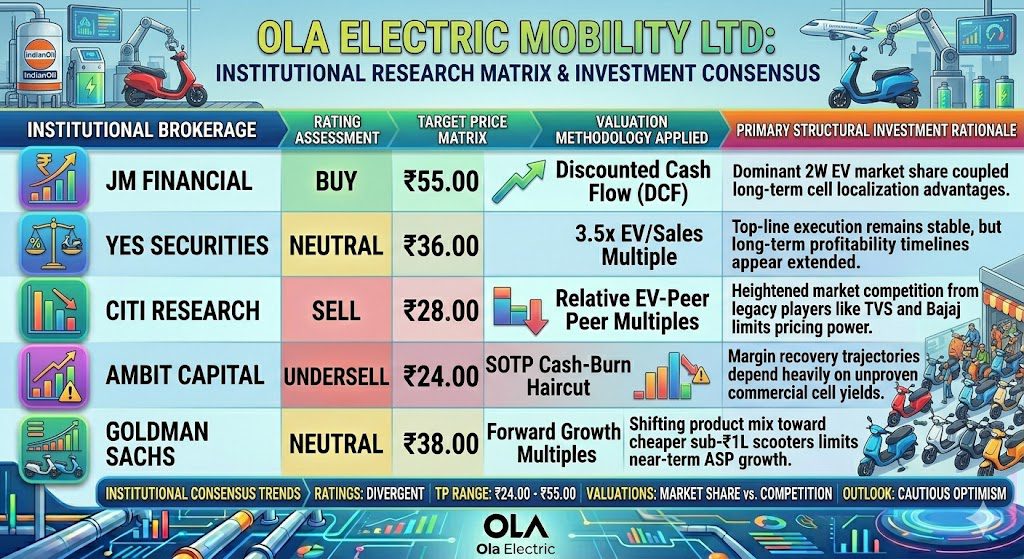
Institutional views on Ola Electric Mobility Limited currently remain sharply divided.
JM Financial maintains a BUY rating with a target price near ₹55, highlighting Ola Electric’s EV market leadership and long-term battery-localization advantages.
YES Securities currently maintains a NEUTRAL rating with a target price near ₹36 because profitability timelines still remain uncertain.
Citi Research remains bearish with a SELL rating and a target near ₹28, arguing that rising competition from established automobile manufacturers may continue limiting pricing power.
Ambit Capital also maintains an UNDERSELL rating with a target near ₹24 because future margin recovery still depends heavily on unproven battery-cell commercialization success.
Goldman Sachs currently maintains a NEUTRAL rating with a target price near ₹38 because increasing demand for lower-cost scooters may limit average selling-price growth.
Overall, institutional consensus remains highly divided, with average target prices remaining close to current trading levels.
Should You Buy, Hold, or Avoid Ola Electric Shares?
For aggressive high-risk investors, Ola Electric may now be entering a speculative accumulation zone after the sharp correction from previous highs.
The combination of narrowing losses, improving gross margins, stabilizing operational efficiency, and a nearing completion of the heavy capital-expenditure cycle significantly improves the company’s long-term survival prospects.
Investors with high risk tolerance may gradually accumulate the stock during corrections near the ₹30–₹33 support zone.
However, conservative investors should continue remaining cautious.
Despite improving operational trends, the company still remains loss-making and operates inside an intensely competitive industry where long-term profitability remains uncertain.
For risk-averse investors focused primarily on capital preservation, waiting for a clear structural breakout above ₹44.50 and sustained profitability improvement may remain the safer investment strategy.
Overall, Ola Electric currently remains one of India’s highest-risk but potentially highest-reward EV growth stories for long-term investors willing to tolerate elevated volatility.
For official company disclosures and exchange filings, investors can also monitor updates through NSE India Official Website.