Company Introduction: The Niche Pharma Specialist Behind India’s Global Generic Success
Natco Pharma Limited has built a unique position within the Indian pharmaceutical industry by focusing on complex generics, oncology medicines, specialty formulations, and high-barrier pharmaceutical products. Unlike traditional pharmaceutical companies that compete primarily on volume, Natco’s strategy revolves around developing difficult-to-manufacture medicines where competition remains limited and profit margins are significantly higher. Headquartered in Hyderabad, the company has established a strong presence across regulated international markets such as the United States, Canada, Brazil, and Europe while simultaneously maintaining a growing domestic pharmaceutical business.
Over the last few years, Natco emerged as one of the biggest beneficiaries of the generic Revlimid opportunity in the United States. The cancer drug generated exceptional profitability and transformed the company’s earnings profile. However, pharmaceutical exclusivity opportunities do not last forever. As competition increases and pricing pressure intensifies, companies must find new growth engines to sustain earnings momentum. The Q4 FY26 results clearly indicate that Natco is now entering this transition phase. While the company’s long-term fundamentals remain solid, the latest earnings report reflects the reality of a business adjusting to a post-Revlimid environment.
Q4 FY26 Financial Performance: Revenue and Profitability Under Pressure
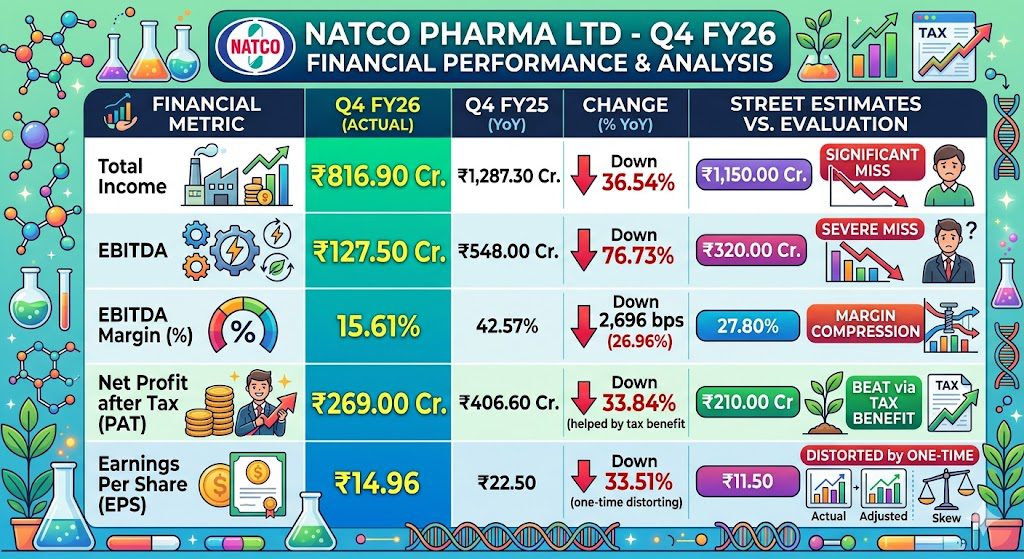
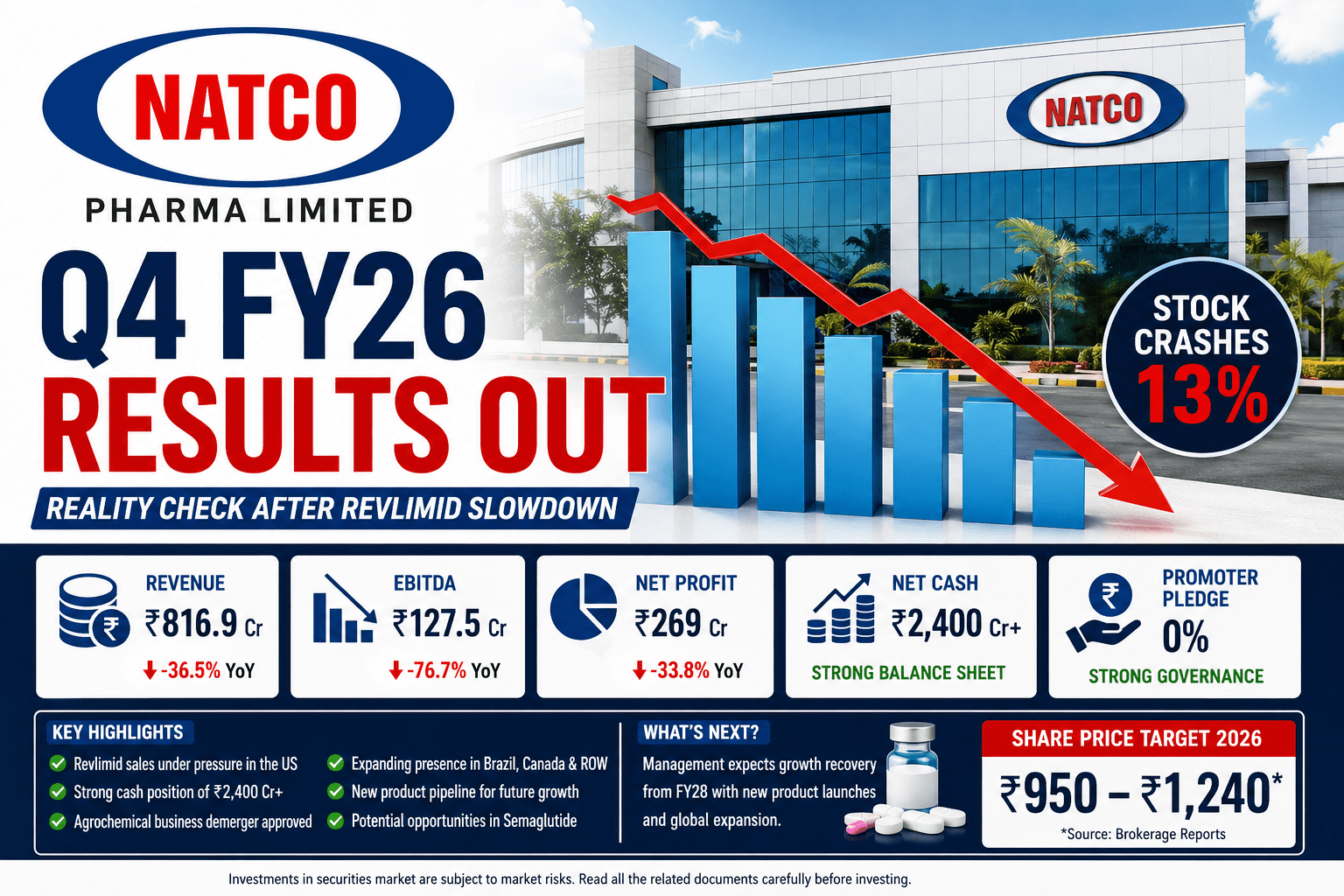
Natco Pharma’s Q4 FY26 earnings report disappointed investors primarily because of the sharp decline in both revenue and operating profitability. Total income for the quarter stood at ₹816.90 crore compared with ₹1,287.30 crore reported during the corresponding quarter of the previous financial year. This represents a decline of 36.54% and was significantly below market expectations. The revenue contraction highlights the growing impact of competition in key export markets, particularly within the company’s generic oncology portfolio.
The operating performance was even weaker than the revenue numbers suggest. EBITDA declined sharply to ₹127.50 crore from ₹548 crore reported during Q4 FY25, reflecting a massive decline of 76.73%. EBITDA margins contracted from an impressive 42.57% to just 15.61%, illustrating the extent of margin compression that occurred during the quarter. Such a dramatic decline shows how dependent profitability had become on high-margin export opportunities and how rapidly earnings can normalize once competitive pressures emerge.
Despite the operational weakness, net profit after tax came in at ₹269 crore compared with ₹406.60 crore during the same period last year. Although this represented a decline of 33.84%, the figure was better than analysts had anticipated. However, investors should understand that this apparent outperformance was largely driven by a one-time tax adjustment rather than stronger operating performance. Earnings per share declined from ₹22.50 to ₹14.96, confirming the pressure on shareholder returns during the quarter.
Earnings Analysis: Understanding the Revlimid Slowdown
The biggest factor behind Natco’s disappointing quarterly performance was the slowdown in formulation exports. This segment, which has historically been one of the company’s most profitable revenue streams, declined sharply to ₹539.60 crore compared with ₹1,052.50 crore reported during Q4 FY25. The decline reflects increasing competition within the generic Revlimid market, where multiple manufacturers are now competing for market share.
For several years, Revlimid provided Natco with exceptional earnings growth and industry-leading margins. However, as additional generic players entered the market, pricing pressure intensified and profit opportunities gradually diminished. This trend was expected by industry observers, but the speed of the decline surprised many investors and analysts.
There were some encouraging signs within other business segments. Domestic formulations generated revenue of ₹108.70 crore, demonstrating resilience in the Indian market. The Active Pharmaceutical Ingredients (API) division contributed ₹63.90 crore and showed modest growth. These businesses continue to provide diversification and stability, although they are currently not large enough to fully offset the decline in export revenue.
The Crop Health Sciences division generated revenue of ₹22.60 crore but faced additional challenges due to a ₹50 crore impairment charge on agrochemical machinery assets. This non-cash adjustment further impacted profitability and added to investor concerns regarding the company’s near-term earnings outlook.
The One-Time Tax Benefit That Supported Net Profit
A closer examination of Natco’s financial statements reveals that the reported net profit figure does not fully reflect the extent of operational weakness. The company recognized a one-time deferred tax benefit of approximately ₹115 crore during the quarter after opting to transition to the new corporate tax regime beginning FY27.
The transition required the revaluation of deferred tax assets and Minimum Alternate Tax credits, resulting in a substantial accounting gain. While this benefit improved reported profitability, it did not originate from core business operations. Without this tax adjustment, net profit would have been considerably lower than the reported figure of ₹269 crore.
For long-term investors, this distinction is important because future earnings should be evaluated based on operational performance rather than one-time accounting benefits. The tax gain provided temporary support to the bottom line but does not change the underlying reality that revenue and operating profits experienced significant pressure during the quarter.
Fundamental Analysis: Strong Balance Sheet Remains a Major Strength
Despite the disappointing quarterly results, Natco Pharma continues to possess several important strengths that support its long-term investment case. The most significant among these is its exceptionally strong balance sheet. The company currently holds approximately ₹2,400 crore in net cash, providing a substantial financial cushion during periods of earnings volatility.
This strong cash position offers multiple strategic advantages. It enables Natco to invest aggressively in research and development, pursue acquisitions, launch new products, and weather temporary downturns without financial stress. Unlike highly leveraged companies, Natco faces virtually no solvency concerns, making it one of the financially strongest mid-sized pharmaceutical companies in India.
Valuation has also become considerably more attractive following the recent correction in share price. Before the earnings announcement, Natco had touched a 52-week high of ₹1,226.80. The sharp sell-off following the results reduced the stock’s valuation multiple to approximately 14.2 times earnings, significantly below the broader pharmaceutical sector average. This valuation adjustment has removed much of the speculative premium that had built up during the peak of the Revlimid earnings cycle.
Another positive development is the company’s decision to demerge its agrochemical business into a separate subsidiary. Such restructuring could help investors assign more appropriate valuations to the pharmaceutical business while allowing management teams to focus more effectively on their respective segments.
Technical Analysis: Critical Levels Investors Should Watch
From a technical perspective, Natco Pharma’s chart structure has weakened significantly following the earnings announcement. The stock experienced a high-volume breakdown and closed near ₹1,015.90 after losing more than 13% in a single trading session.
The most important technical level remains ₹1,090. This zone now serves as the primary trend reversal point. Unless the stock reclaims this level on a sustained basis, short-term momentum is likely to remain negative.
On the downside, immediate support exists near ₹1,001, which was tested during Friday’s trading session. If this support level breaks decisively, the next major demand zone emerges around ₹965. This area may attract bargain hunters and long-term investors seeking attractive entry opportunities.
Below ₹965, the strongest structural support lies near ₹890. While this scenario remains less likely, it represents an important long-term floor if broader market sentiment deteriorates further.
Resistance levels currently stand near ₹1,048, ₹1,095, and ₹1,130. Any short-term recovery rally is likely to face selling pressure around these zones as trapped investors attempt to exit positions.
Management Guidance and Growth Outlook for FY27 and Beyond
During the post-results conference call, management provided realistic guidance regarding the company’s near-term outlook. Chief Executive Officer Rajeev Nannapaneni acknowledged that FY27 will likely be a transition year as the company adjusts to lower contributions from Revlimid-related revenues.
Management expects revenue during FY27 to range between ₹3,400 crore and ₹3,500 crore, with net profit projected between ₹700 crore and ₹750 crore. While these numbers represent a moderation compared with previous peak earnings levels, they reflect a more sustainable earnings base for the future.
The company’s future growth strategy centers around geographic diversification and new product launches. Brazil and Canada are expected to become increasingly important contributors to international revenue. In addition, Natco’s association with South African pharmaceutical company Adcock Ingram is expected to provide additional opportunities for growth and market expansion.
Looking beyond FY27, management remains optimistic about long-term prospects. New oncology products, specialty formulations, and the potential launch of generic Semaglutide products could create significant growth opportunities beginning around FY28. Management believes these initiatives could support annual growth rates of 15% to 25% over the longer term.
Brokerage Opinions and Target Prices
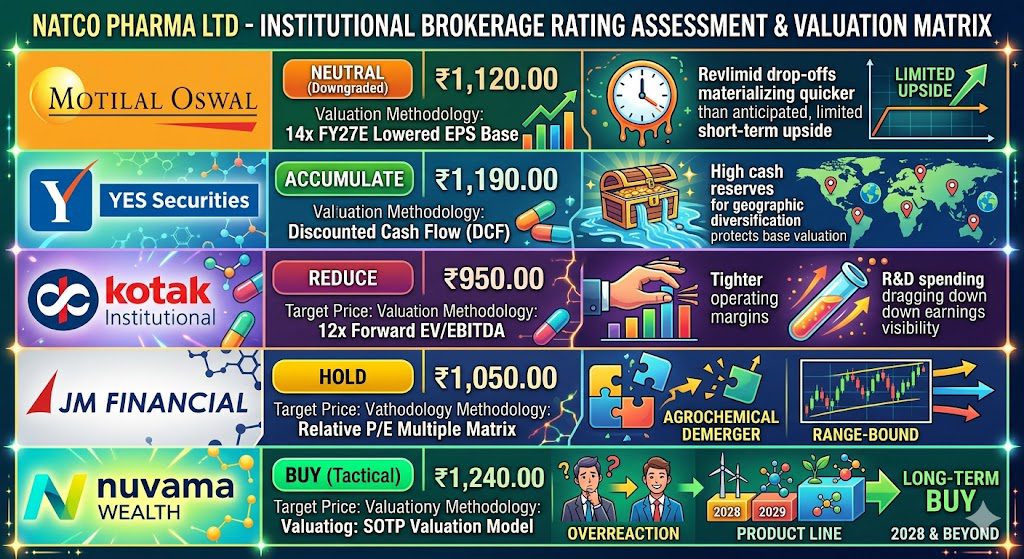
Following the earnings announcement, brokerage firms revised their outlooks to reflect lower near-term earnings expectations. Motilal Oswal downgraded the stock to Neutral and assigned a target price of ₹1,120, citing the faster-than-expected decline in Revlimid revenues. YES Securities maintained an Accumulate rating with a target of ₹1,190, emphasizing the company’s strong balance sheet and diversification strategy.
Kotak Institutional Equities adopted the most conservative stance with a Reduce rating and a target price of ₹950 due to concerns about margin compression and earnings visibility. JM Financial maintained a Hold recommendation with a target of ₹1,050, while Nuvama Wealth remained the most optimistic, assigning a Buy rating and a target price of ₹1,240.
The median consensus target among analysts currently stands near ₹1,110, indicating moderate upside potential if the company successfully stabilizes earnings and executes its growth strategy over the coming years.
Final Verdict: Buy, Hold, or Sell?
For long-term investors, Natco Pharma’s latest earnings report represents a reality check rather than a permanent impairment of the business. The decline in Revlimid-related profits was widely anticipated, and the company retains substantial financial strength, a debt-free balance sheet, significant cash reserves, and a pipeline of future growth opportunities.
Investors with a long-term investment horizon may consider accumulating shares gradually if the stock approaches the ₹950–₹970 range. The current weakness appears cyclical rather than structural, and management has already outlined a roadmap for rebuilding growth beyond FY27.
For traders, however, caution remains appropriate. The technical trend remains negative, and further volatility is possible until the stock establishes a clear base above key support levels.
Overall, Natco Pharma is transitioning from an extraordinary earnings cycle to a more normalized business environment. While the adjustment may create short-term challenges, the company’s financial strength, niche expertise, and future product pipeline continue to provide a foundation for long-term value creation.