Introduction: The Trusted Pillar of Indian Homes
The Evolution of India’s Housing Finance Story
Over the last three decades, India’s housing finance sector has undergone a remarkable transformation. In the mid-1990s, getting a home loan was a slow and exhausting process involving physical paperwork, multiple guarantors, branch visits, and long waiting periods for approval. Today, in 2026, digital underwriting, online KYC verification, instant eligibility checks, and AI-based risk assessment have completely changed the industry. Despite this rapid transformation, one company has consistently maintained its position as one of the most trusted names in Indian housing finance—LIC Housing Finance. The company has successfully adapted to technological changes without losing its traditional strength of credibility and customer trust.
The Big Headline from Q4 FY26
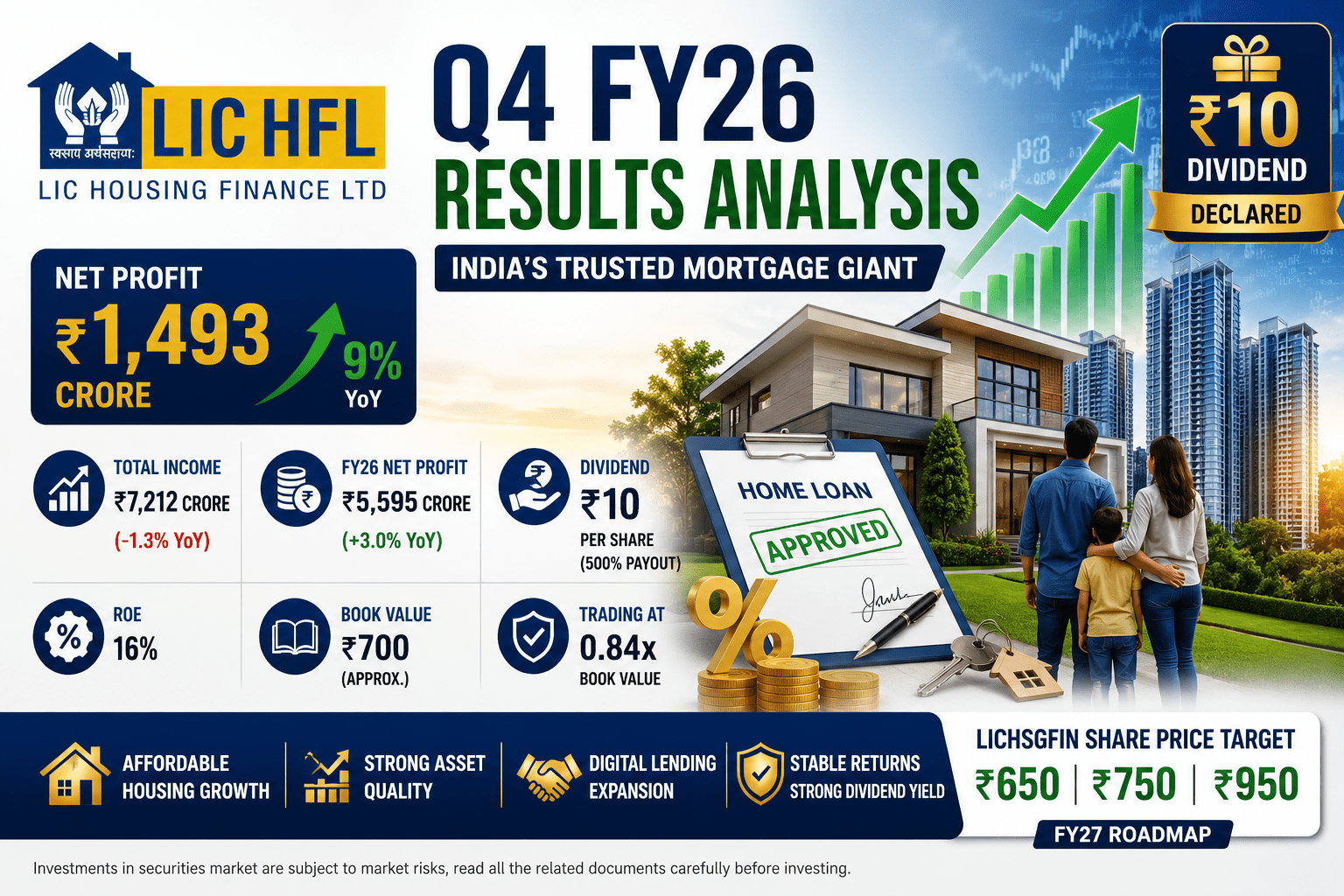
LIC Housing Finance reported a consolidated net profit of ₹1,493 crore for Q4 FY26, representing a healthy year-on-year growth of approximately 8.7% compared to ₹1,373 crore in the same quarter last year. This performance becomes even more impressive when viewed in the context of a high-interest-rate environment where many NBFCs and housing finance companies continue facing pressure on loan demand and margins. The company managed to protect profitability despite slightly lower total income, which clearly reflects disciplined lending practices and strong operational management.
Market Reaction & Investor Sentiment
The market reacted positively after the earnings announcement. The stock closed around ₹585.65 on the NSE, gaining more than 3% during the session as investors welcomed the profit growth and attractive ₹10 per share dividend announcement. Institutional investors also appear increasingly interested in LIC Housing Finance because the stock is trading below its book value while maintaining stable profitability and healthy dividend payouts. In a market where many financial stocks are trading at expensive valuations, LIC Housing Finance is increasingly being viewed as a “value opportunity” with a strong safety margin.
Q4 FY26 Actual Performance: The NSE Data Center
Quarterly Profit Performance
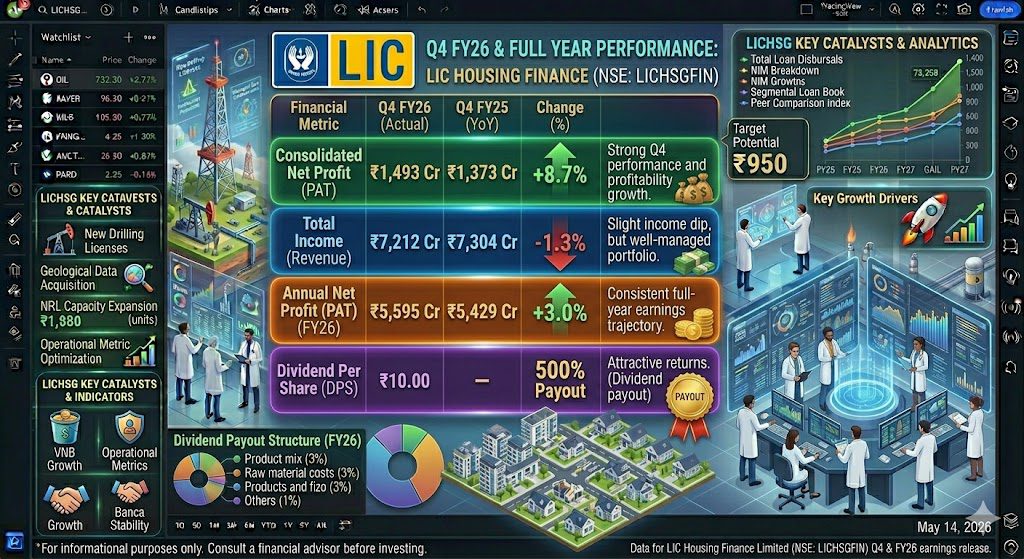
According to the audited results filed with the stock exchanges on May 13, 2026, LIC Housing Finance delivered another stable quarterly performance. Consolidated net profit rose to ₹1,493 crore from ₹1,373 crore in Q4 FY25. Although the growth may not appear explosive compared to aggressive private NBFCs, it reflects steady and sustainable financial performance. Housing finance businesses are generally evaluated more on asset quality and loan stability than on short-term profit spikes, and LIC Housing Finance continues to score strongly on those parameters.
Revenue & Income Trends
The company’s total income during the quarter stood at ₹7,212 crore compared to ₹7,304 crore in the same quarter last year, reflecting a marginal decline of around 1.3%. However, despite lower total income, the company still managed to improve profitability, which indicates strong cost management and lower provisioning pressure. This is particularly important because it demonstrates that management is prioritizing quality and efficiency over aggressive loan-book expansion.
Annual FY26 Performance
For the full financial year FY26, LIC Housing Finance reported annual net profit of ₹5,595 crore compared to ₹5,429 crore in FY25, representing annual growth of around 3%. While this growth rate appears moderate, the company continues operating within a conservative lending framework focused on long-term sustainability rather than risky expansion. Investors looking for stable compounding businesses often prefer such consistency over highly volatile earnings growth.
Dividend Announcement
One of the major highlights from the Q4 FY26 earnings report was the board’s recommendation of a final dividend of ₹10 per equity share. Considering the current stock price and valuation multiples, the dividend yield becomes highly attractive for long-term investors seeking passive income opportunities from the financial sector.
Fundamental Analysis: Quality Over Quantity
Lower Provisions Improve Profitability
One of the key drivers behind LIC Housing Finance’s improved profitability this quarter was the significant reduction in provisions for bad loans. Provisions declined to ₹74 crore compared to ₹104 crore in the year-ago period. Lower provisioning generally signals improving asset quality and better repayment discipline among borrowers. In the housing finance business, asset quality remains one of the most critical indicators of long-term stability because aggressive loan growth without proper underwriting often creates future NPA problems. LIC Housing Finance’s conservative lending philosophy continues helping the company maintain stable credit quality even during challenging economic cycles.
Margin Management & Operational Discipline
Although total income declined slightly, the company maintained disciplined cost controls to protect its Net Interest Margins (NIMs). Rising interest-rate cycles usually create pressure for housing finance companies because borrowing costs rise faster than lending yields. However, LIC Housing Finance appears focused on maintaining profitability through operational efficiency rather than engaging in aggressive rate competition. Stable margin management is extremely important because it directly supports earnings consistency and dividend sustainability over the long term.
Strong Return Ratios & Book Value Comfort
Another important strength of LIC Housing Finance remains its healthy return profile. The company currently maintains a Return on Equity (ROE) near 16%, which remains respectable for a large housing finance institution operating in a competitive lending market. Meanwhile, the company’s estimated book value currently stands near ₹700 per share, significantly above the prevailing market price. This means the stock is trading below book value despite remaining profitable and fundamentally stable. Historically, quality financial companies trading below book value often attract long-term value investors looking for rerating opportunities.
Technical Analysis: The Rebound from Pivot
Current Technical Setup
From a technical analysis perspective, LIC Housing Finance is showing signs of entering a potentially important recovery phase. The stock is currently trading around 0.84 times its book value, making it one of the more attractive value-oriented opportunities in the housing finance space. Technical traders are closely watching the stock because recent price action suggests a rebound from key pivot levels after extended consolidation.
Major Support Levels
The most important support zone currently lies between ₹550.02 and ₹558.84. This area has repeatedly acted as a strong buying zone where institutional accumulation tends to emerge. As long as the stock remains above this support band, the broader technical structure remains constructive. For long-term investors, support zones like these often provide favorable entry opportunities into fundamentally strong companies trading at discounted valuations.
Immediate Resistance Zones
On the upside, immediate resistance is visible between ₹598.82 and ₹607.64. A sustained breakout above this range could trigger stronger momentum toward the previous 52-week high near ₹647. If financial-sector sentiment improves further and the company continues delivering stable quarterly performance, analysts believe the stock could eventually rerate toward higher valuation multiples.
The Golden Cross Possibility
Technical analysts are also monitoring the possibility of a “Golden Cross” formation, where shorter-term moving averages cross above longer-term averages. This pattern is widely viewed as a bullish structural signal that often precedes medium-term trend reversals. If this confirmation appears while earnings remain stable, momentum toward the ₹750 target projected by several brokerages may accelerate significantly.
Shareholder Rewards: The Dividend Story
₹10 Dividend Recommendation
LIC Housing Finance’s board has recommended a final dividend of ₹10 per equity share with a face value of ₹2. This translates into a 500% payout ratio, making it one of the strongest dividend announcements within the housing finance sector during this earnings season. Stable dividend payouts are particularly important for long-term investors because they provide consistent income even during periods of stock-market volatility.
Why Dividend Yield Matters
One of the strongest investment arguments for LIC Housing Finance today is the combination of low valuation and healthy dividend yield. The stock is currently trading around 8x–11x earnings multiples depending on forward estimates, which remains significantly cheaper compared to many private-sector financial stocks. When profitable and stable financial companies offer strong dividends at discounted valuations, value-focused investors usually become increasingly interested because the downside risk remains relatively protected.
Brokerage Sentiment & Targets
Consensus Bullish Outlook
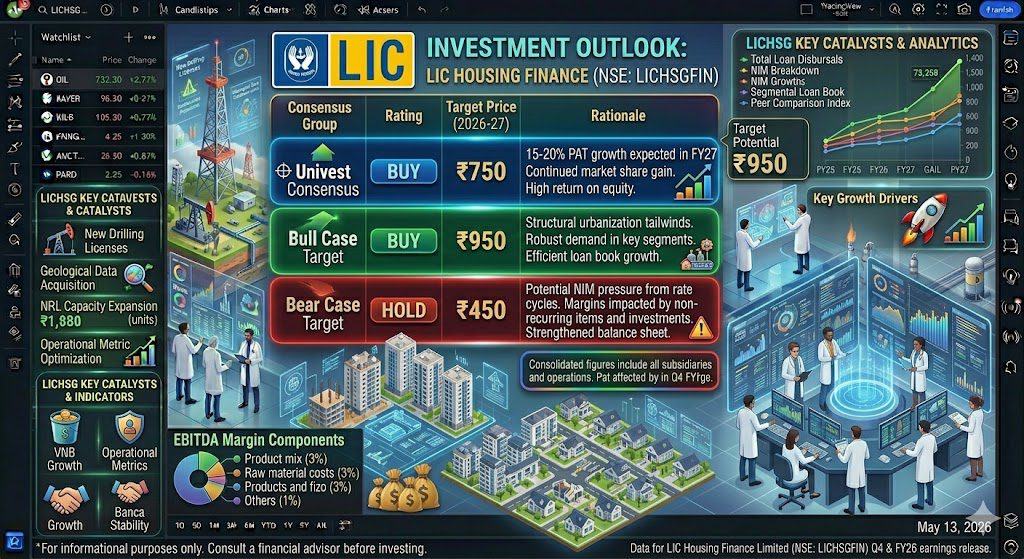
Brokerage sentiment toward LIC Housing Finance has gradually improved following the Q4 FY26 results. The broader analyst consensus currently maintains “Buy” ratings with target estimates near ₹750 over FY27. Analysts expect the company to benefit from improving affordable housing demand, lower provisioning costs, and stable credit quality.
Bull Case Scenario
More bullish analysts project long-term targets closer to ₹950 based on India’s long-term urbanization trends and structural housing demand growth. Mortgage penetration in India still remains significantly lower compared to developed economies, leaving enormous room for long-term expansion in the housing finance sector. As urbanization accelerates and income levels improve, housing loan demand is expected to remain structurally strong for many years.
Bear Case Risks
Some cautious analysts continue highlighting risks related to interest-rate volatility and potential pressure on Net Interest Margins. If borrowing costs rise sharply while lending yields remain competitive, profitability could face temporary pressure. In such scenarios, downside targets near ₹450 are sometimes projected. However, LIC Housing Finance’s conservative lending profile continues providing relative stability compared to riskier NBFC segments.
Management Guidance & Future Outlook
FY27 Growth Strategy
Management has indicated that FY27 will focus heavily on expanding loan growth within the affordable housing segment. The company is targeting annual loan growth of approximately 10–13% over the coming year. Affordable housing remains one of India’s strongest structural growth themes due to rising urbanization, government support schemes, and increasing middle-class aspirations.
Digital Integration & LIC Ecosystem Advantage
Another major advantage for LIC Housing Finance remains its integration with the LIC ecosystem. Through its partnership with Life Insurance Corporation of India, the company benefits from one of India’s largest customer-distribution networks. This significantly reduces customer acquisition costs compared to many standalone NBFC competitors. The company is also accelerating digital lending integration to improve processing speed, customer experience, and operational efficiency.
The 30-Year Analyst Verdict
For Long-Term Investors
LIC Housing Finance increasingly looks like a classic “Quality-at-a-Discount” opportunity. Very few fundamentally stable financial companies with healthy ROE, strong brand trust, stable asset quality, and generous dividends are currently trading below book value in India. The combination of a ₹10 dividend, low valuation, and structural housing-demand growth creates a compelling long-term investment case for conservative investors seeking stable compounding opportunities.
For Active Traders
For traders, the stock currently appears technically attractive after bouncing from important support levels near ₹550. As long as this support remains intact, the probability of a medium-term move toward ₹600–₹650 remains favorable. Momentum traders are especially watching for breakout confirmation above ₹607, which could potentially trigger a stronger rally toward higher targets.
Conclusion & Engagement (CTA)
Final Word on LIC Housing Finance
LIC Housing Finance’s Q4 FY26 performance once again demonstrates the value of consistency, discipline, and trust in financial markets. A nearly 9% rise in quarterly profit, lower provisions, healthy ROE, strong dividend payout, and discounted valuation together reinforce why the company continues remaining one of India’s most respected housing finance institutions. At a time when many financial-sector stocks trade at expensive valuations despite operational uncertainty, LIC Housing Finance offers a relatively rare combination of value, income generation, and long-term housing-market exposure.
Investor Engagement CTA
Are you buying LIC Housing Finance for its ₹10 dividend yield or betting on the ₹750 long-term target? Share your housing finance investment strategy and favorite mortgage-sector stocks in the comments below.