Introduction: The Quality Fortress
If you’ve tracked India’s banking sector over the last three decades, you would know that very few institutions have consistently balanced growth with discipline. Kotak Mahindra Bank is one of those rare names. From its early days as a boutique finance house in the 1990s to becoming a trillion-rupee asset powerhouse in 2026, the bank has built its reputation on a simple principle—growth with governance.
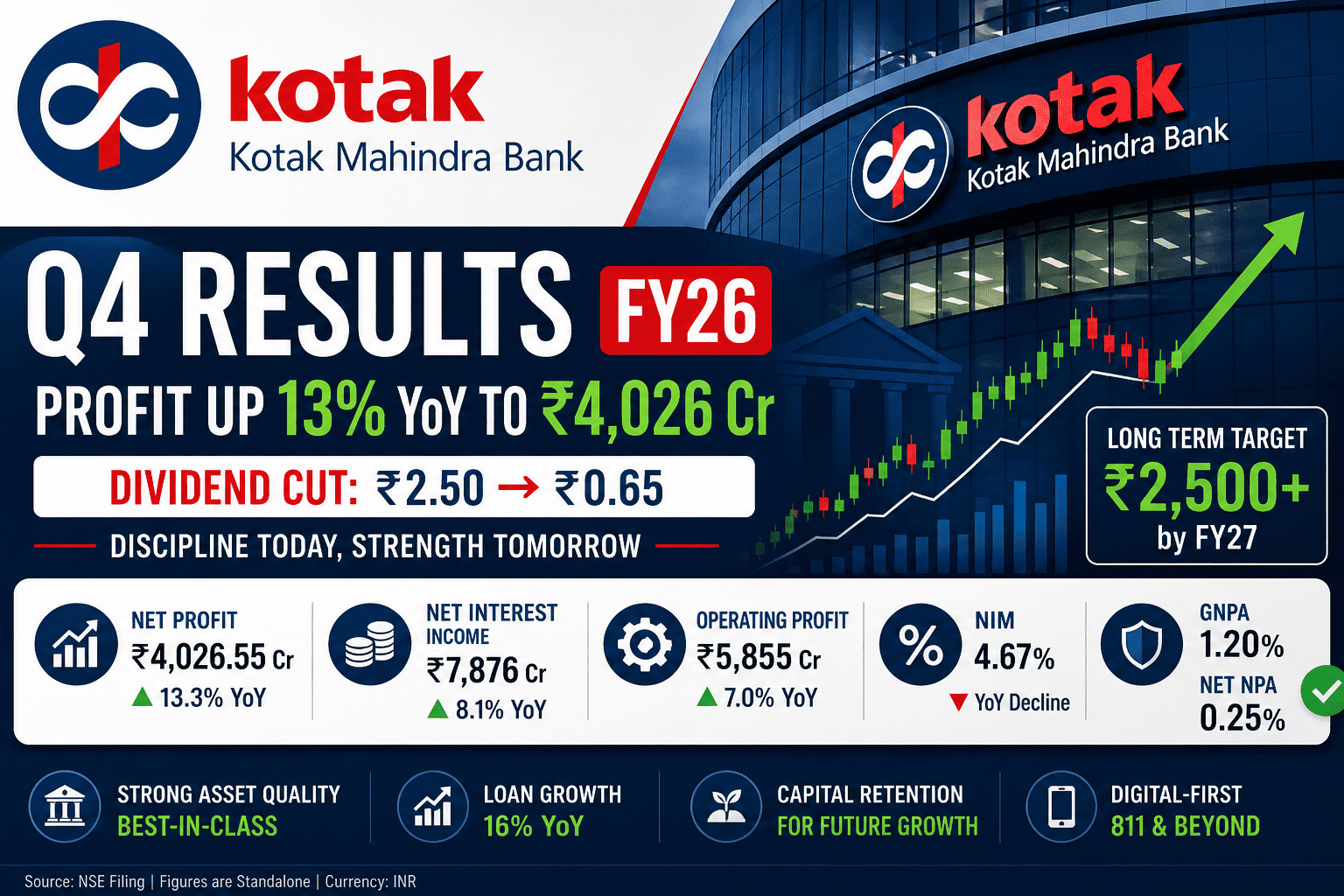
The Q4 FY26 results, released on May 2, 2026, reinforce that identity. On the surface, the numbers look strong. The bank reported a standalone net profit of ₹4,026.55 crore, marking a 13.3% year-on-year growth. But as any seasoned analyst will tell you, banking is not just about profit—it’s about capital allocation, risk control, and long-term sustainability.
The market reaction reflects this nuance. The stock has been trading in the range of ₹1,870–₹1,885, showing some pressure despite strong earnings. The reason? A sharp cut in dividend. This is where the story becomes interesting—because Kotak is clearly prioritizing capital preservation over immediate shareholder payouts.
Q4 FY26 Financial Scorecard (Actual Data from NSE Filing)
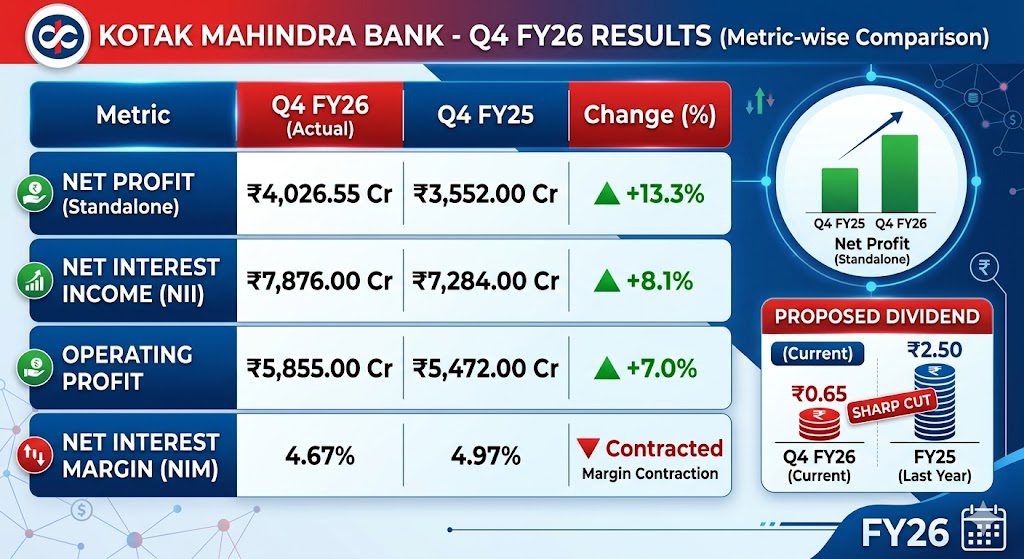
The financial performance for Q4 FY26 highlights steady and controlled growth across key metrics. Net profit came in at ₹4,026.55 crore, compared to ₹3,552 crore in Q4 FY25, reflecting a 13.3% increase. This growth places Kotak ahead of many peers in terms of profitability expansion.
Net Interest Income (NII), which is the core earnings engine for any bank, stood at ₹7,876 crore, up from ₹7,284 crore, showing an 8.1% growth. This indicates stable lending activity and effective interest rate management.
Operating profit rose to ₹5,855 crore, registering a 7% year-on-year increase. This suggests that the bank continues to maintain strong operational efficiency even in a competitive environment.
However, one metric that stands out is the Net Interest Margin (NIM), which declined to 4.67% from 4.97%. While this may raise concerns at first glance, it is important to note that NIMs improved sequentially from the previous quarter, indicating that the pressure from rising deposit costs may be stabilizing.
The biggest surprise in the results is the dividend cut. The bank has proposed a dividend of just ₹0.65 per share, compared to ₹2.50 in FY25. This sharp reduction signals a deliberate shift in strategy—one that prioritizes strengthening the balance sheet over rewarding shareholders in the short term.
Fundamental Analysis: Decoding the “Kotak Moat”
To truly understand Kotak Mahindra Bank, you need to look beyond quarterly numbers and focus on what makes it structurally strong. This is what I call the “Kotak Moat”—a combination of asset quality, disciplined lending, and capital efficiency.
Asset Quality Masterclass
Kotak continues to maintain one of the cleanest balance sheets in the Indian banking sector. Gross Non-Performing Assets (GNPA) declined to 1.20%, down from 1.42% last year. Even more impressive is the Net NPA, which stands at a razor-thin 0.25%.
In a sector where asset quality can quickly deteriorate, these numbers reflect exceptional risk management. It also means lower provisioning costs in the future, which supports profitability.
Loan Book Strength
The bank’s net advances grew by 16% year-on-year to ₹4,96,009 crore. This is a healthy growth rate, especially considering Kotak’s conservative lending approach. Unlike aggressive lenders, Kotak focuses on quality over quantity, ensuring that growth does not come at the cost of risk.
NIM Management
While NIM declined year-on-year to 4.67%, the sequential improvement from 4.54% in Q3 suggests that the worst of margin pressure may be behind. This is important because NIM stability is a key driver of long-term profitability in banking.
Operational Efficiency
Operating profit growth of 7% YoY was supported by a significant 32% decline in slippages, which came down to ₹1,018 crore. Lower slippages mean fewer bad loans entering the system, reinforcing the bank’s strong asset quality.
Technical Analysis: The Consolidation Zone
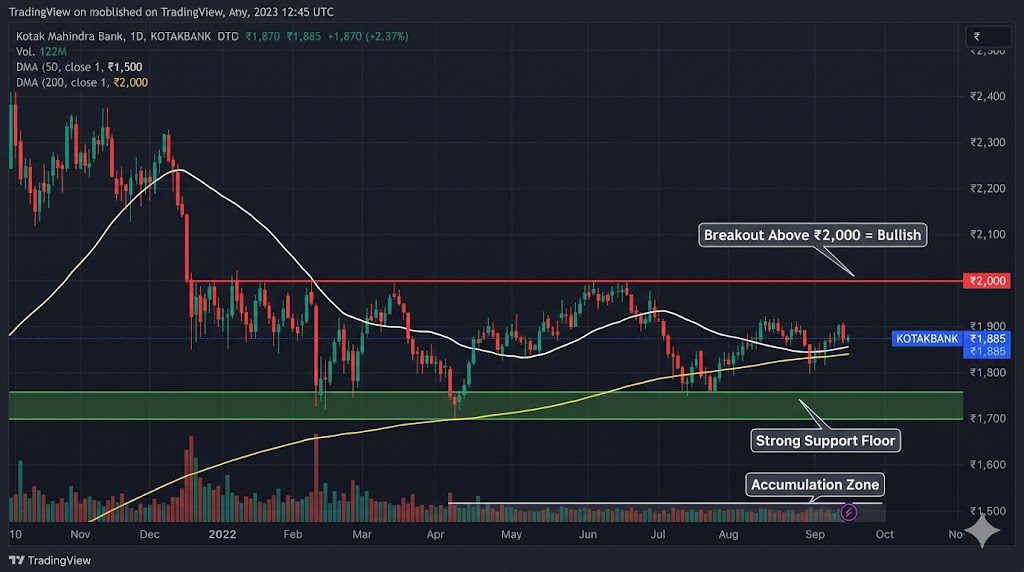
From a technical perspective, the stock is currently in a sideways consolidation phase. Over the past year, it has delivered around -12% returns, reflecting a period of accumulation rather than trend movement.
The major support zone lies between ₹1,700 and ₹1,750, which has acted as a strong floor over the last 52 weeks. This is where long-term investors typically step in.
On the upside, the immediate resistance is around ₹2,000. A sustained breakout above this level could trigger a fresh rally toward ₹2,300.
The Relative Strength Index (RSI) is currently at neutral levels, indicating that the stock is neither overbought nor oversold. This suggests that the market is waiting for a clear trigger—most likely management commentary or clarity on capital allocation strategy.
Management Guidance: The Strategic Shift
The most important takeaway from this quarter is not just the numbers—it’s the message behind them.
Capital Preservation
The decision to reduce the dividend to ₹0.65 per share is a clear signal that the bank is prioritizing capital retention. This could be due to anticipated regulatory requirements, expansion plans, or a cautious outlook on the macro environment.
In banking, capital is the foundation of growth. By retaining earnings, Kotak is strengthening its Tier-1 capital, which will support future lending and expansion.
Digital-First Focus
The bank continues to invest heavily in its 811 digital platform, which is central to its long-term strategy. By leveraging technology, Kotak aims to reduce its cost-to-income ratio and improve customer acquisition efficiency.
Automation in underwriting and risk assessment is another key focus area, which will enhance both speed and accuracy in lending decisions.
Brokerage Sentiment & Targets (The Path to ₹2,500)
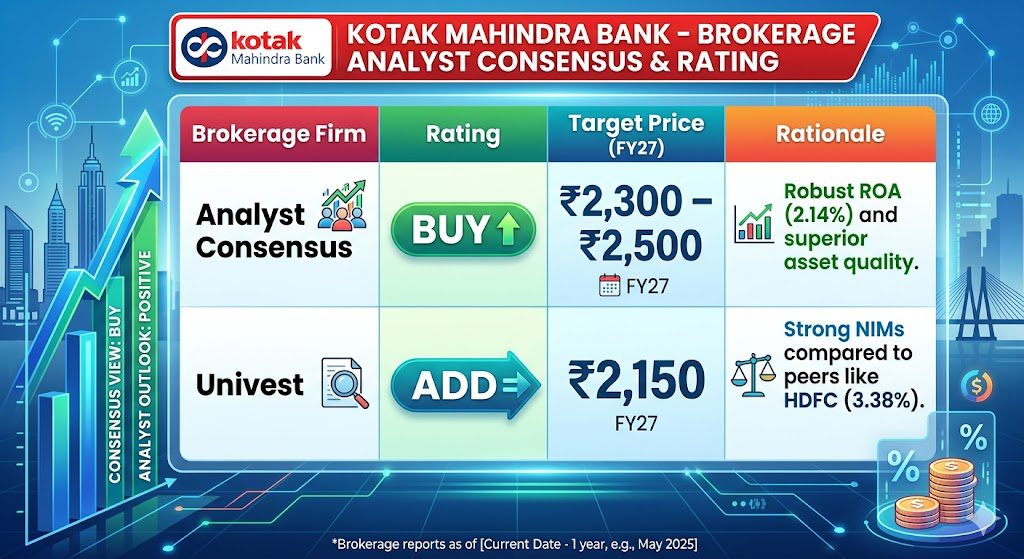
Despite the dividend cut, brokerage sentiment remains positive.
- Consensus estimates suggest a target range of ₹2,300–₹2,500, driven by strong return on assets (ROA) of around 2.14% and superior asset quality.
- Some analysts maintain an “Add” rating with targets around ₹2,150, citing Kotak’s strong NIMs compared to peers like HDFC Bank.
This indicates that the market still views Kotak as a high-quality banking franchise with long-term growth potential.
The “30-Year” Analyst Verdict
From a long-term perspective, Kotak Mahindra Bank remains a compounder. The 13% profit growth this quarter outpaces many peers, including ICICI Bank and HDFC Bank, which have reported lower growth rates.
The dividend cut may disappoint short-term investors, but it strengthens the bank’s capital base. In the world of banking, this is often a smart move, especially when preparing for future growth or economic uncertainty.
For long-term investors, this is a story of stability, discipline, and consistent compounding. For traders, the strategy is clear—wait for a breakout above ₹1,950–₹2,000 before entering, with a strict stop-loss around ₹1,800.
Conclusion & Engagement (CTA)
Kotak Mahindra Bank’s Q4 FY26 results present a balanced picture. A 13.3% profit growth and strong asset quality reaffirm its position as one of India’s best-managed banks. At the same time, the sharp dividend cut introduces a new variable that investors must consider.
This is not a weakness—it is a strategic choice. The bank is clearly focusing on long-term strength rather than short-term rewards.
So the real question is this: are you willing to stay invested for the long-term potential of ₹2,500 and beyond, or does the reduced dividend change your investment thesis?
Let’s discuss this “Capital Retention vs. Payout” debate in the comments—because in banking, the smartest decisions are often the least obvious ones.