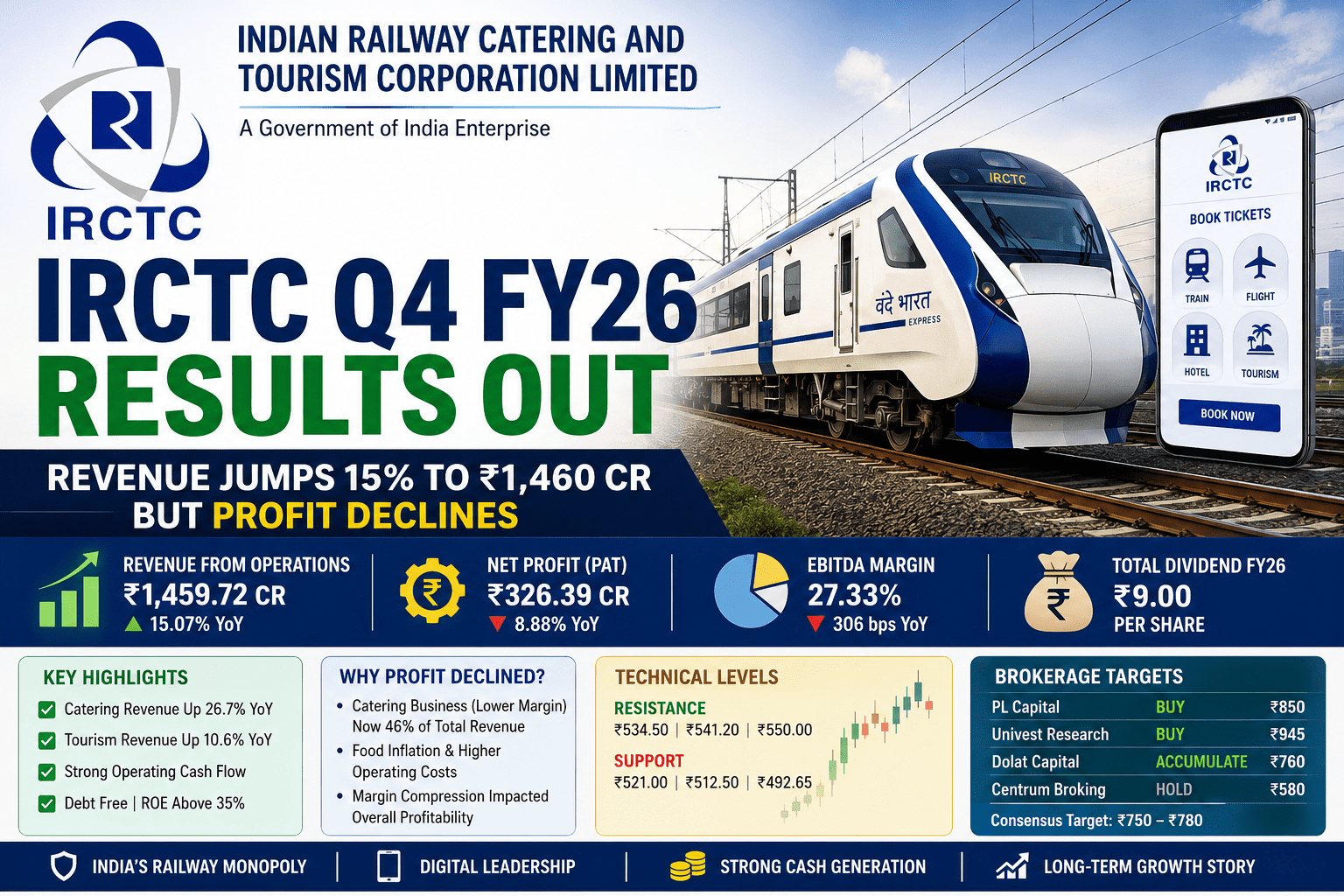
Indian Railway Catering and Tourism Corporation Limited announced its Q4 FY26 earnings on May 26, 2026, and the results created mixed reactions across the market. On one side, the company reported strong revenue growth supported by rising railway passenger activity, expanding catering demand, and improving tourism operations. On the other side, profitability declined because operational costs increased sharply, especially within the catering business. As a result, the stock witnessed selling pressure immediately after the earnings release and declined nearly 2% during the next trading session. However, beneath the short-term market reaction, the broader long-term business story remains significantly stronger than what the headline profit numbers initially suggest.
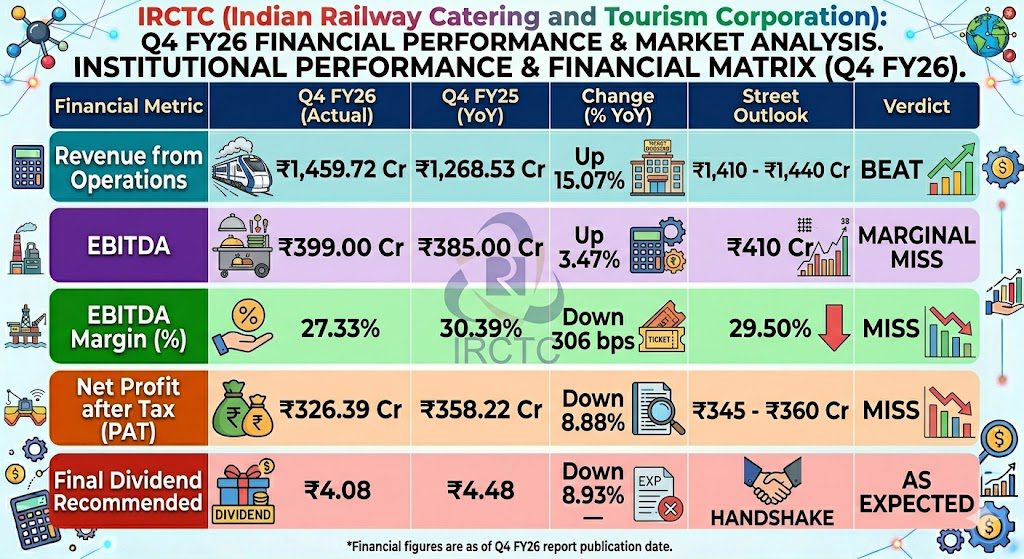
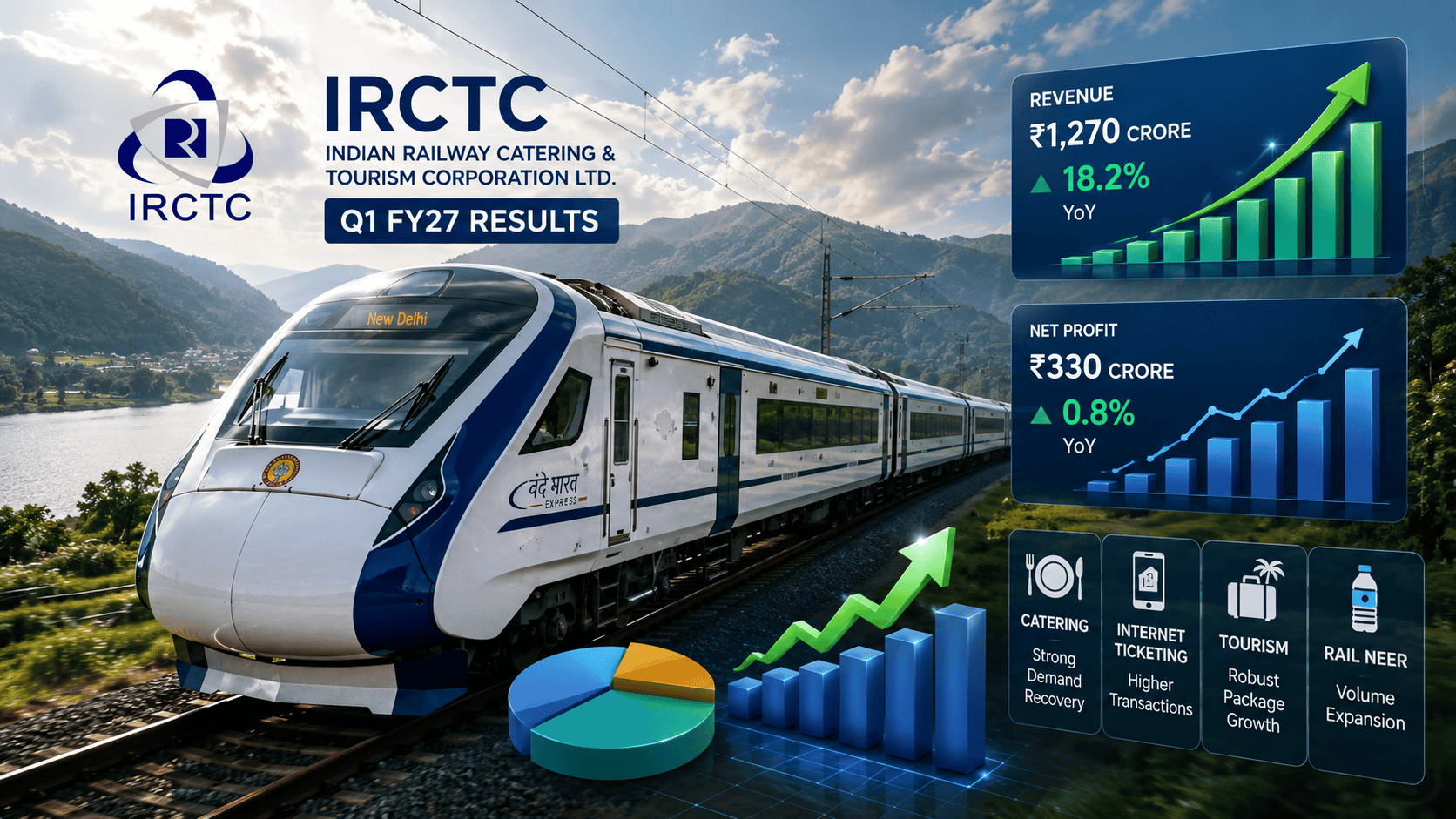
The company reported revenue from operations of ₹1,459.72 crore during Q4 FY26 compared to ₹1,268.53 crore during the same quarter last year, reflecting strong year-on-year growth of approximately 15.07%. The revenue performance comfortably exceeded most Street estimates, which were broadly positioned between ₹1,410 crore and ₹1,440 crore. This strong growth clearly indicates that India’s railway ecosystem continues witnessing rapid passenger recovery, higher digital transaction volumes, and increasing demand for railway-linked catering and tourism services.
Despite the strong revenue growth, operational profitability remained under pressure. EBITDA increased moderately to ₹399 crore compared to ₹385 crore during Q4 FY25, representing growth of only 3.47%. However, EBITDA margins declined sharply from 30.39% last year to 27.33% during the latest quarter, reflecting margin contraction of approximately 306 basis points. This decline in operating margins became the biggest concern for investors because it directly impacted bottom-line profitability.
Net profit after tax declined to ₹326.39 crore compared to ₹358.22 crore during Q4 FY25, representing a year-on-year fall of approximately 8.88%. Earnings per share (EPS) also declined from ₹4.48 to ₹4.08 during the same period. Both the profit and EPS numbers missed analyst expectations, which immediately triggered short-term weakness in the stock price.
The biggest question investors started asking after the earnings report was simple: if revenue is growing so strongly, why is profit declining?
The answer lies primarily in IRCTC’s changing business mix and rising operational costs. Historically, the company’s internet ticketing business has been its most profitable segment because online railway bookings generate extremely high margins with relatively low incremental operating costs. However, during Q4 FY26, the lower-margin catering business expanded significantly faster than the ticketing segment.
Catering revenue surged to ₹670.88 crore during the quarter, reflecting massive year-on-year growth of approximately 26.7%. This segment now contributes nearly 46% of the company’s total revenue. In comparison, the high-margin internet ticketing segment generated ₹390.25 crore with growth of only 4.78%, while tourism revenue increased 10.6% to ₹303.58 crore. Because catering is structurally a lower-margin business compared to digital ticketing convenience fees, the rapid expansion of catering revenue reduced the company’s overall profitability margins.
Rising food procurement costs, higher employee expenses, and broader food inflation pressures also contributed toward margin compression during the quarter. This means the earnings pressure was primarily operational rather than structural. Importantly, demand across all core business segments remained healthy.
One of the strongest long-term positives for Indian Railway Catering and Tourism Corporation Limited remains its monopoly-like operational structure. The company controls:
- Online railway ticketing
- Rail Neer packaged drinking water
- Railway catering services
- Tourism packages
- Premium train hospitality services
Very few listed companies in India possess this type of nationwide digital and infrastructure monopoly backed directly by government railway operations. This creates an exceptionally strong competitive moat that remains difficult for private competitors to challenge.
Another major positive for investors was the company’s dividend payout. The board recommended a final dividend of ₹0.50 per share on a face value of ₹2. Combined with the interim dividends already distributed during FY26 — ₹5 in December 2025 and ₹3.50 in March 2026 — the total annual dividend payout reaches ₹9 per share. This continues reinforcing IRCTC’s reputation as one of India’s strongest cash-generating public sector companies.
Looking at the full-year FY26 numbers provides a much clearer perspective regarding the company’s broader operational health. During the entire fiscal year:
- Revenue increased 11.55% to ₹5,214.86 crore
- Net profit rose 5.97% to ₹1,393.45 crore
- Operating cash flows surged more than 57% year-on-year to ₹1,273 crore
These numbers clearly indicate that the company’s overall financial structure remains extremely strong despite temporary quarterly margin volatility.
From a balance sheet perspective, IRCTC continues maintaining one of the healthiest financial profiles among PSU companies in India. The company remains effectively debt-free while generating exceptionally high return ratios:
- Return on Equity (ROE): Above 35%
- Return on Capital Employed (ROCE): Near 45%
These are extremely strong efficiency metrics for a government-owned infrastructure-linked business.
Another important factor investors should understand is that the company has already undergone a significant valuation correction over the past year. The stock previously traded near ₹800 during its earlier momentum phase but has now corrected nearly 32% toward the ₹527 range. As a result, the trailing Price-to-Earnings (P/E) ratio has cooled toward approximately 30x, making the valuation considerably more reasonable compared to earlier speculative levels.
Management also provided several important strategic updates regarding future growth plans. One major focus area remains the expansion of high-margin digital monetization streams. The company is aggressively scaling:
- Digital advertising revenue
- Loyalty programs
- Co-branded travel cards
- Premium digital partnerships
These initiatives are specifically designed to improve margin quality and reduce dependence on lower-margin catering revenue.
The company also plans to expand Rail Neer capacity aggressively. Four additional packaged drinking water plants are expected to become operational during the next 12 months. This expansion could improve production efficiency and gradually strengthen profitability margins through higher internal sourcing.
Another major long-term growth driver remains the rapid expansion of Vande Bharat trains and premium railway services across India. Premium passengers generally spend significantly more on catering, tourism, and value-added railway services. As the government continues modernizing railway infrastructure and introducing high-speed premium trains, IRCTC is expected to remain one of the biggest structural beneficiaries.
From a technical analysis perspective, the stock currently trades near ₹527 after the post-results decline.
The most important short-term technical pivot currently stands near ₹538.
y=538y=538
The stock must reclaim this level decisively in order to invalidate the current short-term bearish structure. Immediate resistance levels currently remain near ₹534.50, ₹541.20, and ₹550 respectively, while important support zones remain visible near ₹521, ₹512.50, and ₹492.65.
If the stock fails to hold the ₹521 support region, traders could witness additional downside pressure toward the ₹492 structural support zone. However, long-term institutional investors may increasingly view deeper corrections as accumulation opportunities because of the company’s monopoly positioning, debt-free balance sheet, and powerful cash-generation capability.
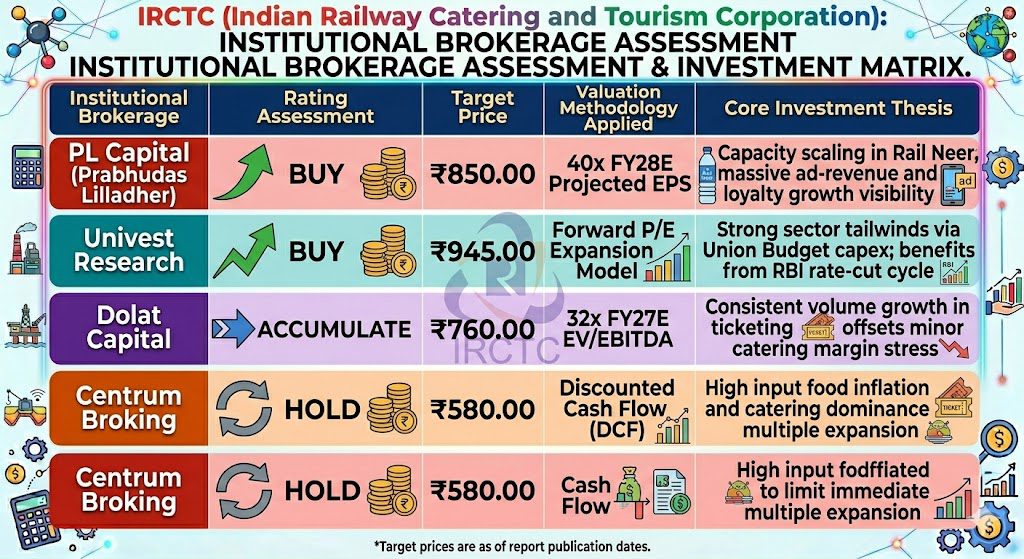
Institutional brokerages continue maintaining broadly constructive long-term outlooks despite temporary margin concerns. PL Capital maintained a BUY rating with a target price of ₹850 due to long-term digital monetization opportunities and Rail Neer expansion. Univest Research assigned a target near ₹945 because of India’s railway modernization and travel demand growth. Dolat Capital maintained an ACCUMULATE rating with a target price of ₹760, while Centrum Broking adopted a more cautious HOLD stance near ₹580 because of ongoing food inflation pressures. The broader institutional consensus currently remains near ₹750–₹780, implying meaningful upside potential from current levels.
Overall, the Q4 FY26 earnings report from Indian Railway Catering and Tourism Corporation Limited reflected a company experiencing temporary operational margin pressure rather than structural business weakness. Strong passenger demand, expanding catering volumes, rising tourism activity, premium railway modernization, and IRCTC’s monopoly digital ecosystem continue supporting the long-term investment thesis. While short-term traders may remain cautious because of ongoing technical weakness and catering-related margin compression, long-term investors are likely to continue viewing IRCTC as one of India’s strongest consumer infrastructure and digital monopoly businesses.