India’s aviation industry has been one of the fastest-growing sectors in the country over the past decade, and no airline has benefited more from this growth than InterGlobe Aviation, the parent company of IndiGo. Known for its low-cost model, operational efficiency, and dominant market share, IndiGo has become synonymous with domestic air travel in India. However, the company’s Q4 FY26 earnings have shocked investors and analysts alike.
On May 29, 2026, IndiGo released its quarterly results after market hours, revealing a massive net loss of ₹2,536.9 crore. The headline immediately triggered concerns across Dalal Street because only a year ago the airline had reported a healthy profit of ₹3,067.5 crore. At first glance, it appears that India’s largest airline has suddenly lost its profitability. But as is often the case in financial markets, the headline tells only part of the story.
For investors and traders, the key question is whether this loss signals a structural problem within the business or whether it is merely a temporary accounting impact caused by extraordinary circumstances. To answer that question, it is essential to look beyond the headline numbers and understand what really happened inside the company’s books.
Q4 FY26 Financial Snapshot: A Quarter of Contradictions
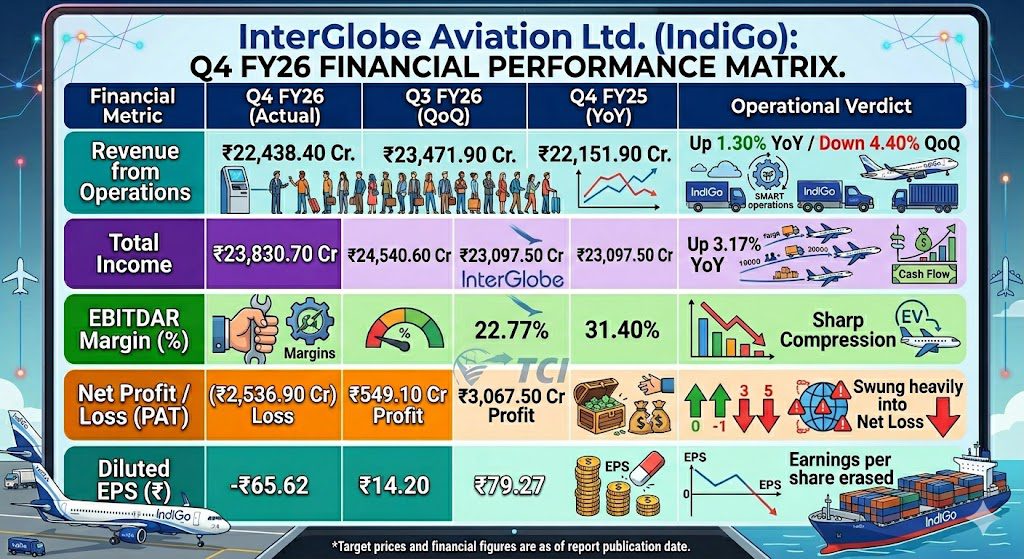
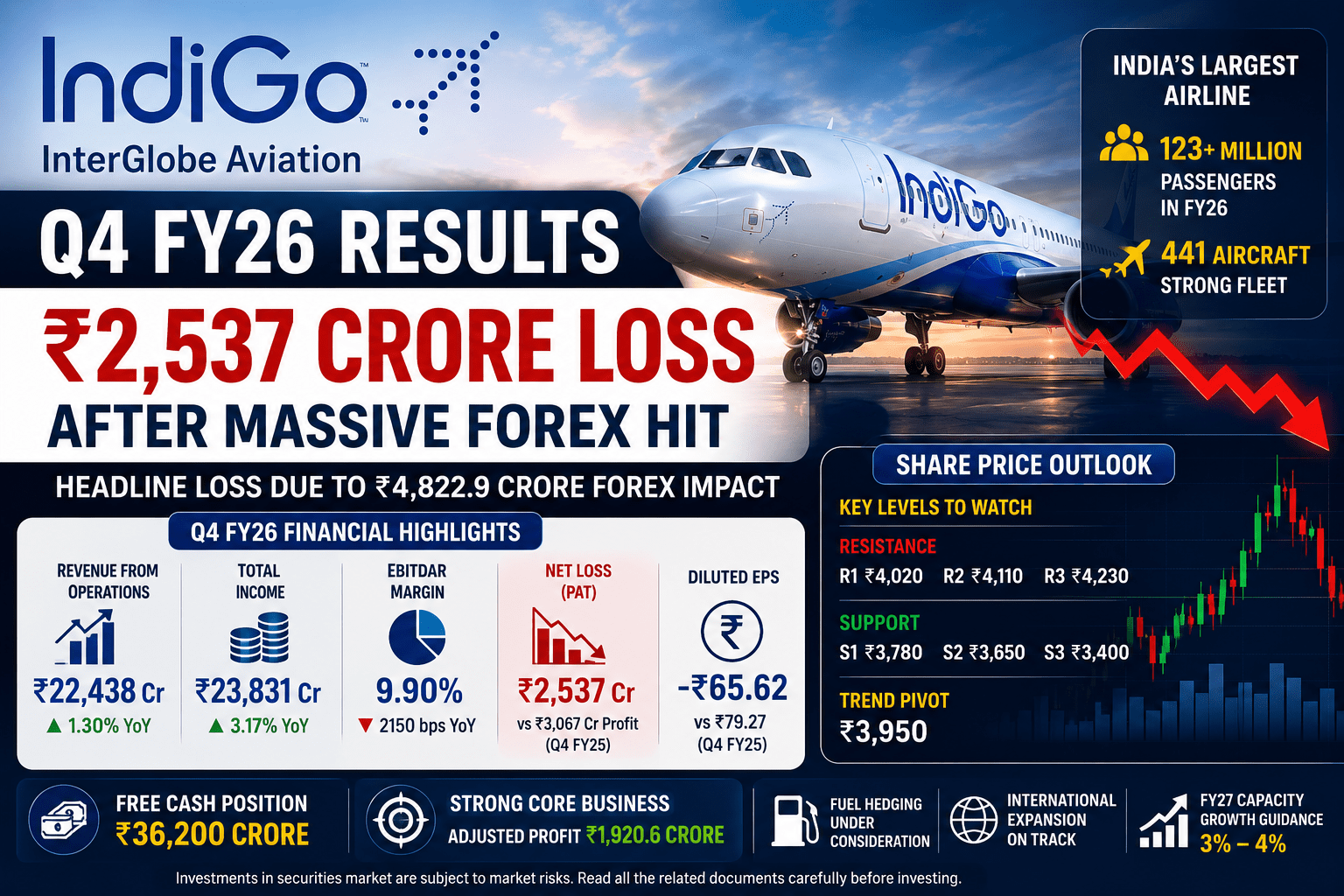
IndiGo reported revenue from operations of ₹22,438.40 crore during Q4 FY26 compared with ₹22,151.90 crore in the corresponding quarter last year. Despite challenging market conditions, revenue still grew by approximately 1.30% year-on-year, demonstrating the continued strength of passenger demand across the domestic aviation market. However, on a sequential basis, revenue declined about 4.40% from ₹23,471.90 crore reported in Q3 FY26.
Total income increased to ₹23,830.70 crore compared with ₹23,097.50 crore during Q4 FY25, reflecting growth of approximately 3.17%. While these numbers indicate stable business activity, profitability experienced a dramatic collapse.
EBITDAR margins declined sharply to 9.90% compared with 31.40% during the previous year and 22.77% during Q3 FY26. Net profit swung from a positive ₹3,067.50 crore during Q4 FY25 to a loss of ₹2,536.90 crore in Q4 FY26. Diluted earnings per share also collapsed from ₹79.27 to a negative ₹65.62. These figures represent one of the most dramatic earnings reversals seen among major Indian listed companies this year.
Company Introduction: The Undisputed King of Indian Skies
Before analyzing the loss, investors must remember the scale and strength of IndiGo’s business.
InterGlobe Aviation remains India’s largest airline by a wide margin. The company commands a dominant share of the domestic aviation market and continues to outperform competitors in operational efficiency, fleet utilization, and passenger traffic. While airline businesses globally often struggle with profitability because of volatile fuel prices and intense competition, IndiGo has historically managed to maintain strong margins through disciplined cost management and a highly efficient low-cost carrier model.
The company’s operational scale is staggering. During FY26, IndiGo served more than 123 million passengers, the highest annual passenger volume in its history. Its fleet expanded to 441 aircraft, allowing the airline to operate across a vast domestic and international route network. These numbers reinforce the company’s position as the backbone of India’s rapidly expanding aviation ecosystem.
The long-term growth drivers also remain intact. Rising middle-class incomes, increasing air travel penetration, expanding regional connectivity, and growing tourism demand continue supporting the structural growth story of Indian aviation.
The Q4 FY26 Earnings Post-Mortem: What Really Caused the Loss?
The headline loss naturally creates concern, but investors should avoid drawing conclusions before understanding the primary cause.
The biggest culprit behind the loss was not weak demand, declining ticket sales, or operational deterioration. Instead, the major factor was a massive foreign exchange loss.
During Q4 FY26, IndiGo reported a foreign exchange loss of approximately ₹4,822.9 crore. This extraordinary charge was triggered by the sharp depreciation of the Indian rupee against the US dollar. Since airlines lease aircraft, purchase spare parts, and incur maintenance costs largely in dollars, currency fluctuations can significantly impact financial statements.
The forex loss was large enough to completely overwhelm otherwise healthy operating performance.
This distinction is critical.
If the airline had suffered the loss because of declining passenger traffic or operational inefficiency, investors would have far greater reason for concern. Instead, the loss was primarily an accounting impact arising from currency volatility.
Management highlighted that excluding forex-related effects and exceptional items, the company would have reported an adjusted operational profit of approximately ₹1,920.6 crore during the quarter. This suggests that the core business remains profitable and resilient despite macroeconomic disruptions.
Operational Challenges Added Further Pressure
While forex losses were the primary driver of the reported net loss, several operational headwinds also weighed on performance.
Non-fuel operating costs increased approximately 7.3% during the quarter. Rising airport charges, maintenance expenses, employee costs, and infrastructure-related expenditures contributed to this increase. The aviation industry globally continues facing inflationary pressures that affect cost structures even when fuel prices remain relatively stable.
Geopolitical tensions in the Middle East also created operational disruptions. Certain international routes experienced scheduling adjustments and higher operating costs due to evolving regional conditions.
Additionally, severe winter weather disruptions during December led to flight cancellations and delays across multiple airports. These disruptions negatively affected operational efficiency and passenger management costs during the quarter.
Unlike many consumer businesses, airlines operate within a highly sensitive ecosystem where weather events, geopolitical developments, and currency fluctuations can materially affect profitability within a single quarter.
Capital Allocation Strategy: Strengthening the Balance Sheet
Although IndiGo did not announce a dividend for FY26, management outlined a strategic capital allocation plan aimed at strengthening long-term financial health.
The company plans to prepay up to $450 million in finance lease obligations related to aircraft engine assets. This move demonstrates management’s commitment to reducing future financing costs and improving fleet ownership economics.
By proactively reducing lease liabilities, IndiGo can improve future profitability while increasing financial flexibility. In a capital-intensive industry like aviation, such decisions often create significant shareholder value over the long term.
Fundamental Analysis: Looking Beyond the Temporary Shock
Long-term investors should evaluate whether the reported loss changes the company’s structural investment case.
The evidence suggests it does not.
Despite reporting a full-year net loss of ₹2,393.6 crore, IndiGo remains one of the strongest airlines globally from a liquidity perspective. The company currently holds approximately ₹36,200 crore in free cash, supported by total cash equivalents exceeding ₹16,000 crore. This massive liquidity cushion provides significant protection against temporary macroeconomic shocks and allows the airline to continue investing in expansion opportunities.
The stock has already corrected substantially. Prior to the earnings release, shares had declined approximately 14% year-to-date, reflecting investor concerns regarding rising costs and forex volatility. As a result, valuation multiples have cooled significantly compared to previous years.
For value-oriented investors, periods of temporary earnings disruption often create opportunities to accumulate shares of high-quality businesses at more reasonable valuations.
The key question is whether the core business remains healthy. Based on passenger growth, operational profitability, fleet expansion, and liquidity strength, the answer appears to be yes.
Technical Analysis: Key Levels for Monday’s Trading Session
From a technical perspective, traders should expect heightened volatility following the earnings announcement.
The stock entered the results period under selling pressure and closed near an important support region. Market participants will closely monitor whether investors focus on the headline loss or the stronger underlying operational profitability.
The most important trend pivot currently stands near ₹3,950.
A decisive move above this level would signal improving short-term sentiment and potentially attract momentum buyers. Immediate resistance levels are positioned near ₹4,020, ₹4,110, and ₹4,230.
On the downside, traders should monitor support zones at ₹3,780 and ₹3,650. A deeper correction could test the major structural support level near ₹3,400.
Given the magnitude of the reported loss, initial market reaction may remain emotional. However, once investors digest the forex-related nature of the loss, sentiment could stabilize.
Management Guidance and FY27 Flight Plan
Management remains focused on long-term growth despite the challenging quarter.
One important initiative under consideration is fuel hedging. Historically, IndiGo has maintained limited hedging exposure compared with some international carriers. However, management indicated that hedging strategies are being evaluated to reduce earnings volatility arising from fluctuating fuel prices.
The company also continues pursuing international expansion opportunities. The upcoming deployment of Airbus A321 XLR aircraft will enable IndiGo to operate longer international routes more efficiently, opening access to new markets and higher-yield passengers.
For Q1 FY27, management expects capacity growth measured through Available Seat Kilometers (ASK) to increase approximately 3% to 4% year-on-year. This guidance suggests continued confidence in passenger demand and operational expansion plans.
Institutional Radar: What Brokerages Are Saying
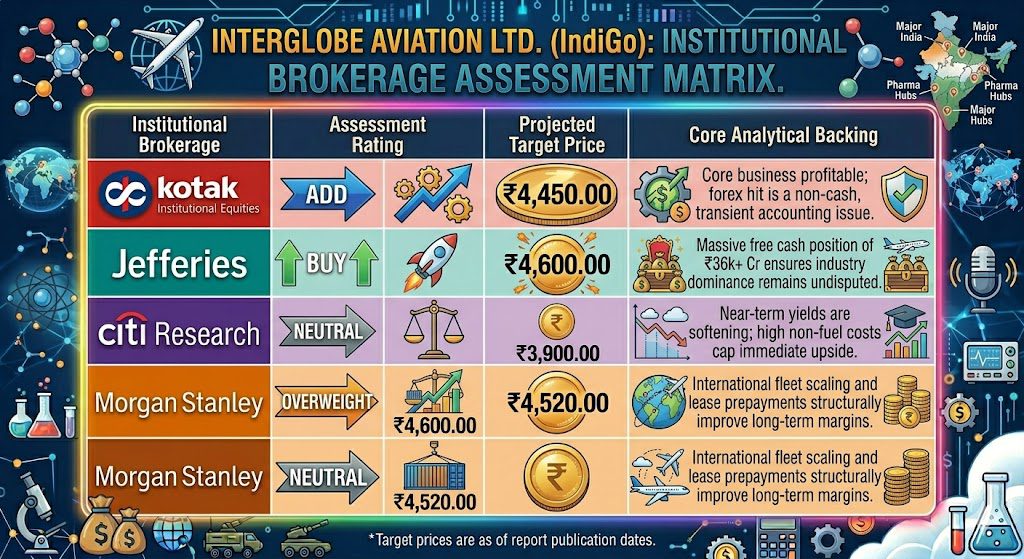
Brokerages have largely viewed the earnings disappointment as a temporary accounting issue rather than a fundamental deterioration in business quality.
Kotak Institutional Equities maintained an ADD rating with a target price of ₹4,450, emphasizing that the core business remains profitable and that forex losses are largely non-cash accounting adjustments.
Jefferies retained a BUY recommendation with a target price of ₹4,600, citing IndiGo’s enormous free cash position and dominant industry position.
Morgan Stanley maintained an OVERWEIGHT rating with a target of ₹4,520, highlighting long-term benefits from fleet expansion and lease prepayments.
Citi Research adopted a more cautious NEUTRAL stance with a target price of ₹3,900, reflecting concerns regarding near-term cost pressures and yield softness.
Overall institutional sentiment remains constructive despite the disappointing quarterly headline.
The Veteran’s Verdict: Buy, Hold, or Sell?
For long-term investors, panic selling based solely on the reported loss appears unwarranted.
The underlying business remains healthy. Passenger traffic continues reaching record levels, liquidity remains exceptionally strong, fleet expansion continues, and adjusted operational profitability remains impressive.
Most importantly, the primary cause of the loss was a forex shock rather than operational weakness. Currency movements can reverse over time, whereas structural business deterioration would be far more concerning.
Investors with a long-term horizon may view any significant post-results weakness as an opportunity to accumulate shares gradually. The company’s adjusted profit generation, market leadership, and financial strength continue supporting the long-term investment thesis.
For traders, caution remains appropriate. The stock is likely to experience elevated volatility as the market digests the results. Waiting for stabilization near support zones around ₹3,780 or ₹3,650 may offer a more favorable risk-reward setup for short-term positions.
Ultimately, IndiGo’s Q4 FY26 results represent a reminder that headline earnings can sometimes be misleading. Beneath the surface of a ₹2,536.9 crore loss lies an airline that continues carrying more passengers than ever before, generating healthy operational profits, and strengthening its position as India’s dominant aviation franchise. For patient investors, that distinction may prove far more important than the temporary turbulence visible in this quarter’s financial statements.