1. Introduction: The Strategic Pivot in Indian Life Insurance
As a market veteran who has closely tracked the Indian insurance sector since the early 2000s, I can confidently say that ICICI Prudential Life Insurance has undergone one of the most disciplined and strategic transformations in the industry. From being heavily dependent on ULIPs (Unit Linked Insurance Plans) in the earlier decade to now building a balanced and resilient product mix, the company has evolved into a Value of New Business (VNB)-driven franchise.
As of April 2026, India’s life insurance penetration stands at approximately 3.2% of GDP, still significantly below the global average of ~7%. This under-penetration presents a massive long-term growth opportunity. Against this backdrop, ICICI Prudential Life has strategically pivoted towards high-margin protection products, annuities, and non-par savings products, reducing earnings volatility and improving profitability quality.
The Q4 FY26 results, declared on April 14, 2026, come at a crucial time when the insurance sector is undergoing regulatory tightening, rising competition, and shifting consumer preferences. The key question for investors now is:
👉 Does ICICI Pru Life offer a margin of safety at current levels, or is the growth already priced in?
2. Q4 FY26 Result Analysis: Evaluating VNB, APE & Profitability Metrics
The Q4 FY26 performance reflects resilience with selective growth, rather than aggressive expansion—a hallmark of a mature insurer focused on profitability.
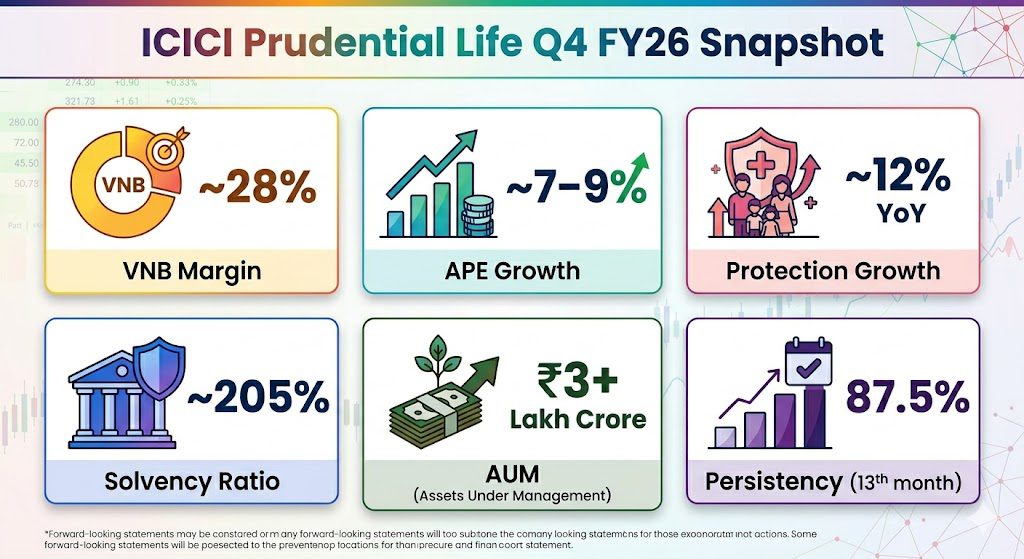
ICICI Prudential Life reported a VNB margin of ~28%, which remains among the best in the industry. To put this into perspective, a decade ago, margins were in the low teens due to ULIP-heavy portfolios. This structural shift towards protection and annuity products has significantly enhanced margin visibility.
The Absolute VNB grew in the high single-digit range, supported by disciplined product pricing and improved persistency. Meanwhile, Annualized Premium Equivalent (APE) growth remained in the single-digit zone (~7–9%), reflecting the impact of tighter regulatory norms, especially on high-ticket policies.
One of the most encouraging signals is the Protection segment growth of ~12% YoY, which is critical because protection products carry 2–3x higher margins than savings products.
From a balance sheet perspective:
- Solvency Ratio: ~205% (well above regulatory requirement of 150%)
- Assets Under Management (AUM): ~₹3 lakh crore+
- Embedded Value (EV): Continued double-digit growth trajectory
This indicates that the company is not just growing but doing so with strong capital efficiency and risk management discipline, even in a volatile interest rate environment.
👉 Key Insight: The market is increasingly rewarding insurers that prioritize quality of growth over quantity, and ICICI Pru Life is clearly aligning with this trend.
3. Fundamental Analysis: Persistency, Distribution & Embedded Value Growth
In life insurance, persistency ratios are the true indicator of business quality. ICICI Prudential Life has demonstrated consistent improvement here, with the 13th-month persistency ratio reaching ~87.5% in FY26, up from ~85% levels a few years ago.
This improvement is not accidental. It reflects:
- Better product suitability
- Improved underwriting standards
- Enhanced customer engagement via digital tools
Another major structural shift is visible in distribution diversification. Historically, ICICI Bank contributed a dominant share of bancassurance business. However, the company has strategically reduced this dependency by:
- Expanding to 40+ bancassurance partners
- Strengthening agency channels
- Investing aggressively in digital direct-to-consumer platforms
This diversification reduces concentration risk and ensures more stable premium inflows across economic cycles.
From a valuation standpoint:
- Embedded Value (EV) CAGR: ~14% over the last few years
- Price-to-EV (P/EV): ~2.1x–2.3x (approx range based on current price ₹642)
When compared to peers:
- HDFC Life trades at ~2.8x–3.2x EV
- SBI Life trades at ~2.5x–2.8x EV
👉 This indicates that ICICI Pru Life is relatively undervalued, especially considering its improving margins and diversified business model.
4. Technical Analysis: Multi-Year Breakout & Momentum Indicators
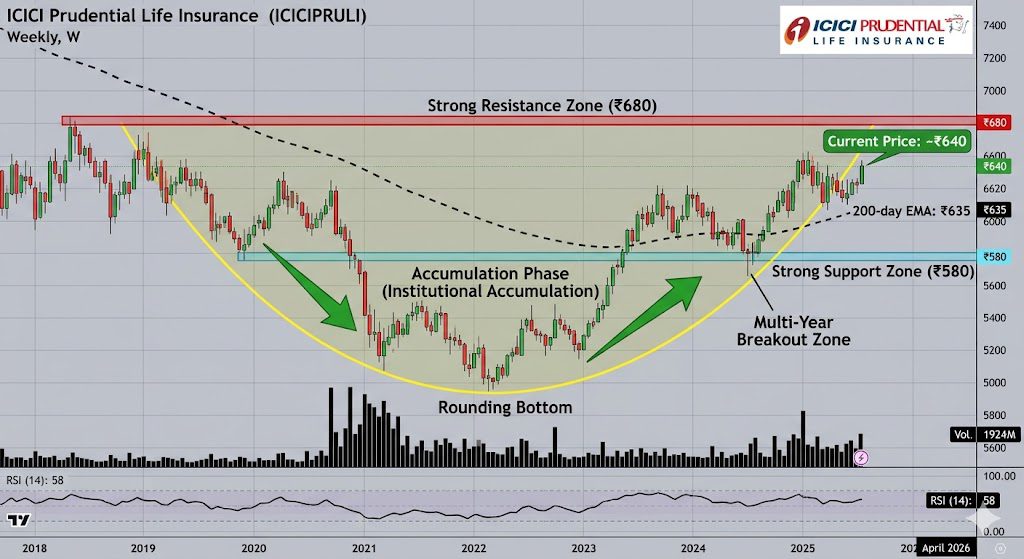
From a technical standpoint, ICICI Prudential Life is at a critical inflection point.
On the weekly chart, the stock has formed a Rounding Bottom pattern over multiple years—a classic indicator of long-term accumulation and trend reversal. This pattern typically precedes strong bullish breakouts when supported by fundamentals, which is exactly what we are witnessing now.
Key technical observations:
- Current Price: ₹642
- 200-day EMA: Strong support below current levels
- Immediate Resistance: ₹680
- Next Target Zone: ₹750–₹780
The Relative Strength Index (RSI) is currently around 58, indicating:
- The stock is in a bullish zone
- Not yet overbought
- Still has room for upward momentum
Volume patterns also suggest institutional accumulation, particularly after the results announcement.
👉 Trading Strategy Insight:
A decisive breakout above ₹680 with strong volume could trigger a momentum rally toward ₹750+ in the medium term, making current levels attractive for both positional investors and swing traders.
5. Dividend Policy & Capital Allocation Strategy
ICICI Prudential Life has maintained a balanced capital allocation strategy, focusing on both growth and shareholder returns.
The company’s Return on Equity (ROE) is approaching 15–16%, which is healthy for a life insurer, especially considering the capital-intensive nature of the business.
Dividend highlights:
- Consistent dividend payouts over the past few years
- Increasing surplus generation from non-par products
- Strong capital buffers enabling sustainable distributions
The shift toward non-participating (non-par) savings products is particularly important. These products:
- Offer higher margins
- Provide predictable cash flows
- Enhance surplus generation
👉 This creates a positive feedback loop: higher surplus → higher dividends → improved investor confidence.
For long-term investors, this makes ICICI Pru Life a defensive compounder with income potential, especially during volatile market cycles.
6. Forward Outlook FY27: Deepening Penetration & Structural Tailwinds
Looking ahead to FY27, the growth story of ICICI Prudential Life is deeply tied to India’s structural insurance opportunity.
India’s insurance density (premium per capita) is still around $90–$100, compared to:
- $500+ in China
- $4,000+ in developed markets
This massive gap highlights the multi-decade growth runway.
Key growth drivers for FY27:
1. Bima Sugam Digital Platform
The upcoming Bima Sugam initiative aims to create a unified digital marketplace for insurance, similar to UPI in payments. ICICI Pru Life, with its strong digital infrastructure, is well-positioned to benefit.
2. Product Innovation
- Retail health riders
- Group term insurance
- Retirement and annuity solutions
These segments are expected to drive 15%+ APE CAGR over the next 2 years.
3. Interest Rate Sensitivity
One key risk factor remains long-term bond yields, which impact:
- Pricing of guaranteed products
- Investment income
However, ICICI Pru Life’s diversified product mix reduces this risk significantly.
4. Regulatory Evolution
IRDAI’s push for transparency and customer-centric products may initially slow growth but will improve long-term trust and penetration.
👉 Bottom Line:
ICICI Prudential Life is not just riding the insurance growth wave—it is structurally positioned to lead it.
| Brokerage | Rating | Target Price | Upside View | Key Trigger |
|---|---|---|---|---|
| ICICI Securities | BUY | ₹800 | High | Margin + growth balance |
| Motilal Oswal | BUY | ₹800 | High | VNB margin expansion |
| Jefferies | BUY | ₹655 | Moderate | VNB growth recovery |
| Goldman Sachs | NEUTRAL | ₹690 | Limited | Valuation concerns |
| Consensus | BUY | ₹750–760 | Strong | Sector tailwinds |
7. ICICI Pru Life vs Peers: Pros & Cons Comparison Table
| Factor | ICICI Pru Life | HDFC Life | SBI Life |
|---|---|---|---|
| VNB Margin | ~28% | ~27% | ~29% |
| P/EV Valuation | Lower (2.1–2.3x) | Premium (3x+) | Moderate |
| Distribution | Highly diversified | Strong banca | SBI-heavy |
| Persistency | Improving | Strong | Very strong |
| Growth Stability | High | High | Moderate |
Pros:
- Strong VNB margins
- Attractive valuation vs peers
- Diversified distribution
- Improving persistency
Cons:
- Slightly lower brand premium vs HDFC Life
- Growth slightly slower than SBI Life in some segments
- Sensitivity to regulatory changes
8. ICICI Prudential Life Share Price Target 2026–2027
Based on a blended approach of fundamental valuation (P/EV multiple) and technical breakout analysis, here are the projected targets:
- Short-Term Target (3–6 months): ₹700–₹750
- Medium-Term Target (6–12 months): ₹780–₹850
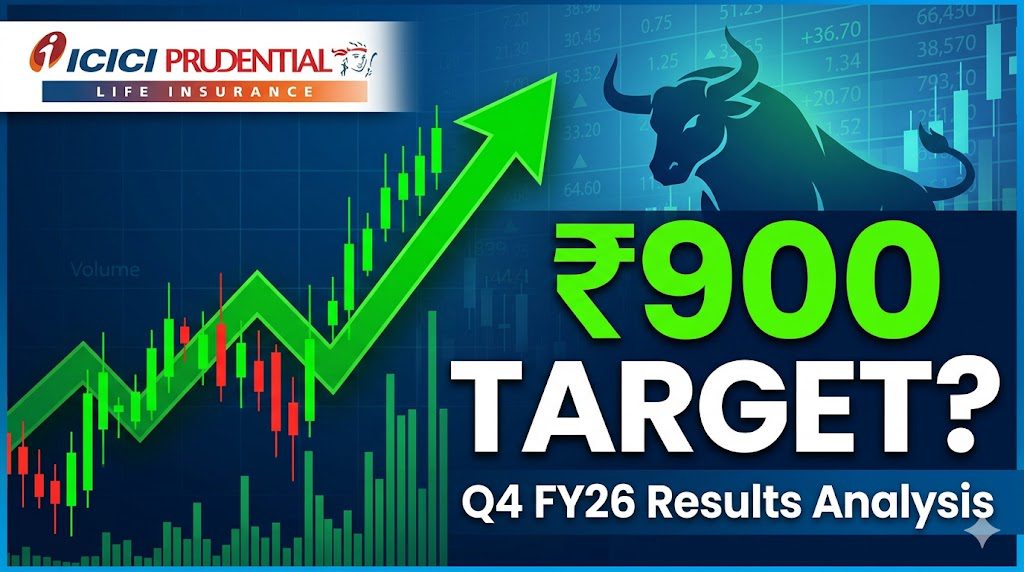
- Bull Case (FY27): ₹900+ (assuming 15% EV growth and re-rating to 2.7x P/EV)
👉 Ideal Accumulation Zone: ₹600–₹650
👉 Strong Support: ₹580
👉 Key Breakout Level: ₹680
9. Final Verdict: Should You Buy ICICI Pru Life After Q4 FY26?
ICICI Prudential Life is currently at a sweet spot where fundamentals and technicals are aligning simultaneously—a rare combination in the market.
- Strong VNB margins indicate profitability strength
- Improving persistency reflects business quality
- Attractive valuation provides margin of safety
- Technical breakout signals upcoming momentum
For long-term investors, this is a classic early-stage re-rating opportunity in a sector with multi-decade tailwinds.
👉 Final Call:
BUY on dips with a 12–18 month investment horizon