Cochin Shipyard Limited announced its Q4 FY26 earnings on May 15, 2026, and the results immediately attracted strong attention across the defence and PSU investment space. The company delivered a mixed but strategically important quarterly performance. While revenue declined compared to the previous year, operational profitability improved dramatically and EBITDA margins surged to one of the strongest levels seen in recent quarters.
For long-term investors, the latest earnings report clearly shows that Cochin Shipyard continues benefiting from India’s defence indigenization push, expanding naval modernization programs, and growing global interest in green maritime infrastructure. Even though top-line growth remained under temporary pressure because of project billing cycles, the company’s ability to significantly improve margins during the quarter demonstrates the underlying strength of its business model.
The market is now closely watching whether Cochin Shipyard can maintain this operational momentum while converting its massive order pipeline into long-term earnings growth. With defence manufacturing becoming one of India’s most strategically important industrial sectors, Cochin Shipyard remains one of the most closely tracked PSU defence stocks in the country.
Quick Summary of Cochin Shipyard Q4 FY26 Results
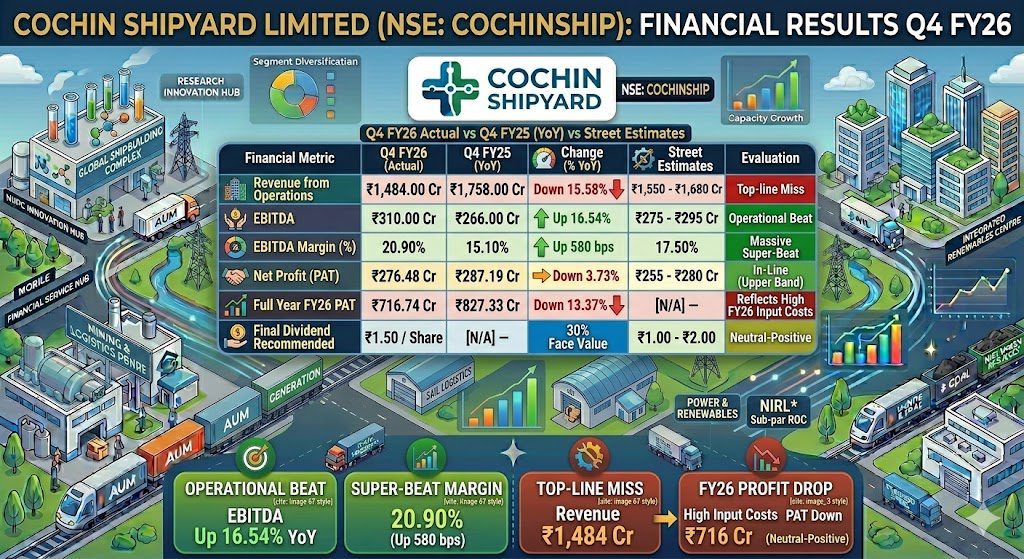
Cochin Shipyard Limited reported revenue from operations of ₹1,484 crore during Q4 FY26 compared to ₹1,758 crore in the same quarter last year. This represented a decline of approximately 15.6% year-on-year and came slightly below market expectations.
However, despite softer revenue, the company delivered a major operational surprise. EBITDA increased to ₹310 crore from ₹266 crore in Q4 FY25, while EBITDA margins expanded sharply from 15.1% to 20.9%. This margin expansion of 580 basis points significantly exceeded analyst expectations and became the biggest positive highlight of the earnings report.
Net profit after tax stood at ₹276.48 crore compared to ₹287.19 crore during the same quarter last year, reflecting only a marginal decline of around 3.7%. Considering the weaker revenue environment, the relatively stable profitability clearly demonstrates strong operational efficiency improvements within the company.
For the full financial year FY26, consolidated net profit stood at ₹716.74 crore compared to ₹827.33 crore during FY25, mainly reflecting elevated input costs and cyclical revenue recognition patterns within large defence contracts.
The board also recommended a final dividend of ₹1.50 per equity share for shareholders.
Corporate Profile: India’s Strategic Defence Shipbuilding Leader
Cochin Shipyard Limited remains one of India’s most strategically important defence manufacturing companies. Operating as a Category-I Miniratna PSU, the company plays a central role in India’s naval infrastructure development and indigenous shipbuilding ambitions.
The company gained national and international recognition after successfully constructing INS Vikrant, India’s first indigenously built aircraft carrier. This historic achievement significantly strengthened India’s defence manufacturing credibility and positioned Cochin Shipyard among the country’s most important strategic industrial assets.
Cochin Shipyard operates through two primary business divisions. The first is shipbuilding, which includes the construction of naval warships, aircraft carriers, stealth vessels, anti-submarine warfare crafts, patrol ships, and advanced commercial vessels. The second is the ship repair and maintenance business, which services commercial shipping fleets, offshore rigs, and Indian Navy vessels.
The ship repair division is especially important because it generates relatively high margins and faster cash flows compared to traditional shipbuilding operations. This combination of long-term defence contracts and profitable repair services creates a highly differentiated business model compared to most industrial PSU companies in India.
Earnings Analysis: Why Margins Improved Despite Revenue Pressure
The most important aspect of Cochin Shipyard’s Q4 FY26 performance was the dramatic improvement in operational profitability despite weaker revenue growth.
Revenue from operations declined to ₹1,484 crore mainly because defence shipbuilding follows milestone-based revenue recognition. Unlike regular manufacturing businesses, shipbuilding revenue does not grow linearly every quarter. Large defence projects recognize revenue only after crossing specific construction and delivery milestones. Because of this, quarterly fluctuations in revenue are common and often temporary.
In fact, the company’s full-year shipbuilding revenue actually increased to ₹3,365.57 crore during FY26 compared to ₹2,955.39 crore in FY25. This indicates that the core shipbuilding business remains fundamentally strong despite temporary quarterly moderation.
The biggest positive surprise came from EBITDA margins, which expanded sharply from 15.1% to 20.9%. This extraordinary 580 basis point improvement signals a major enhancement in operational efficiency.
Several factors contributed to this margin expansion. The company benefited from a more favorable project mix, particularly involving higher-margin defence contracts. Internal supply-chain efficiencies also improved significantly during the quarter, helping management control subcontracting costs and execution leakages more effectively.
Additionally, the ship repair and maintenance division continued supporting overall profitability because of its naturally higher-margin business structure.
From an investor’s perspective, margin improvement often carries greater importance than temporary revenue fluctuations because it reflects the underlying quality and efficiency of the company’s operations.
Dividend Analysis: Stable Shareholder Reward Policy
Despite revenue pressure during the quarter, Cochin Shipyard Limited continued maintaining a stable dividend distribution policy.
The board recommended a final dividend of ₹1.50 per equity share with a face value of ₹5 for FY26. The payout is expected to be completed within 30 days after shareholder approval during the upcoming Annual General Meeting.
For long-term investors, the dividend announcement reflects management confidence regarding the company’s future cash-flow visibility and financial stability. Defence PSU companies with strong government-backed order books often maintain stable dividend distributions even during temporary cyclical earnings phases, and Cochin Shipyard continues fitting within that category.
Fundamental Analysis: Strong Defence Tailwinds Support Long-Term Growth
From a long-term investment perspective, Cochin Shipyard remains one of the strongest beneficiaries of India’s defence indigenization and maritime modernization strategy.
The company currently possesses a massive multi-year order pipeline that provides strong revenue visibility for the next three to four years. Future opportunities remain equally attractive. The Indian Navy’s expected second Indigenous Aircraft Carrier project (IAC-2) could potentially become one of the largest defence manufacturing contracts in Indian history, and Cochin Shipyard remains one of the strongest contenders to benefit from such programs.
Apart from defence manufacturing, the company is also positioning itself aggressively within green maritime infrastructure. Its hydrogen fuel-cell vessel program has already gained significant industry attention and could eventually open commercial opportunities within global sustainable shipping markets.
Even after correcting significantly from its previous highs, the stock still trades at a relatively premium valuation near 42 times trailing earnings. However, this premium is largely supported by strong operational margins, long-term defence-sector growth visibility, and high entry barriers within the shipbuilding industry.
The Government of India continues holding approximately 72.86% stake in the company with zero pledged shares, which also provides additional governance confidence for institutional investors.
Technical Analysis: Key Levels Traders Must Watch
Cochin Shipyard shares closed near ₹1,700 before the weekend and continue consolidating inside a medium-term price range after the sharp correction from previous highs.
Technically, the most important breakout level remains ₹1,802. A strong daily close above this level could potentially trigger fresh bullish momentum and improve overall market sentiment significantly.
Immediate resistance zones are placed near ₹1,802, ₹1,895, and ₹1,950. On the downside, immediate support exists near ₹1,615 followed by ₹1,428. The ₹1,400 zone remains the strongest structural support area and could attract long-term accumulation if broader market volatility increases.
From a swing trading perspective, the ₹1,428–₹1,615 region currently acts as a healthy accumulation range. If the stock successfully defends the ₹1,615 support level with improving trading volumes, traders may target a breakout attempt toward the ₹1,802 resistance zone.
Management Guidance and Future Strategy
Management commentary following the earnings report highlighted a clear focus on expanding high-margin businesses and future-ready maritime technologies.
One of the company’s biggest priorities remains scaling the ship repair and dry-dock infrastructure business. The commercialization of the International Ship Repair Facility (ISRF) is expected to significantly increase high-margin repair activity during FY27.
Management is also targeting strong earnings growth through better operational utilization and efficiency improvements. Apart from traditional defence manufacturing, the company is increasingly focusing on hydrogen-powered vessels and green shipping technologies, positioning itself for future global maritime transition trends.
These strategic initiatives could become major long-term growth drivers as international shipping industries gradually move toward cleaner fuel systems and sustainable transportation infrastructure.
Brokerage Outlook and Institutional Target Prices
Most institutional brokerage firms currently maintain positive long-term views on Cochin Shipyard Limited because of its strong operational execution and strategic defence positioning.
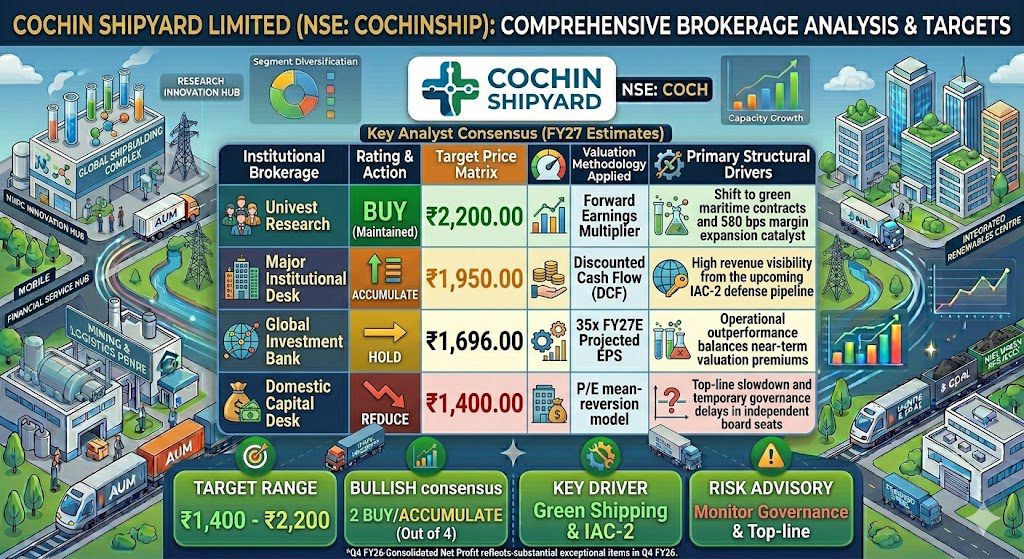
Univest Research maintains a BUY rating with a target price of ₹2,200, highlighting margin expansion and future green maritime opportunities as key growth catalysts.
Another major institutional brokerage currently maintains an ACCUMULATE rating with a target price of ₹1,950 based on strong defence order visibility and discounted cash-flow valuation analysis.
A global investment bank currently maintains a HOLD rating near ₹1,696, arguing that operational strength largely balances the company’s premium valuation multiples.
Meanwhile, one domestic research desk maintains a REDUCE recommendation with a target near ₹1,400 because of concerns regarding temporary revenue moderation and certain governance-related delays.
Overall, institutional target prices currently range between ₹1,696 and ₹2,200, reflecting broadly positive long-term sentiment toward the company’s future growth prospects.
Should You Buy, Hold, or Sell Cochin Shipyard?
For long-term investors, the structural defence manufacturing story remains extremely attractive. The temporary moderation in quarterly revenue should not overshadow the most important positive development from the earnings report — the extraordinary expansion in EBITDA margins to 20.9%.
This margin improvement clearly demonstrates the underlying earnings power and operational quality of the business. Investors with long-term horizons may continue gradually accumulating the stock during corrections, particularly within the ₹1,550–₹1,650 support region.
For short-term traders, the ₹1,802 breakout level remains the most important technical trigger. A sustained breakout above this zone supported by strong trading volumes could potentially push the stock toward ₹1,950 over the medium term.
However, disciplined risk management remains essential because defence PSU stocks can remain volatile during broader market corrections and policy-related developments.
For official company disclosures and exchange filings, investors can also track updates through NSE India Official Website.